- 385 pages
- English
- ePUB (mobile friendly)
- Available on iOS & Android
eBook - ePub
About this book
The first comprehensive history of the nineteenth-century American intellectual movement.
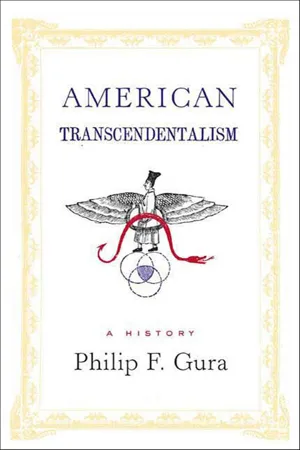
American Transcendentalism is a comprehensive narrative history of America's first group of public intellectuals, the men and women who defined American literature and indelibly marked American reform in the decades before and following the America Civil War. Philip F. Gura masterfully traces their intellectual genealogy to transatlantic religious and philosophical ideas, illustrating how these informed the fierce local theological debates that, so often first in Massachusetts and eventually throughout America, gave rise to practical, personal, and quixotic attempts to improve, even perfect the world. The transcendentalists would painfully bifurcate over what could be attained and how, one half epitomized by Ralph Waldo Emerson and stressing self-reliant individualism, the other by Orestes Brownson, George Ripley, and Theodore Parker, emphasizing commitment to the larger social good.
By the 1850s, the uniquely American problem of slavery dissolved differences as transcendentalists turned ever more exclusively to abolition. Along with their early inheritance from European Romanticism, America's transcendentalists abandoned their interest in general humanitarian reform. By war's end, transcendentalism had become identified exclusively with Emersonian self-reliance, congruent with the national ethos of political liberalism and market capitalism.
American Transcendentalism is a comprehensive narrative history of America's first group of public intellectuals, the men and women who defined American literature and indelibly marked American reform in the decades before and following the America Civil War. Philip F. Gura masterfully traces their intellectual genealogy to transatlantic religious and philosophical ideas, illustrating how these informed the fierce local theological debates that, so often first in Massachusetts and eventually throughout America, gave rise to practical, personal, and quixotic attempts to improve, even perfect the world. The transcendentalists would painfully bifurcate over what could be attained and how, one half epitomized by Ralph Waldo Emerson and stressing self-reliant individualism, the other by Orestes Brownson, George Ripley, and Theodore Parker, emphasizing commitment to the larger social good.
By the 1850s, the uniquely American problem of slavery dissolved differences as transcendentalists turned ever more exclusively to abolition. Along with their early inheritance from European Romanticism, America's transcendentalists abandoned their interest in general humanitarian reform. By war's end, transcendentalism had become identified exclusively with Emersonian self-reliance, congruent with the national ethos of political liberalism and market capitalism.
Frequently asked questions
Yes, you can cancel anytime from the Subscription tab in your account settings on the Perlego website. Your subscription will stay active until the end of your current billing period. Learn how to cancel your subscription.
No, books cannot be downloaded as external files, such as PDFs, for use outside of Perlego. However, you can download books within the Perlego app for offline reading on mobile or tablet. Learn more here.
Perlego offers two plans: Essential and Complete
- Essential is ideal for learners and professionals who enjoy exploring a wide range of subjects. Access the Essential Library with 800,000+ trusted titles and best-sellers across business, personal growth, and the humanities. Includes unlimited reading time and Standard Read Aloud voice.
- Complete: Perfect for advanced learners and researchers needing full, unrestricted access. Unlock 1.4M+ books across hundreds of subjects, including academic and specialized titles. The Complete Plan also includes advanced features like Premium Read Aloud and Research Assistant.
We are an online textbook subscription service, where you can get access to an entire online library for less than the price of a single book per month. With over 1 million books across 1000+ topics, we’ve got you covered! Learn more here.
Look out for the read-aloud symbol on your next book to see if you can listen to it. The read-aloud tool reads text aloud for you, highlighting the text as it is being read. You can pause it, speed it up and slow it down. Learn more here.
Yes! You can use the Perlego app on both iOS or Android devices to read anytime, anywhere — even offline. Perfect for commutes or when you’re on the go.
Please note we cannot support devices running on iOS 13 and Android 7 or earlier. Learn more about using the app.
Please note we cannot support devices running on iOS 13 and Android 7 or earlier. Learn more about using the app.
Yes, you can access American Transcendentalism by Philip F. Gura in PDF and/or ePUB format, as well as other popular books in History & North American History. We have over one million books available in our catalogue for you to explore.
Information
Table of contents
- Title Page
- Table of Contents
- PREFACE
- INTRODUCTION: LOCATING THE “LIKE-MINDED”
- 1 - SEARCHING THE SCRIPTURES
- 2 - REINVIGORATING A FAITH
- 3 - TRANSCENDENTALISM EMERGENT
- 4 - RELIGIOUS COMBUSTION
- 5 - CENTRIPETAL FORCES AND CENTRIFUGAL MOTION
- 6 - HEAVEN ON EARTH
- 7 - VARIETIES OF TRANSCENDENTALISM
- 8 - SELF AND SOCIETY
- 9 - THE INWARD TURN
- 10 - FREE RELIGION AND THE DREAM OF A COMMON HUMANITY
- 11 - TOWARD THE GENTEEL TRADITION
- ALSO BY PHILIP F. GURA
- NOTES
- ACKNOWLEDGMENTS
- INDEX
- Copyright Page