Between 1800 and the First World War, white middle-class men were depicted various forms of literature as weak and nervous. This book explores cultural writings dedicated to the physical and mental health of the male subject, showing that men have mobilized gender constructions repeatedly and self-consciously to position themselves within the culture. Aiming to join those who offer nuanced accounts of masculinity, Devlin investigates the various and changing interests white manhood was positioned to cultivate and the ways elite white men used "their own," so to speak, to promote larger agendas for their class and race.
eBook - ePub
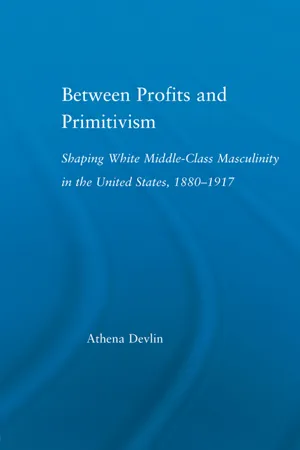
Between Profits and Primitivism
Shaping White Middle-Class Masculinity in the U.S., 1880-1917
- 186 pages
- English
- ePUB (mobile friendly)
- Available on iOS & Android
eBook - ePub
Between Profits and Primitivism
Shaping White Middle-Class Masculinity in the U.S., 1880-1917
About this book
Trusted by 375,005 students
Access to over 1.5 million titles for a fair monthly price.
Study more efficiently using our study tools.
Information
Chapter One
Managing the Middle-Class Male Body in the Age of Efficiency
Beginning with John Higham’s 1970 article, “The Reorientation of American Culture in the 1890s,” scholars have described American manhood at the turn of the twentieth century as variously in “crisis,” “confusion,” or, less drastically, in a state of “renegotiation.”1 While patriarchal authority was in no real danger, it has become clear that in the face of a variety of challenges to antebellum notions of manliness, based most explicitly on men’s behavior in the public realms of politics and business, many middle-class white men felt the need to re-make manhood. The discourses that took men as their subjects did so in ways that had less to do with character (what the term “manliness” most often denoted) and more to do with the male body (for which the less morally connotative term “masculine” was used).2
Issues of class were central to, and consistently informed, discussions of manhood during this period. Two places where class ideologies found voice were in the changing discourses on the nature and meaning of industrialized work—which for the middle class meant bureaucratic work—and proliferating discourses on the care of the body. While many scholars of manliness and masculinity have noted the role both of these discourses played in the new cultural meanings of manhood at the turn of the century, there has been little discussion of the ways in which the two influenced and helped constitute each other. In fact, the thinking and writing on bureaucratic/industrialized work and the body became deeply intertwined during this period and together produced a way of thinking about manhood that was enormously class-conscious and heavily influential in the renegotiation of male middle-class identity.3
Discourses on middle-class male bodies contain interesting negotiations and seemingly contradictory positions. For instance, instead of simply eliding the middle-class male body with concerns about the bodies of “others” or an intensified interest in the bodies of working-class males, a specifically middle-class discourse emerged toward the end of the nineteenth century that took middle-class male bodies as its subject and put them into a realm of explicit representation that was potentially repressive in its pursuit of a normative or ideal corporeality However, despite increased attention to the body during this period, middle-class discourses on men and their bodies were careful not to produce a male identity that was too explicitly wedded to physical performance. In other words, the dialectic between the mind and the body, while being reconfigured in interesting ways, remained and preserved for middle-class men a form of agency through the notion of self-improvement, which the bodily regimes placed on women, racial “others” and the working class often lacked.4
Attributing importance to the formation of a distinct middle class over the course of the nineteenth century is a fairly recent phenomenon in scholarship. According to the historian Stuart Blumin, Burton Bledstein’s 1976 The Culture of Professionalism and Mary P. Ryan’s 1981 Cradle of the Middle Class are two of the pioneering works that make the development of the middle class central to our understanding of the nineteenth century.5 The ease, however, with which later scholars assumed the presence of a solid middle class in this period concerns Blumin. Marx, after all, saw only two classes as fundamental to a capitalist society, with the people in the middle constantly in motion—going either up or down. Although Blumin ultimately feels that a middle class does exist, he bases much of this belief on the distinctiveness of the working and elite classes. He characterizes the middle class as
one that stresses not actively competing ideologies but an essentially passive or even negative class ‘ideology,’ which requires little in the way of class-based solidarity (primarily because the political system is already structured to meet its demands) and seeks to avoid overt displays of explicit class cooperation that too obviously contradict the individualism that lies at the heart of the middle-class value system. (305)
But what is so interesting about the middle-class renegotiation of manliness at the turn of the century is that it does in fact construct what one might call an “active class ideology” in its pursuit of defining manhood: a distinct form of physical education, and with that, a specific bodily ideal.
Understanding descriptions of the body, male or female, as part of an active class ideology forces us look at the body as an important object in the production of ideology as well as a result of it. Here I differ with Foucault, especially in his earlier works, who tends to see the body as lacking any say in the social inscriptions forced (though not necessarily through overt coercion) upon it. In other words, he does not see the body as bringing anything to the equation beyond a place of inscription.6 My disagreement with him will become important later when addressing the question of how middle-class mens position as objects of the gaze differ from women’s, despite a certain degree of feminization inextricable to that position.
Although the nineteenth-century mania for documenting ethnic and racial “types,” as well as criminals, the working class, women and the sick or insane, has been amply studied recently,7 few works note the documentation of “normal” middle-class male bodies during this time period. Leaving them out of the history of this documentation perpetuates the idea that white men have always maintained the position of controlling representation as opposed to being, in their turn, the subject of it and subject to it. To talk about male bodies as an historical and ideological process that is in a constant state of negotiation is not only important to the ongoing project of deconstructing any monolithic notion of “Man”—a category still far less self-consciously investigated than the term “Woman”—but also to our understanding of the power dynamics involved in the exchanges made in visual culture. Feminist theorists from all camps (constructionists, difference feminists, egalitarian feminists, etc.) have long recognized that women’s bodies have been excessively visible in patriarchal culture. In the mind/body dichotomy that influences Western social order so persistently, women have been coupled with the body and men (of a certain class) with the mind. As Elizabeth Grosz points out in her book Volatile Bodies, Aristotle was among the first to theorize this when he described the womb as nothing more than the material container which held the spirit and soul received from the man. Given the connections in Western culture between vision and knowledge, the idea that woman is her body—a visible, material substance—makes her subject to all kinds of psychic and legal surveillance.
Foucault, of course, added men to the list of those repressed by the power/knowledge discourse and its modes of representation. But these men have always been the marginalized figures of the insane, the homosexual, and the criminal, despite noting in his The History of Sexuality that the “emphasis on the body should undoubtedly be linked to the process of growth and establishment of bourgeois hegemony: not, however, because of the market value assumed by labor capacity, but because of what the ‘cultivation’ of its own body could represent politically, economically, and historically for the present and the future of the bourgeoisie” (25, my emphasis). Further, despite the fact that the middle-class preoccupation with the body certainly derived a great deal of its force from the construction of the threatening body of the “other,” the source material discussed in this chapter indicates that many middle-class men involved in physical education saw their own location in the new industrial/urban complex as a source of concern.
Finally, it should be mentioned that the late nineteenth and early twentieth centuries provide an especially fertile ground for complicating (though not eradicating) the mind-body/male-female dichotomies. Phrenology and physiognomy which were concerned almost exclusively with reading character from the shape of the head and size and construction of facial features, were both highly popular “sciences” throughout most of the nineteenth century In the early part of the century, Franz Joseph Gall formulated the idea that the brains functions were compartmentalized into twenty-three discrete areas, with the most developed and complicated skills residing in the front. He reasoned that because the skull of a person grew around the shape of the brain, one could realistically read the inner character of a man through the shape and bumps of the exterior skull. Thus, in works like A Manual of Phrenology and Physiognomy for the People (1885) by Nelson Sizer and H.S. Drayton, the high forehead is the distinguishing feature of the most “civilized” man. By the end of the nineteenth century however, physical education writers were moving consideration away from the head and focusing their attention on the rest of the male body.
This shift from discerning character to assessing bodies not only focused attention on the body in new ways but also created a link between male bodies and more abstract ideas of “fitness” and success. When the educator Francis Walker addressed the Phi Beta Kappa society in 1893, he compared favorably the robust body of the college football player to the earlier nineteenth century “college hero” who he sarcastically describes as “apt to be a young man of towering forehead, from which the hair was carefully brushed backwards and upwards to give the full effect to his remarkable phrenological developments” (261). For Walker, the body on which this towering head rested was weak and dyspeptic. He condemns transcendentalism and sentimentalism for their “contempt for physical prowess,” and disparages the fact that people in the early nineteenth century believed that “Brains and brawn were supposed to be developed in inverse ratio.” He complains that “Affected notions about intellectuality and spirituality had almost complete control of the popular thought” (262–263). He is happy to report that “Better physiology, coinciding with some changes in popular ideals, have driven away the notions about the flesh as an encumbrance, a clog, a burden, a snare” and argues that criminals are not “powerful brutes” but rather “undersized and undervitalized creatures” (267), while good men are robust and attentive to their physical state. Now, he says, the man with a “capacity for action” is revered over the “speech-maker and the fine writer which the nation had once agreed chiefly to admire” (265). Importantly, then, issues of intelligence and “character”—things most often associated with the term “manliness”—were losing some discursive ground at the turn of the century to preoccupations with what had historically been understood as a more feminine domain; the male body did, in fact, matter.
The cultural changes linked to this renegotiation of manhood and their attendant interests in the male body are many. The most common are the birth of consumer culture and mass culture, the waning of small-scale entrepreneurial capitalism, inroads made by women into the public sphere, the growth of commercialized leisure, greater immigrant control over local politics, the official closing of the frontier and labor unrest.8 All of these are important changes. However, what seems to have concerned middle-class men the most is the nature and meaning of work: more specifically, how the new forms of work deemed appropriate for the middle class, defined by its strident distancing from manual labor of all kinds, affected the body.
As the American economy changed from entrepreneurial to corporate—the number of non-propertied, salaried office workers grew eight times between 1870 and 19109—discourses on work proliferated as moralists attempted to keep alive a work ethic that equated work with both individualism and virtue in a radically different environment of production. In many ways, they succeeded. Work remained, as it does today, imbued with moral value. However, within the new industrial system of factories, corporations and massed wage earners, a more complex discourse on work had to evolve to meet the challenges of mechanization and incorporation bred by the new industrial system. Many of these discourses have been rehearsed by scholars.10 My central concern is with the ways in which the middle-class male body became an important point of fascination in the new discourses surrounding work. Daniel Rodgers argues in The Work Ethic in Industrial America, 1850–1920 that the “presumptive tie between work and morality” had to be, by the late nineteenth century, “pitched at a new level of abstraction” to accommodate the highly complex bureaucracy that characterized the working environment (9). The male body, however, provides a concrete, visual place to re-conceptualize and re-realize individualism and virtue in a new industrialized world while simultaneously smoothing away challenges to the new system. Indeed, for all the disparaging remarks made in the popular press and in books on the sedentary nature of modern bureaucratic work and its draining of manly strength, when writings on work connected with those of physical education, the body became, especially for the middle class, a place where the Franklinesque characteristics of individualism, pluck and persistence could be carried out, not only in the gym or on the athletic field but in the turn-of-the-century world of monopolies, bureaucracies and corporations.
Work and physical education were ripe for a merger. Forms of leisure, like work, showed all the same tendencies towards systemization and standardization, or what is generally called in work discourses, rationalization. From ministers and doctors to advice manuals and popular magazines, people began to write and speak of overworked Americans who lost everything from their moral strength to their health because of the new demands of modern work. Thus leisure became, like work, a responsibility, with its own pundits directing the ways in which it should be engaged in properly. However, as nothing short of a way to keep ones health and moral balance, not all leisure activities were equally acceptable to middle-class moralists. Exercise, or more broadly, physical education was appealing, as it turned out, because on some level it avoided certain aspects of leisure altogether and fit with the older, traditional work ethic. It was a way to spend the leisure hours afforded by industrialization in a disciplined, self-improving way that recalled older notions of how to succeed in the work force.
But if exercise was a way to throw off the drudgery of industrial work in a manner that aped the work ethic of a pre-industrial model, it simultaneously taught middle-class men how to labor more efficiently in an industrialized workforce. It was, on the one hand, importantly, a form of “voluntary movement” that attempted to bring men outside the constraints of their working environment, which was often harshly criticized by physical education writers. On the other hand, it placed middle-class men right in the middle of a discourse on efficiency that, I will argue, had much in common with movements like Taylor’s scientific management, which so constrained the working classes. Indeed, the inclusion of the body in these connected discourses of work and health meant that middle-class men were now pictured, measured, photographed and evaluated in ways that brought them as objects into the visual culture and further circumscribed their freedom by heightening fears about their efficiency. Thus, the physical education discourse drew middle-class men closer to their working-class counterparts through both its objectification and fragmentation of the body and through its use of the body-as-machine metaphor. This is especially ironic given that physical exercise often advertised itself as a way to regain the bodily symmetry and wholeness that industrialized work fragmented through the over exertion of one part of the body to the exclusion of others. In the end, physical education, though often critical of the health effects of bureaucratized labor, actually acts as an aid to adjusting to, and perpetuating, industrialized/bureaucratic work, not dismantling it.
Class and Defining Bodies in Need
Physical education has its roots in Massachusetts in the early nineteenth century. It entered the cultural conversation with real urgency, however, just before the turn of the century, at the very moment bureaucratized work was charged with wreaking havoc on the health of the elite white male population. At a conference on physical education in Boston, Dudley Sargent, the director of the Hemenway Gymnasium at Harvard, sold physical education specifically as a way to “resist the destructive wear and waste of American business life.”11 The concerted effort to re-shape these weakened business men was made by the same men who institutionalized physical education at elite colleges and universities; Harvard, Yale and Amherst were at the forefront of the movement that defined middle-class male bodies as enfeebled and sought to re-vitalize them. Indeed, it is in these schools that much of the measuring, charting and photographing went on in an effort to mold efficient bureaucratic workers and profession...
Table of contents
- Cover
- Title Page
- Copyright
- Dedication
- Contents
- List of Figures
- Acknowledgments
- Introduction
- Chapter One: Managing the Middle-Class Male Body in the Age of Efficiency
- Chapter Two: The Male Body and the Market Economy: Valuating Dreiser’s Frank Cowperwood
- Chapter Three: Male Hysteria and the Gendering of the Subconscious
- Chapter Four: Shapes That Haunt the Dusk: Masculinity and the Supernatural Experience in Fiction
- Notes
- Bibliography
- Index
Frequently asked questions
Yes, you can cancel anytime from the Subscription tab in your account settings on the Perlego website. Your subscription will stay active until the end of your current billing period. Learn how to cancel your subscription
No, books cannot be downloaded as external files, such as PDFs, for use outside of Perlego. However, you can download books within the Perlego app for offline reading on mobile or tablet. Learn how to download books offline
Perlego offers two plans: Essential and Complete
- Essential is ideal for learners and professionals who enjoy exploring a wide range of subjects. Access the Essential Library with 800,000+ trusted titles and best-sellers across business, personal growth, and the humanities. Includes unlimited reading time and Standard Read Aloud voice.
- Complete: Perfect for advanced learners and researchers needing full, unrestricted access. Unlock 1.5M+ books across hundreds of subjects, including academic and specialized titles. The Complete Plan also includes advanced features like Premium Read Aloud and Research Assistant.
We are an online textbook subscription service, where you can get access to an entire online library for less than the price of a single book per month. With over 1.5 million books across 990+ topics, we’ve got you covered! Learn about our mission
Look out for the read-aloud symbol on your next book to see if you can listen to it. The read-aloud tool reads text aloud for you, highlighting the text as it is being read. You can pause it, speed it up and slow it down. Learn more about Read Aloud
Yes! You can use the Perlego app on both iOS and Android devices to read anytime, anywhere — even offline. Perfect for commutes or when you’re on the go.
Please note we cannot support devices running on iOS 13 and Android 7 or earlier. Learn more about using the app
Please note we cannot support devices running on iOS 13 and Android 7 or earlier. Learn more about using the app
Yes, you can access Between Profits and Primitivism by Athena Devlin in PDF and/or ePUB format, as well as other popular books in Literature & Literary Criticism. We have over 1.5 million books available in our catalogue for you to explore.