- English
- ePUB (mobile friendly)
- Available on iOS & Android
eBook - ePub
About this book
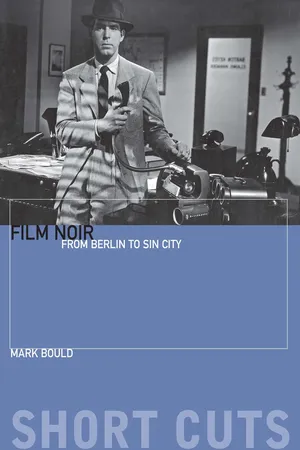
Film Noir explores the murky world of a genre responsible for many of film's most enduring images. Mark Bould discusses problems of definition and the often ambiguous nature of film noir and looks at modern films that could be called neo-noir. Iconic and enduring, film noir attracted great stars (Bogart, Bacall, Mitchum, Lancaster), many of the best directors of the era (Wilder, Lang, Preminger, Hawks, Siodmak, Welles) and this book is an indispensible guide to this popular genre.
Information
1 THE SET-UP: FABRICATING FILM NOIR
Talk is dangerous. Sometimes it makes things happen, it makes them real.
Film noir, like the femme fatale, is an elusive phenomenon: a projection of desire, always just out of reach. The task of delineating and circumscribing film noir, of pinning it down, frequently recalls the convoluted constructions of identity around a central absence in Vertigo (1958). Scottie (James Stewart), who retired from the police because of his vertigo, is hired by Gavin Elster (Tom Helmore) to investigate his wife, Madeleine (Kim Novak). She is possessed, apparently, by the spirit of her grandmother, Carlotta, who was driven to despair and suicide. When his vertigo keeps him from preventing Madeleine’s suicide, Scottie has a breakdown. A year later, he meets Judy Barton (Kim Novak), whom he attempts to reshape into the image of Madeleine. Unknown to him, Gavin had hired Judy to pretend to be Madeleine in order to enable him to murder the real Madeleine. This information is revealed to the audience as soon as Scottie meets Judy – he only realises the truth after he has recreated (the false) Madeleine – and completely alters one’s understanding of what we have already seen.
About halfway through the film, the false-Madeleine wakes up in Scottie’s apartment, having been rescued by him after her (fake) suicide attempt. As they talk for the first time, a mutual attraction is signalled: but to what are they attracted and with whom are they falling in love? Judy, pretending to be Madeleine (who has been possessed by Carlotta), falls for Scottie, who is pretending that he has not been hired by Gavin and following her around all day, while Judy, pretending to be Madeleine, is pretending not to know that Scottie has been hired by Gavin and following her around all day. Infinite regress threatens. Similarly, when Scottie reshapes Judy as Madeleine, of what does his model actually consist? Madeleine? Judy as Madeleine? Judy as her idea of Madeleine? Judy as Gavin’s idea of Madeleine? It is fitting, then, that the film opens with vortices – vaginal images, elaborate structures around empty cores – and closes with Scottie, atop a phallic tower, confronting an abyss. Identity, Vertigo suggests, remains a mystery, an aporia around which can be found prosaic realities (Judy is from Selina, Kansas and can prove it) and elusive trails (Madeleine is an absence, seen only once, in flashback, already dead). Likewise, film noir.
It is customary to acknowledge that film noir was a retrospectively-applied generic label; consequently, no-one could ever have set out to make a film noir because the signifier (and thus what it signified) had not entered into English usage at the time the films now called film noirs were actually made. Suggestions that this might invalidate film noir’s generic status tend to overlook the fact that the introduction and circulation of a generic label for a group of related texts must come after the creation of those texts, that generic labelling must always be, at least initially, retrospective. For example, Charles Musser situates The Great Train Robbery (1903) – the so-called first western – within the railway sub-genre of the then popular travel genre of films, arguing that director Edwin S. Porter ‘was consciously working (and cinema patrons viewing) within a framework’ derived from ‘the violent crime genre which had been imported from England a few months earlier’, and that because it was not ‘primarily perceived in the context of the western’ its success ‘did not encourage other westerns but other films of crime’ (1990: 130–1).
While Steve Neale is correct to be concerned about the homogenising effect of imposing film noir as a generic category, this is common to all applications of generic terminology. Similarly, although Neale’s willingness to concede that ‘film noir now has a generic status it originally did not possess’ (2000: 3) seems to imply that this is unique to film noir, it is true of any genre: one cannot now stop seeing The Great Train Robbery as a western even though in 1903 the genre ‘had not yet been established effectively in the cinema’ (Musser 1990: 131) and even if one is aware of its other generic tendencies and affiliations. Genres arise – or, more accurately, are identified, named and developed – through complex feedback mechanisms involving producers, distributors, exhibitors, consumers, interpreters and other discursive agents. This chapter examines how film noir emerged as an intersubjective discursive phenomenon in French and Anglo-American criticism.
The term ‘film noir’ is said to derive from Série noire, the title of a series of crime novels edited by Marcel Duhamel for French publisher Gallimard, starting in 1945. Following translations of three novels by Peter Cheyney and James Hadley Chase (British writers imitating American models), the series began to translate novels by American writers like Raymond Chandler, Horace McCoy, Dashiell Hammett, W. R. Burnett, William P. McGivern, Cornell Woolrich, David Goodis and Chester Himes (from 1948, French authors were published under English pseudonyms and, after 1951, under their own names).
The term ‘noir’ was used in France before the Second World War, usually in the right-wing press to derogate left-wing culture (see O’Brien 1996), and some late 1930s films were described as ‘film noirs’ in the 1940s; but neither term was applied to American films until 1946. Following the liberation from German occupation, large numbers of American films were released in France. In 1946, Nino Frank linked Double Indemnity, The Maltese Falcon, Murder, My Sweet and Laura (1944) to the revolution in American crime fiction started by Hammett. Whereas previous fictional detectives, like C. Auguste Dupin, Philo Vance and Ellery Queen, were little more than perfectly functioning ratiocination devices, Hammett’s Continental Op and Sam Spade, as well as Chandler’s Philip Marlowe, were flawed characters. This difference, Frank argued, was manifest in the films’ emphasis on character psychology rather than the investigation and retrospective reconstruction of particular crimes. In these film noirs, as he dubbed them, the crime film was psychologised by first-person narration and closely-observed facial expressions, gestures and dialogue.
Later that year, Jean-Pierre Chartier called Double Indemnity, Murder, My Sweet, The Postman Always Rings Twice and The Lost Weekend (1945) film noirs, suggesting they were so dark that French films like Quai des brumes (1938) and Hôtel du nord (1938) could no longer really be considered as film noirs. These pessimistic, misanthropic American films were driven by a logic of sexual desire that the Production Code Administration (PCA) simultaneously required them to suppress. This pattern of desire and repression in the characters, matched by the filmmakers’ double-coding, rendered the crime itself the object of the protagonists’ erotic fascination, further psychologising the crime film. In 1948 Henri-François Rey, who regarded American cinema as propagandist, suggested that Double Indemnity, The Lost Weekend, Scarlet Street and The Woman in the Window presented views of the US so unflattering and despairing as to require special comment. In 1951, Pierre Duvillars considered the centrality of a new version of the vamp to The Postman Always Rings Twice, Murder, My Sweet, Double Indemnity and Criss Cross. A figure ‘accommodated to contemporary taste, itself composed of cynicism, sadism and morbidness’ (1996: 30), she reduces the male protagonist to a hypnotised, machinelike creature through the calculated but, he suggests, never consummated promise of sex. In their survey of American film noir originally published in 1955, Raymonde Borde and Etienne Chaumeton list 22 film noirs, from The Maltese Falcon to Macao (1951). A further 62 appear in related categories: 29 about criminal psychology and ten about social trends, seven costume crime films, six gangster films and ten documentary police thrillers. Except for the costume films, each category contains films now generally considered film noirs, whereas their list of film noirs includes The Mask of Dimitrios (1944), Notorious (1946), Chicago Deadline (1949) and The Window (1949), none of which are now deemed central to the genre.
James Naremore argues that the growing Americanism in postwar French culture and nostalgia for their pre-war cinema predisposed the French to discover or invent American film noir, and because of their affiliations with either surrealism or existentialism these early critics constructed it in particular ways. For surrealist aficionados like Borde and Chaumeton,
the essence of noirness lies in a feeling of discontinuity, an intermingling of social realism and oneiricism, an anarcho-leftist critique of bourgeois ideology and an eroticised treatment of violence. Above all, noir produces a psychological and moral disorientation, an inversion of capitalist and puritan values, as if it were pushing the American system toward revolutionary destruction. We might debate whether such qualities are in fact essential to the Hollywood thriller … but there is no question that they are fundamental to surrealist art. (Naremore 1998: 22)
For existentialist critics, film noirs ‘depicted a world of obsessive return, dark corners or huis-clos’ (ibid.). Where ‘perversely anarchic’ surrealists saw ‘a theatre of cruelty’, existentialists found a ‘despairingly humanist’ protoabsurdism (ibid.). This existentialist criticism can be traced through Jean-Paul Sartre to André Bazin, co-founder of Cahiers du Cinéma, a journal which carried essays by several critics who would go on to become New Wave filmmakers, including Claude Chabrol’s ‘Évolution du film policier’ (1955). It was at this juncture that
the terms film noir and auteur began to work in tandem, expressing the same values from different angles … Film noir was a collective style operating within and against the Hollywood system; and the auteur was an individual stylist who achieved freedom over the studio through existential choice. But the auteur was more important than the genre … the Cahiers group always subordinated general forms to personal visions. (Naremore 1998: 26–7)
And sure enough, two Cahiers critics soon made films – Jean-Luc Godard’s À bout de souffle (1960) and François Truffaut’s Tirez sur la pianiste (1960) – redolent of film noir but conceived as personal visions.
In 1945, American critic Lloyd Shearer described a recent ‘trend in Hollywood toward the wholesale production of lusty, hard-boiled, gut-and-gore crime stories, all fashioned on a theme with a combination of plausibly motivated murder and studded with high-powered Freudian implication’ (1999: 9), consisting of Double Indemnity, Murder, My Sweet, Laura, Conflict (1945) and the forthcoming The Dark Corner (1946), The Big Sleep (1946), The Brasher Dubloon (1947), The Postman Always Rings Twice, Lady in the Lake (1947), The Blue Dahlia and Serenade (an adaptation of Cain’s 1937 novel which eventually appeared in 1956). He explains this trend in terms of a turn to realism, liberalisation at the PCA, imitations of successful films being rushed into production and their cathartic acting-out of suppressed oedipal drives. More significantly, Lloyd Shearer and, a year later, Siegfried Kracauer, identified a cycle more-or-less consonant with film noir, even if neither of them gave it that name.
The first substantial Anglophone treatment of film noir came in Charles Higham and Joel Greenberg’s Hollywood in the Forties from 1968. Their book remains instructive, enabling the reader to see a genre being fabricated. Their chapter entitled ‘Black Cinema’ evokes a film noir iconography of rain-drenched nocturnal streets, trains, elevators, cocktail bars, knocked-over standard lamps, interrogation rooms, heels clicking on pavements. It attests the impact of immigrant Austro-German filmmakers, of certain cinematographers (Lee Garmes, Tony Gaudio, Lucien Ballard, Sol Polito, Ernest Haller, James Wong Howe, John F. Seitz) and composers (Franz Waxman, Max Steiner, Miklós Rózsa, Erich Korngold). (While much has been written on film noir’s visual style, its musical component remains neglected; but see Porfirio 1999 and 2001.)
However, auteurism soon replaces this discussion of genre, iconography and other creative personnel. What now seems peculiar about their selection of directors – primarily Siodmak, Fritz Lang, Otto Preminger, Michael Curtiz, Billy Wilder – is the absolute pre-eminence afforded Alfred Hitchcock for Shadow of a Doubt (1943), Rope (1948) and The Paradine Case (1948), only the first of which might now be considered in any way central to film noir. This change of perspective can probably be explained in terms of the parallel canonisations of Hitchcock as auteur and film noir as genre. Neither now needs the kudos the other might lend, the status of each enhanced by not necessarily being connected to the other. (This, of course, produces anomalies. For example, in many respects Hitchcock’s Vertigo is a quintessential film noir. Based on a French pulp novel, it features an unofficial investigator investigating a mysterious woman, a carefully-orchestrated murder, a voice-over and a flashback, San Francisco as a subjective maze, expressionistic flourishes and traces of gothic melodrama; and it has been profoundly influential on neo-noir, particularly the erotic thriller. However, it is typically treated as tangential to film noir, as if auteurist discourses, combined with the industrial and aesthetic choices involved in making a colour VistaVision A-picture, categorically outweigh generic affiliations.)
Higham and Greenberg’s auteurism is further demonstrated when they discuss 1940s period melodramas (see Barefoot 2001): King’s Row (1941), The Lodger (1944), Gaslight (1944), Hangover Square (1945), Temptation (1946), Ivy (1947) and So Evil My Love (1948) ‘reflect the proper ambience but for the most part fail to disclose the kind of strong personal attitude which could have raised them to the level of works of art’ (1970: 31). It is not insignificant that the studios, as well as 1940s and 1960s audiences, would have perceived them as ‘women’s pictures’, or that detailed treatment is reserved for the one directed by George Cukor, who did appear in lists of possible auteurs, usually to be rejected.
Intriguingly, Higham and Greenberg deal with many film noirs in other chapters. While many films that would now be considered melodramas are treated as ‘women’s pictures’, the ‘Melodrama’ chapter focuses almost exclusively on film noirs. Beginning with the claim that ‘A wry detachment, an amused view of the subject … are the qualities of the best 1940s melodramas. The films were made by hard-bitten men who knew city life inside out’ (1970: 39), it examines various film noirs, including adaptations of Hammett, Chandler and Graham Greene, Gilda (1946), Sorry, Wrong Number (1948), The Big Clock (1948), Caught (1949), The Reckless Moment (1949), Force of Evil (1949) and The Set-Up as well as Hitchcock’s Rebecca (1940), Suspicion (1941) and Notorious. However, Higham and Greenberg acknowledge no similarities between these films and the preceding chapter’s ‘black’ films and women-in-peril melodramas, and they discuss other film noirs as ‘problem and sociological films’ and ‘women’s pictures’. (Higham and Greenberg’s construction of 1940s Hollywood genres so as to privilege certain directors betrays the masculinist assumptions of a nascent Film Studies. Frank Krutnik (1991) offers a contrasting approach which is informative about the development of Film Studies in the intervening decades. Not only does he recognise gender problematics, but he also divides film noirs into more coherent, if overlapping and interacting, cycles of 1940s crime films with tangible connections to their production and initial distribution, exhibition and consumption.)
Raymond Durgnat’s ‘Paint It Black: The Family Tree of Film Noir’ from 1970 begins by trying to elevate film noir to high art, comparable to Euripides, Goya, Dostoyevsky, Faulkner, Greek tragedy, Jacobean drama, Romanticism and, less pretentiously, to French, Italian and British cinema. He insists that film noir should be classified by ‘motif and tone’ (1996: 84) and is, therefore, not a genre in the way that gangster films and westerns are. While he is correct to say that not all crime films are film noirs, his suggestion that film noirs can be found in other genres is undermined by his examples, which include King Kong (1933) and 2001: A Space Odyssey (1968). While few would deny the potential benefits of considering Der Blaue Engel (1930), Attack (1956) and Sweet Smell of Success (1957) in the light of film noir, he offers no coherent reason for claiming them for the genre; and his subsequent typology/genealogy of film noir focuses almost exclusively on crime films, effectively countering his grander claims.
Durgnat divides three hundred film noirs by cycle or motif into eleven incommensurate categories. Social criticism films examine issues like prohibition-era gangsters, miscarried or corrupt justice, juvenile delinquency, boxing and other rackets, and include postwar documentary-thrillers and more general indictments of American society, like Ace in the Hole (1951). The gangster cycles include films nostalgic for the 1930s gangster, films in which gangsters become heroes fighting Nazis or Communists, heist and caper thrillers, and films about organised crime. Other groups of films feature: criminals or innocents on the run; private eyes and adventurers; middle-class murder; portraits and doubles as symbols of paranoia and split personalities; straight and queer sexual pathologies; psychopaths; criminals holding individuals, families or other groups hostage; and Nazis or Communists portrayed as gangsters. Durgnat’s final category contains guignol, horror and fantasy films about paranoia, entrapment, death, desire and alienation. For all its faults, this early charting of noir’s terrain offers insights into the matrix from which current understandings of film noir grew.
Paul Schrader’s 1972 ‘Notes on Film Noir’ reiterates Durgnat’s contention that film noir is not a genre because it ‘is not defined, as are the western and gangster genres, by conventions of setting and conflict but rather by the more subtle qualities of tone and mood’ (1996: 99). However, while arguing that ‘Film noir is also a specific period of film history, like German Expressionism or the French New Wave’ (ibid.), he describes it in terms of setting and conflict as ‘Hollywood films of the 1940s and early 1950s which portrayed the world of dark, slick city streets, crime and corruption’ (1996: 100). His claim that ‘most every dramatic Hollywood film from 1941 to 1953 contains some noir elements’ (ibid.) is unsupported by anything resembling evidence, but it does return us to the dilemma of how to delimit a genre, to the question of semantic and syntactic approaches. In Schrader’s words, ‘How many noir elements does it take to make a film noir?’ (ibid.). Side-stepping this question, he identifies wartime and postw...
Table of contents
- Cover
- Half title
- Series Page
- Title
- Copyright
- Contents
- Acknowledgments
- A Note on Terminology
- On Dangerous Ground: Introducing Film Noir
- 1. The Set-Up: Fabricating Film Noir
- 2. Out of the Past: The Prehistory of Film Noir
- 3. Dark Passage: The Main Cycle of Film Noir
- 4. Against All Odds: Neo-Noir
- Afterword: Kiss Tomorrow Goodbye
- Filmography
- Bibliography
- Index
Trusted by 375,005 students
Access to over 1.5 million titles for a fair monthly price.
Study more efficiently using our study tools.
Frequently asked questions
Yes, you can cancel anytime from the Subscription tab in your account settings on the Perlego website. Your subscription will stay active until the end of your current billing period. Learn how to cancel your subscription
No, books cannot be downloaded as external files, such as PDFs, for use outside of Perlego. However, you can download books within the Perlego app for offline reading on mobile or tablet. Learn how to download books offline
Perlego offers two plans: Essential and Complete
- Essential is ideal for learners and professionals who enjoy exploring a wide range of subjects. Access the Essential Library with 800,000+ trusted titles and best-sellers across business, personal growth, and the humanities. Includes unlimited reading time and Standard Read Aloud voice.
- Complete: Perfect for advanced learners and researchers needing full, unrestricted access. Unlock 1.5M+ books across hundreds of subjects, including academic and specialized titles. The Complete Plan also includes advanced features like Premium Read Aloud and Research Assistant.
We are an online textbook subscription service, where you can get access to an entire online library for less than the price of a single book per month. With over 1.5 million books across 990+ topics, we’ve got you covered! Learn about our mission
Look out for the read-aloud symbol on your next book to see if you can listen to it. The read-aloud tool reads text aloud for you, highlighting the text as it is being read. You can pause it, speed it up and slow it down. Learn more about Read Aloud
Yes! You can use the Perlego app on both iOS and Android devices to read anytime, anywhere — even offline. Perfect for commutes or when you’re on the go.
Please note we cannot support devices running on iOS 13 and Android 7 or earlier. Learn more about using the app
Please note we cannot support devices running on iOS 13 and Android 7 or earlier. Learn more about using the app
Yes, you can access Film Noir by Mark Bould in PDF and/or ePUB format, as well as other popular books in Medios de comunicación y artes escénicas & Películas y vídeos. We have over 1.5 million books available in our catalogue for you to explore.