Increasingly, the religious practices people engage in and the ways they talk about what is meaningful or sacred take place in the context of media culture—in the realm of the so-called secular.
Focusing on this intersection of the sacred and the secular, this volume gathers together the work of media experts, religious historians, sociologists of religion, and authorities on American studies and art history. Topics range from Islam on the Internet to the quasi-religious practices of Elvis fans, from the uses of popular culture by the Salvation Army in its early years to the uses of interactive media technologies at the Simon Wiesenthal Center's Beit Hashoah Museum of Tolerance. The issues that the essays address include the public/private divide, the distinctions between the sacred and profane, and how to distinguish between the practices that may be termed "religious" and those that may not.
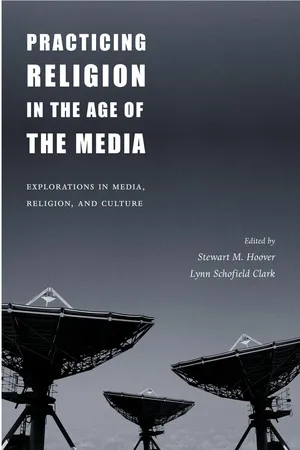
eBook - ePub
Practicing Religion in the Age of the Media
Explorations in Media, Religion, and Culture
- English
- ePUB (mobile friendly)
- Available on iOS & Android
eBook - ePub
Practicing Religion in the Age of the Media
Explorations in Media, Religion, and Culture
About this book
Information
Subtopic
Comparative ReligionIndex
Social SciencesCHAPTER 1
OVERVIEW:
THE “PROTESTANTIZATION” OF RESEARCH INTO MEDIA, RELIGION, AND CULTURE
THE “PROTESTANTIZATION” OF RESEARCH INTO MEDIA, RELIGION, AND CULTURE
Research into the intersecting fields of media, religion, and culture has grown exponentially in the past decade. The pages in this volume represent a starting point for the reader new to the field. Yet while the contributions to this book are consistent with an overall trend that will be reviewed in this chapter, they are by no means exhaustive of current approaches. In this overview, I discuss how research in this area has developed, seeking to place current agendas—both those represented here and those taking place in other settings—into social and historical perspective.
By using the term Protestantization to describe the contemporary situation, I do not mean to assert that American Protestantism has at some level defeated Roman Catholicism, or for that matter any other denomination or religion.1 I wish, rather, to point to what N. Jay Demerath III has described as a paradox of cultural victory and organizational decline for liberal Protestantism in the United States.2 Most of us are familiar with the statistics regarding the atrophy of membership in the liberal Protestant church, but, as Demerath points out, we must not overlook the fact that a set of culturally dominant values—a set that includes individualism, freedom, pluralism, tolerance, democracy, and intellectual inquiry—has its roots in the Protestant Reformation and its challenges to the authority of religious institutions.
Demerath’s assertion follows related arguments made a century earlier by social observers Alexis de Tocqueville and Max Weber, both of whom identified the interrelation of religious foundations and the emergent cultural values of collectivity, individualism, and capitalism.3 I use the term Protestantization in this sense, referring not to certain theological positions or the specific workings of the denominations that bear that name, but to the values emergent with the Reformation.4 Those values specific to my argument include the rise of intellectual inquiry as an endeavor separated from religious aims and the cultural norm of religious tolerance and relativism in the context of a U.S. society that is increasingly pluralistic.
I will illustrate what I mean by relating two occurrences that reveal what I believe is an inherent tension for research into media, religion, and culture today. Each of the events took place during the Second Public Conference on Media, Religion, and Culture in Edinburgh, Scotland, in the summer of 1999. In the first happening, a longtime researcher in media, religion, and culture was ruminating about subjects he felt younger scholars should pursue. Among other things, he bemoaned the contemporary religious “crisis” in a European country that, like many locations around the world, has in the last decade seen a significant upswing in Muslim converts. The wording of his description caught the attention of several of those seated around me. “Crisis?” someone gasped. It struck many that those in the room who were Muslim certainly would not describe the phenomenon in that way; the words spoke of a time when it was possible to assume that people interested in this interdisciplinary research topic came primarily from Christian traditions. The discomfort obvious in the audience illustrated the extent to which pluralism and tolerance, rather than an assumed common starting point of Christian confessions, has become the norm.
The second event involved me more directly. In an amiable conversation, a fellow researcher asked rather pointedly, “Why conduct this research if you can’t directly apply the research to solving the church’s problems?” As I attempted to argue for the “practical” applicability of my research, others around us immediately responded to his question by raising the benefits of knowledge for its own sake. I admit that sometimes when confronted with this issue, I, like the journalists interviewed by John Schmalzbauer in chapter 7, am struck by a tension between the norms of religious organizations that encourage the disclosure of religious beliefs and the norms of professional life that discourage them. No one asks what personal journey brought someone to the study of the media and its political economic system, so why should the study of religion and media be different? Yet of course, it is different, both because of the specific history of the field of inquiry and its earlier, uneasy relationship to the presumed “objective” scholarship of the social sciences. Appeals to inquiry for the sake of knowledge itself have not always applied to studies of religion as comfortably as they do today. As evidenced by my interlocutor, many people are still uncomfortable with the idea that one might conduct a neutral, or even critical, analysis of religion and its role in society.
Those seasoned analysts who have conducted research in religion and media over recent decades may be dismayed by the developments signaled in these and other examples of the shifting sands of scholarship. In another session during the same conference, one veteran railed against those he perceived as less committed or even indifferent to work that he passionately described as a “mission.” How is it that we have come to a point in history when a subject as personally important (to some) as religion can be thought to be studied impartially? Moreover, is it not strange that this should occur just as the rising epistemological tides encourage greater, not less, attention to self-reflexivity in research? Like Demerath, I see the roots of this development in the cultural success of Protestantism, and therefore we turn first to a discussion of contemporary values in the historical context in which they emerged.
KNOWLEDGE AND RELIGION FROM THE REFORMATION ONWARD
In the sixteenth century, Protestantism was first and foremost a movement that signaled a new independence from the institutions of religion. Divine authority was no longer solely and completely anchored in the church, and this initiated a long process of increased privatization of religion. This privatization is related to what Philip Hammond has termed a rise in “personal autonomy,” or the sense in which the individual is the ultimate authority over his or her understanding of religion; it also provides an important context for the individualism that Bellah and his colleagues have described as culturally dominant in the United States.5 Of course, the Reformation not only changed relationships between individuals and religious institutions but also reordered society as a whole, fostering a movement toward greater protection of individual rights relative to the state and displacing notions of truth from religious institutions into the realm of scientific inquiry and human understanding.
At first, the weakening of papal authority led to increased power for the monarchies of Europe. However, the religious and political debates of the time, coupled with the rise of a mercantilist middle class and the wider distribution of ideas (the latter being fostered by both increased travel and the printing press) provided the necessary context for the emergence of democratic forms of government emphasizing freedoms from imposed or “established” religion as well as protection for the pursuit of intellectual inquiry. The era of the Reformation, with its increased scientific experimentation and geographic exploration, fundamentally called into question the notion that the church was the only and final source of truth, thus fostering a position of pluralism and tolerance toward other religions. Eventually, the pursuit of knowledge came to be understood in relation to the greater good of society rather than specifically related to the fostering of religious faith.
Scientific methods and rationalist views supplanted the religious community’s explanatory powers regarding the natural world. Eventually, Western theology itself took on the methods of hermeneutical philosophy, in many cases complementing learnings of the natural world with explorations of the relationship between humans and the divine. Increasingly, however, scientific exploration and the thought of religious leaders were seen to occupy different spheres and to serve different purposes.
Philosophers of the French Enlightenment era, and later the German idealists, viewed religion as at best a retrogressive aspect of a society yearning for greater economic and political freedoms. Yet while divisions between these influential political philosophers and religious institutions reinforced a separation in intellectual traditions, the deep commitment to religious institutions among a large part of the population preserved an important role for religion in social change.
During the era of the industrial revolution in Europe and the United States, as many Christian organizations sought to relieve urban poverty, philosophers and sociologists developed tools to explore the changing social relationships wrought by immigration and urbanization. While religion was accepted by some as important in the private realm, it remained problematic in intellectual circles. James Turner, in fact, has dated the roots of intellectual agnosticism in the United States to the post–Civil War period—a time when Christianity, perhaps ironically, continued to serve as the primary content and hence driving force behind the spread of magazines, almanacs, and other printed materials throughout the settled East and the Western frontier.6 An interesting intellectual history has yet to be done on this verdant period for the intersection of media, religion, and culture.7
Not coincidentally, it was during the era of the industrial revolution that the mass media became an object of study in a significant way. Prior to this, published accounts tended to debate the worth of ideas put forth in printed form rather than the political and social issues raised by the emergent industries themselves. By the mid-nineteenth century, newspapers had come to be widely accepted as a key instrument for an informed democracy, and as such they were studied both in Europe and in the United States. Writers of this period such as Weber, Tonnies, and Simmel bemoaned the workings of capitalism and urbanization, nostalgically longing for a past that sometimes included religion’s presumed peaceful and moral influence. At the turn of the century, John Dewey, Robert Park, and others in what is known as the Chicago school embraced the Progressive’s views of technology and social life articulated by Tocqueville nearly a century earlier, arguing that newspapers could provide a basis for consensual understandings that would foster a “great community” and thus counter the negative results of urbanization and immigration.
While religion was favorably linked with the do...
Table of contents
- Cover
- Half title
- Title
- Copyright
- Contents
- Acknowledgments
- Introduction: The Cultural Construction of Religion in the Media Age
- Chapter 1. Overview: The “Protestantization” of Research into Media, Religion, and Culture
- Part 1. Mediation in Popular Religious Practice
- Part 2. The Mediation of Religion in the Public Sphere
- Part 3. Religion Made Public Through the Media
- Part 4. Implicit Religion and Mediated Public Ritual
- Part 5. Explicit and Public Expression in New Media Contexts
- Part 6. Specific Religions and Specific Media in National and Ethnic Contexts
- List of Contributors
- Index
Trusted by 375,005 students
Access to over 1.5 million titles for a fair monthly price.
Study more efficiently using our study tools.
Frequently asked questions
Yes, you can cancel anytime from the Subscription tab in your account settings on the Perlego website. Your subscription will stay active until the end of your current billing period. Learn how to cancel your subscription
No, books cannot be downloaded as external files, such as PDFs, for use outside of Perlego. However, you can download books within the Perlego app for offline reading on mobile or tablet. Learn how to download books offline
Perlego offers two plans: Essential and Complete
- Essential is ideal for learners and professionals who enjoy exploring a wide range of subjects. Access the Essential Library with 800,000+ trusted titles and best-sellers across business, personal growth, and the humanities. Includes unlimited reading time and Standard Read Aloud voice.
- Complete: Perfect for advanced learners and researchers needing full, unrestricted access. Unlock 1.5M+ books across hundreds of subjects, including academic and specialized titles. The Complete Plan also includes advanced features like Premium Read Aloud and Research Assistant.
We are an online textbook subscription service, where you can get access to an entire online library for less than the price of a single book per month. With over 1.5 million books across 990+ topics, we’ve got you covered! Learn about our mission
Look out for the read-aloud symbol on your next book to see if you can listen to it. The read-aloud tool reads text aloud for you, highlighting the text as it is being read. You can pause it, speed it up and slow it down. Learn more about Read Aloud
Yes! You can use the Perlego app on both iOS and Android devices to read anytime, anywhere — even offline. Perfect for commutes or when you’re on the go.
Please note we cannot support devices running on iOS 13 and Android 7 or earlier. Learn more about using the app
Please note we cannot support devices running on iOS 13 and Android 7 or earlier. Learn more about using the app
Yes, you can access Practicing Religion in the Age of the Media by Stewart M. Hoover,Lynn Schofield Clark, Stewart Hoover, Lynn Schofield Clark in PDF and/or ePUB format, as well as other popular books in Social Sciences & Comparative Religion. We have over 1.5 million books available in our catalogue for you to explore.