The belief that America has been providentially chosen for a special destiny has deep roots in the country’s past. As both a stimulus of creative American energy and a source of American self-righteousness, this notion has long served as a motivating national mythology.
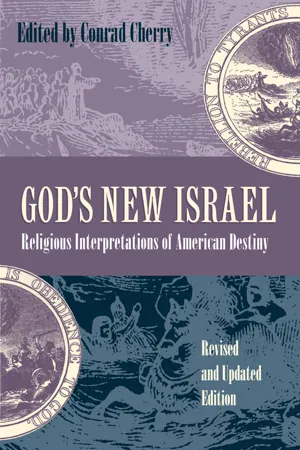
God’s New Israel is a collection of thirty-one readings that trace the theme of American destiny under God through major developments in U.S. history. First published in 1971 and now thoroughly updated to reflect contemporary events, it features the words of such prominent and diverse Americans as Jonathan Edwards, Thomas Jefferson, Brigham Young, Chief Seattle, Abraham Lincoln, Frances Willard, Martin Luther King Jr., Malcolm X, Ralph Reed, and Rosemary Radford Ruether. Neither a history of American religious denominations nor a history of American theology, this book is instead an illuminating look at how religion has helped shape Americans' understanding of themselves as a people.
- 448 pages
- English
- ePUB (mobile friendly)
- Available on iOS & Android
eBook - ePub
About this book
Information
The Colonial Errand into the Wilderness
The rudiments of the theme of American destiny under God emerged in the English colonization of the New World. The new nation that was to appear would inherit from the thirteen colonies an English language, legal system, and set of social customs, all appropriately adapted to the American environment. It would fall heir also to a religious view of history that had developed in the mother country. By the time they launched their colonial enterprises in the seventeenth century, the English had been taught from childhood that the course of human history is directed by God’s overruling providence and that God’s redemptive efforts centered on England and English Christianity. These assumptions about history were frequently joined with the millennialist belief that God and his chosen English saints were actively defeating the powers of Satan, the first major victory being the Protestant Reformation.1 The establishment of colonies, therefore, was hardly considered an ordinary undertaking. Many in England saw it as an opportunity to extend the influence of their civilization through which God was working for the redemption of humankind. For others colonization was a chance to bring England to its senses by achieving on new soil what they had not been able to do at home. The Quaker William Penn was moved to announce that his “holy experiment” in religious toleration was meant to be God’s own “example to the nations.” The letters of the Jesuit father Andrew White claimed that the settlement of Maryland was continuously presided over by the providence of God and that the “first and most important design” of the colony was “sowing the seeds of religion and piety.”
Religion was by no means the only, or even the dominant, motive for the settlement of most of the colonies. A religious view of history, however, did furnish a framework of self-understanding for colonists and stockholders who were impelled by a variety of motives. In the early literature of Virginia, for example, an admitted economic motive was interwoven with a historical perspective in which the providence of God loomed large. John Rolfe, whose method of cultivating a sweet leaf of tobacco was instrumental in establishing Virginia’s staple crop, wrote that the migration to Virginia was a venture of “a peculiar people, marked and chosen by the finger of God” to possess the land. Alexander Whitaker, a clergyman of the Church of England who arrived at Jamestown with Sir Thomas Dale in 1611 and helped Dale found the town of Henrico, explicated the religious meaning of the Virginia planting but not without reference to economics. Whitaker’s Good Newes from Virginia was sent to the Virginia Company, which directed it into publication in 1613. In that sermon he enumerated the religious reasons why the English should maintain a financial interest in Virginia. God’s deliverance of Sir Thomas Gates and the survivors of the Sea Venture which wrecked on Bermuda and His saving of the colony from famine were signs of providential blessing on the enterprise. As a Christian nation England was obligated to answer God’s call to convert the “heathen” Indians to the Christian faith and civilized customs. England was being challenged to defend its reputation among the nations as a charitable and persevering people. Though counseling patience and condemning a usurious spirit, Whitaker frankly appealed to the economic motive, placing it in his religious framework: “fortie years were expired, before Israel could plant in Canaan, and yet God had called them by the word of his mouth, had led them himselfe by a high hand. Yet may you boldly looke for a shorter time of reward.”
The most self-conscious pursuit of destiny under God in the New World was enacted by the Puritans of Massachusetts Bay, and the most articulate colonial spokesmen for the theme of American destiny were the Puritans. Ecclesiastical and civic leaders in New England conceived of America as a place where a Protestant Reformation of church and society could be completed—a task that had not been carried out in England and Europe. They envisioned their journey to these shores less as an escape from religious persecution than as a positive mission for the construction of a model Christian society. They were on an “errand into the wilderness”; their purpose was to build a holy commonwealth in which the people were covenanted together by their public profession of religious faith and were covenanted with God by their pledge to erect a Christian society. Their government also shared in this covenant since one of the roles of government was to protect their Congregational form of church polity and safeguard their religion against dissident groups. The original errand, however, was more than a mission for the Puritans themselves. They believed that, like Israel of old, they had been singled out by God to be an example for the nations (especially for England). With their charter and company in America, the Puritans could in effect construct a republic independent of an English crown that had not allowed them the freedom of their experiment at home. Nevertheless, they insisted that they were English settlers on an English errand: their godly commonwealth was to be a New England that would serve as a working model for Old England. If they succeeded in their errand, they would mark a turning point in history, for their commonwealth would be imitated by the nations. If they failed, they would fail not only themselves but their God and the very course of history.
The sense of destiny in the New World pervaded Puritan literature. John Winthrop, first governor of the Bay Colony, gave the theme one of its earliest and most pointed expressions. Winthrop’s Model of Christian Charity, written aboard the flagship Arbella as it led the Puritan expedition toward the Promised Land, briefly spelled out the terms of the Puritan covenant (terms founded on a divinely ordained social order in which “some must be rich, some poore”) and captured both the anticipation and the dread that arose in the heart of Puritan New Israel as it struck a covenant with Jehovah.
Beginning around 1650 much Puritan literature was replete with lamentations over the failure of New England to measure up to its divine calling. Sermons before the General Assembly at election time became particularly mournful as the clergy bewailed the decline of godliness among the people. Numerous signs of decay were cited: conflict among church members and between pastors and laity, the appearance of heretics, violations of Sabbath observance, impious children. And since the Puritan was quite capable of discerning the hand of God in most any natural or historical event, the jeremiads warned that New England’s crop failures, Indian wars, droughts, and epidemics were the judgment of a thoroughly provoked God upon his wayward people. It seemed that Winthrop’s worst fears aboard the Arbella had come true: “if our hearts shall turne away soe that wee will not obey, but shall be seduced and worshipp . . . other Gods, our pleasures, and proffitts, and serve them; it is propounded unto us this day, wee shall surely perishe out of the good Land.” Behind this sense of apostasy regarding the internal task of New England hovered the even greater frustration over the failure of New England to become a model for the nations. In fact, it was probably this frustration that led the clergy to look for signs of a broken covenant in the first place. The root of the problem was, quite simply, that England refused to look upon the Holy Commonwealth as its model. Even the Puritans back home, living under improved conditions of religious toleration, became critical of the American Puritans’ harsh treatment of dissenting religious groups. In Perry Miller’s apt metaphor, the American Puritans must have felt something like the actor with the dramatic role of the century who rehearsed his lines, took a deep breath, and strode onto the stage only to find the theater empty and no spotlight working.2
Michael Wigglesworth, usually judged one of three major poets in seventeenth-century America, laments the state of the Puritan New Israel in his God’s Controversy with New England. A graduate of Harvard, Wigglesworth enjoyed considerable influence as both a minister and a physician in Maiden, Massachusetts, but his verse rather than his sermons or medical practice exerted the greatest influence on Puritan New England. Within a year after the publication of his poetic account of Judgment Day, Day of Doom (1662), all eighteen hundred copies of the work had been sold. The first edition alone, therefore, had a distribution of one copy to every thirty-five people in Massachusetts.3God’s Controversy did not attain the renown of Day of Doom, but it was widely read and was quoted and imitated by other Puritan proclaimers of God’s wrath. Like most other lamentations of the period, God’s Controversy contrasts the vision, zeal, and sacrifices of the original settlers with the shortsightedness, sloth, and materialism of a later generation of New Englanders. Although the judgment of God thunders forth in the poem in the form of warnings and punishments, the hope is still held out that New England may renew its covenant with God if it will but repent of its sinful ways.
There is no evidence that New Englanders were as morally bankrupt as the preachers of doom intimated, but as the years passed there seemed to be a waning of the ardor with which the Puritans pursued their errand into the wilderness. It appeared to the later generations of preachers of doom that their people were more interested in their growing economic prosperity than in their spiritual state, that there was a cooling of religious zeal. Furthermore, the establishment of a tightly knit holy commonwealth in the wilderness suffered a series of disappointments. Massachusetts eventually lost its charter (1684), and dissenting groups (Quakers and Baptists) made inroads into the Puritan Zion. Yet the hope that God had something special in store for New England was never completely abandoned. Therefore, when the revivals of the Great Awakening deluged the colonies in the 1740s, there occurred not only an upsurge of religious vitality but also a revivification of the view of the New World as the place where God was breaking forth new light for the world at large. Jonathan Edwards, the foremost theologian of the eighteenth century and a formidable defender of the Great Awakening, stated the conviction that the revivals might very well mark the beginning of God’s religious renewal of all humankind. It appeared to Edwards that America’s opportunity to become a “city upon a hill” had returned through the movement of God’s Spirit in the Awakening. In his Thoughts Concerning the Present Revival of Religion (1742), Edwards engaged in a typological interpretation of Scripture and world history to describe the likelihood that his age would be the time when the Kingdom of God would spread from America—and especially from the shores of New England.4
Many eighteenth-century figures, including Edwards, found their enthusiasm for the Awakening checked by some of the results of the revivals: heated theological controversies, the division of denominations into prorevivalist and antirevivalist factions, uncontrolled emotionalism. Despite the Great Awakening’s divisive influence upon Protestant denominations and the Protestant religious consciousness, however, it played an important cohesive role in the colonies. It crossed class and geographical boundaries (the revivals were well received by city dwellers as well as by rural folk, by highly educated as well as by uneducated) and generated a common religious interest. Above all, it aroused anew the sense of American destiny under God, thus contributing to an emerging feeling of American unity and preparing the way for a new nation’s bid for a crucial historical mission.
SUGGESTED READING
Bercovitch, Sacvan. The American Jeremiad. Madison: University of Wisconsin Press, 1978.
Gaustad, Edwin S. The Great Awakening in New England. 1957. Reprint, Chicago: Quadrangle, 1968.
Morgan, Edmund S. The Puritan Dilemma: The Story of John Winthrop. Boston: Little, Brown and Company, 1958.
Stout, Harry S. The New England Soul: Preaching and Religious Culture in Colonial New England. New York: Oxford University Press, 1986.
Wright, Louis B. Religion and Empire: The Alliance between Piety and Commerce in English Expansion, 1558–1625. New York: Octagon Books, 1965.
Notes
1. As Winthrop S. Hudson and John Corrigan have observed, this perspective on history was greatly influenced by the writings of John Foxe, whose Book of Martyrs was officially placed in every cathedral church in 1571 and later came to occupy a place second only to the Bible in Protestant homes. Winthrop S. Hudson and John Corrigan, Religion in America (New York: Macmillan Publishing Company, 1992), p. 24. On Foxe see William Haller, The Elect Nation: The Meaning and Relevance of Foxe’s Book of Martyrs (New York: Harper & Row, Publishers, 1963). On millennialism see Ernest Lee Tuveson, Redeemer Nation: The Idea of America’s Millennial Role (Chicago: University of Chicago Press, 1968), pp. 1–30.
2. Perry Miller, Errand into the Wilderness (Cambridge, Mass.: Harvard University Press, Belknap Press, 1956), pp. 12–13.
3. Richard Crowder, No Featherbed to Heaven: A Biography of Michael Wigglesworth, 1671–1705 (East Lansing: Michigan State University Press, 1962), p. 121.
4. Gerald McDermott has pointed out that according to Edwards God singled out New England not because of its virtues but for His own mysterious reasons, and in his other writings Edwards gave a definite international emphasis to the “glorious work” of the revivals. Gerald McDermott, One Holy and Happy Society: The Public Theology of Jonathan Edwards (University Park: Pennsylvania State University Press, 1992), pp.82–90.
Good Newes from Virginia
[sent to] The Right Worshipful Sir Thomas Smith, Knight, Treasurer of the English Colonie in Virginia
ECCLESIASTES II.I.
“Cast thy bread upon the waters: for after many daies thou shalt finde it”
“Cast thy bread upon the waters: for after many daies thou shalt finde it”
. . . let me turne your eyes, my brethren of England, to behold the waters of Virginia: where you may behold a fit subject for the exercise of your Liberalitie, persons enough on whom you may cast away your Bread, and yet not without hope, after many daies to finde it. Yea, I will not feare to affirme unto you, that those men whom God hath made able any way to be helpefull to this Plantation, and made knowne unto them the necessities of our wants, are bound in conscience by vertue of this precept, to lay their helping hands to it, either with their purse, persons, or prayers, so farre forth as God hath made them fit for it. For it is evident that our wise God hath bestowed no gift upon any man, for their private use, but for the good of other men, whom God shall offer to their Liberalitie.
Wherefore, since God hath opened the doore of Virginia, to our countrey of England, wee are to thinke that God hath, as it were, by word of mouth called us in, to bestow our severall Charity on them. And that this may the better appeare, we have many reasons to encourage us to bee Liberall minded and open-handed toward them.
First, if we consider the almost miraculous beginning, and continuance of this plantation, we must needs confesse that God hath opened this passag...
Table of contents
- Cover Page
- God’s New Israel
- Copyright Page
- Contents
- Epigraphs
- Preface to the Revised and Updated Edition
- Introduction
- Part One
- Part Two
- Part Three
- Part Four
- Part Five
- Part Six
- Part Seven
- Index
Trusted by 375,005 students
Access to over 1.5 million titles for a fair monthly price.
Study more efficiently using our study tools.
Frequently asked questions
Yes, you can cancel anytime from the Subscription tab in your account settings on the Perlego website. Your subscription will stay active until the end of your current billing period. Learn how to cancel your subscription
No, books cannot be downloaded as external files, such as PDFs, for use outside of Perlego. However, you can download books within the Perlego app for offline reading on mobile or tablet. Learn how to download books offline
We are an online textbook subscription service, where you can get access to an entire online library for less than the price of a single book per month. With over 1.5 million books across 990+ topics, we’ve got you covered! Learn about our mission
Look out for the read-aloud symbol on your next book to see if you can listen to it. The read-aloud tool reads text aloud for you, highlighting the text as it is being read. You can pause it, speed it up and slow it down. Learn more about Read Aloud
Yes! You can use the Perlego app on both iOS and Android devices to read anytime, anywhere — even offline. Perfect for commutes or when you’re on the go.
Please note we cannot support devices running on iOS 13 and Android 7 or earlier. Learn more about using the app
Please note we cannot support devices running on iOS 13 and Android 7 or earlier. Learn more about using the app
Yes, you can access God's New Israel by Conrad Cherry in PDF and/or ePUB format, as well as other popular books in Theology & Religion & History of Religion. We have over 1.5 million books available in our catalogue for you to explore.