Passover Haggadah
eBook - ePub

Passover Haggadah

As Commented Upon By Elie Wiesel and Illustrated b

  1. 144 pages
  2. English
  3. ePUB (mobile friendly)
  4. Available on iOS & Android
eBook - ePub

Passover Haggadah

As Commented Upon By Elie Wiesel and Illustrated b

About this book

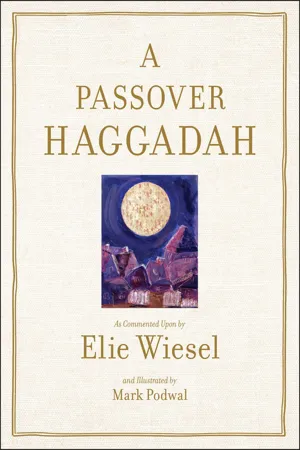
A Passover Haggadah, enhanced with more than fifty original drawings, Elie Wiesel and his friend Mark Podwal invite you to join them for the Passover Seder—the most festive event of the Jewish calendar. Read each year at the Seder table, the Haggadah recounts the miraculous tale of the liberation of the Children of Israel from slavery in Egypt, with a celebration of prayer, ritual, and song. Wiesel and Podwal guide you through the Haggadah and share their understanding and faith in a special illustrated edition that will be treasured for years to come. Accompanying the traditional Haggadah text (which appears here in an accessible new translation) are Elie Wiesel's poetic interpretations, reminiscences, and instructive retellings of ancient legends. The Nobel laureate interweaves past and present as the symbolism of the Seder is explored. Wiesel's commentaries may be read aloud in their entirety or selected passages may be read each year to illuminate the timeless message of this beloved book of redemption.
Frequently asked questions

Yes, you can cancel anytime from the Subscription tab in your account settings on the Perlego website. Your subscription will stay active until the end of your current billing period. Learn how to cancel your subscription.
No, books cannot be downloaded as external files, such as PDFs, for use outside of Perlego. However, you can download books within the Perlego app for offline reading on mobile or tablet. Learn more here.
Perlego offers two plans: Essential and Complete
  • Essential is ideal for learners and professionals who enjoy exploring a wide range of subjects. Access the Essential Library with 800,000+ trusted titles and best-sellers across business, personal growth, and the humanities. Includes unlimited reading time and Standard Read Aloud voice.
  • Complete: Perfect for advanced learners and researchers needing full, unrestricted access. Unlock 1.4M+ books across hundreds of subjects, including academic and specialized titles. The Complete Plan also includes advanced features like Premium Read Aloud and Research Assistant.
Both plans are available with monthly, semester, or annual billing cycles.
We are an online textbook subscription service, where you can get access to an entire online library for less than the price of a single book per month. With over 1 million books across 1000+ topics, we’ve got you covered! Learn more here.
Look out for the read-aloud symbol on your next book to see if you can listen to it. The read-aloud tool reads text aloud for you, highlighting the text as it is being read. You can pause it, speed it up and slow it down. Learn more here.
Yes! You can use the Perlego app on both iOS or Android devices to read anytime, anywhere — even offline. Perfect for commutes or when you’re on the go.
Please note we cannot support devices running on iOS 13 and Android 7 or earlier. Learn more about using the app.
Yes, you can access Passover Haggadah by Elie Wiesel in PDF and/or ePUB format, as well as other popular books in Theology & Religion & Jewish Theology. We have over one million books available in our catalogue for you to explore.

Information

text

Maggid

line

TELLING THE STORY

line
The matzot are uncovered and raised for all to see as we recite:
text
This is the bread of affliction
which our forefathers ate in the land of Egypt.
Let all those who are hungry come and eat with us.
Let all those who are in need come and share our meal.
This year we are here.
Next year may we all be in the land of Israel.
This year we are still slaves.
Next year may we all be free.
The matzot are covered.
diagarm
A memory from my town, Sighet: Our Seder table was never without a stranger. I remember that we went from one synagogue to the other, from one house of study to the other, looking for a stranger without whom our holiday would be incomplete. And this was true of most Jews in my town and probably of most Jews in other towns. On Passover eve, the poor, the uprooted, the unhappy were the most sought-after, the most beloved guests. It was for them and with them that we recited: ā€œThis year we are still slaves. Next year may we all be free.ā€ Without comforting our impoverished guest, our riches would shame us. And so we were grateful to him. In some towns, before Passover, Jews would raise funds discreetly: One by one, they would enter a room in the community house. There they would find a dish filled with money. Those who had money left some; those who needed money took some. No one knew how much was given or how much was taken. Thus, the needy were taken care of with dignity.
At this moment, the second cup of wine is poured. Then the youngest of the children asks the Four Questions:
text
How does this night differ from all other nights? On all other nights we eat either leavened or unleavened bread. Why on this night do we eat only unleavened bread?
On all other nights we eat all kinds of herbs. Why on this night do we eat only bitter herbs?
On all other nights we need not dip our herbs even once. Why on this night do we need to dip twice?
On all other nights we eat either sitting or reclining. Why on this night must we all recline?
These questions are simple and practical. As said before, the entire Seder has been conceived for children. We must teach them how to ask questions. And therefore, for guidance, we offer them the proverbial Four Questions. Then, it is up to each child to ask his own.
Commentators have found all kinds of secret meanings in the Four Questions. According to Don Yitzhak Abrabanel, the great Spanish sage, the questions deal with the contradictions that govern Jewish life in exile. More specifically, there are mystical scholars who assert that leavened bread symbolizes the evil spirit, whereas matzah represents purity of the soul. Perhaps. We are all entitled to our own interpretation. For the learned, the Seder offers the possibility of further study. For the novice, it affords the pleasures of a simple story. Children will begin by wanting to understand the nature of what they see and hear, what they touch and taste. Later their questions will become more complex: Why exile? Why suffering? Why evil? And who can explain why they prevail? Here, then, is the answer offered since the beginning of exile:
diagarm
The matzot are uncovered.
text
We were all slaves to Pharaoh in Egypt. And the Lord our God delivered us from there with a mighty hand and an outstretched arm. Had the Holy One, blessed be He, not brought our forefathers out of Egypt, then we, our children, and our children’s children, would still be slaves to Pharaoh in Egypt. And even if all of us were scholars, all of us full of understanding, all of us masters, all of us learned in the Torah, we would still be commanded to tell the story of how we left Egypt. And the more one tells the story, with ever more detail and fervor, the greater one’s merit.
This statement expresses the essence of Jewish faith, of Jewish allegiance to a collective memory. It is as though we had all been in Egypt together, prisoners of the same enemy, suffering the same pain, the same anguish. It is as though we had all been carried by the same hope.
Even converts must affirm their connection with Egypt, with the experience that preceded our liberation. Is it possible for strangers, sons and daughters of strangers, to have lived in exile as we did? Yes, answers our tradition. In becoming Jewish, converts absorb our entire past, effectively making it their own. Thus we share our memory, going all the way back to Egypt. In exchange, like us, converts must proclaim their faith in divine strength and goodness.
ā€œIf God had not brought our forefathers out of Egypt, then we, our children, and our children’s children would still be slaves to Pharaoh in Egypt.ā€ What a strange statement. The Pharaoh has long ceased to exist. How could we still be his slaves? Clearly, this sentence is allegorical. Pharaohs are not necessarily Egyptian. And Egypt, is not the only place where exile is felt. Each generation has its own enemies, its own struggles and—sometimes—its own victories. We evoke Exodus not only to remember our suffering in Egypt, but also to relive the manner in which we overcame our suffering.
diagarm
text
A tale: One Passover eve, Rabbi Eliezer, Rabbi Joshua, Rabbi Elazar ben Azariah, Rabbi Akiba, and Rabbi Tarfon reclined together at B’nai Brak. They told and retold the story of the Exodus from Egypt all through the night, until their disciples came running to tell them: ā€œThe time has come to read the morning Sh’ma, the time has come to say the morning prayers.ā€
Why do we tell this story? It teaches us an important lesson. These five sages, among the most illustrio...

Table of contents

  1. Cover
  2. Preface
  3. The Seder
  4. The Seder
  5. Kadesh
  6. U’rechatz
  7. Karpas
  8. Yachatz
  9. Maggid
  10. Rachtzah
  11. Motzi Matzah
  12. Maror
  13. Korech
  14. Shulchan Orech
  15. Tzafun
  16. Barech
  17. Hallel
  18. Nirtzah
  19. About Elie Wiesel
  20. Copyright