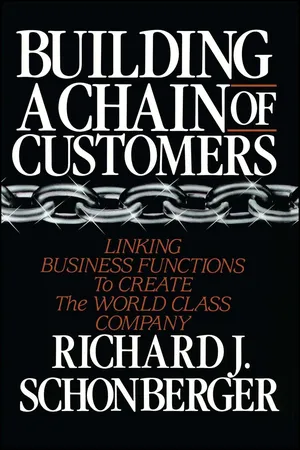
Richard Schonberger, in his fourth and most important book yet, introduces a powerful new concept: that the many links between and within the four main business functions -- design, operations, accounting, and marketing -- form a continuous "chain of customers" that extends to those who buy the product or service. Everyone has a customer -- the next department, office, shop, or person -- at the hundreds of pioneering companies Schonberger has studied throughout the world.
Schonberger demonstrates the universality of customer wants: Both the next and final customers want ever better quality, quicker response, greater flexibility, and lower cost. This condition provides a common strategy and calls for common methods to be used across the organization. Every employee is a data gatherer and analyst, unearthing more and better ways to provide for these customers' wants -- before the competition does so.
As the new thinking and methods permeate every comer of the firm, they topple departmental walls and adjust gang-like mind-sets and "them-versus-us" attitudes. Performance is no longer measured by internal costs but by improvement as seen by the next customer; direct control of causes generally replaces after-the-fact control of costs. Design is brought out of isolation. Finally, with the rest of the firm reoriented toward customer service, marketing escapes from a "negative" mode -- covering up for failures -- to a positive one -- crowing about the firm's competence and ability to improve.
With the close attention to detail for which he has become famous, Schonberger constructs a blueprint for unifying corporate functions, brilliantly describing the new microcosms that will make up the company of the 1990s -- focused teams of multi-skilled, involved employees arranged according to the way the work flows or the service is provided -- that compose the chain of customers. Aetna, for example, is organizing customer-focused teams that cut across underwriting and the administrative functions. At Hewlett-Packard, teams of marketing, manufacturing, and R&D people have already gone through several iterations of "activity-based costing", which provides product designers with previously unavailable data for shaving costs throughout product life cycles. And at Du Pont, even production people on the factory floor are involved in assessing competitors' product quality and probable costs and methods. Through these and hundreds of other real company examples, Schonberger shows how the customer-driven chain of action leads directly to the kinds of bottom-line performance that have been so elusive to executives who manage at a distance "by the numbers" -- namely, higher profits, greater security, and gains in market share at the expense of the laggard competion.
- 352 pages
- English
- ePUB (mobile friendly)
- Available on iOS & Android
eBook - ePub
Building a Chain of Customers
About this book
Information
Table of contents
- Cover Page
- Title Page
- Contents
- The Great Awakening Earthquakes in the Business Functions
- Universal Strategy The Shattering of Strategic Business Thought
- The “Customer In” Organization
- Total Quality Toward Delighting the Customer
- Work Force on the Attack
- The Learning Organization
- Attack on Nonobvious Wastes
- Minimal Accounting and Noncost Cost Control
- Pay Recognition Celebration
- World Class Product Development
- Marketing for Total Gain
- Success Formulas for Volume and Flexibility
- Elevated Performance Standards
- Appendix Quick JIT Response
- Notes
- Index
Trusted by 375,005 students
Access to over 1.5 million titles for a fair monthly price.
Study more efficiently using our study tools.
Frequently asked questions
Yes, you can cancel anytime from the Subscription tab in your account settings on the Perlego website. Your subscription will stay active until the end of your current billing period. Learn how to cancel your subscription
No, books cannot be downloaded as external files, such as PDFs, for use outside of Perlego. However, you can download books within the Perlego app for offline reading on mobile or tablet. Learn how to download books offline
Perlego offers two plans: Essential and Complete
- Essential is ideal for learners and professionals who enjoy exploring a wide range of subjects. Access the Essential Library with 800,000+ trusted titles and best-sellers across business, personal growth, and the humanities. Includes unlimited reading time and Standard Read Aloud voice.
- Complete: Perfect for advanced learners and researchers needing full, unrestricted access. Unlock 1.5M+ books across hundreds of subjects, including academic and specialized titles. The Complete Plan also includes advanced features like Premium Read Aloud and Research Assistant.
We are an online textbook subscription service, where you can get access to an entire online library for less than the price of a single book per month. With over 1.5 million books across 990+ topics, we’ve got you covered! Learn about our mission
Look out for the read-aloud symbol on your next book to see if you can listen to it. The read-aloud tool reads text aloud for you, highlighting the text as it is being read. You can pause it, speed it up and slow it down. Learn more about Read Aloud
Yes! You can use the Perlego app on both iOS and Android devices to read anytime, anywhere — even offline. Perfect for commutes or when you’re on the go.
Please note we cannot support devices running on iOS 13 and Android 7 or earlier. Learn more about using the app
Please note we cannot support devices running on iOS 13 and Android 7 or earlier. Learn more about using the app
Yes, you can access Building a Chain of Customers by Richard J. Schonberger in PDF and/or ePUB format, as well as other popular books in Business & Customer Relations. We have over 1.5 million books available in our catalogue for you to explore.