
- 416 pages
- English
- ePUB (mobile friendly)
- Available on iOS & Android
eBook - ePub
About this book
The Progressive Era, a few brief decades around the turn of the last century, still burns in American memory for its outsized personalities: Theodore Roosevelt, whose energy glinted through his pince-nez; Carry Nation, who smashed saloons with her axe and helped stop an entire nation from drinking; women suffragists, who marched in the streets until they finally achieved the vote; Andrew Carnegie and the super-rich, who spent unheard-of sums of money and became the wealthiest class of Americans since the Revolution. Yet the full story of those decades is far more than the sum of its characters. In Michael McGerr's A Fierce Discontent America's great political upheaval is brilliantly explored as the root cause of our modern political malaise.
The Progressive Era witnessed the nation's most convulsive upheaval, a time of radicalism far beyond the Revolution or anything since. In response to the birth of modern America, with its first large-scale businesses, newly dominant cities, and an explosion of wealth, one small group of middle-class Americans seized control of the nation and attempted to remake society from bottom to top. Everything was open to question -- family life, sex roles, race relations, morals, leisure pursuits, and politics. For a time, it seemed as if the middle-class utopians would cause a revolution.
They accomplished an astonishing range of triumphs. From the 1890s to the 1910s, as American soldiers fought a war to make the world safe for democracy, reformers managed to outlaw alcohol, close down vice districts, win the right to vote for women, launch the income tax, take over the railroads, and raise feverish hopes of making new men and women for a new century.
Yet the progressive movement collapsed even more spectacularly as the war came to an end amid race riots, strikes, high inflation, and a frenzied Red scare. It is an astonishing and moving story.
McGerr argues convincingly that the expectations raised by the progressives' utopian hopes have nagged at us ever since. Our current, less-than-epic politics must inevitably disappoint a nation that once thought in epic terms. The New Deal, World War II, the Cold War, the Great Society, and now the war on terrorism have each entailed ambitious plans for America; and each has had dramatic impacts on policy and society. But the failure of the progressive movement set boundaries around the aspirations of all of these efforts. None of them was as ambitious, as openly determined to transform people and create utopia, as the progressive movement. We have been forced to think modestly ever since that age of bold reform. For all of us, right, center, and left, the age of "fierce discontent" is long over.
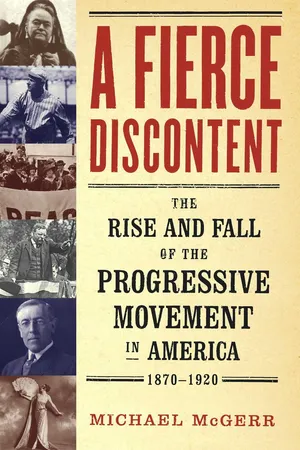
The Progressive Era witnessed the nation's most convulsive upheaval, a time of radicalism far beyond the Revolution or anything since. In response to the birth of modern America, with its first large-scale businesses, newly dominant cities, and an explosion of wealth, one small group of middle-class Americans seized control of the nation and attempted to remake society from bottom to top. Everything was open to question -- family life, sex roles, race relations, morals, leisure pursuits, and politics. For a time, it seemed as if the middle-class utopians would cause a revolution.
They accomplished an astonishing range of triumphs. From the 1890s to the 1910s, as American soldiers fought a war to make the world safe for democracy, reformers managed to outlaw alcohol, close down vice districts, win the right to vote for women, launch the income tax, take over the railroads, and raise feverish hopes of making new men and women for a new century.
Yet the progressive movement collapsed even more spectacularly as the war came to an end amid race riots, strikes, high inflation, and a frenzied Red scare. It is an astonishing and moving story.
McGerr argues convincingly that the expectations raised by the progressives' utopian hopes have nagged at us ever since. Our current, less-than-epic politics must inevitably disappoint a nation that once thought in epic terms. The New Deal, World War II, the Cold War, the Great Society, and now the war on terrorism have each entailed ambitious plans for America; and each has had dramatic impacts on policy and society. But the failure of the progressive movement set boundaries around the aspirations of all of these efforts. None of them was as ambitious, as openly determined to transform people and create utopia, as the progressive movement. We have been forced to think modestly ever since that age of bold reform. For all of us, right, center, and left, the age of "fierce discontent" is long over.
Frequently asked questions
Yes, you can cancel anytime from the Subscription tab in your account settings on the Perlego website. Your subscription will stay active until the end of your current billing period. Learn how to cancel your subscription.
No, books cannot be downloaded as external files, such as PDFs, for use outside of Perlego. However, you can download books within the Perlego app for offline reading on mobile or tablet. Learn more here.
Perlego offers two plans: Essential and Complete
- Essential is ideal for learners and professionals who enjoy exploring a wide range of subjects. Access the Essential Library with 800,000+ trusted titles and best-sellers across business, personal growth, and the humanities. Includes unlimited reading time and Standard Read Aloud voice.
- Complete: Perfect for advanced learners and researchers needing full, unrestricted access. Unlock 1.4M+ books across hundreds of subjects, including academic and specialized titles. The Complete Plan also includes advanced features like Premium Read Aloud and Research Assistant.
We are an online textbook subscription service, where you can get access to an entire online library for less than the price of a single book per month. With over 1 million books across 1000+ topics, weâve got you covered! Learn more here.
Look out for the read-aloud symbol on your next book to see if you can listen to it. The read-aloud tool reads text aloud for you, highlighting the text as it is being read. You can pause it, speed it up and slow it down. Learn more here.
Yes! You can use the Perlego app on both iOS or Android devices to read anytime, anywhere â even offline. Perfect for commutes or when youâre on the go.
Please note we cannot support devices running on iOS 13 and Android 7 or earlier. Learn more about using the app.
Yes, you can access A Fierce Discontent by Michael McGerr in PDF and/or ePUB format, as well as other popular books in History & North American History. We have over one million books available in our catalogue for you to explore.
Information
PART ONE
THE PROGRESSIVE OPPORTUNITY
CHAPTER ONE
âSIGNS OF FRICTIONâ Portrait of America at Centuryâs End
In one of Chicagoâs elite clubs on election night in November 1896, a group of rich men were euphoric. After a tense, uncertain campaign, their presidential candidate, the Republican William McKinley, had clearly defeated the Democratic and Populist nominee, William Jennings Bryan. As the celebration continued past midnight, a wealthy merchant, recalling his younger days, began a game of Follow the Leader. The other tycoons joined in and the growing procession tromped across sofas and chairs and up onto tables. Snaking upstairs and down-, the line finally broke up as the men danced joyfully in one anotherâs arms.1
Their euphoria was understandable. McKinleyâs victory climaxed not only a difficult election but an intense, generation-long struggle for control of industrializing America. For Chicagoâs elite, the triumph of McKinley, the sober former governor of Ohio, meant that the federal government was in reliable, Republican hands. The disturbing changes that Bryan had promisedâthe reform of the monetary system, the dismantling of the protective tariffâwould not pass. The frightening prospect of a radical alliance of farmers and workers had collapsed. The emerging industrial order, the source of their wealth and power, seemed safe.2
McKinleyâs victory certainly was a critical moment, but the election did not settle the question of control as fully as those rich men in Chicago would have liked. The wealthy could play Follow the Leader, but it was not at all clear that the rest of the nation was ready to follow along. Driven by the industrial revolution, America had grown enormously in territory, population, and wealth in the nineteenth century. The United States was not one nation but several; it was a land divided by region, race, and ethnicity. And it was a land still deeply split by class conflict. The upper class remained a controversial group engineering a wrenching economic transformation, accumulating staggering fortunes, and pursuing notorious private lives. Just three months later another partyâthis one in New York Cityâhighlighted the precariousness of upper-class authority at the close of the nineteenth century.
While McKinley and Bryan battled for the presidency, Cornelia Bradley Martin had been plotting her own coup in the social wars of New Yorkâs rich. She and her husband, Bradley, were no newcomers to the ranks of wealthy Manhattan. Corneliaâs father had been a millionaire merchant in New York; Bradleyâs, a banker from a fine Albany family. Though wealthy, their parents had lived by the old Victorian virtues. Corneliaâs father, it was said, had been âdomestic in his tastesâ; Bradleyâs father, who early practiced âabsolute self-denial,â ânever lost an opportunity of instillingâ in his sons âideas of the importance of work and oneâs duty towards others in every-day life.â Cornelia and Bradley, married in 1869, had moved away from the old values. One sign of the change was their surname, which somewhere along the line borrowed Bradleyâs first name, occasionally added a hyphen, and doubled from âMar-tinâ to âBradley-Martin.â Another was Corneliaâs collection of jewelry, which included pieces from the French crown jewels, most notably a ruby necklace that had belonged to Marie Antoinette. Never âdomesticâ in their tastes, the Bradley Martins had become well known in New York social circles, especially for their renowned parties in 1885 and 1890.3
In the depression winter of 1897, Cornelia arranged a costume ball at the Waldorf Hotel that would, she hoped, eclipse not only her previous efforts but also Alva Vanderbiltâs famous ball of 1883, widely recognized as the greatest party in the history of the city. Cornelia was not bashful about her intentions. For weeks before the ball, her secretary made sure that the papers got all the details. Yet the publicity was not quite what Cornelia had expected. Across the country, preachers and editorial writers argued over the propriety of a party that would cost hundreds of thousands of dollars amid the worst depression in the nationâs history. At the fashionable St. Georgeâs Episcopal Church in New York, rector Dr. William Rainsford urged his congregation, which included financier J. P. Morgan, to forgo the ball. âNever were the lines between the two classesâthose who have wealth and those who envy themâmore distinctly drawn,â Rainsford warned. â[S]uch elaborate and costly manifestations of wealth would only tend to stir up ⌠widespread discontentâ and âfurnish additional texts for sermons by the socialistic agitators.â âEvery thoughtful man,â agreed a parishioner, âmust have seen signs of friction between the upper ten and the lower. Whatever tends to increase it, as very elaborate social affairs may, can well be spared now.â The pastor of Fifth Avenue Baptist Church, where John D. Rockefeller worshipped, preached that wealth should be used for philanthropy. Undeterred, Cornelia went ahead. Her supporters claimed that the expenditures for the ball would stimulate the economy.4
Some invited guests decided not to attend. But about six or seven hundred turned up, in costume, when the great night came on February 10. Bradley dressed as a member of the court of Louis XV. Cornelia, despite her Marie Antoinette necklace, dressed as another luckless queen, Mary Stuart. Like a queen, the hostess greeted her guests from a raised dais âbeneath a canopy of rare tapestries.â There were mirrors, tables laden with food, âa wild riot of roses,â and âmimic woodland bowers.â The scene âreproduced the splendour of Versailles in New York, and I doubt if even the Roi Soleil himself ever witnessed a more dazzling sight,â Bradleyâs brother, Frederick Townsend Martin, remembered. âThe power of wealth with its refinement and vulgarity was everywhere. It gleamed from countless jewels, and it was proclaimed by the thousands of orchids and roses, whose fragrance that night was like incense burnt on the altar of the Golden Calf.â Royalty was everywhere, tooââperhaps a dozenâ Marie Antoinettes came to the ball. Amid all the bewigged and bejeweled royalty, a reporter noted, there were hardly any American costumes. Only one or two George Washingtons reminded the guests of their republican origins. Outside, about 250 police closed the sidewalks to pedestrians and braced for trouble. While his wife danced inside, Police Commissioner Theodore Roosevelt directed his men as they watched for anyone âlikely to prove dangerous from an anarchistic viewpoint.â 5
The revolutionary moment never came, but Corneliaâs triumph turned into disaster anyway. Across the country, elite opinion condemned the Bradley Martins. The Chicago Tribune gave its verdict by quoting Shakespeareâs Puck: âWhat fools these mortals be.â Worse, New York City itself suddenly became inhospitable. Municipal officials, noting Bradleyâs opulence, raised his property taxes. The members of the cityâs elite clubs pronounced the Bradley Martinsâ ball âmagnificentâ but âstupid.â Unlike Marie Antoinette and Mary Stuart, Cornelia kept her head, but she and Bradley soon left the United States to begin a self-imposed exile. Selling their mansion in Manhattan, the Bradley Martins bought a new place in London, where their daughter had married Lord Craven a few years before. In 1899, they returned briefly to New York to give a defiant farewell dinner party at the Waldorf at the cost of $116 a plate. From then on, the Bradley Martins divided their time between London and Balmacaan, Bradleyâs estate in Scotland. They left behind a bemused Frederick Townsend Martin. Years later he still could not understand why all this had happened. After all, the ball had helped the economy because âmany New York shops sold out brocades and silks which had been lying in their stock-rooms for years.â âI cannot conceive,â Frederick wrote sadly, âwhy this entertainment should have been condemned.â 6
If McKinleyâs victory emphasized the strength of the âupper ten,â the Bradley Martinsâ ball epitomized their weakness. Absurd as it was, the affair highlighted the cultural isolation and internal division that plagued the wealthy. The industrial upper class upheld a set of values at odds with those of other classes. Approaching life so differently from the rest of America, the rich could not command respect from farmers and workers. Even among themselves, the âupper tenâ disagreed how best to live their lives and secure their future. The party did not last very long at all.

Cornelia Bradley Martin staged her costume ball when class differences were more pronounced than at any time in the history of industrial America. The end of the nineteenth century saw more than just âsigns of friction between the upper ten and the lowerâ : wage workers, farmers, and the rich were alien to one another. That sense of strangeness was not only a matter of obvious differences in material circumstances. By choice and by necessity, Americaâs social classes lived starkly divergent daily lives and invoked different and often conflicting values to guide, explain, and justify their ways of life. The classes held distinctive views on fundamental issues of human existence: on the nature of the individual; on the relationship between the individual and society; on the roles of men, women, children, and the family; and on the relative importance of work and pleasure. What would become the Progressive Eraâan extraordinary explosion of middle-class activismâbegan as an unprecedented crisis of alienation amid the extremes of wealth and poverty in America.
In a land of some 76 million people, the âupper tenâ were no more than a tiny minority, a mere sliver of the nation. Wealthy capitalists, manufacturers, merchants, landowners, executives, professionals, and their families made up not âten,â but only 1 or 2 percent of the population. These were the people who owned the majority of the nationâs resources and expected to make the majority of its key decisions. They could be found in cities, towns, and rural estates across the country. Their ranks included the nationâs roughly four thousand millionaires, fabulously rich by almost any standard. Their most visible and most powerful members were the two hundred or so families worth at least $20 million, fortunes with few parallels in history. Concentrated in the Northeast and especially New York State, theirs were the famous names of American capitalismâVanderbilt, Whitney, Carnegie, Harriman, and Morgan. Probably the greatest fortune of them allâa billion dollars by 1913âbelonged to John D. Rockefeller, the leader of Standard Oil.7
Membership in the upper ten was never only a matter of precise calculation in dollars; it was also a matter of origins, experience, and outlook. Wealthy Americans shared several attributes that made them a homogenous and distinctive group, similar to one another and different from the rest of the population. In an increasingly diverse nation of new and old immigrants, the upper class came mostly from English stock, from families long in America. In a largely Protestant land, they belonged, by birth or conversion, to the smaller, most fashionable Protestant denominationsâEpiscopalian, Presbyterian, and Congregational. With only occasional exceptions, they came from middle- and upper-class origins. Hardly any matched Andrew Carnegieâs storied rise from rags to riches, from working-class bobbin boy in a textile factory to multimillionaire steel baron. While fewer than 10 percent of the population had even graduated from high school, many of the upper ten had gone to college or professional school.8
Above all, the upper ten shared a fundamental understanding about the nature of the individual. Glorifying the power of individual will, the wealthy held to an uncompromising belief in the necessity of individual freedom. To Andrew Carnegie, âIndividualismâ was the very âfoundationâ of the human race. âOnly through exceptional individuals, the leaders, man has been able to ascend,â Carnegie explained. â[It] is the leaders who do the new things that count, all these have been Individualistic to a degree beyond ordinary men and worked in perfect freedom; each and every one a character unlike anybody else; an original, gifted beyond most others of his kind, hence his leadership.â It was just this strong-willed sense of her âexceptionalâ individuality that inspired Cornelia Bradley Martinâs idea for a ball; and it was just this sense of her right to âperfect freedomâ that enabled her to stick to her plans in the face of so much condemnation.9
The upper ten attributed the hardships of the poor not to an unfair economic system but to individual shortcomings. The remedy was individual regeneration rather than government action. â[The] failures which a man makes in his life are due almost always to some defect in his personality, some weakness of body, or mind, or character, will, or temperament,â wrote John D. Rockefeller. âThe only way to overcome these failings is to build up his personality from within, so that he, by virtue of what is within him, may overcome the weakness which was the cause of the failure.â Individualism, moreover, helped the wealthy resolutely deny the existence of social classes, despite all the signs of friction around them. âThe American Commonwealth is built upon the individual,â explained the renowned corporate lawyer and U.S. Senator Chauncey Depew of New York. âIt recognizes neither classes nor masses.â 10
Upper-class individualism was more than just a crude version of âmight makes right.â These men and women had grown up in a land dedicated to individualism. In the Revolutionary era, the nationâs sacred documentsâthe Declaration of Independence, the Constitution, and the Bill of Rightsâproclaimed the dignity and worth of the individual. By the nineteenth century, that notion was so powerful and so distinctively American that the visiting French observer Alexis de Tocqueville coined the term individualism to describe it. The relentless spread of capitalism reaffirmed the individualist creed, but with a new emphasis on each personâs ownership of his or her labor. By midcentury, this reworked individualism drove the abolitionist assault on slavery and spurred the Northern war against the South. Individualism justified the emerging factory system, built on individual workersâ free exchange of their labor for wages. Individualism provided the core of the Victorian culture that taught middle-class men self-discipline and self-reliance in the struggle for success. âTake away the spirit of Individualism from the people,â warned Wall Street veteran Henry Clews, âand you at once eliminate the American spiritâthe love of freedom,âof free industry,âfree and unfettered opportunity,âyou take away freedom itself.â 11
Ironically, the wealthy themselves challenged freedom and individualism by creating the nationâs pioneering big businesses, the giant trusts and corporations that employed the first white-collar âorganization men.â There were even a few âorganization menâ among the upper ten. William Ellis Corey, the second president of United States Steel, âis part of the mechanism itself,â wrote an observer early in the twentieth century. âHe feels himself to be a fraction, rather than a unit. His corporation is an organism like a human body, and he is the co-ordinating function of its brain.â 12
Yet, men like Corey were unusual. For one thing, many of the wealthy did not share his familiarity with corporate life. In the industrial city of Baltimore, sixth largest in the nation in 1900, only about one-fifth of leading businessmen had made their careers as bureaucrats. Of the 185 leaders of the largest American firms between 1901 and 1910, just under half were career bureaucrats, men who had never had their own businesses. But even business leaders accustomed to bureaucracy tended to see themselves as individual units rather than fractions of some larger whole. Railroad executives, members of the nationâs pioneering corporate hierarchies, still rejoiced in âcompetitive individualismâ after decades of collective enterprise. Such people may have felt a special tie to their organizations, but that did not prevent them from feeling superior to everybody else. William Ellis Corey was, after all, United States Steelâs âbrain,â rather than one of its lesser organs. James Still-man, the leader of New Yorkâs National City Bank, thought of his firm as a god and sometimes as âour mother.â Yet, the obedience Stillman owed his god and his mother did not keep him from being âlordly in his manner.â 13
The aristocratic and even regal bearing, with its assumption of individual prerogative, came easily for the men and women of the upper ten. There were all those kings and queens at the Bradley Martin ball. There was the financier E. H. Harriman, who âhad the philosophy, the methods of an Oriental monarch.â His niece, Daisy Harriman, recalled visiting him in his library one evening. âDaisy, I have a new plaything,â he told her. âI have just bought the Erie [railroad] for five million dollars. I think I will call them up now.â 14
J. P. Morgan, Harrimanâs sometime competitor in buying railroads and organizing the corporate world, shared that regal sense of individual entitlement. Although âa great gentleman,â Morgan âwas in his own soul, in his ego, a king; royalty.â He exercised the royal prerogative not only in the male world of work on Wall Street but in the female domain of the home. Morgan, a family member related, âloved to display a frank disregard of the usual rules about b...
Table of contents
- Cover Page
- Title Page
- CONTENTS
- ACKNOWLEDGMENTS
- PART ONE THE PROGRESSIVE OPPORTUNITY
- PART TWO PROGRESSIVE BATTLES
- PART THREE DISTURBANCE AND DEFEAT
- CONCLUSION
- NOTES
- INDEX
- ABOUT THE AUTHOR