
- 272 pages
- English
- ePUB (mobile friendly)
- Available on iOS & Android
eBook - ePub
The End Of Alice
About this book
"Superlative...undeniably shocking...superbly achieved by a writer who is a true artist." —Vogue
From the prizewinning author of May We Be Forgiven, a dark and twisting novel following the correspondence between a jailed pedophile and a nineteen-year-old woman asking for his help with her own unthinkable obsessions—a controversial yet unnervingly compelling story.
Only a work of such searing, meticulously controlled brilliance could provoke such a wide range of visceral responses. A dark, provocative, but utterly fascinating story, The End of Alice dives deep into the darkest corners of the human psyche. Following the correspondence between a seasoned pedophile imprisoned for horrific crimes and a nineteen-year-old following her own forbidden desires, the narrative blurs the line between confessor and accomplice. Through the voice of the jailed pedophile, the narrative weaves between his current state in prison, his memories of the horrifying acts he committed, and his letters of advice to the young woman with an obsessive appetite for prepubescent boys.
With Homes' sharp prose and fearless exploration of morality, this novel is an utterly captivating unraveling of chilling layers of manipulation, obsession, and secrets. Acclaimed for its unflinching honesty and controversial themes, The End of Alice challenges all to confront the uncomfortable.
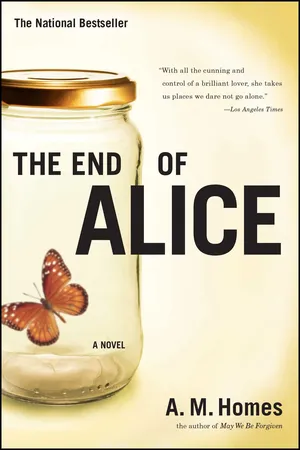
From the prizewinning author of May We Be Forgiven, a dark and twisting novel following the correspondence between a jailed pedophile and a nineteen-year-old woman asking for his help with her own unthinkable obsessions—a controversial yet unnervingly compelling story.
Only a work of such searing, meticulously controlled brilliance could provoke such a wide range of visceral responses. A dark, provocative, but utterly fascinating story, The End of Alice dives deep into the darkest corners of the human psyche. Following the correspondence between a seasoned pedophile imprisoned for horrific crimes and a nineteen-year-old following her own forbidden desires, the narrative blurs the line between confessor and accomplice. Through the voice of the jailed pedophile, the narrative weaves between his current state in prison, his memories of the horrifying acts he committed, and his letters of advice to the young woman with an obsessive appetite for prepubescent boys.
With Homes' sharp prose and fearless exploration of morality, this novel is an utterly captivating unraveling of chilling layers of manipulation, obsession, and secrets. Acclaimed for its unflinching honesty and controversial themes, The End of Alice challenges all to confront the uncomfortable.
Frequently asked questions
Yes, you can cancel anytime from the Subscription tab in your account settings on the Perlego website. Your subscription will stay active until the end of your current billing period. Learn how to cancel your subscription.
At the moment all of our mobile-responsive ePub books are available to download via the app. Most of our PDFs are also available to download and we're working on making the final remaining ones downloadable now. Learn more here.
Perlego offers two plans: Essential and Complete
- Essential is ideal for learners and professionals who enjoy exploring a wide range of subjects. Access the Essential Library with 800,000+ trusted titles and best-sellers across business, personal growth, and the humanities. Includes unlimited reading time and Standard Read Aloud voice.
- Complete: Perfect for advanced learners and researchers needing full, unrestricted access. Unlock 1.4M+ books across hundreds of subjects, including academic and specialized titles. The Complete Plan also includes advanced features like Premium Read Aloud and Research Assistant.
We are an online textbook subscription service, where you can get access to an entire online library for less than the price of a single book per month. With over 1 million books across 1000+ topics, weâve got you covered! Learn more here.
Look out for the read-aloud symbol on your next book to see if you can listen to it. The read-aloud tool reads text aloud for you, highlighting the text as it is being read. You can pause it, speed it up and slow it down. Learn more here.
Yes! You can use the Perlego app on both iOS or Android devices to read anytime, anywhere â even offline. Perfect for commutes or when youâre on the go.
Please note we cannot support devices running on iOS 13 and Android 7 or earlier. Learn more about using the app.
Yes, you can access The End Of Alice by A.M. Homes in PDF and/or ePUB format, as well as other popular books in Literature & Literature General. We have over one million books available in our catalogue for you to explore.
Information
ONE
Who is she that she should have this afflicted addiction, this oddly acquired taste for the freshest of flesh, to tell a story that will start some of you smirking and smiling, but that will leave others set afire determined this nightmare, this horror, must stop. Who is she? What will frighten you most is knowing she is either you or I, one of us. Surprise. Surprise.
And perhaps you wonder who am I to be running interference, to be acting as her translator and yours. Mine is the speech, the rhythm and rhyme of an old and peculiar man who has been locked away for too long, punished for pursuing a taste of his own.
Fair to say that I see in her the seeds of my youth and the memory of another girl I couldnât help but know.
Alice, I hand you her name gently, suggesting that if you hold it, carefully as I do, pressed close to the heart, you might at the end of this understand how confusing the beating of two such similar hearts can be and how one finally had to stop.
And by now, if you are anything at all, you know who I amâand find my disguise the silly childish senility of the long confined, of the good mind gone sour. But know, too, that as I tell you this, I feel like a contestant on Whatâs My Line; before me is my tribunal, the three members of the panel, blindfoldedâthat detail should cause some excitement in a few of you. They ask me questions about my profession. The audience looks directly at me and recognizing my visage from its halftone reproductions is entirely atitter. I am the first pervert, the first lover of youth, theyâve had on the show. I am honored. I am touched. When I think no one is looking, I touch myself.
And let it be said that I have the utmost admiration and respect for the young woman to be discussedâfor young women in general, the younger the better. Serving my sentence, I have become the chief correspondent, the conversant majora, in these matters. From near and far, by youth and beauty, and those not so fortunate, I am sought for my view, my sampling of these situations.
In the beginning, the words sent were often kept from me, the letters delivered opened and marked with long black passages, the jealous ink of my jailersâ heavy hand. It bothered them that I had fansâand I still doâbut at some point it was acknowledged, supported by research, that we are not a kind to operate in groups, tribes, or packs. We are not an organization, a political machine, we have no common goal and are therefore considered too diffuse, pathetic, and self-centered to cause a revolution. And so my mail began to arrive unencumbered, to simply be delivered, unopened, uninteresting. Then, too, over the course of time, my keepers have changed two, three, and four times, subject to varieties of administrations, the warming and cooling of the social climate, etc. And while I have largely been forgotten or dismissed by my keepersâno doubt due to my advancing ageâthe mail still arrives with astonishing regularity.
Unfortunately, I am not the correspondent I once was. I do read everything, but too often perhaps for some of you, I do not write back. I no longer feel that every question deserves an answer and can no longer afford to spend my pocket money on postage.
However, there are exceptions. What drew me to this particular offering, this large flat envelopeâI find significance in the page not folded, the document of such value that it cannot be tampered with, altered to fit through the thin slot of a mailbox, that its contents are of such import that they need be taken by hand to the postmaster and left in his care for quickest deliveryâwhat interested me about this well-typed tome was the willingness of its author to transcend, to flirt, outside her chosen category or group.
Among our kind what annoys me most is the unwillingness to explore, or even acknowledge, an attraction other than oneâs own. Weâlike the unafflictedâact as though our pleasure palace is superior, as though no other exists. This lack of appreciation for the larger world of activity causes a sadness in me that damn near ruins the whole thing. Why not celebrate the full range? That she, too, raised this question is perhaps near the root of my attraction to herâthat and the fact of her attraction to him, attraction to telling me, the way she reminded me of my beloved Alice. And to be honest, I donât get much mail from girls. I immediately write back a short introductory note: âMost interesting. Please do send a photograph of yourself as it would help me to understand better.â
She responds with a note of her own. âFuck photos. What are you, a pervert?â
Caught again. Returned to my humbleness, my place.
âYes, dear,â I jot back on a plain white card.
I had hoped that in a photograph of her I might find some part I could enjoy, some piece still a childâthere often is a little something left until one is well into the second or even third decade. Sometimes itâs just the chin, a bit of the neck, or the lobe of the ear. Sometimes there is one perfect sliver that has thus far gone unmarked. From that, I am able to go on, focusing on that place, that segment of youth, filling in the rest, whatever is needed, from my memory of how it once was. But now I am getting ahead of myself.
Call me old-fashioned in that my concentration here is on an arrangement that according to many of my peers has long since passed. My fellow esthetes in this great colony of philes insist that I am a classicist. I am interested in the coupling that throughout history has propagated the human race. I realize that for many the real interest, the contemporary current, is in what some consider the greatest refinement, the linkage of related parties either by marriage, familial bonds, or the nearness and dearness of the same sexâthe mind-bending adjustments, fascinating alterations, and gesticulations associated with the pairing of two like objects. But I ask that you bear with me, that you allow for this reconsideration of the more traditional of our species. All will not be lost.
She writes: The way you talk is so peculiarâdid you go to school in England? Or is it a speech impediment? One of my friends had to have a âtalking tutorâ all the way through high school.
I answer: University of Virginia, B.A., 1961. The speech impediment is an affectation.
Oh.
Before continuing I must also ask that you excuse the idiosyncrasies of my sound, of my thought, for I so rarely speak these days that all I do say seems to hurl itself forward, collecting references, attachments to both past and present as it goes. My access to society is limited, making what does filter through so much more dear, filled with import and meaning. I am often moved to tears, or worse, or more. Here, too, I could go on, I do go on, but it is best if we stick to the story at hand, that being hers not mine. Mine, all too familiar; mine, now a life of late nights in my room, cot against the wall, color television setâa gift from an anonymous admirerâon a distant chair, the spectral color wheel of light radiating across the white walls, throwing shadows into the stillness of night. Alone, I watch with the plug of a headphone pressed into my ear, and then sometimes I have companyâI share my set with Clayton, a Princeton boy cum murderer, well adjusted, having taken the prison fantasy to heart. We have cable here, stolen in from a wire in the wall, working well when the winds are right. The volume is kept low, lest the keepers hear our groans, our howls, our tears, and take the toy away. We sit perched on the edge of the cot and watch: Voyeur Vision, Nude Talk Show, Robyn Byrd, ads for outcalls, Dial 970-Peee (the extra e stands for extra pee), Chicks With Dicks. And lest I sound like a hypocrite, I am horrified, breathless. For the first time I feel my age, as weak bones and heartbreak. But I am drawn to these things, that is the nature of my disease, to be drawn to far too many things. And I am horrified and I am sad.
Prison. The bell rings. Upstate New Yorkâthe cornerstone reads 1897. My room, housed in a wing known only as West, has not been redecorated for ninety-seven years. Iâve been up for hours. There is no rest. I make notesâbeginning to feel that the clock is ticking faster, thereâs not much left for me. The bellsâpunctuation marks of the day. The bell rings and suddenly I am back. I am here, in prison, just as I was beginning to escape.
Morning count. I stand at the door, the gate to my cell. Halfway down I begin to hear the namesâsome days I hear as far as Wilson, but more often the sound comes in at either Stole or Kleinman. I hear their names, I know their crimes. Some days I think Kleinman should have gotten fifteen to twenty, and other days itâs five to ten. What makes me change my mind?
âJerusalem Stole,â the sergeant callsâthey are four doors down from me.
âItâs a mistakeâcall me Jerry,â Jerusalem answers.
I tuck my shirt in and attempt to pull myself together.
âFrazier,â the sergeant calls, and Frazier, my next-door neighbor, answers, âSo what about it?â
I stand ready. When my own name is called, I review myself, my crimes, and am strangely silent.
Again, the sergeant calls my name. He presses his face to the bars of my cell and asks, âEverything all right?â
I nod.
âHow come you donât answer?â
I shrug.
âYou got nothing to say?â His keys jingle. There are doors here, locks, that I believe serve no purpose at all. Trick doors. Fake doors, passageways that are roads to nowhere.
âWhat time is it?â I ask the sergeant.
Above the entrance to this place, and I saw it only once, twenty-three years ago, as I was coming in, above the entrance is a giant clock with only one hand.
âWhat time is it?â
âAinât it a shame,â the sergeant says, fitting his keys into the lock and undoing me. âItâs breakfast time.â
Wet eggs. Dry toast. Little bowls of cereal. Milk.
The girl. She is home for the summer, returned to her people after sophomore year at a prominent girlsâ college, whose name I will keep secret, to spare the institution the embarrassment or perhaps the pride, depending on which of the trustees you might ask. And while one can recognize the benefits of a single-sex education, the high pursuits of the few remaining such colleges, one rarely discusses the drawbacks, the demand that the body suspend its development, its inclinations, while the intellect is encouraged to grow. This lack of balance causes difficulties, a uniquely female disorder where the majority of physical evidence is displayed in strange postures (political, social, and sexual), a vicious and hostile lethargy, an attractive perplexity of the eye, and as has been reported a not entirely unpleasant kind of tingling sensation in the bodyâs more yielding spots.
From her letter it is clear that she has been looking for years, searching out the places where all variety and versions of her chosen kind are on display, where one can browse, where it is easy to shop unnoticed. She goes to the public parks that dot every town in America, the baseball diamonds/soccer fields where they frolic in the uniforms of youth and league. They trounce and trample each other, jumping one atop the other, hurling their light flesh against that of their friends, slapping and smacking each other as though nothing else matters, as though no one is looking, or cares.
She sits on the sidelines, cheerfully applauding. âGo, go, go,â she screams when the goal is made, when the bat strikes the ball and the player rounds third and heads for home.
She frequents those places where families congregateâzoos, circus performances, little puppet theatersâand watches them among their own, bickering over souvenirs and snacks, wrapping their plump palms and lips around fluffy spirals of falsely colored cotton candy, boxes of Cracker Jacks, helium balloons, felt pennants purchased for good little boys and girls. She can be found in amusement arcades and shopping malls where the fed-up, frustrated parents of these creatures deposit their offspring, as though this modern structure, this architecture of commerce and commercial intercourse, this building itself, were a well-trained baby-sitter.
In a case such as this where one has been looking so hard for so long, it is within the range of possibility that a buildup of ocular imaginings exaggerates the current draw so that the actual pressure within the eye from such frequent pupil dilation causes a discomfiture not unlike that found in other regions. At peak, it produces a kind of blindnessânearly classically hystericalâduring which she does not see what she is doing, giving birth, so to speak, to the notion that her grabbing of his flesh is simply a hand reaching out for direction.
Perhaps quite differently from how it has previously been presented, perhaps in truth this boy is her guide rather than her demon. I have long suspected that youth knows far more than the sugar-glazed gap between mind and body allows it to articulate.
Spring semester sucked, two incompletes to finish by July, otherwiseâacademic probation! A paper to write, twenty to thirty pages on âThe Criminal Personalityâ? Dare me to submit my own journal?
Wild with something, dunno what. Migraines. Aarrgghhh.
What do you do for fun in that place anyway?
On the sixth day following her return, the previous days spent in a state of deep tranquilization, a close-to-comatose, chain-reactive, biochemically linked readjustment period replete with headaches severe enough to warrant the use of prescription medication, the stunning, stoning combination of Fiorinal and Percocetâpass the bottle, dearâand the development of a full series of symptoms fully related to the life of a female nineteen-year-oldâanorexia, followed by gorging on motherâs good cooking, a bloating feeling, four tempers played against declarations of love, nausea, strange dreams buried in the sound sleep of oneâs own bed, diarrheaâthe closet cleaned and reorganized, still more of the unending supply of childhood remnants left in plastic bags at the end of the driveway for the Salvation Army to claim, purging.
âItâs the water. The change of water never agrees with you,â her mother says.
On the seventh day, she rose anew and carefully washed and clothed herself: a floral-based bath-and-shower gel was used in the morning ritual along with fresh mint toothpaste, a talcy deodorant balanced for the acidity of a womanâs sweatâsheâll grow into it yet, damn herâand also a dab of motherâs Chanel placed on the back of her spine just above the start of her ass crack. The minutiae of her ablutions not so much described as deduced by my own interpretation, my more personal understanding of her. I would also add that using a razor found in the shower, she did, taking care to lather first with motherâs moisturizing soap, shave her legs, her armpits, and as though a gift to me, the few odd and not quite pubic hairs on her inner thigh. Thank God for the accuracy, the clean sweep, of the double blade. She then slipped into her disguiseâa pair of oversize and out-of-style shorts and a shirt cast off by her fatherâwent down to the morning meal, and then, costumed for obscurity, set out to find her man.
The amount of nervousness generated by these proceedings, these thoughts about to become deeds, was enormous. When her mother asked in a lovely and lilting voice, âWhere are you going?â breaking the concentration, disturbing the frequency of the daughterâs thoughts, the obsessive-compulsive nature of her plan, her very movements, the child seemed to flicker and, for the portion of a second, to lose her mind entirely.
âSweetie,â her mother repeated, following the still youthful one as she walked back and forth, a carnivore suddenly trapped, her motherâs heels tap-dancing behind her. âI asked you, where are you going?â
Our hero turned to her mater and bellowed, âOut,â blowing the breath of ripe desire into her motherâs face. The mother, overwhelmed, stepped back as the daughter went quickly out the door, slamming the heavy wooden bottle stop, the gate to the tomb, behind her.
Outside. The great wide Westchester open held the clarity of a late-May morning. The flowers through the earth, buds coming to bloom, the New York State sky, clear and bright, the air neither warm nor cold, but just right, and the silence of the suburban streets spread thick like a woolen blanket muffling whatever sound or impulse might lurk just beneath.
Down and around she wound, figuring to take the long way, the way that was no way at all, figuring to seem as though she had no objective. To walk directly to his home, to stand at the foot of the drive, binoculars pointed at his bedroom window, would be so painfully obvious, so pathetically boring, so terribly devoid of pathos, of anticipation, of all that creates mood and memory, that it was unthinkable. And thank God that it would not even occur to her. Thank God her mind was subtle and cunning enough to not even entertain such stupidity. Forgive me now for even having mentioned it.
Her heart is full as she rounds the corner. His fatherâs castle is intact. The garage door stands open, she sees the toysâbicycles, sleds, skis, a canoeâthe very props of the charade, laid up against the interior wall. For each she can construct a scenario, a scene and manner in which sheâd like to see them used. She sees the family station wagon at rest, its bumpers clotted from the childishâhence unevenâapplication of what some might consider humor. If U Can Read This Then UR 2 Close; Drummers Do It to the Beat; Honk If You Like. . . . In a bustle of commotion, hurr and whir, the younger brother comes speeding down the drive on his âBig Wheelâ bike. Here I quote her directly, somewhat unsure of exactly what is described, but imagining something akin to a unicycle. She sees this little one but is neither amused nor interestedâtoo wiggly. She knows from having done a semesterâs work in a nursery project, having zipped and unzipped, pulled down and up so many pairs of pants, having witnessed up close the peculiarities of infantile privates in plumpest form. She would have to say that, while it is sweet, while it is tender, it is simply not enough; nothing more than the stuff of a lovely brooch, a modern sculpture to be worn by the envious have-nots. The cherubic cock and balls, like so many other miniatures, like the bony baby bird, better observed than ordered, better taken in from across the room than taken on oneâs own plate. And so she stood on the sidewalk ...
Table of contents
- Cover
- Dedication
- Chapter One
- Chapter Two
- Chapter Three
- Chapter Four
- Chapter Five
- Chapter Six
- Chapter Seven
- Chapter Eight
- Chapter Nine
- Chapter Ten
- Chapter Eleven
- Chapter Twelve
- Chapter Thirteen
- Chapter Fourteen
- Chapter Fifteen
- Chapter Sixteen
- Acknowledgments
- About A. M. Homes
- Copyright