Better Together
eBook - ePub

Better Together

Restoring the American Community

  1. 336 pages
  2. English
  3. ePUB (mobile friendly)
  4. Available on iOS & Android
eBook - ePub

Better Together

Restoring the American Community

About this book

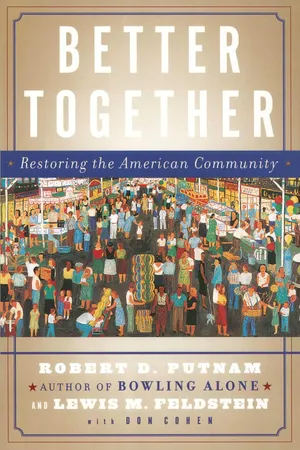
From the acclaimed author of Bowling Alone comes the story of people who are reweaving the social fabric across America by building local communities and revitalizing our civic spirit.

In his acclaimed book Bowling Alone, Robert Putnam describes the United States as a nation in which we have become increasingly disconnected from one another, where our social structures have disintegrated. He asks an important question: what can we do to end the atrophy of America’s civic vitality, and what can bring us together again?

Now, in Better Together, Putnam and Lewis Feldstein examine how people across the country are inventing new forms of social activism and community renewal. An arts program in Portsmouth, New Hampshire, brings together shipyard workers and their gentrified neighbors; a deteriorating, crime-ridden neighborhood in Boston is transformed by a determined group of civic organizers; an online community in San Francisco allows its members to connect with each other; in Wisconsin schoolchildren learn how to participate in the political process to benefit their town.

As our society grows increasingly diverse, it’s more important than ever to grow social capital, whether by traditional or more innovative means. The people profiled in Better Together are doing just that, and their stories illustrate the extraordinary power of social networks for enabling people to improve their lives and the lives of those around them.
Frequently asked questions

Yes, you can cancel anytime from the Subscription tab in your account settings on the Perlego website. Your subscription will stay active until the end of your current billing period. Learn how to cancel your subscription.
At the moment all of our mobile-responsive ePub books are available to download via the app. Most of our PDFs are also available to download and we're working on making the final remaining ones downloadable now. Learn more here.
Perlego offers two plans: Essential and Complete
  • Essential is ideal for learners and professionals who enjoy exploring a wide range of subjects. Access the Essential Library with 800,000+ trusted titles and best-sellers across business, personal growth, and the humanities. Includes unlimited reading time and Standard Read Aloud voice.
  • Complete: Perfect for advanced learners and researchers needing full, unrestricted access. Unlock 1.4M+ books across hundreds of subjects, including academic and specialized titles. The Complete Plan also includes advanced features like Premium Read Aloud and Research Assistant.
Both plans are available with monthly, semester, or annual billing cycles.
We are an online textbook subscription service, where you can get access to an entire online library for less than the price of a single book per month. With over 1 million books across 1000+ topics, we’ve got you covered! Learn more here.
Look out for the read-aloud symbol on your next book to see if you can listen to it. The read-aloud tool reads text aloud for you, highlighting the text as it is being read. You can pause it, speed it up and slow it down. Learn more here.
Yes! You can use the Perlego app on both iOS or Android devices to read anytime, anywhere — even offline. Perfect for commutes or when you’re on the go.
Please note we cannot support devices running on iOS 13 and Android 7 or earlier. Learn more about using the app.
Yes, you can access Better Together by Robert D. Putnam,Lewis Feldstein,Donald J. Cohen in PDF and/or ePUB format, as well as other popular books in Social Sciences & Social Theory. We have over one million books available in our catalogue for you to explore.

Information

CHAPTER 1
{ Rio Grande Valley, Texas }

Valley Interfaith
“The Most Dangerous Thing We Do Is Talk to Our Neighbors.”

In the early 1990s, teachers and administrators at the Palmer Elementary School in Pharr, Texas, began working with Valley Interfaith, a coalition of church and school groups, to organize parents and other area residents to improve the school. Pharr is in the Rio Grande Valley, not far from the Mexican border. Many of Palmer’s students came from “colonias” in the surrounding area—unincorporated communities of mainly Mexican Americans and Mexican immigrants, among the poorest localities in the poorest region in the United States at that time. Many colonias lacked even such basic residential services as electricity, sewers, and paved roads. The lack of adequate sewers forced the closing of the elementary school several days each year. Eighty-six percent of the students at Palmer were classified as economically disadvantaged; 58 percent had limited proficiency in English.1
Significantly, the teachers did not ask parents to come in to the school but made visits to students’ homes, asking parents about their hopes and worries regarding the school and their children. For many parents, it was their first real connection with the school, the first time anyone had bothered to ask their opinions. For the teachers, it was a first glimpse of their students’ lives outside school. In Valley Interfaith and School Reform, author Dennis Shirley quotes school principal Salvador Flores: “When we first started doing our home visits, some of the teachers would come back to the school crying when they saw the conditions that the children were living in.”2 These home visits, the face-to-face conversations between a teacher and a child’s parent or parents, gradually built up a group of parents who believed enough in the possibility of improving the schools (and believed enough in the goodwill of the teachers) to meet together to take the next step in organizing and planning. These were the parents who came to the small- and medium-sized gatherings known as house meetings organized by Valley Interfaith with and for the school.
The heart of a house meeting is when participants break into small groups of six to ten so they will all have a chance to express their concerns and listen to stories about what has brought them there, why they care enough to act. Later, the groups will describe the issues they discussed to the meeting as a whole and all will vote for what they consider the most important ones—part of the process of developing an action agenda to address the problems that matter most to the people affected by them.
In a small group at one of the Palmer Elementary house meetings, an older man who seemed restless and distracted while others talked interrupted a parent and launched into a tirade against the school district: how the people who worked for the district cared only about their next promotion, how they didn’t care if streets around the school were safe or if drug dealers prowled the neighborhood.3 It wasn’t the first time the man, Mr. Ortiz, had spoken out; he was raising his grandson and regularly launched into similar tirades at these meetings. The group leader tried to get him to talk more directly out of his and his grandson’s experience, but he went on in the same loud, angry style and then crossed his arms and turned away from the group, mumbling angrily to himself while others talked.
After a while, the leader addressed him: “It’s obvious that you’re angry about things at this school. I’m angry, too, because I want my daughter in special ed to get the services she needs but the district is cutting back. That’s why I’m here—to organize so we can make sure our kids succeed. Can you tell me a story about something that happened to make you so angry?”
For a moment, Mr. Ortiz stayed as he was, arms across his chest, body twisted in his chair. Then he dropped his arms and turned to face the group, his face softening. His voice, when he spoke, was different, too. This was a man speaking about the pain in his life. He told about his other grandson, the one who had been hit and killed by a car outside his elementary school five years earlier.
The group’s frustration and impatience with Mr. Ortiz melted away. They could see him as a man who had suffered a terrible loss and had had no way to express that pain except through his rage. Another member of the group who had not yet spoken said, “I’ve never lost a kid, but I know what that kind of being powerless feels like.” Then she told the story of her daughter, who had joined a gang. Mr. Ortiz looked at her and listened. He nodded when she said, “It’s too late for my daughter, but damned if I’m not going to do something so that other parents don’t have to go through that pain.”
Father Alfonso Guevara, pastor of Christ the King Church in Brownsville, Texas, and a longtime leader in Valley Interfaith, says, “We make private pain public.” The house meeting was part of the process, a step toward making the pain public in a local group to build the energy and commitment needed to bring that pain—and the actions needed to relieve it—to a wider public stage where officials would have to recognize it and respond.
Relational Organizing
It’s called relational organizing. The Southwest Industrial Areas Foundation network, of which Valley Interfaith is a part, builds its membership through one-on-one conversations and at house meetings like the one Mr. Ortiz attended. Catalina Mendiola, a local organizer, says, “The heart of our work is one-on-one meetings with people. Organizing is all about building relationships. It’s not about meetings. These are not counseling sessions. They are not an interview. It’s a conversation. You’re building a relationship here. Not extracting information. Not pushing an agenda. And the only way to do this is to leave yourself open to be changed by the conversation.”4 Unlike activist organizations that develop a public agenda first and then try to attract people who support it, the IAF encourages the emergence of local agendas from these conversations. Similarly, it allows each organization in the network to develop its state or regional agenda; it does not impose one from above. The IAF’s power to make progress on the issues it takes up resides in the relationships. Although people come together because they have similar concerns, building relationships is the first priority, the foundation for defining and acting on public issues that represent an accumulation of personal and local concerns. The professional organizers who work for the IAF organizations see their primary job as finding and training the leaders in the community who will develop a following to devise and carry out the organization’s agenda. The “Iron Rule” of the Industrial Areas Foundation is “Never do anything for anybody that they can do for themselves.”
The Texas Industrial Areas Foundation originated in the Industrial Areas Foundation movement created in Chicago in 1940 by reformer Saul Alinsky. (The name, which survives in organizations that have few or no industrial workers as members, refers to the Chicago industrial areas where the work began.) Alinsky believed that reform could best be achieved when the citizens of poor and neglected communities organized and exerted power on their own behalf. He saw doing for others as less effective and as a kind of welfare colonialism. The inability of these citizens to accomplish much previously, he was convinced, stemmed from their isolation, not from any lack of intelligence, skill, or desire for a better life. Alinsky’s idea shapes and motivates the Industrial Areas Foundation organizations of the twenty-first century.5 At present, more than sixty IAF organizations representing more than one thousand institutions and a million families are active in the United States and the United Kingdom.6
Ernesto CortĂ©s, Jr., brought the IAF concept to Texas, beginning with his native San Antonio. CortĂ©s had had organizing experience with the United Farm Workers in the Rio Grande Valley when he went to Chicago for leadership training with IAF organizers there in 1971. After that training and a year of organizing with the IAF in several northern cities, he returned to San Antonio in 1974 to apply and adapt what he had learned. Through hundreds of one-on-one conversations with community figures from the mainly working-class Mexican-American West Side of San Antonio, he learned about local problems while establishing personal relationships with members of the community. CortĂ©s worked closely with church congregations, rooting his organization in the networks and values of those institutions—an innovation that made it possible to tap into well-established ties of trust and mutual interest, as well as shared religious beliefs that supported justice and social action. Professional and lay leaders in the churches drew other members of their congregations into the conversation about local needs, forming groups large enough to get the attention of local politicians.
Those organizing efforts in parts of San Antonio that had largely been ignored by city government led to some early local successes: the installation of pollution controls to reduce the noxious fumes of a hide-processing plant, a footbridge over a drainage canal, traffic lights at some dangerous intersections. The neighborhood accomplishments and the continued work of CortĂ©s and activist clergy led to the creation of Communities Organized for Public Service (COPS), a movement based on two dozen churches in San Antonio organized to respond to problems that affected the whole area—problems having to do with drainage, parks, and libraries, for example—that could not be addressed one parish at a time.7 The first IAF organization in Texas, COPS is still thriving and effective more than twenty-five years later. In 1978, a second IAF group was founded in Houston, the Metropolitan Organization, a network of thirty-two churches. In 1982, Valley Interfaith came into existence.
Over the past twenty-five years, Texas IAF organizations, individually and as a statewide network, have improved underperforming schools and created effective job-training programs, helped direct hundreds of millions of state and federal dollars to infrastructure improvements in neglected parts of Texas cities and the small colonias in the Rio Grande Valley, and helped pass living-wage laws and health-care regulations. The network now represents about half a million Texans.
In training programs, in conversation, and in his writings, CortĂ©s emphasizes participation, relationships, and “relational power.” He argues that we are social beings, defined by our relationships with other people—with “family and kin, but also with less familiar people with whom we engage in the day-to-day business of living our lives in a complicated society.” Without organizations that connect people to political power and public participation, these broader social relations “disintegrate.” “There is no time and energy for collaboration,” he writes, “no reciprocity, no trust—in short, no social capital.”8 The IAF strives to rebuild or replace some of the lost networks of relationships—lost social capital—organizing in churches and schools “to reconnect these critical institutions around a vibrant culture of relational one-on-one and small-group conversations.”9
Getting individuals to articulate their needs and the possibilities they see and creating relationships that knit individuals into powerful groups is the core of the IAF’s work. CortĂ©s lays out the principles underlying the organization’s methods in his response to a college student who asked what “motivates people to support a cause with actions as well as words”:
When I hear your question, what I think you’re really saying is, “How can I convince people to do what’s good? How do I get them to do what’s right? How do I get them to follow my agenda?” That’s not organizing. What I mean by organizing is getting you to recognize what’s in your best interest. Getting you to recognize that you have a child, that you have a career and a life to lead, and that there are some things that are obstacles to the quality of your life. I need to get you to see how you can affect those things through relationships with other people.10
If the people who live on the West Side of San Antonio or in the unincorporated colonias of the Rio Grande Valley see their first priority as getting paved streets and drainage, that becomes the primary action item on the local agenda. If the parents of schoolchildren in an elementary school in Austin worry most about the dangers their children face crossing busy streets near the school, then getting a stop sign installed or a traffic pattern changed will be their first goal. Other aims and actions may follow, once they experience their collective power. “Winning creates imagination,” says Sister Judy Donovan, leading organizer of Valley Interfaith. “Once they see they can get a stop sign, they start thinking about what might be done in the school.” Successful action gives people lessons in their own power.
Member after member of Valley Interfaith recalls the same two victories as moments when they truly understood what their collective efforts could accomplish, banishing their old feelings of powerlessness. One was the passage of a half-cent increase in sales tax that politicians had previously tried and failed to pass. Valley Interfaith agreed to work for passage in exchange for a commitment that roughly 30 percent of the tax revenue would go to support the organization’s family-friendly agenda. “We went out and did house meetings,” says Joe Hinojosa. “We negotiated for weeks with the city to get agreement on where the money would go before we agreed to support it.”11 The other was the drive to change political representation in McAllen from at-large commissioners to single-district commissioners, a modification that would open the door for representatives who were not part of the all-white elite that had governed the city for many years. Those involved saw the victories not only as important in themselves but as revelations of what was possible.
The group had to overcome the charge that they were radicals. “We had this mayor for twenty years—Othal Brand—who used to throw us out of city council meetings. He said we were too radical, that we were communists, dangerous. . . .Yeah, the issue still comes up some, but he’s gone now, and we have won single-district commissioners,” says Hinojosa. “The most dangerous thing we do is talk to our neighbors.”12
There is nothing abstract about the issues they take on, or the events that motivate them. Father Bart Flaat, pastor of St. Joseph the Worker and a longtime Valley Interfaith leader, describes going to bless the house of a parishioner during his first months in McAllen, a city near the midpoint of the highway that crosses the Rio Grande Valley east to west and about ten miles from the Mexican border. After the short ceremony, the family asked him to visit a sick neighbor. Entering the house next door, he found a woman with a high fever and an injured leg that was obviously gangrenous. Why didn’t she go to the doctor? he asked her. She could lose her leg or even her life if the leg wasn’t treated soon. She told him that even a doctor in Mexico would cost forty dollars, money she did not have. Enraged at the idea of this woman losing her leg for lack of forty dollars, he gave her the money himself. The woman’s plight was no isolated case. Finding people in his congregation concerned about the unavailability of health care, Father Bart began working with them and Valley Interfaith to get a free clinic built in the area. Four years later the clinic opened.
Relationship-building is a way of looking at the world, not just a strategy. The IAF Alliance Schools initiative has procured money for physical improvements in schools, for in-school clinics, and for changes in the school day (toward block classes rather than shorter class periods, for instance); but as in the case of Palmer Elementary, the core of its school-improvement efforts has been building relationships: between the school and the community; between students and teachers. Relationships are not just the engine of reform, they are one of the goals of reform. So, for instance, Houston’s Metropolitan Organization worked with teachers and parents at Jefferson Davis High School to introduce block scheduling in the school, the longer classes meaning more effective teaching and more opportunities for teachers and students to get to know one another, to have genuine relationships. As Dennis Shirley points out, the IAF organizations see schools, and learning, as embedded in the community, not as isolated institutions that can be fixed by applying the latest philosophy of teaching.13 Unsurprisingly, the document in which the Texas IAF describes its vision for public schools is subtitled “Communities of Learners.”14
Two IAF job-training programs, Project QUEST (Quality Employment Through Skills Training) in San Antonio and VIDA (Valley Initiative for Development and Advancement) in the Rio Grande Valley, use relationship building to bring potential employers into the process. Before enrolling trainees, IAF leaders negotiate with employers to get their commitment to hire the individuals who successfully complete the program. The employer promises good jobs with good pay; QUEST and VIDA agree to deliver well-trained, productive workers. Thus the interests of both sides are served.
Similarly, the IAF maintains working relationships even with politicians who often disagree with its aims. The organization exerts public pressure on politicians, notably at “accountability sessions,” highly ritualized performances in which each politician has a minute or two at most to tell a hallful of voters whether or not he or she supports the IAF agenda. The IAF plays hardball. But it also works to develop solutions, not just voice grievances. Through “research actions,” members educate themselves in the political, legal, and budgetary details of their issues, in part to know where to exert pressure, but also to be able to offer officials practical plans. The accountability session is only one moment in an ongoing relationship. Public commitment by the politicians comes after long conversations with up to a dozen IAF leaders to hash out the issues. The relationship continues after the session, not only because the IAF keeps an eye on the politicians but because it works with them to turn verbal commitment into action. “No permanent allies, no permanent enemies” is a core principle. The organization neither endorses nor opposes candidates but works with whoever can help it achieve its goals. The IAF has built relationships not only with outside individuals and groups but between outside groups. In 1998, when the Texas Water Development Board withheld $100 million in funding because it judged that Hidalgo County was n...

Table of contents

  1. Cover Page
  2. Title Page
  3. Copyright Page
  4. Dedication
  5. Contents
  6. Acknowledgments
  7. Introduction
  8. Chapter 1 Valley Interfaith: “The Most Dangerous Thing We Do Is Talk To Our Neighbors.”
  9. Chapter 2 Branch Libraries: The Heartbeat Of The Community
  10. Chapter 3 The Shipyard Project: Building Bridges With Dance
  11. Chapter 4 The Dudley Street Neighborhood Initiative: Grass Roots In The City
  12. Chapter 5 The Tupelo Model: Building Community First
  13. Chapter 6 Saddleback Church: From Crowd To Congregation
  14. Chapter 7 Do Something: Letting Young People Lead
  15. Chapter 8 The Harvard Union Of Clerical And Technical Workers: “The Whole Social Thing”
  16. Chapter 9 Experience Corps: Bringing “Old Heads” To The Schools
  17. Chapter 10 Ups: Diversity And Cohesion
  18. Chapter 11 Craigslist.Org: Is Virtual Community Real?
  19. Chapter 12 Portland: A Positive Epidemic Of Civic Engagement
  20. Conclusion: Making Social Capital Work
  21. Notes
  22. Index