
- 200 pages
- English
- ePUB (mobile friendly)
- Available on iOS & Android
eBook - ePub
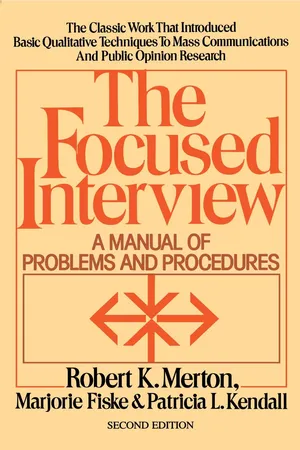
Focused Interview
About this book
A reissue of the classic report of Columbia's Bureau of Applied Social Research, outlining techniques for eliciting specific responses of individuals and groups to particular events and situations. The 1956 edition of this book may be regarded as seminal within sociology, spawning a whole field of qualitative opinion research that has continued to evolve through half a century of inquiry. This is a reissue of the book, with a new preface by Merton, a select bibliography of writings on the focused interview and focus group research, and a new introduction that traces the diffusion of Merton's technique from sociology to other fields, including history, psychology, mass media and marketing research.
Frequently asked questions
Yes, you can cancel anytime from the Subscription tab in your account settings on the Perlego website. Your subscription will stay active until the end of your current billing period. Learn how to cancel your subscription.
No, books cannot be downloaded as external files, such as PDFs, for use outside of Perlego. However, you can download books within the Perlego app for offline reading on mobile or tablet. Learn more here.
Perlego offers two plans: Essential and Complete
- Essential is ideal for learners and professionals who enjoy exploring a wide range of subjects. Access the Essential Library with 800,000+ trusted titles and best-sellers across business, personal growth, and the humanities. Includes unlimited reading time and Standard Read Aloud voice.
- Complete: Perfect for advanced learners and researchers needing full, unrestricted access. Unlock 1.4M+ books across hundreds of subjects, including academic and specialized titles. The Complete Plan also includes advanced features like Premium Read Aloud and Research Assistant.
We are an online textbook subscription service, where you can get access to an entire online library for less than the price of a single book per month. With over 1 million books across 1000+ topics, weâve got you covered! Learn more here.
Look out for the read-aloud symbol on your next book to see if you can listen to it. The read-aloud tool reads text aloud for you, highlighting the text as it is being read. You can pause it, speed it up and slow it down. Learn more here.
Yes! You can use the Perlego app on both iOS or Android devices to read anytime, anywhere â even offline. Perfect for commutes or when youâre on the go.
Please note we cannot support devices running on iOS 13 and Android 7 or earlier. Learn more about using the app.
Yes, you can access Focused Interview by Robert K. Merton in PDF and/or ePUB format, as well as other popular books in Social Sciences & Marketing. We have over one million books available in our catalogue for you to explore.
Information

Nature of the Focused Interview
The focused interview differs in several respects from other types of research interview which might appear similar at first glance. In broad outline, its distinguishing characteristics are as follows. First of all, the persons interviewed are known to have been involved in a particular situation: they have seen a film, heard a radio program, read a pamphlet, article or book, taken part in a psychological experiment or in an uncontrolled, but observed, social situation (for example, a political rally, a ritual or a riot). Secondly, the hypothetically significant elements, patterns, processes and total structure of this situation have been provisionally analyzed by the social scientist. Through this content or situational analysis, he has arrived at a set of hypotheses concerning the consequences of determinate aspects of the situation for those involved in it. On the basis of this analysis, he takes the third step of developing an interview guide, setting forth the major areas of inquiry and the hypotheses which provide criteria of relevance for the data to be obtained in the interview. Fourth and finally, the interview is focused on the subjective experiences of persons exposed to the pre-analyzed situation in an effort to ascertain their definitions of the situation. The array of reported responses to the situation helps test hypotheses and, to the extent that it includes unanticipated responses, gives rise to fresh hypotheses for more systematic and rigorous investigation.
From this synopsis it will be seen that a distinctive prerequisite of the focused interview is a prior analysis of the situation in which subjects have been involved. Such foreknowledge of the situation is clearly at an optimum in the case of experimentally contrived situations, although it can be acquired also in uncontrolled, but observed, situations. Equipped in advance with an analysis of the situation, the interviewer can readily distinguish the objective facts of the case from the subjective definitions of the situation. He is thus alerted to the patterns of selective response. Through his familiarity with the objective situation, the interviewer is better prepared to recognize symbolic or functional silences, distortions, avoidances, or blockings and is, consequently, better prepared to explore their implications. The prior analysis thus helps him to detect and to explore private logics, symbolism and spheres of tension. It helps him gauge the importance of what is not being said, as well as of what is being said, in successive stages of the interview.
Finally, prior content or situational analysis facilitates the flow of concrete and detailed reporting of responses. Summary generalizations by the interviewee mean that he is presenting, not the raw data for interpretation, but the interpretation itself. It is not enough to learn that an interviewee regarded a situation as âunpleasantâ or âanxiety-provokingâ or âstimulatingââsummary judgments which are properly suspect and, moreover, consistent with a variety of interpretations. The aim is to discover more precisely what âunpleasantâ denotes in this context, which concrete feelings were called into play, which personal associations came to mind. Furthermore, when subjects are led to describe their reactions in great detail, there is less prospect that they will, intentionally or unwittingly, conceal the actual character of their responses.
The interviewer who has previously analyzed the situation on which the interview focuses is in a peculiarly advantageous position to elicit such detail. In the usual depth interview, one can encourage informants to reminisce about their experiences. In the focused interview, the interviewer can play a more active role; he can introduce more explicit verbal cues to the stimulus situation or even re-present it, as we shall see. In either case, this ordinarily activates a concrete report of responses by interviewees.
Uses of the Focused Interview
The focused interview was initially developed to meet certain problems growing out of communications research and propaganda analysis. The outlines of such problems appear in detailed case studies by Dr. Herta Herzog, dealing with the gratification found by listeners in various types of radio programs.1 With the sharpening of objectives, research interest centered on the analysis of responses to particular pamphlets, radio programs, and motion pictures. During the war, Dr. Herzog and the senior author of this manual were assigned by several war agencies to study the social and psychological effects of specific efforts to build morale. In the course of this work, the focused interview was progressively developed to a relatively standardized form.
In the beginning, the primary, though not the exclusive, purpose of the focused interview was to provide some basis for interpreting statistically significant effects of mass communications. But, in general, experimental studies of effects, and inquiries into patterned definitions of social situations might well profit by the use of focused interviews in research. The character of such applications can be briefly illustrated by examining the role of the focused interview at four distinct points:
1. specifying the effective stimulus;
2. interpreting discrepancies between anticipated and actual effects;
3. interpreting discrepancies between prevailing effects and effects among subgroupsââdeviant casesâ;
4. interpreting processes involved in experimentally induced effects.
1. Experimental studies of effect face the problem of what might be called the specification of the stimulus, i.e., determining which x or patterns of xâs in the total stimulus situation led to the observed effects. But, largely because of the practical difficulties which it entails, this requirement is often not satisfied in psychological or sociological experiments. Instead, a relatively undifferentiated complex of factorsâsuch as âemotional appeals,â âcompetitive incentives,â and âpolitical propagandaââis regarded as âtheâ experimental variable. This would be comparable to the statement that âliving in the tropics is a cause of higher rates of malariaâ; it is true but unspecific. However crude they may be at the outset, procedures must be devised to detect the causally significant aspects of the total stimulus situation. Thus Gosnell conducted an ingenious experiment on the âstimulation of voting,â in which experimental groups of residents in twelve districts in Chicago were sent âindividual nonpartisan appealsâ to register and vote.2 Roughly equivalent control groups did not receive this literature. It was found that the experimental groups responded by a significantly higher proportion of registration and voting. But what does this result demonstrate? Was it the nonpartisan character of the circulars, the explicit nature of the instructions which they contained, the particular symbols and appeals utilized in the notices, or what? In short, to use Gosnellâs own phrasing, what were âthe particular stimuli being testedâ?
According to the ideal experimental design, such questions would, of course, be answered by a series of successive experiments, which test the effects of each pattern of putative causes. In practice not only does the use of this procedure in social experimentation involve prohibitive problems of cost, labor, and administration; it also assumes that the experimenter has managed to detect the pertinent aspects of the total stimulus pattern. The focused interview provides a useful near-substitute for such a series of experiments; for, despite great sacrifices in scientific exactitude, it enables the experimenter to arrive at plausible hypotheses concerning the significant items to which subjects responded. Through interviews focused on this problem, Gosnell, for example, could probably have arrived at testable hypotheses about the elements in his several types of ânonpartisanâ materials which proved effective for different segments of his experimental group.3 Such a procedure provides an approximate solution for problems4 heretofore consigned to the realm of the unknown or the speculative, and provides for further and more sharply focused experiments.
2. There is also the necessity for interpreting the effects which are found to occur. Quite frequently, for example, the experimenter will note a discrepancy between the observed effects and those anticipated on the basis of other findings or previously formulated theories. Or, again, he may find that one subgroup in his experimental population exhibits effects which differ in degree or direction from those observed among other parts of the population. Unless the research is to remain a compendium of unintegrated empirical findings, some effort must be made to interpret such âcontradictoryâ results. But the difficulty here is that of selecting among the wide range of post factum interpretations of the deviant findings. The focused interview provides a tool for this purpose. For example:
Rosenthalâs study of the effect of âpro-radicalâ motion-picture propaganda on the socioeconomic attitudes of college students provides an instance of discrepancy between anticipated and actual effects.5 He found that a larger proportion of subjects agreed with the statement âradicals are enemies of societyâ after they had seen the film. As is usually the case when seemingly paradoxical results are obtained, this called forth an âexplanationâ: âThis negative effect of the propaganda was probably due to the many scenes of radical orators, marchers, and demonstrators.â
Clearly ad hoc in nature, this âinterpretationâ is little more than speculation; but it is the type of speculation which the focused interview is particularly suited to examine, correct, and develop. Such interviews would have indicated how the audience actually responded to the âorators, marchers, and demonstratorsâ; the authorâs conjecture would have been recast into theoretical terms and either confirmed or refuted. (As we shall see, the focused interview has, in fact, been used to locate the probable source of such âboomerang effectsâ in film, radio, pamphlet, and cartoon propaganda.) 6
In a somewhat similar experiment, Peterson and Thurstone found an unexpectedly small change in attitudes among high-school students who had seen a pacifist film.7 The investigators held it â. . . probable that the picture, âJourneyâs End,â is too sophisticated in its propaganda for high school children.â
Once again, the plausibility of a post factum interpretation would have been enhanced, and entirely different hypotheses would have been developed had they conducted a focused interview.8 How did the children conceive the film? To what did they primarily respond? Answers to these and similar questions would yield the kind of data needed to interpret the unanticipated result.
3. We may turn again to Gosnellâs study to illustrate the tendency toward ad hoc interpretations of discrepancies between prevailing effects and effects among subgroups (âdeviant casesâ) and the place of focused interviews in avoiding them.
Gosnell found that, in general, a larger proportion of citizens registered or voted in response to a notice âof a hortatory character, containing a cartoon and several slogansâ than in response to a âfactualâ notice, which merely called attention to voting regulations. But he found a series of âexceptions,â which invited a medley of ad hoc hypotheses. In a predominantly German election district, the factual notice had a greater effect than the âcartoon noticeââa finding which at once led Gosnell to the supposition that âthe word âslackerâ on the cartoon notice probably revived war memories and therefore failed to arouse interest in voting.â In Czech and Italian districts the factual notices also proved more effective; but in these instances Gosnell advances quite another interpretation: âthe information cards were more effective than the cartoon notices probably because they were printed in Czech [and Italian, respectively] whereas the cartoon notices were printed in English.â And yet in a Polish district the factual notice, although printed in Polish, was slightly less effective than the cartoon notice.9
In short, lacking supplementary interviews focused on the problem of deviant group responses, the investigator found himself drawn into a series of self-generated conjectures instead of deriving tentative interpretations from intervieweesâ reports of actual experience. This characteristic of the Gosnell experiment, properly assessed by Catlin as an exceptionally well-planned study, is, a fortiori, found in a host of social and psychological experiments.
4. Even brief introspective interviews as a supplement to experimentation have proved useful for discerning processes involved in experimentally induced effects. Thus Zeigarnik, in her well-known experiment on memory and interrupted tasks, was confronted with the result that in some cases interrupted tasks were often forgotten, a finding at odds with her modal findings and her initial theory.10 Interviews with subjects exhibiting this âdiscrepantâ behavior revealed that the uncompleted tasks which had been forgotten were experienced as failures and, therefore, were subjectively âcompleted.â She was thus able to incorporate this seeming contradiction into her general theory. The value of such interpretative interviews is evidenced further in the fact that Zeigarnikâs extended theory, derived from the interviews, inspired a series of additional experiments by Rosenzweig, who, in part, focused on the very hypotheses which emerged from her interview data.
Rosenzweig found experimentally that many subjects recalled a larger percentage of their successes in tasks assigned them than of their failures.11 Interviews disclosed that this âobjective experimental resultâ was bound up with the personal symbolism which tasks assumed for different subjects. For example, one subject reported that a needed scholarship depended âupon her receiving a superior grade in the psychology course from which she had been recruited for this experiment. Throughout the test her mind dwelt upon the lecturer in this course: âAll I thought of during the experiment was that it was an intelligence test and that he [the lecture...
Table of contents
- Cover
- Dedication
- Foreword by Albert E. Gollin
- Introduction to the Second Edition by Robert K. Merton
- Chapter I: Purposes and Criteria
- Chapter II: Retrospection
- Chapter III: Range
- Chapter IV: Specificity
- Chapter V: Depth
- Chapter VI: Personal Contexts
- Chapter VII: The Group Interview
- Chapter VIII: Selected Problems
- Selected Bibliography
- Index
- Footnotes
- Copyright