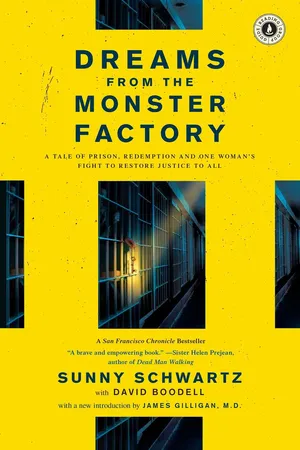
Dreams from the Monster Factory
eBook - ePub

Dreams from the Monster Factory

A Tale of Prison, Redemption, and One Woman's Fight to Restore Justice to All

  1. 224 pages
  2. English
  3. ePUB (mobile friendly)
  4. Available on iOS & Android
eBook - ePub

Dreams from the Monster Factory

A Tale of Prison, Redemption, and One Woman's Fight to Restore Justice to All

About this book

Dreams from the Monster Factory tells the true story of Sunny Schwartz's extraordinary work in the criminal justice system and how her profound belief in people's ability to change is transforming the San Francisco jails and the criminals incarcerated there. With an immediacy made possible by a twenty-seven-year career, Schwartz immerses the reader in the troubling and complex realities of U.S. jails, the monster factories -- places that foster violence, rage and, ultimately, better criminals. But by working in the monster factories, Schwartz also discovered her dream of a criminal justice system that empowers victims and reforms criminals.

Charismatic and deeply compassionate, Sunny Schwartz grew up on Chicago's south side in the 1960s. She fought with her family, struggled through school and floundered as she tried to make something of herself. Bucking expectations of failure, she applied to a law school that didn't require a college degree, passed the bar and began her life's work in the criminal justice system. Eventually she grew disheartened by the broken, inflexible system, but instead of quitting, she reinvented it, making jail a place that could change people for the better.

In 1997, Sunny launched the Resolve to Stop the Violence Project (RSVP), a groundbreaking program for the San Francisco Sheriff 's Department. RSVP, which has cut recidivism for violent rearrests by up to 80 percent, brings together victims and offenders in a unique correctional program that empowers victims and requires offenders to take true responsibility for their actions and eliminate their violent behavior.

Sunny Schwartz's faith in humanity, her compassion and her vision are inspiring. In Dreams from the Monster Factory she goes beyond statistics and sensational portrayals of prison life to offer an intimate, harrowing and revelatory chronicle of crime, punishment and, ultimately, redemption.
Frequently asked questions

Yes, you can cancel anytime from the Subscription tab in your account settings on the Perlego website. Your subscription will stay active until the end of your current billing period. Learn how to cancel your subscription.
No, books cannot be downloaded as external files, such as PDFs, for use outside of Perlego. However, you can download books within the Perlego app for offline reading on mobile or tablet. Learn more here.
Perlego offers two plans: Essential and Complete
  • Essential is ideal for learners and professionals who enjoy exploring a wide range of subjects. Access the Essential Library with 800,000+ trusted titles and best-sellers across business, personal growth, and the humanities. Includes unlimited reading time and Standard Read Aloud voice.
  • Complete: Perfect for advanced learners and researchers needing full, unrestricted access. Unlock 1.4M+ books across hundreds of subjects, including academic and specialized titles. The Complete Plan also includes advanced features like Premium Read Aloud and Research Assistant.
Both plans are available with monthly, semester, or annual billing cycles.
We are an online textbook subscription service, where you can get access to an entire online library for less than the price of a single book per month. With over 1 million books across 1000+ topics, we’ve got you covered! Learn more here.
Look out for the read-aloud symbol on your next book to see if you can listen to it. The read-aloud tool reads text aloud for you, highlighting the text as it is being read. You can pause it, speed it up and slow it down. Learn more here.
Yes! You can use the Perlego app on both iOS or Android devices to read anytime, anywhere — even offline. Perfect for commutes or when you’re on the go.
Please note we cannot support devices running on iOS 13 and Android 7 or earlier. Learn more about using the app.
Yes, you can access Dreams from the Monster Factory by Sunny Schwartz,David Boodell in PDF and/or ePUB format, as well as other popular books in Social Sciences & Social Science Biographies. We have over one million books available in our catalogue for you to explore.

CHAPTER 1

1980
Jails are about doors. You wait for them to open. You wait for them to close. There is nothing subtle about a jail door. It rumbles and clangs like a death knell. You don’t open them yourself. Others decide whether you come in or go out.
I was waiting at Post 5, outside Mainline, the processing center for anyone arrested in San Francisco County. I was shoving my ID up to a window so that the annoyed-looking deputy sheriff could flip the switch and let me in. I was beginning to grow angry at how long the deputy was taking when an electrical buzzing shriek cut through my thoughts and the door shuddered open.
A wave of noise crashed over me, quickly followed by a rancid smell of ammonia and body odor. I stepped out onto the tier. Mainline was like a zoo, except uglier than any zoo I’d ever been to. Huge cages framed the long corridor in front of me, which stretched out the length of a football field. Every cage was filled with men wearing jail-issue orange—orange pants, orange T-shirts, orange sweatshirts, orange flip-flops or canvas shoes. A few prisoners wandered the corridor. They were workers with special privileges, allowed to be out of the tanks when going to or from their jobs. Half the cages were open dormitories filled with bunk beds; the other half were lined with two-man cells. The echoing of angry voices was deafening. There was nothing to absorb or interrupt the noise. Shouts and shrieks banged off bulletproof glass, steel bars and cinder blocks. There were probably four hundred prisoners in the jail that day. I was the only woman in sight. This was my first day of work.
I’d been hired as a legal intern for the San Francisco Prisoner Legal Services unit. There were eight of us: five men and three women. The interns handled legal issues for prisoners for eveything but the crimes that had brought them to jail in the first place. They had their public defender for that. My colleagues and I spread out through the jails every day, going wherever we were assigned or needed. If a prisoner was accused of a rule violation in the jail, or if he wanted to accuse a deputy sheriff of harassment, or if he was getting evicted from the apartment where he lived, or if he was losing custody of his children, he talked to me or one of my colleagues. The legal interns were the catchall. I wasn’t a lawyer, none of us were, but I was supposed to function like one.
I was twenty-six years old, had barely made it through high school and didn’t have a college degree. I’d never been in a jail before, and had one day of training, which consisted of being told how to use the phones and how to file paperwork. I was told repeatedly not to give the prisoners gum because they’d use it to jam the locks, but I received no training on what to do if someone turned violent. I was handed a box of pens and a legal pad and told, in essence, to go save lives. ā€œWildly unpreparedā€ would be the polite way of describing how I felt.
I’d been warned about walking Mainline my first day. Rita, a colleague I’d met during training, compared it to being a sheep in a pack of wolves. She’d recommended that I present my request at the front office and meet the prisoner in an interview room, at least until I got the hang of things. But I wanted to prove that I was strong enough to stare down the monsters without flinching. I was curious, too, wondering if the men were as scary as I’d heard.
The men crowded to the front of their tanks to watch me when I stepped onto the tier. The few inmate workers in the hall stopped in place and turned toward me, as if they were a compass and I was due north. The noise receded for a second, then there was an explosion of voices.
ā€œOooh baby, come over here. I won’t hurt you.ā€
ā€œHey, baby. What’s the matter, you get lost?ā€
ā€œCome here, I need some smokes.ā€
ā€œHey, little girl, I got something you could smoke.ā€
Some of the men smiled, some made a meal of me with their eyes, a few just stood there with pitiful looks, like little children trapped in men’s bodies.
With each step, a jolt of fear coursed through me. But I was also growing angry. I singled out a jeering kid on my left, walked up to him and barked, ā€œAre you addressing me? Do you need something?ā€
I surprised him. His face went blank. I went up to the bars. ā€œIf you whistle at me again, I will hurt you like a dog. How would you feel if your mother was walking down these tiers and she was treated like this?ā€
The guy’s voice barely slipped out of him. ā€œUh, um, I dunno.ā€ His eyes were wide. The others were watching. I could see some were smiling, taking my measure.
I was there to interview my first client. His name was Martin Aguerro. I’d been handed his file with a pile of others that morning. His seemed like the most interesting case and so here I was, ready to work. I returned to Post 5 and told the deputy I wanted to interview Aguerro. He rolled his eyes at me. This was the second deputy sheriff I’d talked to and the second set of rolled eyes, and it was pissing me off. Moving at a glacial pace, he checked his books, got on the phone, and after a few grunts, hung up and said, unceremoniously, ā€œNo.ā€
ā€œWhat do you mean no?ā€
ā€œJust what I said. No.ā€ He crossed his arms.
I expected to fight with the prisoners, but I hadn’t expected to fight the deputies, too. ā€œFirst of all, he filed a claim,ā€ I said through clenched teeth. ā€œThe only way to follow up on the claim is to meet the guy. Why can’t I see him?ā€
ā€œI’m just doing what I’m told, lady. They tell me he’s too dangerous. You can’t see him without a two-deputy security complement and I don’t have the staff right now.ā€
I knew the deputy was giving me the ā€œweak girlā€ assessment. I didn’t look older than my twenty-six years, but I was no Twiggy. I was five feet nine, solid and could handle myself. After all, I had two older brothers whose idea of nurturing was an unceasing flurry of full nelsons and charley horses. I liked to think that had made me tough.
ā€œListen,ā€ I said, ā€œI don’t care if he’s the biggest gangbanger ya got. He has a right to see me and I am not leaving until I meet with him.ā€
I got a tired stare. I stared back until finally, with a shake of his head, the deputy reached for the phone and called the chief. Twenty minutes later the chief deputy sauntered up with a smirk on his face. At six feet five and three hundred pounds, he towered over me. ā€œYou know your so-called client is a shot caller in the Mexican Mafia?ā€ he said.
I was too green to know that the Mexican Mafia was one of the most powerful gangs operating behind bars in California, and they controlled large portions of the drug traffic coming up from Central and South America. What I did know was what any child of Chicago knew: anybody who came from the mafia, any mafia, was probably a tough SOB. I pushed on, breathing through my teeth. ā€œI couldn’t care less; this is my job.ā€
ā€œWell, Miss Schwartz, I want you to know, I can’t guarantee your safety.ā€
I rolled my eyes, told him I understood and sat down to wait and bring my heart rate down. I was sitting right outside the deputy’s station. Prisoners periodically came up asking for things. They needed to get to the next tier for work detail. Someone’s toilet was stopped up. Somebody else was complaining about his mail delivery. I caught pieces of conversations I didn’t understand—the guys on D block were freaking out because they missed their commissary delivery, a sergeant was twitching because two code 3s had been called yesterday and he was buried under paperwork. (A code 3 was radio shorthand for a deputy needing assistance because a situation had turned violent, meaning the prisoners were fighting or there was an attack on a deputy.)
As I sat there, I was struck by the most unexpected thought. Even though this was my first time inside a jail, and I was far away from Chicago, where I’d grown up, and far from Tucson, where I’d spent the last eight years of my life, I felt like I was home. In the eyes of the inmates, in the cold stares of the men trying to be hard, in their vulnerability, in all the pathetic, twisted, mangled personalities on display on the walk down Mainline, I’d seen shadows of myself.
I could do something for these men.
I certainly felt more at home on Mainline than I did in a law school classroom. I’d been a first-year law student at this point for exactly three weeks. (How I managed to scam my way into law school without a college degree is a story I’ll get to later.) The world of books and notes and tests and number-two pencils had always been a place of shame for me. My school transcripts were a minefield of truant reports, failing grades and discipline problems. I thought about the class I had that night—it was about contracts—and, honestly, I felt more comfortable in the jail.
Half an hour went by and there was still no sign of my client. Martin Aguerro had filed a claim accusing the San Francisco Police Department of shooting him in the back. The allegation was serious and could end up in court one day, but the rules said he had to file an administrative claim against the city first and exhaust that route, so that’s where I came in. Out of the mountain of files I’d been handed that morning, his sparked my interest. Most claims were from inmates needing a defense after they’d broken some jail rule. They’d gotten into a fight or had refused to obey an order from the deputies. Penny-ante crap that might add a day or a week onto their sentence. This was different, something I could sink my teeth into.
Finally, I heard the echo of a gate opening and closing, and I saw a man in red who I presumed was my client at the end of the tier with two deputies flanking him. The color red was for the most dangerous inmates and escape risks. I watched Martin Aguerro come toward me. He was moving slowly, as if he were underwater, and it looked like he was pushing a cart. As he and the deputies came closer, I realized that this violent, dangerous prisoner, the man around whom they could not guarantee my safety, was dragging his legs behind a walker. He was trussed up in full belly chains that kept his hands secured at his waist so he could barely hold the walker. Martin Aguerro was a skinny Latino man with greasy hair that hung into his eyes. His file said he was my age, twenty-six, but he looked eighteen. He was no taller than I was and had to be a good twenty pounds lighter. When he got closer, I could see he had the trappings of toughness. He had hate tattooed on the fingers of one hand and love on the other. On his left arm, he had a Sacred Heart of Jesus, on his right, a half-naked woman. But yapping poodles have frightened me more. I suppose he could’ve whacked me with his walker, if he’d been able to lift his arms.
I introduced myself as we sat down at a table. He was polite, didn’t bring any attitude. His voice was slight, his speech a little lispy. We talked about his claim. He said that there’d been a warrant for his arrest and the cops came for him. They surprised him at his apartment and he didn’t know what was happening. He’d tried to run, and before anyone said anything, a cop had shot him in the back.
ā€œThey didn’t say ā€˜You’re under arrest’?ā€ I asked. ā€œThey didn’t announce themselves, identify themselves as cops?ā€
ā€œNah, man, they just started firing. I get hit. The next thing I know, I’m in the fucking hospital. Man, I can’t piss right. Can’t walk. They really fucked me up.ā€
Good, I was thinking, good. It was a miserable story, but if what he was saying was true, I had a case. I’d barely started law school, but I did know that the police had to announce themselves. They couldn’t just come in firing.
I pushed on. I didn’t know anything about Martin, didn’t know his rap sheet and had no way of assessing if he was being truthful with me. Someone had told me during training that I didn’t need to worry about what crime they’d committed. Our job was to deal with their grievances, not with the reason they were locked up. But I felt like I needed to know.
ā€œWhat was the warrant for?ā€ I asked.
ā€œOral copulation on a child and rape.ā€ He said it like he was wanted for traffic tickets. Here I’d been feeling sorry for the guy, ready to jump into his corner and fight it out. But in an instant that feeling was replaced with disgust. After a few more questions, I was shaking with rage. The girl he was accused of molesting was nine years old.
ā€œI gotta tell you something.ā€ I coughed, my fist clenched. ā€œI want to hurt you for committing such a horrible act of violence. So we’re gonna have to talk about this ’cause I’m sickened.ā€
Martin’s eyebrows shot up. But he didn’t say anything except ā€œYeah?ā€
I paused for a second, trying to find my words. ā€œIt’s really unpleasant for me to be in the same room with someone who’s done that to a child. So actually working on this complaint is going to be difficult for me.ā€
Martin stared at me during my explanation, nursing his silence. He didn’t try to defend himself. He didn’t tell me he’d ā€œbeen framedā€ or that there were ā€œextenuating circumstancesā€ or that everything was consensual. He just looked at me and answered my questions, as I tried to figure out how I was going to live with myself and work with him.
I was making it up as I went along. I made sure he knew how to read and assigned him a book report on Susan Brownmiller’s Against Our Will: Men, Women, and Rape. I’d read Brownmiller’s book a year earlier. It was a comprehensive history of rape and its place in Western culture. It wasn’t full of academic jargon—I got through it, for God’s sake—but it clocked in at around five hundred pages, and I was pretty sure Martin was never going to finish it, which worked for me. If he didn’t do the assignment, then I wouldn’t have to deal with him. He said he’d try and we set a time to meet.
A week later, when I sat down with him again, he’d made it through the first chapter. He’d even produced a book report. His writing was pathetic, looking like mine did in the fifth grade, full of misspellings, bad grammar and incomplete sentences, so his report didn’t reveal much. But we talked about his insights, such as they were. He’d read the ā€œPersonal Statement,ā€ and chapter 1, ā€œThe Mass Psychology of Rape,ā€ which contained references to Freud and Marx. He didn’t know who they were, but he did get the basic point of the chapter, which was that throughout history, women have had to contend with men defining what rape is. ā€œIt’s like, these ladies came along and they said, rape ain’t right, right?ā€ he said, which was pretty close to the gist of the first chapter. I wanted to believe he was taking something away from our discussion, but honestly, I couldn’t read the guy.
We met every week. He reported on the chapter he’d read and I learned about his case. He was so unguarded in everything he said to me. I didn’t have any reason to disbelieve his story of the night of the arrest. But his account—that he received no warning, that he was unarmed, that he was running away scared when he was shot—was contradicted by the arresting officers and some of the physical evidence. The arrest reports said all the proper protocols were followed: officers had clearly identified themselves when they came through his door and he was shot going for a handgun found at the scene. Was he telling me the truth, or just trying to game the system? Eventually I decided I wasn’t going to figure it out. If the cops were as disgusted as I was, I could picture them going in with guns drawn ready to fire.
The third time we met, he said to me, ā€œCan you believe it, they’re shackling me when I’m paralyzed. Where the hell am I going to go?ā€ He complained all the time. ā€œIt’s a jungle in here,ā€ he’d say. ā€œI wanted to do the book report but they don’t even let me have a pen to write with.ā€ Other times he told me, ā€œI can’t take a shower because they don’t have any facilities for guys like me.ā€ They were all garden-variety complaints, and I couldn’t disagree with him. The food sucked? Yup, no argument there. The doctors didn’t care? True as well. He was being treated like an animal; who wouldn’t complain? But eventually I just wanted to shake him, knock some sense into him. ā€œYou’ve got to be kidding me!ā€ I wanted to tell him. ā€œWhose fault is it that you raped a little girl?ā€
He read the book dutifully. Finally, after two months, even though he hadn’t finished the book, I told him he’d done enough and I’d file his complaint. But I had him sign a contract, a contract I made up, that said if he heard someone joking about rape or objectifying women in any way, he would confront the man and tell him to knock it off. We’d been talking for weeks now, and when I asked him to do that, it was the first time I heard any interest from him, any sense that he was thinking about the ideas I’d been trying to put into his head.
ā€œI can do that,ā€ he said over and over. ā€œMan, I will do that.ā€ Either he was hustling me, or he really thought it was a good idea, or maybe he just liked the idea of telling other men what to do. Whatever the reason, he signed the contract and agreed to confront other men if they made women-hating jokes. He also agreed to try to start a study group in prison to figure out ways to help women and children who’d been raped.
Then and only then did I file his complaint. Even as I did, I pictured Martin back in his cell spouting off, ā€œGet this—this bitch is crazy,ā€ and laughing with the other predators. I had no time to do follow-up with him, no way to call him out if he did go back to his cell to form a predator support group for his hideous views.
His complaint was summarily dismissed. Given the evidence against him, it didn’t matter if he was r...

Table of contents

  1. COVER
  2. COLOPHON
  3. TITLE PAGE
  4. COPYRIGHT
  5. DEDICATION
  6. EPIGRAPH
  7. CONTENTS
  8. PROLOGUE
  9. CHAPTER 1
  10. CHAPTER 2
  11. CHAPTER 3
  12. CHAPTER 4
  13. CHAPTER 5
  14. CHAPTER 6
  15. CHAPTER 7
  16. CHAPTER 8
  17. CHAPTER 9
  18. CHAPTER 10
  19. CHAPTER 11
  20. CHAPTER 12
  21. CHAPTER 13
  22. CHAPTER 14
  23. CHAPTER 15
  24. CHAPTER 16
  25. CHAPTER 17
  26. CHAPTER 18
  27. EPILOGUE
  28. ACKNOWLEDGMENTS
  29. RESOURCES
  30. ABOUT THE AUTHORS