No Peace, No Honor
eBook - ePub

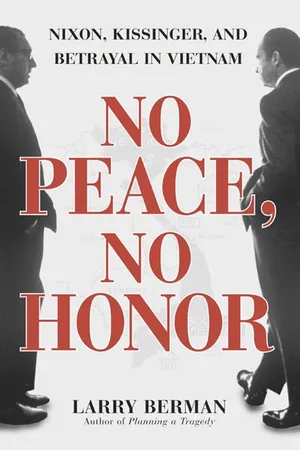
No Peace, No Honor

Nixon, Kissinger, and Betrayal in Vietnam

  1. 352 pages
  2. English
  3. ePUB (mobile friendly)
  4. Available on iOS & Android
eBook - ePub

No Peace, No Honor

Nixon, Kissinger, and Betrayal in Vietnam

About this book

In this shocking exposé on the betrayal of South Vietnam, premier historian Larry Berman uses never-before-seen North Vietnamese documents to create a sweeping indictment against President Nixon and Henry Kissinger. On April 30, 1975, when U.S. helicopters pulled the last soldiers out of Saigon, the question lingered: Had American and Vietnamese lives been lost in vain? When the city fell shortly thereafter, the answer was clearly yes. The Agreement on Ending the War and Restoring Peace in Vietnam—signed by Henry Kissinger in 1973, and hailed as "peace with honor" by President Nixon—was a travesty.In No Peace, No Honor, Larry Berman reveals the long-hidden truth in secret documents concerning U.S. negotiations that Kissinger had sealed—negotiations that led to his sharing the Nobel Peace Prize. Based on newly declassified information and a complete North Vietnamese transcription of the talks, Berman offers the real story for the first time, proving that there is only one word for Nixon and Kissinger's actions toward the United States' former ally, and the tens of thousands of soldiers who fought and died: betrayal.
Frequently asked questions

Yes, you can cancel anytime from the Subscription tab in your account settings on the Perlego website. Your subscription will stay active until the end of your current billing period. Learn how to cancel your subscription.
No, books cannot be downloaded as external files, such as PDFs, for use outside of Perlego. However, you can download books within the Perlego app for offline reading on mobile or tablet. Learn more here.
Perlego offers two plans: Essential and Complete
  • Essential is ideal for learners and professionals who enjoy exploring a wide range of subjects. Access the Essential Library with 800,000+ trusted titles and best-sellers across business, personal growth, and the humanities. Includes unlimited reading time and Standard Read Aloud voice.
  • Complete: Perfect for advanced learners and researchers needing full, unrestricted access. Unlock 1.4M+ books across hundreds of subjects, including academic and specialized titles. The Complete Plan also includes advanced features like Premium Read Aloud and Research Assistant.
Both plans are available with monthly, semester, or annual billing cycles.
We are an online textbook subscription service, where you can get access to an entire online library for less than the price of a single book per month. With over 1 million books across 1000+ topics, we’ve got you covered! Learn more here.
Look out for the read-aloud symbol on your next book to see if you can listen to it. The read-aloud tool reads text aloud for you, highlighting the text as it is being read. You can pause it, speed it up and slow it down. Learn more here.
Yes! You can use the Perlego app on both iOS or Android devices to read anytime, anywhere — even offline. Perfect for commutes or when you’re on the go.
Please note we cannot support devices running on iOS 13 and Android 7 or earlier. Learn more about using the app.
Yes, you can access No Peace, No Honor by Larry Berman in PDF and/or ePUB format, as well as other popular books in History & North American History. We have over one million books available in our catalogue for you to explore.

Information

Publisher
Free Press
Year
2001
Print ISBN
9780743223492
eBook ISBN
9780743217422

CHAPTER ONE
“Search for Peace”

[Ambassador Averell] Harriman told me at least twelve times that if I called a halt, the North Vietnamese and Vietcong would stop shelling South Vietnamese cities. But nothing happened. Every one of the bombing halts was a mistake.
Lyndon Baines Johnson to Richard Nixon
during 1968 presidential transition
By 1968 Lyndon Johnson had become a war president. Hoping to be remembered as the president who used his office and powers to build a truly Great Society of equal opportunity and justice for all Americans, Johnson now feared a legacy shaped by the chants, “Hey, hey, LBJ, how many kids did you kill today?” and “One, two, three, four. We don’t want your fucking war!”
The optimistic rhetoric of kill ratios, body counts, attrition, weapons loss, order of battle, and population control no longer held credibility with the American public. By 1968 a dwindling number of Americans doubted that they would ever see the long-promised “light at the end of the tunnel.”
Despite 525,000 troops committed to the war, thousands upon thousands dead, wounded, and missing, billions of dollars and resources allocated, extensive bombings of South and North Vietnam, and the defoliation of forests with deadly toxins that destroyed jungles and poisoned civilians and soldiers alike, the pace of the war and the capacity to sustain it were controlled not by America but by the enemy.
During the early morning hours of January 31, the Vietnamese New Year known as Tet, a combined force of approximately 80,000 North Vietnamese regulars and Vietcong guerrillas attacked over 100 cities in South Vietnam. The military goal was to achieve a popular uprising and, as captured documents revealed, “move forward to achieve final victory.”
This final victory was not achieved, but there were psychological and political gains in the offing. The front page of the February 1 New York Times showed the picture of the U.S. embassy in Saigon under assault. Guerrillas had blasted their way into the embassy and held part of the ground for nearly six hours. All 19 guerrillas were killed, as were four MPs, a Marine guard, and a South Vietnamese embassy employee.
The story of Tet has been told elsewhere and will not be repeated here. The enemy sustained major losses from which it would take years to recover. As Don Oberdorfer explained, “The Viet Cong lost the best of a generation of resistance fighters, and after Tet increasing numbers of North Vietnamese had to be sent South to fill the ranks. The war became increasingly a conventional battle and less an insurgency.” But Tet also demonstrated the enemy’s great skill in planning, coordination, and courage. North Vietnam regular and Vietcong forces had successfully infiltrated previously secure population centers and exploited Saigon’s claims of security from attack.
Johnson’s field commander, General William C. Westmoreland, now requested additional troops to regain the strategic initiative. Westmoreland believed that the enemy was throwing in all his military chips to go for broke. In late February 1968 the chairman of the Joint Chiefs of Staff, General Earle G. Wheeler, went to Vietnam for three days of consultations with Westmoreland and the senior American commander in each of the corps areas. Secretary of Defense Clark Clifford described President Johnson during this period “as worried as I have ever seen him.”
On February 27 Johnson received Wheeler’s report with recommendations on military requirements in South Vietnam, which amounted to a request for 206,000 additional troops. To many, this was proof of the bankruptcy of the Army’s strategy in Vietnam. Despite the large enemy losses during Tet, the United States was no closer to achieving its goal in Vietnam than it was in 1965. There appeared to be no breaking point in the enemy’s will to continue the struggle indefinitely. The new reinforcements would bring the total American military commitment to three-quarters of a million troops. It seemed increasingly evident that no amount of military power would bring North Vietnam to the conference table for negotiations without stopping the bombing.
That very evening of February 27, CBS television anchorman Walter Cronkite told the nation that the war was destined to end in stalemate: “We have been too often disappointed by the optimism of the American leaders, both in Vietnam and Washington, to have faith any longer in the silver linings they find in the darkest clouds. . . . For it seems now more certain than ever that the bloody experience of Vietnam is to end in a stalemate. To say that we are mired in stalemate seems the only realistic, yet unsatisfactory, conclusion.”
The president appointed a task force under the direction of Secretary of Defense Clifford to evaluate the Wheeler-Westmoreland troop request. The president’s final instructions to Clifford were, “Give me the lesser of evils.” Clifford took the lead among a small group of LBJ advisers who believed that the war had become a sinkhole and that no matter how many forces the U.S. put in, the enemy would match it. “I see more fighting with more and more casualties on the U.S. side with no end in sight to the action,” Clifford would tell the president. For weeks, Johnson wavered between a bombing halt and upping the ante by another 206,000 troops. For weeks, an anguished president awakened in the middle of the night and walked the halls of the White House or called downstairs to the situation room for an update on American casualties. Meanwhile, Clifford led a cabal trying to convince their president that he ought to stop the bombing and thereby start the negotiations that might end the war. “Is he with us?” a phrase used from the French Revolution, became the code for the group.
Johnson was torn between instincts that told him the North Vietnamese could not be trusted and fears that a bombing halt would be exploited by domestic political opponents. At the National Farmers Union convention in late March 1968, Johnson spoke of his desire to “achieve an honorable peace and a just peace at the negotiating table. But wanting peace, praying for peace, and desiring peace, as Chamberlain found out, doesn’t always give you peace.” Johnson also believed that there was political capital in a bombing halt. If things did not work out, he had gone the extra mile, only to be rebuked, and therefore the bombing could be renewed. Johnson had grave doubts about the sincerity of the men in Hanoi’s Politburo but he felt he had no choice except to move ahead. “It’s easier to satisfy Ho Chi Minh than Bill Fulbright,” Johnson told Clifford. (From 1959 to 1974 J. William Fulbright served as chairman of the Senate Foreign Relations Committee. His was a powerful voice of dissent during the Vietnam War, leading Johnson to refer demeaningly to the senator as “half-bright.”)
Johnson would be wrong in his judgment of Ho. But at this crucial juncture in the history of the war, LBJ was rolling the dice, believing that his decisions might result in negotiations but most certainly would allow him to renew the bombing if Hanoi did not cease its military activities. He would not stop all of the bombing until Hanoi agreed to cease attacking the cities. Addressing the nation on March 31, 1968, the president spoke of his willingness “to move immediately toward peace through negotiations.” Johnson announced, “There is no need to delay talks that could bring an end to this long and this bloody war.” He was “taking the first step to de-escalate the level of hostilities” by unilaterally reducing attacks on North Vietnam, except in the area north of the demilitarized zone, known as the DMZ. “The area in which we are stopping our attacks includes almost 90% of North Vietnam’s population and most of its territory,” said Johnson. “Even this very limited bombing of the North could come to an early end if our restraint is matched by restraint in Hanoi.”
Johnson called on North Vietnam’s leader, Ho Chi Minh, to respond favorably and positively to these overtures and not to take advantage of this restraint. “We are prepared to move immediately toward peace through negotiations.” The United States was “ready to send its representatives to any forum, at any time, to discuss the means of bringing this ugly war to an end.” To prove his sincerity, Johnson named the distinguished American ambassador W. Averell Harriman as his “personal representative for such talks,” assigning Harriman the task to “search for peace.”
Then, in a dramatic gesture toward national unity, the president renounced his chance at reelection. “With America’s sons in the fields far away, with America’s future under challenge right here at home, with our hopes and the world’s hopes for peace in the balance every day, I do not believe that I should devote an hour or a day of my time to any personal partisan causes or to any duties other than the awesome duties of this office—the presidency of your country. Accordingly, I shall not seek and I will not accept the nomination of my party for another term as your President.”
Three days later, Radio Hanoi broadcast the news that North Vietnam had accepted Johnson’s offer and would agree to establish contact between the representatives of the United States and North Vietnam. This was the first time that Hanoi had said publicly it was willing to talk. It nevertheless was careful to stipulate that these initial contacts would focus first on bringing about the unconditional end to American bombing and other acts of aggression against Vietnam.
Johnson’s announcement that he would not seek reelection stunned the country. To many, the hawk was dead. To others, the war had claimed as victim a man of immense talent and heart. Tragedy then further unraveled the fabric of the Great Society on April 4 when the Rev. Martin Luther King was assassinated in Memphis, igniting riots in America’s cities. The Great Society was dead.
Recently declassified documents from communist archives disclose that Hanoi’s positive response to initiate contacts with the U.S. engendered a serious rebuke from China, whose leaders believed that there was no reason to begin negotiations until the North Vietnamese post-Tet military position had improved. Two weeks after the March 31 announcement, North Vietnam’s prime minister, Pham Van Dong, was told by Chou Enlai, “In the eyes of the world’s people, you have compromised twice.” Chou asked how it was possible for Hanoi to have contacts while the United States still bombed north of the DMZ. “We entirely believe in your fighting experience. But we are somewhat more experienced than you as far as conducting talks with the United States is concerned,” observed Chou. The Chinese believed that Hanoi was helping to transform Johnson from a man of war to a man of peace, and there was no need to have done so before improving their military situation.
A few days later, Chou Enlai told Pham Van Dong that the North Vietnamese needed to be prepared to fight for at least two to three more years, through at least 1970. “Comrade Mao said that the question is not that of success or failure, nor of big or small success, but of how you gain the great victory. It is high time you gain a complete victory. That task gives rise to the need for large-scale battles.” Chou described LBJ’s March 31 speech as “a wicked and deceitful scheme.”
It would soon become apparent to the Chinese as well as the Soviets that North Vietnam was determined to be master of its own fate in these negotiations. Le Duc Tho and other members of the Hanoi Politburo possessed lingering memories of betrayal in 1954 at Geneva, when the Vietminh were pressured into compromise by their allies, the Chinese and Soviets. When Japan had finally admitted defeat in World War II, the Vietnamese had hoped for freedom. Ho Chi Minh, who four years earlier had founded the League for Revolution and Independence—the Vietminh—had been preparing his entire lifetime for the August 1945 revolution. Here was the opportunity to rid Vietnam not only of the Japanese but the Vichy French colonial regime as well. Military Order No. 1, issued by Vo Nguyen Giap on August 12, called for a general insurrection throughout Vietnam. Within weeks the Vietminh had taken control of major cities throughout the country.
Following Emperor Bao Dai’s abdication on August 24, Ho Chi Minh quickly moved to proclaim a new independent Democratic Republic of Vietnam (DRV). The People’s Republic of China (PRC) was the first country to recognize the new DRV. It was an exciting time. Eighteen-year-old Bui Tin had come to the ornate French-style Opera House in Hanoi that August to witness the end of French colonialism. “I too was fired with enthusiasm. Like the rest of my generation and indeed most Vietnamese people, we were bursting with optimism and excitement,” he recalled.
Throughout Vietnam, banners proclaimed “Vietnam for the Vietnamese.” Saigon was seething. Truong Nhu Tang described the moment: “Caught in a tide of emotional patriotism and excited by danger and the idea of independence, all of Saigon’s young people seemed to be joining.” On August 21 Tang was in the crowd marching from one end of Saigon to the other chanting, “Da Dao de quoc, Da Dao thuc dan dhap” (“Down with the Imperialists, Down with the French colonialists”).
Two weeks later, on September 2, 1945, Bui Tin was in the crowd in Hanoi’s Ba Dinh Square to witness Ho Chi Minh’s historic proclamation of independence in which he borrowed words from the American Declaration of Independence: “We hold the truth that all men are created equal, that they are endowed by their Creator certain inalienable rights, among them life, liberty and the pursuit of happiness. . . . Do you hear me distinctly my fellow countrymen?”
Born Nguyen Sinh Cuong in 1890, Ho left Vietnam in 1911 for a variety of jobs in Western Europe; he traveled to the United States, where he lived briefly in Brooklyn and Boston, and by 1917 had returned to France. He became one of the founders of the French Communist party and agitated for Vietnamese rights. He was later sent to South China, where he organized and recruited Vietnamese students and dissidents. He became known for his writings as a pamphleteer, editor, and organizer. His writings attracted the attention of young Vietnamese like Vo Nguyen Giap and Pham Van Dong, who would remain forever loyal to their leader and themselves played important roles in Vietnam’s diplomatic and military history.
In September 1945 the DRV controlled the region of Hanoi and the northern part of the country, but the French, determined to stop their declining world reputation, focused on reasserting control over Indochina. Following the shelling of Haiphong by French cruisers in November 1946, full-scale war broke out between the French and Vietminh. As the cold war developed, Washington became more sensitive to the colonial interests of its allies than to the decolonization of Indochina. Ho was a Leninist and pro-Moscow. Not surprisingly, the U.S. indirectly supported the French military action in Indochina against the Vietminh. After the communist victory in China in 1949 and the outbreak of the Korean War in 1950, its contribution became direct. A month after the outbreak of hostilities in Korea, Secretary of State Dean Acheson announced the first increment of American aid to the French for the Indochina war.
In 1954 the French were defeated in battle at Dien Bien Phu. The Vietminh controlled most of Vietnam and sought a political settlement at Geneva that would lead to the withdrawal of French forces and the establishment of an independent government led by Ho Chi Minh. But four of the men sitting around the large horseshoe shaped table at the old League of Nations building with a map of Southeast Asia on it put their own interests ahead of the fifth person at the table, Pham Van Dong. The four—Foreign Secretary Anthony Eden of the United Kingdom, Premier Pierre Mendes-France of France, Foreign Minister Vyacheslav Molotov of the Soviet Union, and Foreign Minister Chou Enlai of China—pressured the DRV to accept much less than it had won in battle. The Vietnamese would never forget this “negotiation.”
The Pentagon Papers make clear that the United States intended to disassociate itself from the results at Geneva, fearing a “sellout” of U.S. interests. A May 4, 1954, meeting of the National Security Council established U.S. policy: “The United States will not associate itself with any proposal from any source directed toward a cease-fire. . . . In the meantime, as a means of strengthening the hands of the French and the Associated States during the course of such negotiations, the United States will continue its program of aid and its efforts to organize and promptly activate a Southeast Asian regional grouping for the purpose of preventing further expansion of communist power in Southeast Asia.”
The Chinese and Soviets, fearing American intervention under Secretary of State John Foster Dulles, forced Ho to accept two major concessions: a demarcation line drawn at the 17th parallel and free nationwide elections supervised by an international commission scheduled for 1956. The elections would settle the question of political control over Vietnam. Vietnam was to be neutralized, meaning that no military alliances were to be made by either side.
The Geneva settlement partitioned Vietnam at a nominally temporary “line of demarcation” between North and South at the 17th parallel, with the Vietminh taking control of the Northern zone and France and an opposing Vietnamese government, ultimately led by Ngo Dinh Diem, controlling the South. The Vietminh surrendered two strongholds in Quang Nam and Quang Ngai. They had wanted the elections to be held in six months, not two years. All in all they gave up quite a bit.
Nguyen Khac Huyen later explained that at the time of Geneva, the Vietminh did not yet have any experience with diplomacy or multilateral discussions. They had just fought a ten-year war in the jungles; there were few diplomats among them. “Literally, we were stepping out of the jungle and going to Geneva, at the invitation of our friends; our allies, the Chinese and Soviets.”
Robert McNamara later observed, “At Geneva, they compromised in order to secure a promise, which was broken. In the future, their willingness to compromise would seem virtually nonexistent to Washington. At Geneva, they tried to play the game of diplomacy with the big powers and lost. In the future, ‘diplomacy’ with the United States would be conducted only between Washington and Hanoi—or not at all. And, most importantly, one suspects, at Geneva they felt they had, in effect, betrayed their counterparts south of the 17th parallel, who had already suffered most in the war with the French.”
“All in all, the 1954 Geneva Agreement was a disaster for us,” said Luu Doan Huynh, “because the big powers were the architects and the Vietnamese the victims.” Why did Ho Chi Minh accept these compromises? As Ziang Zhai’s recent scholarship shows, “Ho Chi Minh must have realized that without Chinese and Soviet assistance, he could not have defeated the French and achieved the position he now had. He could not afford to resist the pressure of his two communist allies.” He must also have believed that in two years, “all Vietnam would be his.”
Instead, Vietnam would remain divided for over two decades. Indeed, Geneva would prove an important prelude to the Paris Peace talks in more than one way. Richard Nixon was vice president at the time of Geneva, and Pham Van Dong headed the DRV delegation. By 1970 both men would be the leaders of the United States and the DRV, respectively. Both drew lessons from the Geneva experience that would influence how each approached the negotiations in Paris. Dong believed that the Vietminh were betrayed by their friends. For example, two weeks after Nixon’s election in 1968, Dong would visit Mao in Beijing. “Twenty three years have passed since the Japanese surrender in 1945 but your country is still existing,” said Mao. “You have fought the Japanese, the French, and now you are fi...

Table of contents

  1. Cover Page
  2. Title Page
  3. Copyright Page
  4. Dedication Page
  5. CONTENTS
  6. CAST OF CHARACTERS
  7. GLOSSARY
  8. prologue
  9. CHAPTER ONE. “Search for Peace”
  10. CHAPTER TWO. Nixon Takes Control
  11. CHAPTER THREE. “You Cannot Hide an Elephant With a Basket”
  12. CHAPTER FOUR. McGovern’s October Surprise
  13. CHAPTER FIV. A Chess Match
  14. CHAPTER SIX. Nixon Goes Public
  15. CHAPTER SEVEN. The Easter Offensive
  16. CHAPTER EIGHT. “They Have Concluded They Cannot Defeat You”
  17. CHAPTER NINE. Thieu Kills the Deal
  18. CHAPTER TEN. Peace Is at the End of a Pen
  19. CHAPTER ELEVEN. Linebacker II
  20. CHAPTER TWELVE. Nixon’s Peace with Honor
  21. CHAPTER THIRTEEN. The Jabberwocky Agreement
  22. Epilogue
  23. APPENDIX A White House Fact Sheet: Basic Elements of the Vietnam Agreement
  24. APPENDIX B The Lessons of Vietnam: Henry Kissinger to President Ford
  25. APPENDIX C Text of Address by President Nixon on the Vietnam Agreement
  26. NOTES
  27. BIBLIOGRAPHY
  28. ACKNOWLEDGMENTS
  29. INDEX