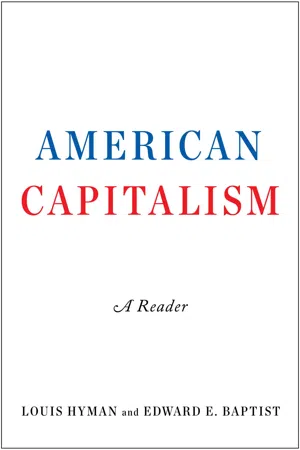
American Capitalism
eBook - ePub

American Capitalism

A Reader

  1. 464 pages
  2. English
  3. ePUB (mobile friendly)
  4. Available on iOS & Android
eBook - ePub

American Capitalism

A Reader

About this book

From Cornell University Professors Louis Hyman and Edward E. Baptist, a collection of the most relevant readings on the history of capitalism in America, created to accompany their EdX course American Capitalism: A Reader. To understand the past and especially our own times, arguably no story is as essential to get right as the history of capitalism. Nearly all of our theories about promoting progress come from how we interpret the economic changes of the last 500 years. This past decade's crises continue to remind us just how much capitalism changes, even as basic features like wage labor, financial markets, private property, and entrepreneurs endure. While capitalism has a global history, the United States plays a special role in that story. American Capitalism: A Reader will help you to understand how the United States became the world's leading economic power, while revealing essential lessons about what has been and what will be possible in capitalism's ongoing revolution. Combining a wealth of essential readings, introductions by Professors Baptist and Hyman, and questions to help guide readers through the materials and broader subject, this course reader will prepare students to think critically about the history of capitalism in America.
Frequently asked questions

Yes, you can cancel anytime from the Subscription tab in your account settings on the Perlego website. Your subscription will stay active until the end of your current billing period. Learn how to cancel your subscription.
At the moment all of our mobile-responsive ePub books are available to download via the app. Most of our PDFs are also available to download and we're working on making the final remaining ones downloadable now. Learn more here.
Perlego offers two plans: Essential and Complete
  • Essential is ideal for learners and professionals who enjoy exploring a wide range of subjects. Access the Essential Library with 800,000+ trusted titles and best-sellers across business, personal growth, and the humanities. Includes unlimited reading time and Standard Read Aloud voice.
  • Complete: Perfect for advanced learners and researchers needing full, unrestricted access. Unlock 1.4M+ books across hundreds of subjects, including academic and specialized titles. The Complete Plan also includes advanced features like Premium Read Aloud and Research Assistant.
Both plans are available with monthly, semester, or annual billing cycles.
We are an online textbook subscription service, where you can get access to an entire online library for less than the price of a single book per month. With over 1 million books across 1000+ topics, we’ve got you covered! Learn more here.
Look out for the read-aloud symbol on your next book to see if you can listen to it. The read-aloud tool reads text aloud for you, highlighting the text as it is being read. You can pause it, speed it up and slow it down. Learn more here.
Yes! You can use the Perlego app on both iOS or Android devices to read anytime, anywhere — even offline. Perfect for commutes or when you’re on the go.
Please note we cannot support devices running on iOS 13 and Android 7 or earlier. Learn more about using the app.
Yes, you can access American Capitalism by Louis Hyman, Edward E. Baptist in PDF and/or ePUB format, as well as other popular books in Economics & Business General. We have over one million books available in our catalogue for you to explore.

Information

PART I

Images

CAPITALISM COMES TO AMERICA

MODULE 1


ECONOMIES BEFORE CAPITALISM

The Wealth of Nations (1776)

Images
ADAM SMITH
The Wealth of Nations is the origin of Western economic thought. Every thinker since Smith has been forced to engage with his foundational ideas about division of labor, productive investment, and trade. In Smith we see the roots of both Marxism and mainstream economics. Smith’s belief in manufacturing broke with Continental ideas which held that value could only come from cultivating land. Instead, he distinguishes laborers who add value to a commodity from other laborers, like “menial servants,” who do not. Another major insight is that productivity can be increased by either hiring more workers or providing workers with better machines. Both choices require more capital to be invested, but the possibilities for increasing the productivity of manufacturing are much greater than those for agriculture. In this way, Smith sees the future of wealth in nations that manufacture, not in ones that simply grow crops.
BOOK I: Of the Causes of Improvement in the Productive Powers of Labour, and of the Order According to which its produce is Naturally Distributed Among the Different Ranks of the People
CHAPTER I: Of the Division of Labour
The greatest improvements in the productive powers of labour, and the greater part of the skill, dexterity, and judgment, with which it is anywhere directed, or applied, seem to have been the effects of the division of labour. The effects of the division of labour, in the general business of society, will be more easily understood, by considering in what manner it operates in some particular manufactures. It is commonly supposed to be carried furthest in some very trifling ones; not perhaps that it really is carried further in them than in others of more importance: but in those trifling manufactures which are destined to supply the small wants of but a small number of people, the whole number of workmen must necessarily be small; and those employed in every different branch of the work can often be collected into the same workhouse, and placed at once under the view of the spectator.
In those great manufactures, on the contrary, which are destined to supply the great wants of the great body of the people, every different branch of the work employs so great a number of workmen, that it is impossible to collect them all into the same workhouse. We can seldom see more, at one time, than those employed in one single branch. Though in such manufactures, therefore, the work may really be divided into a much greater number of parts, than in those of a more trifling nature, the division is not near so obvious, and has accordingly been much less observed.
To take an example, therefore, from a very trifling manufacture, but one in which the division of labour has been very often taken notice of, the trade of a pin-maker: a workman not educated to this business (which the division of labour has rendered a distinct trade), nor acquainted with the use of the machinery employed in it (to the invention of which the same division of labour has probably given occasion), could scarce, perhaps, with his utmost industry, make one pin in a day, and certainly could not make twenty. But in the way in which this business is now carried on, not only the whole work is a peculiar trade, but it is divided into a number of branches, of which the greater part are likewise peculiar trades. One man draws out the wire; another straights it; a third cuts it; a fourth points it; a fifth grinds it at the top for receiving the head; to make the head requires two or three distinct operations; to put it on is a peculiar business; to whiten the pins is another; it is even a trade by itself to put them into the paper; and the important business of making a pin is, in this manner, divided into about eighteen distinct operations, which, in some manufactories, are all performed by distinct hands, though in others the same man will sometimes perform two or three of them. I have seen a small manufactory of this kind, where ten men only were employed, and where some of them consequently performed two or three distinct operations. But though they were very poor, and therefore but indifferently accommodated with the necessary machinery, they could, when they exerted themselves, make among them about twelve pounds of pins in a day. There are in a pound upwards of four thousand pins of a middling size. Those ten persons, therefore, could make among them upwards of forty-eight thousand pins in a day. Each person, therefore, making a tenth part of forty-eight thousand pins, might be considered as making four thousand eight hundred pins in a day. But if they had all wrought separately and independently, and without any of them having been educated to this peculiar business, they certainly could not each of them have made twenty, perhaps not one pin in a day; that is, certainly, not the two hundred and fortieth, perhaps not the four thousand eight hundredth, part of what they are at present capable of performing, in consequence of a proper division and combination of their different operations.
In every other art and manufacture, the effects of the division of labour are similar to what they are in this very trifling one, though, in many of them, the labour can neither be so much subdivided, nor reduced to so great a simplicity of operation. The division of labour, however, so far as it can be introduced, occasions, in every art, a proportionable increase of the productive powers of labour.
[ . . . ] It is the great multiplication of the productions of all the different arts, in consequence of the division of labour, which occasions, in a well-governed society, that universal opulence which extends itself to the lowest ranks of the people. Every workman has a great quantity of his own work to dispose of beyond what he himself has occasion for; and every other workman being exactly in the same situation, he is enabled to exchange a great quantity of his own goods for a great quantity or, what comes to the same thing, for the price of a great quantity of theirs. He supplies them abundantly with what they have occasion for, and they accommodate him as amply with what he has occasion for, and a general plenty diffuses itself through all the different ranks of the society.
Compared, indeed, with the more extravagant luxury of the great, his accommodation must no doubt appear extremely simple and easy; and yet it may be true, perhaps, that the accommodation of an European prince does not always so much exceed that of an industrious and frugal peasant, as the accommodation of the latter exceeds that of many an African king, the absolute masters of the lives and liberties of ten thousand naked savages. [ . . . ]
CHAPTER II: Of the Principle which gives Occasion to the Division of Labour
This division of labour, from which so many advantages are derived, is not originally the effect of any human wisdom, which foresees and intends that general opulence to which it gives occasion. It is the necessary, though very slow and gradual, consequence of a certain propensity in human nature, which has in view no such extensive utility; the propensity to truck, barter, and exchange one thing for another.
Whether this propensity be one of those original principles in human nature, of which no further account can be given, or whether, as seems more probable, it be the necessary consequence of the faculties of reason and speech, it belongs not to our present subject to inquire.
Two greyhounds, in running down the same hare, have sometimes the appearance of acting in some sort of concert. Each turns her towards his companion, or endeavours to intercept her when his companion turns her towards himself. This, however, is not the effect of any contract, but of the accidental concurrence of their passions in the same object at that particular time. Nobody ever saw a dog make a fair and deliberate exchange of one bone for another with another dog. Nobody ever saw one animal, by its gestures and natural cries signify to another, this is mine, that yours; I am willing to give this for that. Whoever offers to another a bargain of any kind, proposes to do this. Give me that which I want, and you shall have this which you want, is the meaning of every such offer; and it is in this manner that we obtain from one another the far greater part of those good offices which we stand in need of. It is not from the benevolence of the butcher, the brewer, or the baker that we expect our dinner, but from their regard to their own interest. We address ourselves, not to their humanity, but to their self-love, and never talk to them of our own necessities, but of their advantages.
The difference of natural talents in different men, is, in reality, much less than we are aware of; and the very different genius which appears to distinguish men of different professions, when grown up to maturity, is not upon many occasions so much the cause, as the effect of the division of labour. The difference between the most dissimilar characters, between a philosopher and a common street porter, for example, seems to arise not so much from nature, as from habit, custom, and education. When they came in to the world, and for the first six or eight years of their existence, they were, perhaps, very much alike, and neither their parents nor play-fellows could perceive any remarkable difference. About that age, or soon after, they come to be employed in very different occupations. The difference of talents comes then to be taken notice of, and widens by degrees, till at last the vanity of the philosopher is willing to acknowledge scarce any resemblance. But without the disposition to truck, barter, and exchange, every man must have procured to himself every necessary and conveniency of life which he wanted. All must have had the same duties to perform, and the same work to do, and there could have been no such difference of employment as could alone give occasion to any great difference of talents.
As it is this disposition which forms that difference of talents, so remarkable among men of different professions, so it is this same disposition which renders that difference useful. Those different tribes of animals, however, though all of the same species are of scarce any use to one another. The strength of the mastiff is not in the least supported either by the swiftness of the greyhound, or by the sagacity of the spaniel, or by the docility of the shepherd’s dog. The effects of those different geniuses and talents, for want of the power or disposition to barter and exchange, cannot be brought into a common stock, and do not in the least contribute to the better accommodation and conveniency of the species. Each animal is still obliged to support and defend itself, separately and independently, and derives no sort of advantage from that variety of talents with which nature has distinguished its fellows. Among men, on the contrary, the most dissimilar geniuses are of use to one another; the different produces of their respective talents, by the general disposition to truck, barter, and exchange, being brought, as it were, into a common stock, where every man may purchase whatever part of the produce of other men’s talents he has occasion for.
Book II: Of the Nature, Accumulation, and Employment of Stock
Chapter III: Of the Accumulation of Capital, or of Productive and Unproductive Labour
There is one sort of labour which adds to the value of the subject upon which it is bestowed: there is another which has no such effect. The former, as it produces a value, may be called productive; the latter, unproductive labour. Thus the labour of a manufacturer adds, generally, to the value of the materials which he works upon, that of his own maintenance, and of his master’s profit. The labour of a menial servant, on the contrary, adds to the value of nothing.
We are more industrious than our forefathers; because in the present times the funds destined for the maintenance of industry are much greater in proportion to those which are likely to be employed in the maintenance of idleness than they were two or three centuries ago. Our ancestors were idle for want of a sufficient encouragement to industry. It is better, says the proverb, to play for nothing than to work for nothing.
The annual produce of the land and labour of any nation can be increased in its value by no other means but by increasing either the number of its productive labourers, or the productive powers of those labourers who had before been employed. The number of its productive labourers, it is evident, can never be much increased, but in consequence of an increase of capital, or of the funds destined for maintaining them. The productive powers of the same number of labourers cannot be increased, but in consequence either of some addition and improvement to those machines and instruments which facilitate and abridge labour; or of a more proper division and distribution of employment. In either case an additional capital is almost always required. It is by means of an additional capital only that the undertaker of any work can either provide his workmen with better machinery or make a more proper distribution of employment among them.
Questions
1. Why is division of labor possible?
2. What distinguishes a productive use of capital from an unproductive use of capital?
3. Why can manufacturing expand more, in Smith’s mind, than agriculture?
4. Do you think you would enjoy pin making more or less if you were a pinmaker using division of labor? Would you enjoy your overall existence more or less?
5. Smith points to trade as one of the key differences between humans and animals. How does he make his argument?
6. Smith’s account is largely about individual producers exchanging goods. Why do you think that his vision of the economy does not include firms? How might this story change with larger businesses?
7. Does Smith believe that talent is innate or learned? What does this mean for division of labor? What does this mean about the justice of inequality?
8. Selfishness is not usually thought of as a virtue, yet for Smith it results in virtuous outcomes. Does this imply that selfishness is not in fact unvirtuous?
9. How does Smith justify the existence of peasants in a wealthy country?

The Communist Manifesto (1848)

Images
KARL MARX AND FRIEDRICH ENGELS
By the early 1830s, the process of industrialization, which had allowed capitalism to take hold of British society and start it on a process of continual transformation, had made Britain the wealthiest and most powerful country in the world. For some in the new working class of the factory towns and cities, life in what the poet and early critic of industrialization William Blake called “the dark Satanic mills” was indeed a process of brutalizati...

Table of contents

  1. Cover
  2. Acknowledgments
  3. Foreword by Edward E. Baptist
  4. Why Study the History of Capitalism? by Louis Hyman
  5. Part I: Capitalism Comes to America
  6. Part II: Making Capitalism American
  7. Part III: Making Corporate Capitalism
  8. Part IV: Making American Capitalism Global
  9. Bibliography
  10. Permissions
  11. Copyright