![]()
Appendix 1
SOME DEFINITIONS OF NOSTALGIA
A wistful or excessively sentimental yearning for return to or of some past period or irrecoverable condition (Merriam-Webster). |
The name we commonly give for to a bittersweet longing for former times and spaces (Niemeyer, 2014, p. 1). |
Nostalgia is a recognition – pleasant, but not entirely welcome – that the past is home (Birkerts, 2000, p. 36). |
Recalling the fun without reliving the pain (Collins, 2011, p. 65). |
Today’s favoured mode of looking back (Lowenthal, 2015, p. 31). |
A positively toned evocation of a lived past (Davis, 1979, p. 18). |
An emotional state in which an individual yearns for an idealised or sanitised version of an earlier time period (Stern, 1992, p. 11). |
A sentimental or bittersweet yearning for an experience, product or service from the past (Baker & Kennedy, 1994, p. 169). |
Longing for what is lacking (Pickering & Keightley, 2006, p. 920). |
Bad history (Angé & Berliner, 2015, p. 4). |
An empty trope within an overly mediated society (de Groot, 2009, p. 249). |
The desire for desire (Stewart, 1999, p. 23). |
Optimism for the past (Smith, 2012, p. 11). |
Hankering for the idealised past … a mildly contemptuous descriptor for golden age myths of all kinds (Wernick, 1997, pp. 218–219). |
Yearning for a golden age in less complex, more harmonious times (Kammen, 1991, p. 294). |
A product of a shared historical consciousness of general displacement that is able to make parochial misfortunes and individual losses socially meaningful (Fritzsche, 2004, p. 64). |
A state of decline and languor caused by an obsessive regret for one’s native land, for the places where one lived for a long time (Kessous & Roux, 2008, p. 195). |
Nostalgia invokes a positively evaluated past world in response to a deficient present world (Tannock, 1995, p. 454). |
A powerful stimulant to feel optimistic about the future (Adams, 2014, p. 26). |
A situation where the problematic individual looks back with painful yearning and respect to the non-problematic individual of earlier times (Wright, 2009, p. 23). |
Nostalgia is neither illusion nor repetition; it is a return to something we have never had. Through nostalgia we know is not only what we hold most dear, but also the quality of experiencing that we deny ourselves habitually (Harper, 1966, pp. 26–27). |
![]()
Appendix 2
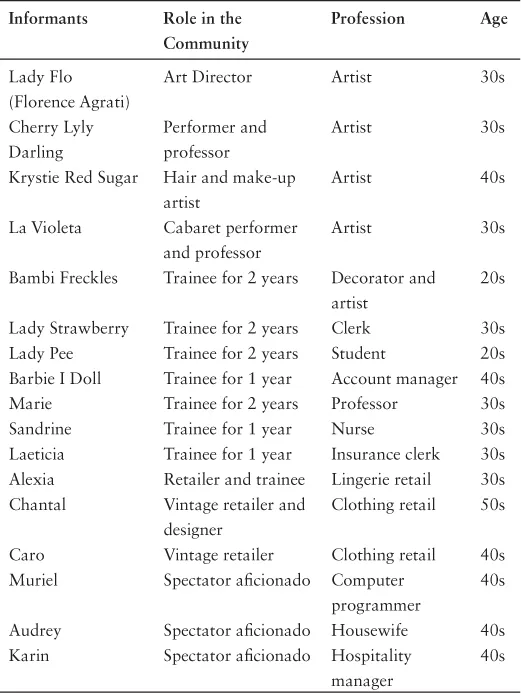
LIST OF INFORMANTS
![]()
REFERENCES
Abrams, M. H. (1993). A glossary of literary terms. Fort Worth, TX: Harcourt Brace.
Acocella, J. (2013). Take it off: The New Burlesque scene. The New Yorker, May 13. http://www.newyorker.com. Accessed on March 16, 2016.
Adams, T. (2014). Do look back. The Observer Magazine, November 9, pp. 24–30.
Agamben, G. (2011/2009). In D. Kishik & S. Pedatella (Trans.), Nudities. Stanford, CA: Stanford University Press.
Allen, R. C. (1991). Horrible prettiness: Burlesque and American culture. Chapel Hill, NC: University of North Carolina Press.
Angé, O. (2016). Social and economic performativity of nostalgic narratives in Andean barter fairs. In O. Angé & D. Berliner (Eds.), Anthropology and nostalgia (pp. 178–197). New York, NY: Berghahn.
Angé, O., & Berliner, D. (2016). Introduction: Anthropology of nostalgia: Anthropology as nostalgia. In O. Angé & D. Berliner (Eds.), Anthropology and nostalgia (pp. 1–15). New York, NY: Berghahn.
Anspach, C. K. (1934). Medical dissertation on nostalgia by Johannes Hofer, 1688. Bulletin of the History of Medicine, 2, 376–391.
Appadurai, A. (1996). Modernity at large: Cultural dimensions in globalization. Minneapolis, MN: University of Minnesota Press.
Arlidge, J. (2016). Meet Linda from Coventry: She’s in the driving seat at Citroën. The Sunday Times, August 28, p. 7.
Armstrong, S. (2010). Preparing for take off. Sunday Times Culture, November 21, pp. 6–7.
Arnould, E. J., Price, L., & Moisio, R. (2006). Making contexts matter: Selecting research contexts for theoretical insights. In R.W. Belk (Ed.), Handbook of qualitative research methods in marketing (pp. 106–125). Cheltenham: Edward Elgar.
Arnould, E. J., & Thompson, C. J. (2005). Consumer culture theory (CCT): Twenty years of research. Journal of Consumer Research, 31(March), 868–882. https://doi.org/10.1086/426626
Arnould, E. J., & Thompson, C. J. (2015). Introduction: Consumer Culture Theory: Ten years gone (and beyond). In A. E. Thyroff, J. B. Murray, & R. W. Belk (Eds.), Consumer Culture Theory: Research in Consumer Behavior (Vol. 17, pp. 1–21). Bingley: Emerald.
Arsel, Z., Eräranta, K., & Moisander, J. (2015). Introduction: Theorising gender and gendering theory in marketing and consumer research. Journal of Marketing Management, 31(15–16), 1553–1558. https://doi.org/10.1080/0267257X.2015.1078396
Askegaard, S., & Scott, L. (2013). Consumer Culture Theory: The ironies of history. Marketing Theory, 13(2), 139–147. https://doi/abs/10.1177/1470593113479007
Aspden, P. (2004). A freeze frame too far. FT Magazine, July 3, p. 8.
Aspden, P. (2007). Après-garde, not avant. Financial Times, November 2. http://www.ft.com. Accessed on July 10, 2014.
Aspden, P. (2013). The past is a time whose time has come. ...