The acute processes of globalisation at the turn of the century have generated an increased interest in exploring the interactions between the so-called global cultural products or trends and their specific local manifestations. Even though cross-cultural connections are becoming more patent in filmic productions in the last decades, cinema per se has always been characterized by its hybrid, transnational, border-crossing nature. From its own inception, Spanish film production was soon tied to the Hollywood film industry for its subsistence, but other film traditions such as those in the Soviet Union, France, Germany and, in particular, Italy also determined either directly or indirectly the development of Spanish cinema.
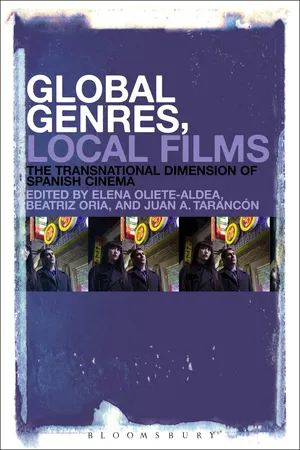
Global Genres, Local Films: The Transnational Dimension of Spanish Cinema reaches beyond the limits of the film text and analyses and contextualizes the impact of global film trends and genres on Spanish cinema in order to study how they helped articulate specific national challenges from the conflict between liberalism and tradition in the first decades of the 20th century to the management of the contemporary financial crisis. This collection provides the first comprehensive picture of the complex national and supranational forces that have shaped Spanish films, revealing the tensions and the intricate dialogue between cross-cultural aesthetic and narrative models on the one hand, and indigenous traditions on the other, as well as the political and historical contingencies these different expressions responded to.
eBook - ePub
Global Genres, Local Films
The Transnational Dimension of Spanish Cinema
- 256 pages
- English
- ePUB (mobile friendly)
- Available on iOS & Android
eBook - ePub
Global Genres, Local Films
The Transnational Dimension of Spanish Cinema
About this book
Information
Part One
Rethinking Spanishness: The Soft Edges of Early Cinema
1
The Tuneful 1930s: Spanish Musicals in a Global Context
Valeria Camporesi
According to Vicente Benet, the explosively successful encounter between the Spanish musical culture of the early twentieth century and cinema “created one of the most powerful and long-lasting phenomena of Spanish contemporary culture” (2012, 98), the españolada.1 As he keenly observes, in this peculiar version of the national identity elaborated local traditions and styles converged along with transnational ingredients and models.2
Indeed, in the first decade of sound cinema the cultural and industrial crossbreed between music and cinema was an extraordinarily widespread and successful practice all over the world, and it often involved a re-elaboration of particularly effective figments of local identity in the context of a new cultural hybrid. This peculiar phenomenon has been detected and analysed from different viewpoints in a great number of national film histories.3 Among them, the musicals made in the USA have been singled out as the prototype that functioned in many ways as a reference for the rest. However, a such ubiquitous model is not to be taken simply as one sweeping cultural archetype. As Rick Altman has effectively argued, it is possible to distinguish three different models of American musical films, the “fairy-tale,” the “show,” and the “folk” musical (1987, 27). He sees the first one as molded on the “European” model, the second one as epitomized by Hollywood and the third one as somehow authentically American in a broader, more cultural sense. What is astounding about his classification is that quite a few of the determining features he bestows on the American folk musical (1987, 273–85) seem actually to apply, mutatis mutandis, to a large extent, to the Spanish españolada. So when Altman says that “the folk musical preaches a gospel of folk values to an age of mass media” (1987, 322), he is establishing an analytic framework which could fruitfully be applied to other national cases.
In the following pages, the study of the musical films produced in Spain between the final establishment of sound cinema in 1932,4 and the outbreak of the Civil War in 1936 will be pursued with that inspiring formula in mind. The basic question which this analysis shall try to approach is to what extent those Spanish movies of the early sound era shifted between a Euro-Hollywood pattern and Altman’s “folk musical model,” and how the global/local dialectics apply to them. Not too far in the background lies the intricate question of transnational transactions of formats, texts, and people (directors and actors, as well as technicians) which characterizes the whole history of cinema, and certainly the 1930s, and which will provide some hard facts to be reflected upon. Hopefully, this inevitably short analysis will highlight some basic, distinctive features which will not only make possible a comparison between different national cinemas, but also pinpoint how globalization might have worked in the cinematographic world well before the actual term was universally adopted to describe worldwide transactions of all kinds.
Pursuing this line of analysis leads us to revise and reassess the ways in which folkloric musicals are normally studied. As mentioned above, in his widely influential 1987 book on the subject, Rick Altman approached movie musicals with the idea of producing a broad and an all-embracing analytical framework. Within that context, he defined US folk musicals as movies whose specificity was rooted in the reappropriation of cultural and visual ingredients “borrowed from the American past and colored by an euphoric memory” (1987, 273). According to Altman, a mythical image of the past was an essential trait of folk musicals, but no less important was a strong sense of a geographical identity, normally linked to “the construction of sets based on conventions of American painting, printmaking and photography” as well as on the “use of location photography … carefully chosen to recall a cinematic or other pictorial precedent” (1987, 273, 277). Last but not least, music, far from being a simple element of the audiovisual text, functioned as an essential framework that structured the text and helped make sense of the different narrative and stylistic pieces upon which the movie was structured. Notwithstanding the perceptiveness of this analysis, it is particularly intriguing that Altman does not refer back to any kind of authentic essence of local cultures, and repeatedly insists on how those films brought about a rearrangement of existing shards of representation. It may be worth keeping this approach in mind when one turns the attention to Spanish films.
A swift look at the musicals made in Spain between 1932 and 1936 suggests a remarkable presence of folk elements very much along the lines so precisely described by Altman. Although movies without specific national cultural contents were also profusely produced within the genre, references to local motives, melodies, stars, and settings recurred in most films, and therefore one could safely talk of a strong presence of Spanish elements within a global format.
Current historiography normally divides the bulk of that production according to the movies’ adherence to certain patterns that have come to be identified with particular geographic contexts. Therefore, it is deemed possible to find Spanish musicals made either in the European or Hollywood-style, adopting a Central/South American nuance or striving to appear straightforwardly Spanish, a typology not too different from the one Altman devises for the American version of the genre. This interpretation is certainly very helpful when it comes to establish the basic features of a very complicated panorama. However, for a more nuanced cultural analysis, it is necessary to account more precisely for the confusing and sometimes contradictory elements which usually merge in a particular movie. What is particularly questionable is its failure to take into account the dialogical nature of filmic texts. In the 1930s, cinema audiences all over the world were increasingly aware of and familiarized with mainstream productions from a number of different countries. On the other hand, film production had always been intrinsically global and, contrary to popular belief, this did not change substantially when sound cinema brought to the fore the importance of national languages, or when aggressively nationalistic dictators required cinema and other media to promote patriotic values. For all this, it is reasonable to open up the question of the national cultural identity of a movie a little further, and work on the hypothesis that movies were hybrid compounds including elements from more than one model. This does not mean that films cannot be an expression of a national culture, or that filmmakers did not use and combine discourses rooted in a specific understanding of the local/national culture. What is at stake here is an attempt to define more sharply what happens when those discourses are launched into a broader space and have to preserve their attractiveness in the eyes of a much wider and probably diverse audience. As Benet argues, musical films are extraordinary sources to explore this.
According to Román Gubern (1995, 156), in the period under consideration the Spanish film industry produced 109 feature films. Musicals constituted slightly more than 35 percent of the overall production,5 a percentage which reveals a remarkable similarity with what was happening in other developed countries.6 Quite a few of these movies can be described as truly transnational, but this cosmopolitanism was not always evident, and, in some cases, it was straightforwardly concealed. The transnational connections were often the consequence of the absorption and adaptation of the above-mentioned international formats, although they were often reinforced by tangible and specific exogenous ingredients. These could be directly inserted in the texts as part of the plots and mise-en-scène (original stories, settings, accents, costumes, etc.) and/or might be the result of the work and presence of foreign cast and crew. In general terms, settings, characters and production design dwelt upon easily recognizable local features, in particular in the españoladas and the zarzuela adaptations, but also, quite frequently, in urban comedies. On the other hand, and not necessarily in contradiction with the effort to “look Spanish,” a discreet number of the performers (singers, actors, actresses) as well as directors, scriptwriters, set designers, cameramen, etc. who were employed in the production of musicals were either foreigners, as in the case for instance of Doña Francisquita (Hans Behrendt 1934) or María de la O (Francisco Elías 1936),7 or Spaniards with experience abroad. A particularly remarkable case among directors was Harry d’Abbadie d’Arrast, a French Basque filmmaker with a successful career in Hollywood who directed in Spain what is considered the best musical film of the period, La traviesa molinera/It Happened in Spain (1934), also filmed in English and French.8
Therefore, the provocative label “Euro-American” that Peter Lev (1993) has applied to modern and postmodern “art cinema” to describe the complex relationships between the movies made in the old continent and the movies made in the US might prove useful here in more than one sense, in particular at a moment when popular and classical cinema were at their height. But with an important nuance: in the 1930s the Spanish cinematographic establishment was experiencing an increasing interest in Central and South America, a crucial market which the advent of sound apparently made more approachable. Crucial steps were then taken to strengthen commercial links and to set up a “Hispano” cinematographic network, within which music and dance would play a remarkable role.9 A close analysis of a group of films which can reasonably be said to represent the production of musicals during this period might help to explore how and to what extent the Euro-American connection actually worked within the genre.10 It will thus be possible to go into some detail and at the same time put forward a new way of looking at well-known individual movies and possibly reassess thei...
Table of contents
- Cover
- Dedication
- Title Page
- Contents
- List of Figures
- Acknowledgments
- List of Contributors
- Foreword: Spanish Cinema and the “National/Transnational” Debate: A Brief Reflection
- Introduction: Questions of Transnationalism and Genre
- Part 1 Rethinking Spanishness: The Soft Edges of Early Cinema
- 1 The Tuneful 1930s: Spanish Musicals in a Global Context
- 2 Historical Films During the First Years of the Franco Regime and their Transnational Models
- 3 Realism, Social Conflict, and the Rise of Crime Cinema in Francoist Spain
- 4 Luis Lucia’s Lola la piconera (1951): Hybridity, Politics, Entertainment
- 5 Nothing Ever Happens: Juan Antonio Bardem and the Resignification of Hollywood Melodrama (1954–63)
- Part 2 Broadening Perspectives: Crossing Borders, Crossing Genres
- 6 Carlos Saura’s Stress es tres, tres (1968): A New Spanish Cinema with French and American Influences?
- 7 Violence, Style and Politics: The Influence of the Giallo in Spanish Cinema of the 1970s
- 8 Spanish Gothic Cinema: The Hidden Continuities of a Hidden Genre
- 9 Reframing Empire: Mediating Encounters and Resistance in Spanish Transatlantic Cinema since 1992
- 10 The Transnational Dimension of Contemporary Spanish Road Movies
- 11 Rural Spain as a Transnational Space for Reflection in Icíar Bollaín’s Flores de otro mundo (1999)
- Part 3 Appropriating the Global: Self-Conscious Transnationalism
- 12 Isn’t it Bromantic? New Directions in Contemporary Spanish Comedy
- 13 Malamadres and Bertomeus: Transnational Crime Film and Television
- 14 Local Responses to Universal Sufferings in Isabel Coixet’s Transnational Melodramas
- 15 Transnational Contours and Representation Models in Recent Films about Immigration in Spain
- 16 Transnational Identities in Galician Documentary Film: Alberte Pagán’s Bs. As. and Xurxo Chirro’s Vikingland
- 17 (In)Visible Co-Productions, Spanish Cinema, the Market and the Media
- Index
- Copyright
Trusted by 375,005 students
Access to over 1.5 million titles for a fair monthly price.
Study more efficiently using our study tools.
Frequently asked questions
Yes, you can cancel anytime from the Subscription tab in your account settings on the Perlego website. Your subscription will stay active until the end of your current billing period. Learn how to cancel your subscription
No, books cannot be downloaded as external files, such as PDFs, for use outside of Perlego. However, you can download books within the Perlego app for offline reading on mobile or tablet. Learn how to download books offline
Perlego offers two plans: Essential and Complete
- Essential is ideal for learners and professionals who enjoy exploring a wide range of subjects. Access the Essential Library with 800,000+ trusted titles and best-sellers across business, personal growth, and the humanities. Includes unlimited reading time and Standard Read Aloud voice.
- Complete: Perfect for advanced learners and researchers needing full, unrestricted access. Unlock 1.5M+ books across hundreds of subjects, including academic and specialized titles. The Complete Plan also includes advanced features like Premium Read Aloud and Research Assistant.
We are an online textbook subscription service, where you can get access to an entire online library for less than the price of a single book per month. With over 1.5 million books across 990+ topics, we’ve got you covered! Learn about our mission
Look out for the read-aloud symbol on your next book to see if you can listen to it. The read-aloud tool reads text aloud for you, highlighting the text as it is being read. You can pause it, speed it up and slow it down. Learn more about Read Aloud
Yes! You can use the Perlego app on both iOS and Android devices to read anytime, anywhere — even offline. Perfect for commutes or when you’re on the go.
Please note we cannot support devices running on iOS 13 and Android 7 or earlier. Learn more about using the app
Please note we cannot support devices running on iOS 13 and Android 7 or earlier. Learn more about using the app
Yes, you can access Global Genres, Local Films by Elena Oliete-Aldea, Beatriz Oria, Juan A. Tarancón, Elena Oliete-Aldea,Beatriz Oria,Juan A. Tarancón in PDF and/or ePUB format, as well as other popular books in Media & Performing Arts & Film History & Criticism. We have over 1.5 million books available in our catalogue for you to explore.