Winner of the 2018 Book Award awarded by the American Association for Applied Linguistics
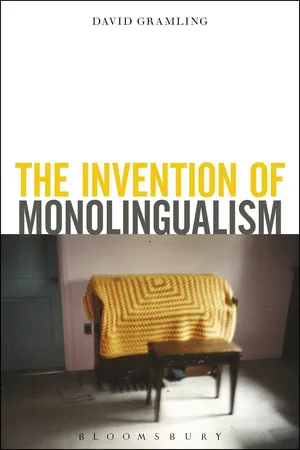
The Invention of Monolingualism harnesses literary studies, applied linguisitics, translation studies, and cultural studies to offer a groundbreaking investigation of monolingualism. After briefly describing what "monolingual" means in scholarship and public discourse, and the pejorative effects this common use may have on non-elite and cosmopolitan populations alike, David Gramling sets out to discover a new conception of monolingualism. Along the way, he explores how writers-Turkish, Latin-American, German, and English-language-have in recent decades confronted monolingualism in their texts, and how they have critiqued the World Literature industry's increasing hunger for "translatable" novels.
- 240 pages
- English
- ePUB (mobile friendly)
- Available on iOS & Android
eBook - ePub
The Invention of Monolingualism
About this book
Information
Chapter 1
MONOLINGUALISM: A USER’S GUIDE
In the mid-1990s, an unattributed report made rounds on the young internet under the title “Dihydrogen Monoxide: Unrecognized Killer.” According to this text, the substance DHMO proves so caustic when consumed that it “accelerates the corrosion and rusting of many metals, […] is a major component of acid rain, [and] has been found in excised tumors of terminal cancer patients.” Symptoms of exposure include “excessive sweating,” and “for those who have developed a dependency on DHMO, complete withdrawal means certain death” (Glassman 1997). Controversialized in this way, dihydrogen monoxide was something no conscientious citizen would want to be exposed to, let alone consume on a regular basis. Inevitably, a fourteen-year-old science enthusiast in Idaho Springs, Idaho, decided to survey fifty of his classmates to see whether the substance should be banned by law, given its clinically proven hazardous properties. A vigorous 86 percent of the junior high school population queried—many of whom were ambitious, ecologically minded science students—voted for the ban, while the other 14 percent harbored unspecified reservations about doing so. When the young experimenter Nathan Zohner presented his findings at the local science fair, he revealed—or rather pointed out—that dihydrogen monoxide was another word for water.
The bulky and authoritative term dihydrogen monoxide—hyper-accurate in nomenclature, cloying in timbre, and utterly alien to vernacular charisma—had been packaged up as a stand-in term for a common, everyday thing we all avail ourselves of; that we combine with other substances; that we cook, bathe, and wash with; harvest, hoard, waste, and design conservation plans around; fight over rights to; bottle, market, and manipulate for profit; and develop geopolitical strategies about. Word of this Kantian stunt quickly spread coastward, where David Murray, research director of the Washington, DC-based Statistical Assessment Service, responded to the teen’s findings as follows: “The likelihood is high that I could replicate these results with a survey of members of Congress” (Glassman 1997).
Zohner’s meta-science project in an Idaho classroom, inevitably called “How Gullible Are We?”, made his peers feel ashamed, and then incensed, at what seemed to be untowardly aggressive, scientistic snobbery. Thinking he had made a useful contribution to the advancement of knowledge, the young man instead found that he was presumed guilty of a mild but unforgiveable civic misdemeanor—that of testing, and then making a big poster about, his own peer group’s credulity toward crypto-authoritative language. Structurally, it mimicked the social opportunism of the snitch. As in many such cases of community-based research, respondents were disappointed to discover that his project was about mere language, rather than about the advancement of, say, health sciences or technological innovation. Suspecting entrapment, people were particularly upset at what seemed to be this precocious Enlightener-of-the-moment’s practical joke on them, this seditious bait-and-switch in something so mundane as “semantics.” Whether to blame the message or the messenger was a secondary concern, in this moment of collective social face-threat.
After decades of debate on cultural hybridity and transnationalism in the humanities and social sciences, a threshold situation of distemper with the word monolingualism has been lately afoot, similar to the messy public showdown dihydrogen monoxide incited in an Idaho town circa 1997. Monolingualism—no longer a clinical, ethnological, or demographic term alone—has gone social. It has taken up a performative role in the broader micro-political economies of what Deborah Cameron (1995, 2013) has called “verbal hygiene,” finding diverse and meaningful functions in a variety of discourse genres. This newly explicit and flexible role for monolingualism—as we will explore in this chapter—is not entirely an unprecedented innovation in public life, but the word’s spectrum of social usage and political utility has expanded significantly in recent decades.1
While the words “monolingualism” and “monolingual” continue to bear little to no specific discourse that might make them meaningful in a scholarly context, the words themselves are rapidly becoming an effective and pejorative force in twenty-first-century political and commercial contexts. Companies like Inglés sin Fronteras and Education First increasingly present Spanish-language consumers with ultimatums like “If you are monolingual, the limits of the world are more clearly defined. But in an era of borderless communications and global travels, it seems almost archaic to be limited to one language alone.”2 Buttressed with scientific-sounding claims about the bilingual mind, Education First’s advertisements conclude their pitch with the clickable buttons “Prepara tu Gap Year [Prepare for your Gap Year]” and “Hazte bilinguë con nosotros [Make yourself bilingual with us].” For its part, Inglés sin Fronteras is currently being investigated on allegations of defrauding and blackmailing consumers who are living undocumented in the United States. Having purchased the Inglés sin Fronteras CD-bundle as a ticket out of monolingualism, in the hopes of gaining the kind of “English you need to know” for a chance at legal residence, they reportedly find themselves under extortionary threats of deportation from the same company that had promised them an escape from “their” monolingualism.3 This new-found commercial and culture-political utility of the word indicates that, if monolingualism was indeed once a clinical, universitarian abstraction, the experiment has long since left the laboratory and is now at large in all manner of social discourses about what it means to be a good, effective, and intelligent world citizen.
A proto-historical snapshot
Despite its recently expanding usage, “monolingual” isn’t quite a neologism. In the pages of the London-based political magazine The Spectator from the late nineteenth century, we find the (admittedly rare) indication of what the word “monolingual” used to leverage in eras past. In a review of The Intellectual Status of the Aborigines of Victoria (1878), an anonymous reviewer for The Spectator paraphrases Robert Brough Smyth’s findings about the Koori people of southern Australia:
They have good memories, but it is in the way children have,—memories, for instance, for words, and for stories, and for the customs of the house, but not for anything requiring separate and original mental exertion, nor, it may be suspected, for things that are long past. They learn English, for example, very readily, and sometimes very perfectly, just as children in India will learn two or three languages apparently without any mental effort, and certainly without any draft upon the intelligence, which remains as undeveloped in the trilingual child—such, for example, as the well-to-do child in Pondicherry often is, and the English children in Calcutta always are—as in the monolingual one. (1879)
This unnamed reviewer’s summary of Brough Smyth’s findings on the Koori are—as the stacked prepositions in this sentence indicate—composed at great remove from the linguistic experience of actual living, speaking persons. Drawing as it does on ambient imperial truisms about how young people in Puducherry and Calcutta spoke and thought, the review expands its summary findings into a general claim about language and intellect, obscuring whether the prospective “monolingual” person is still to be understood specifically as a colonial subject or, as a potentially normative case of British home citizenship. Amid all this leisurely obfuscation, a few other things happen: 1) language and language learning are cast as not necessarily helpful in the development of intelligence, particularly for indigenous learners of English as a Second Language; 2) the monolingual child is by default characterized as the most likely candidate for achieving “separate and original mental exertion”; and 3) the colony is staged as the proper symbolic locale for “lingualism” of any sort. The colony has languages, whereas the metropole has intellect. Perhaps regrettably, The Spectator’s hypotheses about monolingualism found their way through syndication to Eliakim Littell’s popular American review The Living Age, where it debuted for U.S. readers in the same year.
Though users of the word “monolingual” in 2016 are less Lamarckian in their bid to better the lot of individual speakers, shades of the minute narratives about language emanating from The Spectator’s imperial gloss above do continue to inhere in the ways the word is deployed today. In one sense, the label “monolingual” has returned over the course of the twentieth century from the colony to the home territory. That is, the ascription “monolingual,” as presumptively applicable to persons, has mutated from a reductionist descriptor bolstering colonial discourses about the intellect of indigenous speakers abroad, to what it has become today: a reductionist descriptor bolstering moral discourses about intercultural world-readiness among citizens “at home.” What has changed, then, is the complex social mode of othering that accompanies the ascription, and the scales upon which it is found to be applicable.4
The innovation and industrialization of a concept
The title of this chapter, “Monolingualism: A User’s Guide,” is meant to openly acknowledge how little defining has been done around this bulky, inelegant, six-syllable, Latinate term. It is also meant to conjure up the “metaphors we live by” in professional discussions on language subjectivity. Is monolingualism, for instance, something one is susceptible to? Something one suffers from or under? Or is it something that one owns and instrumentalizes? Is it on loan from a regulatory body—like the electrical meter outside one’s house? Or is monolingualism a home-fashioned artesian well, cobbled privately and without external doctrine from the resources at hand in one’s own family kitchen or vernacular landscape? Does monolingualism come from the land, from God, from school, from the internet, from global capital, or from vernacular reactions to global capital?
Where The Spectator’s reviewer is thrice removed from an observed speech situation, in which the Koori are endeavoring to communicate translingually with the Anglo-Australians eager to research them, the discourse of monolingualism in the twenty-first century has set up camp in many of our most intimate social discussions: about civic responsibility, educational achievement, parenting and child development, military and counter-insurgency strategy, citizenship and migration, and the presumptive characteristics of the modern person. It has also moved into our technical lives as users of social media, electronic devices, and service interfaces. On our computers, we can download a program called Monolingual, which will remove all of the extraneous “other-language” user-interface data designed for us according to Microsoft World-Readiness protocols, so that our ever-expanding hard-drive space can remain reserved for language we really need or desire. Copyrighted by Igmar Stein and J. Schrier in 2001, the program Monolingual is represented by an on-screen program icon depicting the German, French, and U.S. flags being stuffed into a trash-bin.
The social debut of “monolingualism” is thus not merely a terminological development, but an infrastructural one. Newly laid translation and distribution pathways in the global film and fiction markets, the rise of the corporate content-management industry GILT (Globalization, Internationalization, Localization, and Translation), discontentment with L2-only or nativist approaches to teaching English as an Additional Language, as well as War-on-Terror language panics in national security and intelligence-gathering discourse have conspired to bring this awkwardly named mountain of monolingualism to the Mohammed of public discussion. This is in itself a remarkable turn, offering a unique moment of reflection for thinkers, teachers, and activists working toward what Philippe van Parijs calls Linguistic Justice for Europe and the World (2011). Though The Spectator’s usage in 1879 bodes ill for those interested in a critical reframing of monolingualism for scholarly or political purposes, the fact that the review was able to posit such a phenomenon as monolingualism, even in a register of effacement and oppression, is a feat of some note. In its various forms throughout modernity (Gogolin 1994; Bonfiglio 2010; Yildiz 2012), monolingualism has been able to naturalize itself, render itself unremarkable, and pre-empt its own historical contextualization, such that, as the Romance comparatists Jan Walsh Hokenson and Marcella Munson have it, “Bilinguality seems to be the one category of language user that high modernist thought did not, indeed perhaps even refused to, consider” (2007: 148).
The Australian applied linguist Elisabeth Ellis’s essay from 2006, “Monolingualism: The Unmarked Case,” was a watershed moment, followed by Yasemin Yildiz’s pathbreaking discussion of the “postmonolingual condition” (2012). Both of these works helped raise critical consciousness about the problematic conceptual underspecification of monolingualism in scholarship, creative work, and civic policy. As it turns out, however, there are more than a few ways to “mark” a previously unmarked category of human experience or structural privilege. As I will claim in Chapter 4, “marking the unmarked” can easily become less of a critical process than a pejorative maneuver. A phenomenon as historically and structurally complex as monolingualism requires something beyond being merely marked—it must be, in Roland Barthes’s (1957) sense, de-mythologized.
Since 2000, however, efforts—scholarly and otherwise—to open a public conversation about the conceptual and experiential substance of monolingualism have tended to run a similar course as dihydrogen monoxide once did in 1...
Table of contents
- Dedication
- Title
- Contents
- Foreword and Acknowledgments
- Introduction
- Chapter 1 Monolingualism: A User’s Guide
- Chapter 2 Kafka’s Well-Tempered Piano
- Chapter 3 The Passing of World Literaricity
- Chapter 4 A Right of Languages
- Afterword: Into the Linguacene
- Works Cited
- Index
- Copyright
Trusted by 375,005 students
Access to over 1.5 million titles for a fair monthly price.
Study more efficiently using our study tools.
Frequently asked questions
Yes, you can cancel anytime from the Subscription tab in your account settings on the Perlego website. Your subscription will stay active until the end of your current billing period. Learn how to cancel your subscription
No, books cannot be downloaded as external files, such as PDFs, for use outside of Perlego. However, you can download books within the Perlego app for offline reading on mobile or tablet. Learn how to download books offline
Perlego offers two plans: Essential and Complete
- Essential is ideal for learners and professionals who enjoy exploring a wide range of subjects. Access the Essential Library with 800,000+ trusted titles and best-sellers across business, personal growth, and the humanities. Includes unlimited reading time and Standard Read Aloud voice.
- Complete: Perfect for advanced learners and researchers needing full, unrestricted access. Unlock 1.5M+ books across hundreds of subjects, including academic and specialized titles. The Complete Plan also includes advanced features like Premium Read Aloud and Research Assistant.
We are an online textbook subscription service, where you can get access to an entire online library for less than the price of a single book per month. With over 1.5 million books across 990+ topics, we’ve got you covered! Learn about our mission
Look out for the read-aloud symbol on your next book to see if you can listen to it. The read-aloud tool reads text aloud for you, highlighting the text as it is being read. You can pause it, speed it up and slow it down. Learn more about Read Aloud
Yes! You can use the Perlego app on both iOS and Android devices to read anytime, anywhere — even offline. Perfect for commutes or when you’re on the go.
Please note we cannot support devices running on iOS 13 and Android 7 or earlier. Learn more about using the app
Please note we cannot support devices running on iOS 13 and Android 7 or earlier. Learn more about using the app
Yes, you can access The Invention of Monolingualism by David Gramling in PDF and/or ePUB format, as well as other popular books in Literatur & Sprachwissenschaft. We have over 1.5 million books available in our catalogue for you to explore.