- 248 pages
- English
- ePUB (mobile friendly)
- Available on iOS & Android
eBook - ePub
About this book
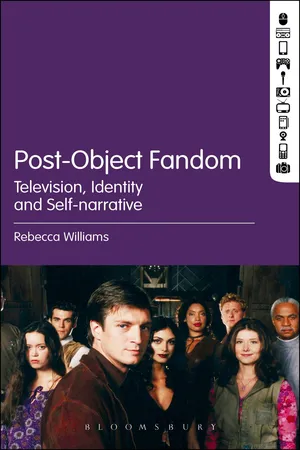
Fandom is generally viewed as an integral part of everyday life which impacts upon how we form emotional bonds with ourselves and others in a modern, mediated world. Whilst it is inevitable for television series to draw to a close, the reactions of fans have rarely been considered. Williams explores this everyday occurence through close analysis of television fans to examine how they respond to, discuss, and work through their feelings when shows finish airing. Through a range of case studies, including The West Wing (NBC, 2000-2006), Lost (ABC 2004 -2010), Buffy the Vampire Slayer (1997-2003), Doctor Who (BBC 1963-1989; 2005-), The X-Files (FOX, 1993-2002), Firefly (FOX, 2002) and Sex and the City (HBO, 1998-2004), Williams considers how fans prepare for the final episodes of shows, how they talk about this experience with fellow fans, and how, through re-viewing, discussion and other fan practices, they seek to maintain their fandom after the show's cessation.
Information
1
Introduction: The Beginning of the End
I am now officially, decidedly 100% OVER Angel: the Series! I feel like now I can finally let it go and move on with my life. Just remember it for the phenomenal show it once was, but with the serene peace of having accepted that it’s over and done, never to return.
Questionnaire respondent, 2003
If texts no longer end, they still have endings that are enormously meaningful to both fans and creators.
Harrington 2013, 591
Among the countless memorable moments that television programmes have given us, it is perhaps the final scenes of many of these that stick most clearly in the mind. The contested and divisive spiritual focus of Lost’s (ABC 2004–10) finale; the seemingly premature conclusion of Twin Peaks (ABC 1990–1), which saw lead character Dale Cooper eerily possessed by his supernatural nemesis BOB; the sad postscript to science-fiction drama series Quantum Leap (NBC 1989–92) that informs the viewer that time-travelling hero Sam Beckett ‘never went home’; the ambiguous conclusion of Buffy the Vampire Slayer (The WB 1997–2001; UPN 2001–3) spin-off Angel (The WB 1999–2004), with its final moments depicting the lead characters about to enter into a battle to avoid the apocalypse and their eventual fate left unresolved. As a viewer, and sometime fan of each of these shows, these are some of my own favourite examples. Each reader will surely have their own. However, while academic studies of fandom have examined the process of ‘becoming a fan’ (Hills 2002, 6), since this is often ‘for most fans, a milestone in their lives in which “everything changed” ’ (Cavicchi 1998, 153), reactions to the cessation of fan objects have received comparatively less academic attention. However, a consequence of a commercially driven and ever-changing media landscape is that favoured bands split up, movie franchises come to an end, characters depart TV shows and television programmes draw to a close.
This book examines responses to the specific moment when a fan object moves from being ongoing to dormant, yielding no new instalments, and the period of ‘post-object fandom’ that follows. It focuses on television and also considers how new fans negotiate discovery of shows that have ended and how this is discussed. Accepting the importance of fandom in helping us negotiate our ‘social, political and cultural realities and identities’ (Gray, Sandvoss and Harrington 2007, 10), the book contributes to a number of key debates in contemporary audience and television studies. Acknowledging that fandom can, and often does, continue through watching DVDs and reruns, collecting merchandise, listening to podcasts or using other online media or conducting ongoing conversations with fellow fans, and that media texts offer a range of endings from character departures to the complete cessation of new episodes of a series, the book explores a range of examples of fandom, transitions and endings.
Fandom is now accepted as an integral part of everyday life which impacts upon ‘how we form emotional bonds with ourselves and others in a modern, mediated world’ (Gray et al. 2007, 10). What follows focuses on how fans form such bonds, drawing upon sociologist Anthony Giddens’ (1990, 1992) work on ‘pure relationships’ to consider how endings may impact upon fans’ self-identities and sense of ontological security when the cessation of ‘a favorite program creates an emotional void and forced detachment from the program narrative’ (Costello and Moore 2007, 135). The book provides empirical material to consider responses in the period immediately before the ending of shows, as their final episodes are aired and how fans continue to use and discuss the programmes in the following years. It also explores other moments of separation and detachment for TV fans, such as the departure of favoured characters, the replacing of actors or moments where the return of a show is uncertain. It argues that attention must be paid to fans’ affective and interpretive responses to such TV events since ‘observation of the way we react to the expiration of a television show offers us another chance to understand the complexities involved in the institution of television as a portion of our social fabric’ (Anderson 2005, online). Consideration of various genres, such as reality television ‘which eliminates characters on a regular basis’ and would allow an interesting study of ‘how viewers react when their favorite character is “voted off” the show’ (Eyal and Cohen 2006, 519), or soap operas which routinely lose characters over their long-running histories, would offer an even broader range of fan responses. However, the book focuses on fans of television dramas and how they respond to the lack of new episodes of their fan objects but, in many cases, continue to engage with these objects. Many of the shows discussed here have been subject to prior academic study including 24 (FOX 2001–10), The West Wing (NBC 2000–6), Lost, Doctor Who (BBC 1963–89, 2005–), Torchwood (BBC Wales/Canadian Broadcasting Company 2006; BBC Worldwide/Starz Entertainment 2010–11), The X-Files (FOX 1993–2002), Twin Peaks, Angel, Firefly (FOX 2002) and Sex and the City (HBO 1998–2004). Discussing a range of drama series allows consideration of programmes that span different periods of longevity from those that continued for up to eight seasons and had a definite end point, to those that were cancelled prematurely and had much shorter television lifespans. The book takes a comparative approach by focusing specifically on fan audiences and considering these during the period of cancellation and beyond. The book thus contributes to debates around television fandom in three distinctive ways:
1.It argues for a rethink of how media scholars view old or ‘dormant’ texts despite the pressure on academics to focus on new media objects.
2.It urges a multi-site approach to studies of fandom, offering empirical work on how fans across different fandoms cope with the ending of shows and discuss these after networks cease airing new TV episodes.
3.It proposes the integration of approaches to fandom and identity with exploration of the concept of post-object fandom.
Revaluing dormant texts
The book focuses on older or ‘dormant’ television shows, whereas much current work within television studies has a tendency to privilege new programmes and has a ‘preoccupation with examples that are themselves “current”’ (Hastie 2007, 79). Amelie Hastie (2007) notes the commercial imperative for such a focus on liveness:
Like its synchronous temporality with television, critical texts … are also born from the particularities of the medium and the texts themselves: after all, television is first and foremost a consumerist medium, often with a proliferation of ancillary texts. In a sense, [academic collections of scholarship] take up the position of the ancillary text, or merchandise: the tie-in. (2007, 91)
Matt Hills takes this up to argue that this ‘scholarly zone of liveness’ (Hills 2010a, 101) means that older shows are often excluded from ongoing examination since they are deemed to be outdated and to have no more academic value to offer researchers: ‘Publishing a study on Buffy or The Sopranos now, however interesting it may be, would tend to fall outside the zone of liveness, with these texts having become “old news”, superseded by the next “event-made-present” ’ (Hills 2010a, 101). This book necessarily addresses the concerns of scholars such as Hills and Hastie, since its focus on fan responses to TV cancellations and their practices after this occurs means that older television shows must be revisited. In arguing that fan practices can still be usefully explored through re-examination of older media texts (especially given the appeal of box sets and reruns) the book also considers how fandom continues and attracts newcomers after the cessation of programmes. Thus, the book offers concrete examples of how older shows that may be seen to have exhausted their academic ‘currency’ (Hills 2010a, 97) can still offer new insights for both audience and television scholars.
Multi-site fan studies
Much fan studies work has been monolithic in approach, with research focusing on single fan communities such as Star Trek (Jenkins 1992), Star Wars (Brooker 2002), Buffy (Gatson and Zweerink 2004), The X-Files (Scodari and Felder 2000) or soap opera (Harrington and Bielby 1995; Baym 2000). Thus, ‘Though we know that they can engage with various objects and phenomenon at the same time, fans’ interests have often been understood singularly and their communities falsely bounded’ (Duffett 2013, 29). Consideration of fandom that ‘explores the parallels between fans of different texts or genres’ (Sandvoss 2005, 8) remains atypical and immersion in ethnographic approaches to individual fandoms continues to be the norm. However, this neglects the possibilities of multi-fandom research which may uncover new similarities or disparities in the ways in which fans engage with their varying fan objects and with one another. One notable exception is Steve Bailey’s (2005) work on identity and self-construction in fandom. He offers three diverse case studies of a local underground film network, fans of the rock group Kiss and online fans of the adult cartoon series Futurama (FOX 1999–2003; Comedy Central 2008–13). Bailey argues that, rather than forming disparate studies, these work together to highlight the ‘practices of self-construction and self-reflection’ (2005, 8) that occur within each fandom. He notes that:
These empirical investigations might be characterised as a ‘collective case study’, to refer to the distinction made by Robert E. Stake, who differentiates such studies, that are designed as a group to ‘provide insight into an issue or refinement of a theory’, from ‘intrinsic case studies’ that are designed primarily for ‘better understanding of this particular case’ (Stake 1994, 237). (Bailey 2005, 8)
Drawing on Bailey’s methods here, I follow the notion of the collective case study, as well as his use of ‘Michael Buroway’s “extended case method” in which empirical research serves a dialogical role, informing and reshaping theoretical work’ (Bailey 2005, 8). This allows ‘insight into an issue or refinement of a theory’ (Bailey 2005, 8) surrounding fan identity and ontological security. Other examples of more comparative research include Bury’s (2005) work on fans of The X-Files and Due South (CTV/CBS 1994–9), Whiteman’s (2009) study of fans of Angel and Silent Hill, and Whiteman and Metivier’s (2013) work on Angel and Harry Potter online fandoms. Despite this work, however, the use of ‘collective case studies’ to draw points of cohesion or conflict across apparently incongruent cultural sites remains rare. The research presented here aims to move beyond enquiry into singular fan communities and to embrace the comparative potential of multi-site case studies. It seeks to follow those scholars who, as Harrington and Bielby summarize, ‘are moving away from studying specific fan communities – soap fans or Doctor Who fans or fans of China’s Super Girl singing contest – to focusing on broader dimensions of fandom or fan affect’ (2013, 99). In offering a way to understand a range of different television fans the book concurs with Matt Hills’s contention that ‘a general theory of media fandom is not only possible but also important; too many previous works have focused on single TV series, singular fan cultures, or singular media (“TV fans” versus “cinephiles”)’ (Hills 2002, 2).
Fandom, identity and post-object fandom
The book’s most ambitious aim is its contribution to the existing and developing literature on television and audience research. The broader concerns of this monograph have been shared by other writers. For instance, whenever studies have examined fan campaigns to prevent the cancellation of television shows such as Star Trek (NBC 1966–9), Angel, Veronica Mars (UPN 2004–6; The CW 2006–7), Chuck (NBC 2007–12), Roswell (The WB 1999–2001; UPN 2001–2), Jericho (CBS 2006–8) or Firefly (FOX 2002) (see Abbott 2005; Scardaville 2005; Menon 2007; Whiteman 2009; Paproth 2013; Barton 2014b, 165–6) they have been implicitly concerned with reactions to the ending of fan objects. Furthermore, wider studies on aging in Goth fandom (Hodkinson 2011) or punks (Bennett 2006) and elderly fans of a Flemish singer (Van den Bulck and Van Gorp 2011), approaches using the notion of ‘status passage’ to understand fans’ changes over time (Crawford 2003, 2004), and discussion of ‘enduring fandom’ (Kuhn 2002) and ‘lifelong fandom’ (Stevenson 2009) all speak to the importance of considering fandom as a continuing part of an individual’s life, one that can have a profound impact on their sense of identity and self-narrative. For instance, Paul Hodkinson’s study of Goths found that fans’ ‘intensity of involvement [with the Goth scene] would fluctuate to and fro at various points, often in relation to developments or ruptures in other elements of individual life trajectories’ (2011, 272), while Harrington and Bielby’s ongoing research into the ‘life course of fandom’ suggests that ‘changes in the fan self over time, age norms within fandom, and changes in the fan object over time’ mean that ‘fans’ identities, practices and interpretive capacities have more age-related structure than has previously been addressed in fan studies’ (Harrington et al. 569–70). Clearly, fandom and self-identity are closely linked. As Mark Duffett summarizes:
Fans tend to periodize their lives around autobiographic turning points where ‘everything changed’ and they became interested. Their initiation frequently becomes an important personal memory, recalled and discussed with others. Autobiographical first-person ‘becoming a fan’ stories are usually the first things fans talk about when they get to know others, whether in person or online. Such stories allow each individual to locate his or her fandom as a shift in personal history. (2013, 154)
In addition to contributing to studies of fandom and self-identity, the book also speaks to debates regarding the endings of television series, whether in reference to the finite episodes of a show or smaller endings such as the exit of particular characters. For instance, Elena Levine and Lisa Parks (2007) argue that examining the ‘afterlife’ of Buffy the Vampire Slayer has much to tell us about a dormant TV text. Similarly an emerging body of work has focused on the importance, both textually and for the audience, of the television finale, with specific cases focusing on Seinfeld (Morreale 2003), Lost and The Prisoner (Morreale 2010), and The Sopranos (Corrigan and Corrigan 2012), as well as Jason Mittell (2013) and C. Lee Harrington’s (2013) attempts to theorize television finales more broadly. There is also emerging work on practices in specific fandoms after series end, including Chin’s discussion of fan/producer relationships in The X-Files fandom, which suffers an apparent ‘absence of new materials to be discussed, analysed and expanded on creatively’ (2013, 88), Thompson’s (2014) exploration of the ongoing fandom of Dark Shadows and Bore and Hickman’s (2013) analysis of post-The West Wing fans’ use of Twitter to portray the characters and continue the diegetic world of the series. Perhaps the most discussed television series, however, is Friends, which has attracted academic study of fan responses to the temporary loss of characters in the show during the 2007–8 writers’ strike (Lather and Moyer-Guse 2011) as well as analysis of fan responses to the show’s ending (Eyal and Cohen 2006; Todd 2011). The work of Eyal and Cohen and Lather and Moyer-Guse draws on Horton and Wohl’s (1956) theory of parasocial interaction to examine fans’ attachment to characters, arguing that both temporary and permanent loss of contact with those characters can lead to a form of ‘parasocial breakup’ (Cohen 2003). In both cases, links were found between the depth of parasocial relationship and the impact of the breakup. Amanda Todd’s work, in contrast, emphasized the construction of the Friends finale by its US broadcasting network NBC and the co...
Table of contents
- Dedication
- Title
- Contents
- Acknowledgements
- 1 Introduction: The Beginning of the End
- 2 Ontological Security, Self-Identity and Post-Object Fandom
- 3 Departures, Deaths and Replacements: When Characters Leave
- 4 ‘The Constant in my Life’: The Reiteration Discourse
- 5 ‘Turning off the Life Support’: The Rejection Discourse
- 6 Moving On? The Renegotiation Discourse
- 7 ‘Living in DVD-Land’: Post-Object Fandom, Re-Watching and Digital Media
- 8 Continuing the Show: Interim Fandom, Resurrections and Fan-Created Texts
- 9 Conclusion: Immortal Fandom
- Bibliography
- Index
- Copyright
Trusted by 375,005 students
Access to over 1.5 million titles for a fair monthly price.
Study more efficiently using our study tools.
Frequently asked questions
Yes, you can cancel anytime from the Subscription tab in your account settings on the Perlego website. Your subscription will stay active until the end of your current billing period. Learn how to cancel your subscription
No, books cannot be downloaded as external files, such as PDFs, for use outside of Perlego. However, you can download books within the Perlego app for offline reading on mobile or tablet. Learn how to download books offline
We are an online textbook subscription service, where you can get access to an entire online library for less than the price of a single book per month. With over 1.5 million books across 990+ topics, we’ve got you covered! Learn about our mission
Look out for the read-aloud symbol on your next book to see if you can listen to it. The read-aloud tool reads text aloud for you, highlighting the text as it is being read. You can pause it, speed it up and slow it down. Learn more about Read Aloud
Yes! You can use the Perlego app on both iOS and Android devices to read anytime, anywhere — even offline. Perfect for commutes or when you’re on the go.
Please note we cannot support devices running on iOS 13 and Android 7 or earlier. Learn more about using the app
Please note we cannot support devices running on iOS 13 and Android 7 or earlier. Learn more about using the app
Yes, you can access Post-Object Fandom by Rebecca Williams in PDF and/or ePUB format, as well as other popular books in Ciencias sociales & Historia y crítica de la televisión. We have over 1.5 million books available in our catalogue for you to explore.