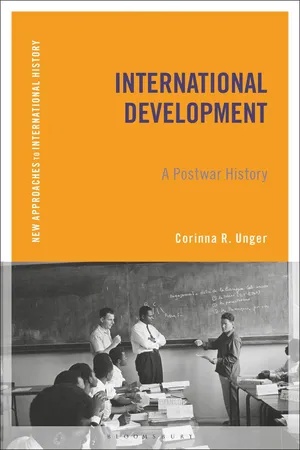
International Development: A Postwar History offers the first concise historical overview of international development policies and practices in the 20th century.
Embracing a longue durée perspective, the book describes the emergence of the development field at the intersection of late colonialism, the Second World War, the onset of decolonization, and the Cold War. It discusses the role of international organizations, colonial administrations, national governments, and transnational actors in the making of the field, and it analyzes how the political, intellectual, and economic changes over the course of the postwar period affected the understanding of and expectations toward development.
By drawing on examples of development projects in different parts of the world and in different fields, Corinna R. Unger shows how the plurality of development experiences shaped the notion of development as we know it today. This book is ideal for scholars seeking to understand the history of development assistance and to gain new insight into the international history of the 20th century.
- 257 pages
- English
- PDF
- Available on iOS & Android
eBook - PDF
About this book
Information

DECOLONIZATION
AND
THE
COLD
WAR
101
effectively
contributed
to
the
internationalization
of
politics.
As
multilateral
assistance
gained
in
scope,
international
organizations
claimed
an
increasingly
influential
position
in
global
governance
issues,
and
the
foreign
policy
interests
of
different
nation
states
became
increasingly
entangled
and
institutionalized
in
new
bodies
like
the
Development
Assistance
Committee
and
the
multilateral
development
consortia.
From
the
point
of
view
of
the
so-called
developing
countries,
the
growing
popularity
of
development
aid
in
the
international
arena
presented
opportunities
as
well
as
dangers.
The
opportunities
were
obvious:
immense
technical
and
financial
resources
were
becoming
available
through
international
assistance,
allowing
the
countries
suffering
from
low
levels
of
productivity
and
income
to
envision
ambitious
development
projects.
Due
to
the
Cold
War,
the
ratio
between
demand
and
supply
was
in
favor
of
the
potential
recipients
of
aid,
and
many
of
them
proved
to
be
skilled
at
playing
the
two
sides
against
each
other
in
securing
access
to
the
resources
they
needed.
Yet
the
aid
game
carried
risks
because
the
geopolitical
constellations
that
characterized
the
Cold
War
could
change
rapidly.
Also,
the
strategic
use
of
assistance
could
create
new
dependencies,
which
the
former
colonies
had
wanted
to
discard
urgently
but
often
found
themselves
caught
in
again.

Table of contents
- Cover
- Contents
- Abbreviations
- Acknowledgments
- 1 Introduction
- 2 Development in History: “Everyman’s Road to Utopia?”
- 3 Forerunners of Development
- 4 The Emergence of Development in the Mid-Twentieth Century
- 5 Development in the Context of Decolonization and the Cold War
- 6 Development Approaches and Practices in the Postwar Period
- 7 Challenges to Development
- 8 The Disintegration of Development
- 9 Conclusion and Outlook
- Notes
- Bibliography
- Index
Trusted by 375,005 students
Access to over 1.5 million titles for a fair monthly price.
Study more efficiently using our study tools.
Frequently asked questions
Yes, you can cancel anytime from the Subscription tab in your account settings on the Perlego website. Your subscription will stay active until the end of your current billing period. Learn how to cancel your subscription
No, books cannot be downloaded as external files, such as PDFs, for use outside of Perlego. However, you can download books within the Perlego app for offline reading on mobile or tablet. Learn how to download books offline
Perlego offers two plans: Essential and Complete
- Essential is ideal for learners and professionals who enjoy exploring a wide range of subjects. Access the Essential Library with 800,000+ trusted titles and best-sellers across business, personal growth, and the humanities. Includes unlimited reading time and Standard Read Aloud voice.
- Complete: Perfect for advanced learners and researchers needing full, unrestricted access. Unlock 1.5M+ books across hundreds of subjects, including academic and specialized titles. The Complete Plan also includes advanced features like Premium Read Aloud and Research Assistant.
We are an online textbook subscription service, where you can get access to an entire online library for less than the price of a single book per month. With over 1.5 million books across 990+ topics, we’ve got you covered! Learn about our mission
Look out for the read-aloud symbol on your next book to see if you can listen to it. The read-aloud tool reads text aloud for you, highlighting the text as it is being read. You can pause it, speed it up and slow it down. Learn more about Read Aloud
Yes! You can use the Perlego app on both iOS and Android devices to read anytime, anywhere — even offline. Perfect for commutes or when you’re on the go.
Please note we cannot support devices running on iOS 13 and Android 7 or earlier. Learn more about using the app
Please note we cannot support devices running on iOS 13 and Android 7 or earlier. Learn more about using the app
Yes, you can access International Development by Corinna R. Unger in PDF and/or ePUB format, as well as other popular books in History & 20th Century History. We have over 1.5 million books available in our catalogue for you to explore.