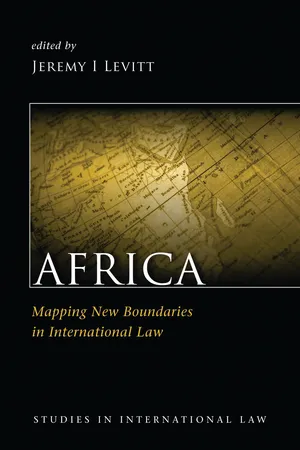
The principal aim of this work is to provide a forum for leading international lawyers with experience and interest in Africa to address a broad range of intellectual challenges concerning the contribution of African states and peoples to international law. As such, the volume addresses orthodox topics of international law - such as jurisdiction and intervention - but tackles them from an African perspective, and seeks to ask whether, in each case, the African perspective is unique or affirms existing arrangements of international law. The book cannot come at a more important time. While international legal discourse has been captured by the challenge of terrorism since September 11, 2001, there are clear signs that other issues are returning to the fore. Political interest in Africa has undergone a global revival, and the OAU has been transformed into the African Union. Infrastructural challenges, along with those taking place in regional contexts, have effectively mapped a new politico-legal landscape for Africa. This, and more, is explored, and the key normative questions are addressed in a series of essays by leading Africanist scholars.
'This is a remarkable collection of essays that clearly and concisely demonstrates that Africa has and will continue to play a major role in fashioning new norms of international law and policy and contribute to its progressive development by affirming existing norms. Professor Levitt is to be commended for having the vision, leadership and intellectual prowess to produce this excellent text. The book signals a major shift from the study of Africa as a basket case to a normative market place.'
Akua Kuenyehia, Vice President, International Criminal Court
'Professor Levitt's work, Africa: Mapping New Boundaries in International Law, is pathbreaking in the true sense of that word. Through old and new voices, it excavates the singular contributions of Africa to a discipline that is marked by Eurocentrism and imperial aspirations. The authors, taking their cue from the indefatigable and insightful Professor Levitt, establish beyond a shadow of a doubt the enormity of the normative contributions that Africa has made to international law. The book must therefore be seen as a defining contribution to the multiculturalization of international law. It is for this reason that Professor Levitt is among the most important American academics working and thinking in international law today.'
Makau Mutua, Interim Dean, SUNY Distinguished Professor, State University of New York Buffalo Law School
- 356 pages
- English
- PDF
- Available on iOS & Android
eBook - PDF
About this book
Information
Table of contents
- Cover
- Half title page
- Title page
- Title verso
- Foreword
- Acknowledgements
- Contents
- Contributors
- Introduction- Africa: A Maker of International Law
- Part I Human Rights, Intervention and Armed Conflict
- Part II Governance, Sovereignty and Development
- Bibliography
- Index
Trusted by 375,005 students
Access to over 1.5 million titles for a fair monthly price.
Study more efficiently using our study tools.
Frequently asked questions
Yes, you can cancel anytime from the Subscription tab in your account settings on the Perlego website. Your subscription will stay active until the end of your current billing period. Learn how to cancel your subscription
No, books cannot be downloaded as external files, such as PDFs, for use outside of Perlego. However, you can download books within the Perlego app for offline reading on mobile or tablet. Learn how to download books offline
Perlego offers two plans: Essential and Complete
- Essential is ideal for learners and professionals who enjoy exploring a wide range of subjects. Access the Essential Library with 800,000+ trusted titles and best-sellers across business, personal growth, and the humanities. Includes unlimited reading time and Standard Read Aloud voice.
- Complete: Perfect for advanced learners and researchers needing full, unrestricted access. Unlock 1.5M+ books across hundreds of subjects, including academic and specialized titles. The Complete Plan also includes advanced features like Premium Read Aloud and Research Assistant.
We are an online textbook subscription service, where you can get access to an entire online library for less than the price of a single book per month. With over 1.5 million books across 990+ topics, we’ve got you covered! Learn about our mission
Look out for the read-aloud symbol on your next book to see if you can listen to it. The read-aloud tool reads text aloud for you, highlighting the text as it is being read. You can pause it, speed it up and slow it down. Learn more about Read Aloud
Yes! You can use the Perlego app on both iOS and Android devices to read anytime, anywhere — even offline. Perfect for commutes or when you’re on the go.
Please note we cannot support devices running on iOS 13 and Android 7 or earlier. Learn more about using the app
Please note we cannot support devices running on iOS 13 and Android 7 or earlier. Learn more about using the app
Yes, you can access Africa by Jeremy I Levitt in PDF and/or ePUB format, as well as other popular books in Law & International Law. We have over 1.5 million books available in our catalogue for you to explore.