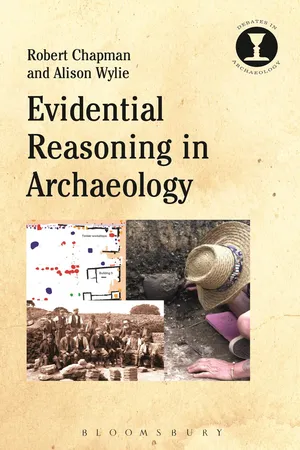
How do archaeologists work with the data they identify as a record of the cultural past? How are these data collected and construed as evidence? What is the impact on archaeological practice of new techniques of data recovery and analysis, especially those imported from the sciences?
To answer these questions, the authors identify close-to-the-ground principles of best practice based on an analysis of examples of evidential reasoning in archaeology that are widely regarded as successful, contested, or instructive failures. They look at how archaeologists put old evidence to work in pursuit of new interpretations, how they construct provisional foundations for inquiry as they go, and how they navigate the multidisciplinary ties that make archaeology a productive intellectual trading zone. This case-based approach is predicated on a conviction that archaeological practice is a repository of considerable methodological wisdom, embodied in tacit norms and skilled expertise – wisdom that is rarely made explicit except when contested, and is often obscured when questions about the status and reach of archaeological evidence figure in high-profile crisis debates.
- 264 pages
- English
- ePUB (mobile friendly)
- Available on iOS & Android
eBook - ePub
Evidential Reasoning in Archaeology
About this book
Information
1
‘An element of conjecture which cannot be tested’
In the mid-1950s a field archaeologist who worked extensively with Christopher Hawkes presented a short paper on ‘The Limitations of Inference in Archaeology’ to the Prehistoric Society at the Institute of Archaeology in London. She was identified as Miss M. A. Smith,1 and she clearly drew on philosophical as well as archaeological training. In this article, which appeared in the British Archaeological Newsletter in 1955, Smith argued that although the ‘assimilation of archaeology to scientific practice’ had greatly expanded the range and improved the quality of the data recovered by archaeologists, providing them with ‘precise determinations’ of their finds, these accomplishments had come at a cost. The growing emphasis on technical competence did tend, she observed, to ‘have a rather hypnotic effect on the mind’; it carried the risk that archaeologists would lose their sense of purpose as practitioners of a human, historical science (1955: 1). But rather than defend an ambitiously humanistic archaeology – one dedicated to grasping the distinctively human, social dimensions of the cultural past – Smith went on to argue that archaeology is inherently limited in what it can hope to understand of the vast reaches of human history that are, as she put it, ‘undocumented’ (p. 2).
The reason for Smith’s pessimism was the appraisal that there is ‘no logical relation’ between the social, cultural past and its surviving record. The only inferences from archaeological data that she recognized as ‘legitimate’ are those for which ‘all the evidence can be empirically verified’ and ‘nothing has been added’ (p. 2); the inferential standard she invokes here is what philosophers would describe as ‘truth-preserving deductive entailment’.2 As she points out, when this level of certainty is realized, the conclusions drawn are really nothing more than ‘a paraphrase of empirical observations’ as these are presented in the premises of the argument (p. 2). If archaeologists adhered to such a standard, she asks, how could they ever grasp the form of life, the animating aesthetic sensibilities and social relations of, say, Trobriand Island society as described in rich ethnographic detail by Bronisław Malinowski? No matter how ‘perfectly conducted’, the archaeological excavation of a Trobriand village could never carry archaeologists any distance towards an understanding of the complexity of Trobriand society, nor even give them a very robust understanding of the agricultural practices, local economy or demography of these communities; ‘it would obviously be impossible’, she concludes, ‘to understand the relics of the Trobrianders from the evidence of the material remains alone’ (p. 3). She then draws from this example a quite general lesson that she refers to as the Diogenes problem. Quoting Mortimer Wheeler, she observes that ‘the archaeologist may find the tub … but altogether miss Diogenes’ (p. 2; Wheeler 1950: 130) and, moreover, may have no way of ever knowing what they have missed.3
Smith’s argument for this conclusion depends on two sets of claims. While she emphasizes the epistemic and methodological challenges that archaeologists face working with an incomplete material record of the cultural past, she also invokes a more fundamental, ontological4 problem that arises from the nature of the subject of inquiry. She argues that, by their very nature, the cultural subjects of interest to archaeologists must elude understanding; the relationship that holds between surviving material traces and the social contexts and actions that give them cultural significance is radically unstable. Although Smith does not develop this point in any detail, she invokes a ‘normative’ or ‘ideational’ conception of culture: the view, most systematically developed in an archaeological context by Walter Taylor, that culture is a ‘mental phenomenon’; it consists of community norms and conventions that inform behaviour and are manifest in material culture, these being ‘objectifications’ of culture proper (1948: 49). This resonates with an influential Wittgensteinian argument against the very ‘idea of a social science’ put forward in philosophical terms by Peter Winch, an Oxford-trained contemporary of Smith’s (Winch 1958). In his account, social actions, as social, are distinctively ‘rule following’, not law-governed; they are intentional, not mere stimulus-responsive behaviours. In this respect, social, cultural subjects are not just more complex or more chaotic than natural phenomena; they are categorically different. To focus on behavioural regularities an effort to emulate the natural sciences is to ignore the beliefs and intentions, the shared understandings and collective norms that give actions meaning, and it is only by grasping the meanings of actions, Winch argued, that they can be understood. The goals of law-governed explanation and prediction (or retrodiction) typical of the natural sciences are inadequate to the study of social phenomena; capturing regularities in behaviour provides no insight into the reasons and intentions of actions that constitute them as social (see his Chapter 3, ‘The Social Studies as Science’). Smith’s worry is that, even with the most complete material record imaginable (a Pompeii or an Ozette), if you cannot invoke uniformitarian law-like premises about the connections between traces and their antecedents, it is impossible to secure interpretive conclusions with the degree of certainty she requires. Between ‘the human activities we should like to know about’ and the ‘visible results which survive from them’ there is, she argues, ‘logically no necessary link’; therefore it is ‘a hopeless task’ to attempt to move from one to the other ‘by argument’ (Smith 1955: 4).
The upshot is that, according to Smith’s account, any inference that goes beyond empirical description of the surviving material traces must be understood to ‘contain an element of conjecture, which cannot be tested’ (p. 3); it is inescapably speculative. Better for archaeologists to trim their sails, she urges, than indulge in the vain hope that ratcheting up scientific rigour in the recovery and analysis of material traces will fill this inferential gap. A lesson that archaeologists should learn from the sciences, Smith counsels, is to respect the ‘insuperable limits to what can legitimately be inferred from archaeological material’ (pp. 4–5).
In fact, Smith’s pessimism is even more undermining than she acknowledges, inasmuch as observational claims about material traces – certainly any claims that involve identifying them as archaeological – are already, themselves, highly selective and richly interpretive. The ‘element of conjecture’ that worries her afflicts the empirical premises of the inferences she considers inherently insecure as much as they do the more ambitious conclusions about the cultural past that she declares out of reach.
Crisis debates5
As extreme as Smith’s line of argument may seem, it is by no means an isolated example of epistemic anxiety about the status of archaeological evidence and the grounds it provides for understanding the cultural past. Indeed, these worries are not unique to archaeology,6 but archaeologists have been especially reflective about the fact that they have no alternative but to depend on evidence that is, as one commentator put it, ‘remote from and uncertainly coupled to the systems [they] seek to study’ (Chippindale 2002: 606). The ‘proxy status’ of archaeological evidence entails a reliance on ‘auxiliary’ hypotheses – background assumptions, ‘gap-crossers’, ‘middle-range theory’7 – that establish the connections between surviving traces and the past events, conditions and actions of which they are presumed to be evidence. As for Smith, these more recent worries are both epistemic and ontological. Material traces are subject to the vagaries of destruction, dispersal and distortion; confounding causal factors are always a possibility to be reckoned with; and, in a great many cases, even if these can be ruled out, the same configuration of traces can plausibly be explained in terms of different originating and mediating conditions. This problem of equifinality is especially acute when the subject of inquiry is a symbolically rich material culture that may embody (by intention or accretion) an array of different meanings; a problem of (epistemic) underdetermination8 is thus amplified by the indeterminacy of the subject of inquiry itself.
To make matters worse, these worries are sometimes amplified and generalized by appeal to the ‘theory-laden’ nature of archaeological evidence.9 If material traces can only be recognized as archaeological and put to work as evidence when interpreted in light of some background theory, so the argument goes, then the conclusions drawn are always vulnerable to what Bell describes as xeroxing (2015: 42, 45): the imposition of interpretive conventions that moulds material traces to contemporary ‘pre-understandings’ (Hodder 1999: 49–52). Furthermore, this suggests that archaeological evidence is inherently unstable; depending on the background theory archaeologists bring to bear, they may interpret the significance of their data as evidence very differently; indeed, their assumptions may predetermine what they will find. At best, then, what we count as archaeological evidence is subject to two orders of sampling bias: first, the biases introduced by the vagaries of survival of material traces and, second, the limitations imposed by the resources archaeologists draw on to recognize, recover and interpret these traces as evidence. At worst, the most deeply pessimistic commentators worry that evidential reasoning in archaeology is nothing but the projection of contemporary expectations onto the past. The shared insight here is that archaeological evidence is not an autonomous, self-warranting empirical ‘foundation’, different in kind from the theoretical claims it supports or is used to test; it is, itself, an interpretive construct. As such, it cannot secure claims about past events with the kind of certainty required by Smith. In its most uncompromising form, this ‘constructionist’ line of argument10 leads to the conclusion that appeals to archaeological evidence never escape the threat of vicious circularity;11 if empirical data are inevitably interpreted in terms of ‘pre-understandings’, the worry is that the evidential claims archaeologists base on these data cannot but conform to their expectations.
Anxieties of this sort have provoked a series of crisis debates within archaeology that go back at least a century and follow a predictable pattern. In the early twentieth century the advocates of a First World War-era ‘New Archaeology’ insisted, in opposition to an antiquarian preoccupation with ‘the mere finding of things’, that archaeologists must set their sights on genuinely anthropological questions about the past and embrace scientific methods in addressing them (Wissler 1917). ‘The time is past when our major interest was in the specimen’, declared Roland Dixon (1913: 564); to move beyond the ‘woefully haphazard and uncoordinated’ practices of their antiquarian forebears, he argued, archaeologists must focus their attention on gathering evidence relevant to building and testing ‘working hypotheses’ about ‘the relations of things … the whens and the whys and the hows’ (p. 565). To this end, Dixon argued, it would be necessary to develop a rich body of cultural theory, including both general theory about cultural systems and processes, and an understanding of specific cultural forms grounded in contemporary ethno-history; only given these resources would archaeologists be able to link surviving material traces to antecedent cultural forms and begin to make use of these data as evidence to refine and test explanatory hypotheses about the past. This call for ‘saner and more truly scientific methods’ (p. 563) was immediately met by criticism from those who objected that any attempt to theorize was premature, little more than a licence to speculate that could only undermine the integrity of the very evidence archaeologists were working so hard to recover; the priority for properly scientific archaeology must be to build a robust body of ‘facts’ and defer theorizing until the evidence was in (Laufer 1913).
Despite repeated declarations that the field had been professionalized – that by mid-century archaeology was ‘completely divorced from the business of collecting curios and the stigma of antiquarianism had practically disappeared’ (F. Johnson 1961: 2) – frustration that more ambitious historical, anthropological goals were still not being addressed effectively resurfaced in the late 1930s, the 1950s and again with the (new) New Archaeology of the 1970s. Clyde Kluckhohn objected that many archaeologists remained ‘but slightly reformed antiquarians’ (1940: 43); the recovery of ‘facts’ from (or about) the archaeological record was still a central preoccupation. Over the next thirty years a succession of internal critics challenged ‘traditional’ modes of practice that were chiefly concerned to bring systematic order to these facts, constructing cultural histories that were little more than a gloss on descriptive claims about the formal variability and spatial-temporal distribution of archaeological material.
At each juncture when the advocates of a more robustly anthropological archaeology have challenged the wisdom of deferring explanatory goals, the lines of dispute have been strikingly similar. On the one hand, there are those who insist that data collection must be the first, foundational stage of archaeological inquiry. So, for example, in a North American context Taylor argues that archaeological inquiry, qua archaeology, is ‘no more than a method or set of specialized techniques for the gathering of cultural information’, and the archaeologist ‘nothing but a technician’ (1948: 41). What archaeologists do with these data once they are recovered will determine whether they contribute to historical or anthropological understanding but, as archaeologists, they should operate with just one objective: ‘to exploit fully and without abridgement the cultural or geographical record contained within the site attacked’ (p. 153); to ‘transpos[e] the record from the ground to some form, both permanent and available’ (p. 154). These themes are reiterated by Philip Barker with reference to British archaeology in the late 1970s when he argues that excavators should strive for ‘complete objectivity’; their primary goal should be to build a foundation of empirical data that is free of interpretive presuppositions and neutral with respect to the questions archaeologists might later want to take up (1977: 12; Bradley 2015).12
On the other hand, the critics of this data-first approach to inquiry13 argue that it is untenable and self-defeating; it can never realize the kind of understanding that makes archaeology worth doing. They object, with increasing intensity and sophistication through the post-war years, that it is fundamentally misguided to assume that archaeological ‘facts’ can be recovered independently of any specific purpose or theory. This is to assume a ‘narrow empiricism’, a ‘simpliste mechanistic-positivistic philosophy’ as Kluckhohn described it, the limitations of which were already evident by the 1940s; the volume of data recovered had grown dramatically with little commensurate expansion of historical or anthropological understanding (1939; 1940: 46). ‘Passive observation’ is not an option, declared John Bennett (1946: 200); there are no empirical givens that archaeologists can establish as ‘facts’ in a theoretical vacuum. Moreover, this is not a predicament distinctive of archaeology as a social, historical science. Kluckhohn arg...
Table of contents
- Debates in Archaeology
- Title
- Contents
- List of Illustrations
- Acknowledgements
- Introduction: The Paradox of Material Evidence
- 1 Archaeological Evidence in Question: Working between the Horns of a Dilemma
- 2 Archaeological Fieldwork: Scaffolding in Practice
- 3 Working with Old Evidence
- 4 External Resources: Archaeology as a Trading Zone
- Conclusions: Reflexivity Made Concrete
- Bibliography
- Index
- Copyright
Trusted by 375,005 students
Access to over 1.5 million titles for a fair monthly price.
Study more efficiently using our study tools.
Frequently asked questions
Yes, you can cancel anytime from the Subscription tab in your account settings on the Perlego website. Your subscription will stay active until the end of your current billing period. Learn how to cancel your subscription
No, books cannot be downloaded as external files, such as PDFs, for use outside of Perlego. However, you can download books within the Perlego app for offline reading on mobile or tablet. Learn how to download books offline
Perlego offers two plans: Essential and Complete
- Essential is ideal for learners and professionals who enjoy exploring a wide range of subjects. Access the Essential Library with 800,000+ trusted titles and best-sellers across business, personal growth, and the humanities. Includes unlimited reading time and Standard Read Aloud voice.
- Complete: Perfect for advanced learners and researchers needing full, unrestricted access. Unlock 1.5M+ books across hundreds of subjects, including academic and specialized titles. The Complete Plan also includes advanced features like Premium Read Aloud and Research Assistant.
We are an online textbook subscription service, where you can get access to an entire online library for less than the price of a single book per month. With over 1.5 million books across 990+ topics, we’ve got you covered! Learn about our mission
Look out for the read-aloud symbol on your next book to see if you can listen to it. The read-aloud tool reads text aloud for you, highlighting the text as it is being read. You can pause it, speed it up and slow it down. Learn more about Read Aloud
Yes! You can use the Perlego app on both iOS and Android devices to read anytime, anywhere — even offline. Perfect for commutes or when you’re on the go.
Please note we cannot support devices running on iOS 13 and Android 7 or earlier. Learn more about using the app
Please note we cannot support devices running on iOS 13 and Android 7 or earlier. Learn more about using the app
Yes, you can access Evidential Reasoning in Archaeology by Robert Chapman,Alison Wylie in PDF and/or ePUB format, as well as other popular books in Social Sciences & Archaeology. We have over 1.5 million books available in our catalogue for you to explore.