eBook - ePub
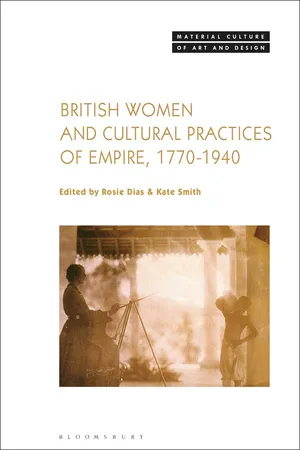
British Women and Cultural Practices of Empire, 1770-1940
- 256 pages
- English
- ePUB (mobile friendly)
- Available on iOS & Android
eBook - ePub
British Women and Cultural Practices of Empire, 1770-1940
About this book
Correspondence, travel writing, diary writing, painting, scrapbooking, curating, collecting and house interiors allowed British women scope to express their responses to imperial sites and experiences in the 18th, 19th and 20th centuries. Taking these productions as its archive, British Women and Cultural Practices of Empire, 1775-1930 includes a collection of essays from different disciplines that consider the role of British women's cultural practices and productions in conceptualising empire. While such productions have started to receive greater scholarly attention, this volume uses a more self-conscious lens of gender to question whether female cultural work demonstrates that colonial women engaged with the spaces and places of empire in distinctive ways. By working across disciplines, centuries and different colonial geographies, the volume makes an exciting and important contribution to the field by demonstrating the diverse ways in which European women shaped constructions of empire in the modern period.
Information
Part One
Travel
1
The Travelling Eye: British Women in Early Nineteenth-Century India
David Arnold
The relationship between British women travellers in India in the first half of the nineteenth century and the material and cultural world they inhabited is reflected in the letters they wrote and in their published correspondence. Although the subject of women travellers, in British India and under empire more generally, has been extensively discussed, the nature and significance of the ‘female gaze’ still calls for re-examination – not least in the light of what men observed and wrote.1 This can best be done not only by examining the letters that women produced and, in many cases, published, but also by regarding women as having, through their journeying and their representational techniques, a distinctive role in the visualizing of India. The letters written by observant and literary-minded women, the wider circulation of that correspondence in print, and the sketching and drawing that accompanied letter writing or to which extensive reference was made in letters constitute a creative nexus that both complemented and contrasted with the work of men. Letters, travelogues and sketches further underscore the importance of mobility – the movement of people as well as objects – to the creative impulse and to our understanding of the material environment and cultural milieu of white women travellers.
Writing home
While the British women who travelled in nineteenth-century India and wrote about their experiences once found little place in the male-oriented historiography of empire, it is now clear that there were a substantial number of educated white women who wrote, often influentially, about their travels, and imperial history writing has itself grown more sensitive to their observations and reminiscences. Some women’s correspondence remained unpublished until recently (the letters of Henrietta Clive and Honoria Lawrence, for example); but many other women published works that either had their origin in letters or partially retained the epistolary form when they appeared in print. It is a mark of their contemporary standing that many of these volumes were issued by leading publishing houses in London or Edinburgh. Some soon lapsed into obscurity, but others were widely read and reviewed at the time. A few (Maria Graham’s Journal, Mrs Mackenzie’s Life) were republished within a year or two of their first appearance. Emily Eden’s collection of letters Up the Country has even been hailed as ‘one of the great classics of British imperial literature’.2 Table 1.1 lists the authors discussed in this chapter, though their works formed only a small part of the voluminous writing about India produced by British women between the late eighteenth and mid-nineteenth centuries.3
These women were not in India as independent travellers but because they were married to (or were the daughters, sisters or sisters-in-law of) men employed in India as m ilitary or naval officers of the Crown or servants of the English East India Company (EIC). Maria Graham’s husband was a captain in the Royal Navy, whose subsequent travels took her to Brazil and Chile.4 Others were the wives of civilians: Ann Deane’s husband was a district collector in Bihar; Fanny Parkes was married to a civil servant in Allahabad. Of the aristocratic authors, Emily Eden was in India because her unmarried brother George, Lord Auckland, was governor-general of India. Lady Clive’s husband was governor of Madras, Lady Falkland’s that of Bombay. While some writers, such as the irrepressible Parkes, exuded almost unbounded enthusiasm for India, others, like Emily Eden and her sister Fanny, regarded India as ‘this horrid country’ and felt they had been ‘transported’ there involuntarily, like convicts condemned to live in unsought exile.5 One of the most widely quoted passages in Emma Roberts’s Scenes and Characteristics related her discomfort at finding herself a single woman in India, an inconvenient accessory and financial burden to her sister and brother-in-law.6
Table 1.1 British women travellers and their works, c. 1800–567
| Author | Period | Published work |
| Henrietta Clive | 1798–1801 | Birds of Passage (2009) |
| Maria Graham | 1809–11 | Journal of a Residence in India (1812) |
| Ann Deane | 1804–14 | A Tour through the Upper Provinces of Hindostan (1823) |
| Anne Elwood | 1826–8 | Narrative of a Journey Overland from England (1830) |
| Fanny Parkes | 1827–38 | Wanderings of a Pilgrim in Search of the Picturesque (1850) |
| Emma Roberts | 1830s | Scenes and Characteristics of Hindostan (1835) |
| Marianne Postans | 1830s | Cutch: Or, Random Sketches (1839) |
| Julia Maitland | 1836–9 | Letters from Madras (1846) |
| Emily Eden | 1836–42 | Up the Country (1867) |
| Honoria Lawrence | 1837–54 | The Journals of Honoria Lawrence (1980) |
| Mrs Colin Mackenzie | 1846–52 | Life in the Mission, the Camp, and the Zenana (1854) |
| Lady Falkland | 1848–53 | Chow-Chow (1857) |
The concentration of these texts between the 1820s and mid-1850s is itself significant. By 1820, EIC rule had been established over a large swathe of the subcontinent and, with the defeat or subordination of most of the ‘country’ powers, especially the Marathas in 1817, it became safer for women as well as men to travel ‘up country’ into the interior of India. Travel for Europeans was made easier by road-building projects, jungle clearance, more reliable transport systems and bungalow accommodation. Conversely, by the 1850s, India had become far more familiar to British readers and, until the crisis of the Mutiny and Rebellion in 1857 (which generated a very different kind of reportage), there was little left to say that was particularly original or beguiling. The role of white women in India had become more physically restricted and socially circumscribed by the 1850s, leaving them less freedom to travel and to develop their creativity. The coming of the railway and the ossifying routine life of the civil lines, cantonments and hill stations rendered India a less appealing subject.8 Although the epistolary genre persisted into the late nineteenth century – a notable example being Lady Dufferin’s letters to her mother published in 1889 – it, too, became less common after mid-century.9
Women’s travel writing was structured by the routes they followed and the literary form in which they wrote. Most nineteenth-century travel accounts began with the ports – Bombay, Calcutta, Madras – where women first disembarked; few travelled overland, except (like Elwood) in their passage through Egypt from the Mediterranean to the Red Sea. Travellers then followed well-established routes into the interior, especially from Calcutta, the capital of British India, through Benares and Allahabad to Agra, Delhi, and on to Punjab and the Himalayas. These were also routes that male travellers took, and so there would have been considerable duplication if men and women had written about the same things and in an almost identical manner.
Some travel narratives ignored or passed quickly over the coastal cities and took up-country locations as their main point of departure: Lady Falkland visited Poona and the Western Ghats from Bombay; Marianne Postans journeyed from Bombay to Kutch, where her husband was Resident (political agent) to the princely states of western Gujarat; Lady Clive ventured inland from Madras to Bangalore and Mysore before returning to the Coromandel Coast; Julia Maitland moved with her civil service husband from Madras to Rajahmundry and so, rather unusually, visited the northern districts of the Madras Presidency. Some published works, including those of Parkes and Roberts, did not follow a single narrative sequence but were constructed around a series of topics or forays. Many employed the idea of ‘scenes’ or ‘sketches’ (terms that carried both written and visual connotations) as a series of social and topographical vignettes. This was what Falkland called her ‘chow-chow’, meaning the odds and ends found in a Bohra peddler’s basket in Bombay, and offered to the public in the hope that ‘something, however trifling, may be found in it, suited to the taste of everyone’.10 This seemingly self-deprecating way of characterizing their writing – as fragmentary, episodic and, possibly, trivial – was a limitation women appeared to place upon themselves and yet it can also be understood as a strategy designed to differentiate their work from that of men.
Furthermore, being dictated by the routes women followed (largely dictated by their husband’s postings or tour of duty), the particular form of their creative endeavour also structured these travelogues. Their published work consisted primarily of letters, of journal entries that doubled as letters, or narratives extracted from original correspondence. Letters were social as well as material objects, whose circulation and survival has proved as important to historians as to contemporary readers.11 The letter form was, of course, very extensively used in eighteenth- and early nineteenth-century writing – for novels, soc ial commentaries, political tracts and commercial treatises, as well as travel accounts. Decades after their first publication in 1774, Lord Chesterfield’s letters to his son remained a model for similar guides to European conduct in India.12 But the letter form was significant for more than literary convention alone. Almost all the women authors cited here whose work was published in their own lifetimes stated that they did not originally intend to write a book; they wrote for the amusement and edification of their family and friends or in response to requests from home that they write about their Indian experiences.13 The letters, once circulated, evoked sufficient interest for the writer to feel that her observations were worth making public. The transition from handwritten letter to printed text was supposedly done without substantial changes to the original text, apart from what Maitland referred to as ‘the necessary omission of family details’.14 The identity of the addressee was sometimes removed, the names of Europeans (but seldom Indians) were disguised, and many (but not all) personal details omitted. For many women, writing letters, and the r...
Table of contents
- Cover
- Half-Title
- Series
- Title
- Contents
- List of Illustrations
- List of Contributors
- Acknowledgements
- List of Abbreviations
- Introduction Rosie Dias and Kate Smith
- Part One Travel
- Part Two Collecting
- Part Three Administering
- Bibliography
- Index
- Plates
- Copyright
Trusted by 375,005 students
Access to over 1.5 million titles for a fair monthly price.
Study more efficiently using our study tools.
Frequently asked questions
Yes, you can cancel anytime from the Subscription tab in your account settings on the Perlego website. Your subscription will stay active until the end of your current billing period. Learn how to cancel your subscription
No, books cannot be downloaded as external files, such as PDFs, for use outside of Perlego. However, you can download books within the Perlego app for offline reading on mobile or tablet. Learn how to download books offline
Perlego offers two plans: Essential and Complete
- Essential is ideal for learners and professionals who enjoy exploring a wide range of subjects. Access the Essential Library with 800,000+ trusted titles and best-sellers across business, personal growth, and the humanities. Includes unlimited reading time and Standard Read Aloud voice.
- Complete: Perfect for advanced learners and researchers needing full, unrestricted access. Unlock 1.5M+ books across hundreds of subjects, including academic and specialized titles. The Complete Plan also includes advanced features like Premium Read Aloud and Research Assistant.
We are an online textbook subscription service, where you can get access to an entire online library for less than the price of a single book per month. With over 1.5 million books across 990+ topics, we’ve got you covered! Learn about our mission
Look out for the read-aloud symbol on your next book to see if you can listen to it. The read-aloud tool reads text aloud for you, highlighting the text as it is being read. You can pause it, speed it up and slow it down. Learn more about Read Aloud
Yes! You can use the Perlego app on both iOS and Android devices to read anytime, anywhere — even offline. Perfect for commutes or when you’re on the go.
Please note we cannot support devices running on iOS 13 and Android 7 or earlier. Learn more about using the app
Please note we cannot support devices running on iOS 13 and Android 7 or earlier. Learn more about using the app
Yes, you can access British Women and Cultural Practices of Empire, 1770-1940 by Rosie Dias, Kate Smith, Rosie Dias,Kate Smith in PDF and/or ePUB format, as well as other popular books in Art & European Art. We have over 1.5 million books available in our catalogue for you to explore.