![]()
1
The Generational Imperative
“Each generation imagines itself to be more intelligent than the one that went before it, and wiser than the one that comes after it.”
—George Orwell, English novelist, essayist, journalist, and critic (1903–1950)
The composition of today’s workforce is complex and will continue to evolve over the next 10 to 15 years. Having read our fair share of materials on the topic, we felt an overwhelming sense of negativity associated with the topic. The majority of articles spoke little about how to overcome the obstacle, instead keying in on annoying behaviors that seemed to stereotype each generation. It is important to recognize that there are many positive impacts from the generational mash-up affecting the workplace. A great example is a well-known, global coffee company. Starbucks employs a wide mix of ages, with store associates, managers, district managers, and regional leadership representing a broad swath of age groups. Employees and customers of Starbucks call this workplace their “third place between work and home,”1 which is no doubt a result of the company’s effort to make their employees and customers feel a certain way. As part of these efforts, the company celebrates generational, cultural, and lifestyle differences. Starbucks clearly understands the power of harnessing generational differences and allowing people to be who they are while at work. Try to resist the urge to look at generational differences as only challenging or frustrating. There are many examples of companies that have embraced generational differences and have achieved extremely positive outcomes as a result.
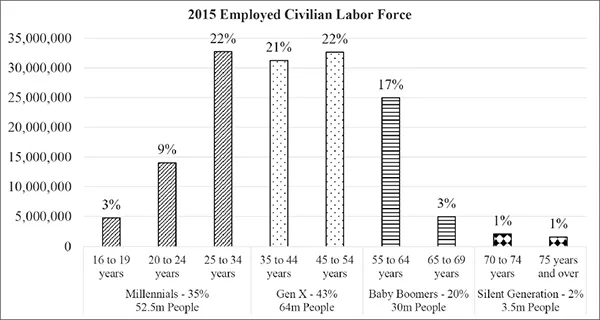
You may be surprised to know that Millennials now represent the second largest generation in the workforce today. According to the Department of Labor Population Survey, the breakdown of the generations in the U.S. employed civilian workforce in 20152 was:
• 51.5 million people, or roughly 35 percent Millennials.
• 63.9 million people, or roughly 43 percent Gen X.
• 29.9 million people, or roughly 20 percent Baby Boomers.
• 3.5 million people, or roughly 2 percent Silent Generation.
As generational groupings can sometimes be nebulous, for the purpose of this book we will reference the generations as follows:
• Baby Boomers were born 1946–1964 and are ages 52 to 71 in 2016.
• Gen Xers were born 1965–1979 and are ages 37 to 51 in 2016.
• Millennials were born 1980–2000 and are ages 16 to 36 in 2016.
These numbers are changing every day. Currently more than 10,000 Baby Boomers retire from the workforce daily, which translates to more than 4 million Baby Boomers per year.3 The trends are easy to understand: Despite data that shows Baby Boomers are working into later stages of life, their representation in the workforce is rapidly shrinking, Gen X representation will remain fairly stable over the next decade, and Millennial representation in the workforce will continue to increase. No matter how you look at the numbers, a study conducted by Ernst & Young highlights the current demographic reality: by 2025 Millennials will represent 75 percent of the workforce.4 Welcome to the Generational Imperative.
So, what makes these demographic changes so imperative that they require immediate action? First, we are losing our most experienced workers. Second, the numbers are dictating a need for a real strategy in order to keep the sales engine running. Senior executives and investors will not give a sales leader a “pass” to miss revenue targets while they train and develop new sales talent. Without question, none of us in sales or leadership positions can sit back and wait to see how it all unfolds.
Some of you may be thinking, “This is not new, and it has happened before.” You are correct. Generational differences have existed in the workforce since the early 1900s, starting with the Industrial Revolution and the major transition from a rural, agrarian society to an urban, industrial society. Another major generational transition took place in the 1950s and 1960s with rapid changes in technology and transportation: from radio to television, black and white to color TV, computers and electronic communications, copiers, and so forth. We went to the moon, popularized rock ’n’ roll music, and adapted to significant cultural shifts. In the workforce, workers and employers both still prized stability and loyalty. For example, the Bureau of Labor Statistics calculated that in 1960, Americans had been with their current employer for 22.5 years.5 In 2014, the Bureau of Labor Statistics released the results of an Employee Tenure Survey that stated that the median number of years workers had been with their current employer was 4.6 years.6 That translates to a drop in nearly 18 years of tenure over the last 50 years!
Looking back at our personal experiences, we see many of the differences between the workplace of today compared to 40 or 50 years ago. David’s father worked for AT&T for 38 years. It is the only job he ever had. He started with NY Telephone, which was folded into AT&T in the 1980s and his first job was to climb telephone poles, after which he ultimately moved into a position installing and servicing large enterprise-level phone systems. David’s family looked forward to the annual AT&T summer picnic. AT&T held these events at large amusement parks or in large public parks, and they involved cooking out, family fun, games, activities, and “rubbing elbows.” David’s father was more of a blue-collar worker, but the executives and senior leaders attended these events as well. It was a celebration of all things AT&T. Employees were recognized for years of service, promotions, retirement, and outstanding service accomplishments; the culture was defined by loyalty and longevity at all levels within the organization. David knew many of the families, and it was normal to spend time together, take family trips together, laugh, cry, and consider themselves part of the extended AT&T family. The unwritten contract between the company and employee was totally different from what we see today. AT&T employees in that era did not leave the corporate “family” until it was time to say goodbye, which usually meant retirement. During David’s father’s career, workplace expectations included loyalty, years of service, long-term thinking, promotions, stability, benefits, retirement plans, and family.
Similarly, Warren’s father began work with Newcomb & Boyd, an Atlanta-based consulting engineering firm, while finishing his education at Georgia Tech in 1959. He remained with the firm for 40 years, until his passing in 1999. Like a smaller version of AT&T, Newcomb & Boyd was a professional “family” and all of the leaders of the firm (“partners”) were promoted from within, usually after 10 to 20 years with the firm.
Since that era, some incredible things occurred in the United States. The U.S. population from 1950 to 2000 doubled, and the so did the size of the workforce.7 In 1950, the workforce population was 62 million people. In 2000, the workforce population was more than 140 million people.8 The social contract between employee and employer changed dramatically as well. Employers enriched benefit programs, healthcare, retirement plans, and earning potential. Employees expected these things from employer to employer but some reshaping of the “loyalty definition” was well underway. A technology boom bubbled at the surface, new companies emerged, and by the 1980s and 1990s, the majority of the workers were Baby Boomers and the inflow of new workers from Gen X increased. In this era, senior leaders and experienced veterans who lead the workplace in 2016 were just beginning their professional careers.
Because both of us represent Gen X, we have also experienced these workplace changes directly. In David’s case, he went to high school and college in the 1980s: no cell phones, no PCs, answering machines, no social media, no DVRs, no CDs, the Sony Walkman, the boom box, and the space shuttle. He started his professional career in sales, cold-calling businesses on the phone more than 100 times daily in order to set appointments for outside sellers. They called it sales: It was telemarketing with a small chance to survive, but his first bosses and influencers were either Baby Boomers or older. Work was still a game of “pay your dues” and “listen to your bosses, who have been here longer than you.” It was truly an “old school” environment: Sellers either dialed the phones or knocked on doors and captured results in paper files. As David’s career progressed, he was thrilled when he was able to start faxing documents to colleagues. Soon enough, computers started to arrive on the scene, but unless you were a technologist, or selling within a high-tech industry, computers were not yet useful. David had a cellphone but did not use it for anything besides making phone calls, if that, as reception was extremely unreliable. At the time, job-hopping was frowned upon and David knew that he had to pay his dues to climb any ladder. The pace of change was accelerating but manageable and interpersonal differences were not mountainous. These were the “good old days,” and it was only 25 years ago.
For Warren, it was a similar experience, but having entered the workforce a decade later, the pace of change accelerated. Warren began his career in management consulting just as portable (laptop) personal computers were being adopted. (In fact, his new hire training consisted of one of the last start groups to go through COBOL training. Bonus points if you can define that acronym.9) At his firm, the expectation was to advance within the firm and work your way up to partner. But with the new millennium, the dotcom era arrived and with it startup companies, IPOs, job-hopping to the “new new thing,”10 and the rapid decline of the monolithic corporation—and with it, the loss of guaranteed career paths with a single organization. Warren’s career has mimicked many of these trends, as he has since worked for more than five different companies and has started his own firm, Symmetrics Group.
We are not alone in saying that more has changed in technology and the world in the last 10 years than in the previous one thousand years. As Eric Schmidt and Jonathan Rosenberg of Google write in their book, How Google Works, “the pace of change is accelerating.”11 The generation that was born in the late 1980s and early 1990s never knew a world without the majority of what we have today and take it for granted. (As an example, just watch a 2-year-old navigate an iPad or a 6-year-old teach his or her grandparents how to use a smartphone. Interestingly, Apple sells 1,000 devices every couple minutes.12) The differences between people entering the workplace today and those who have been around for 20 years or more are significant, and technology is one of the significant drivers of these differences.
Exploring Generational Differences
Just how big are the differences today? Certain expectations have been created that seem to perpetuate the generational divide. Let’s take a look at a few scenarios in order to grasp the depth of the Generational Imperative and its impact within sales organization.
Expectations for Open Communication With the C-Suite (Titles Like CEO, CFO, COO)
In an interview with a Millennial seller named Mitch Touart, who currently works at a startup company named Gladly headquartered in Silicon Valley, we learned that it is not uncommon for Millennials to expect access and open dialogue with their leadership team. Mitch told us that, though cultures that promote this type of transparency can be great, “the dialogue can become hostile quickly, meaning the culture can become really stressful and siloed, because the Millennial seller sometimes divulges more than sellers from other generations.” If we had asked for access to the CEO in 1993, our bosses would have looked at us like we had four heads and then put us on watch as “problem children.” Today, however, these are normal conversations that happen and are even expected in some companies. As authors, we have seen C-Suite communication evolve from a “need to know” to an “open door” policy over the past 25 years.
Expectations for Longevity in a Role or Within an Organization
A quick look back in time points to major shifts in attitudes toward tenure with a company. As referenced above, professionals in the 1960s spent more than 15 more years, on average, with their employer than professionals do today. We continue to see that it is perfectly normal if professionals have numerous roles or companies on their resume before they turn 30. Many seem to have a “try this out” philosophy, which leaves hiring managers and sales leaders confused and frustrated. David Stillman and Steve Richard, who lead a Washington, DC–based company called Vorsight, illustrated this well. They had a Millennial “up and comer” who the organization was developing because of the seller’s promising future. To ensure this star employee would continue to be engaged at their company, Vorsight promoted the seller to a training department role, to challenge him and allow to him learn a new part of the business. After nine months in the promoted role, the seller quit and told his boss, “I learned everything that I needed to learn in these nine months.” David and Steve could not believe this star employee could not see the opportunities that lay ahead that would allow him to continue to learn and grow within the organization. The Millennial mindset is more focused on “being whatever you want to be”—not necessarily loyalty and longevity to a company. This represents a change for organizations and employees alike.
Expectations for Career Growth and Ability to Advance Quickly
We have had the pleasure of spending a number of years as sales professionals and leaders within several environments, including inside sales, enterprise-level outside sales, professional services sales, entrepreneurs, and so on. In the past, many of those seeking sales roles took these roles for the earning potential. Today, many entering sales positions see the role as a “stepping stone” and quickly look to define their next step, either inside or outside of the company. In our research, we found that a higher percentage of Millennials would rather hold multiple roles over two years and strive for proficiency, compared to the other generations that prefer to hold a single role and strive for mastery. Increasingly, senior sales leaders are bothered by this mindset unless their sales team/roles are truly an entry-level proposition. Companies need sellers who come onboard, learn, build a book of business and relationships with clients, and stay in the role. Unfortunately, many people focus on what is next and not the role they are in, and they usually fail. In starting our careers, if we had requested an open-door policy and frequently asked what else we could do within the company, our bosses might have helped us find the elevators to exit the building. Today, this dialogue occurs during the interview process.
Expectations for the Boundaries Between Business and Social Time
In our early professional careers, social time was called happy hour after work. We did not have smartphones, iPads, Facebook, Snapchat, and so forth, so the temptation to engage in personal life during work hours was limited to communication with coworkers and the occasional personal phone call. Mostly, there was a clear line between business and social time. Today, there is always an opportunity for “social time,” not to mention a multitude of channels and mediums for social interaction. Companies must now decide what message to se...