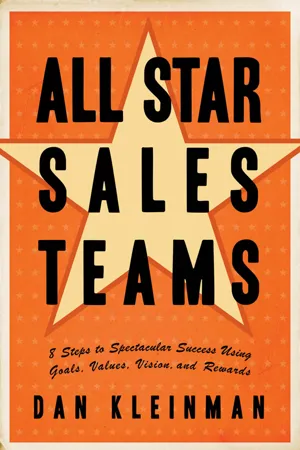
All Star Sales Teams focuses on molding the sales team into an organization's most productive nucleus. This book uniquely integrates critical development, organizational, and compensation concepts into practical, day-to-day processes. It also answers eight key questions that define successful sales and reward structures: * What methods most clearly communicate sales objectives? * How do you make sure that new products or services reinforce the organization's vision, strategy, and operating style? * What critical information does management need about how the marketplace rewards comparable delivery teams? * What tactics boost the effectiveness of sales rewards? * How can leaders maximize sales management strengths and neutralize weaknesses? * How does a company fully engage its sales representatives? * What functional areas ought to participate in designing sales rewards? * How can an organization minimize design complexity? This comprehensive book benefits anyone who manages a sales force, influences their company's strategy and staff productivity, or is critical in sustaining the culture of selling throughout an organization. It also provides a needed blueprint for achieving a dynamic sales environment and a satisfied and productive team of selling all-stars.
Clarify Your Sales Objectives: Planning for Change
Planning Pitfalls
Considering that we had just met, Jed was a little too glad to see me. I wondered if this CEO expected me to provide a silver bullet to eliminate whatever problem was troubling him. He didn’t keep me in suspense. As we sipped our obligatory cups of coffee, he explained that the firm’s last two quarterly financials confirmed that business was okay, but not what shareholders, investors, and analysts had expected.
He stood up and began to pace. Maybe his key product’s life cycle had reached its tipping point; maybe it was the way his company had been approaching the market; maybe it was the sales staff. He stopped and rolled his eyes. The sales staff was driving him nuts. A few superstars surrounded by mediocrity. There were too many maybes. He could feel his organization going on defense while his competition was on offense.
I offered a cautious question. “When we set up this meeting, you said you were about to launch a new initiative?”
“I’d heard you’re the guy we needed to put together a pay package that gets our sales staff producing better results—results that would be based on our new initiative. Well, things have changed since I first called you.”
Jed explained that he and his inner circle of seven had met for an off-site day of planning. When they gathered, he outlined the critical nature of the meeting. He told them the company’s future hinged on their ability to plot a course out of the morass. In spite of some initial acting out around vested interests, the overall result was positive. At the end of a long day there were handshakes and backslaps as they left the meeting room. They had a plan, a strategy, for improving sales.
But as it turned out they had not just a strategy, but eight different strategies. Each person at the meeting left with a different take on decisions they had made, and each one had told their subordinates their own version of the agreed upon plan.
Jed said, “We were all at the same meeting, yet afterward, there was no consensus about what went on. We were poised to go in several different directions at once. Some of those directions were diametrically opposed to others. We were on multiple collision courses. So I told my managers that until we agree as to the next moves, there will be no next moves.”
He looked out the window. “I just didn’t anticipate the confusion. Not with this group.” Jed turned back to me. “Steve said your approach to pay design takes all this potential chaos into account—that it’s nothing you’re not used to.”
Our mutual acquaintance was right. There was a process we could follow to get everyone back on the same page and moving toward productive change. But first Jed would have to decide how he wanted to bring about change—through participative management or executive fiat. Based on the operating style of his company, his key players’ readiness to work collaboratively on a common goal, and their histories of management interaction, what approach had the best chance of sticking, of producing meaningful change?
While it is always more inclusive and binding to gain acceptance of change through collaborative reasoning, it is not always an option. There are times when a leader must press forward. Fiat works if the CEO is trusted, is consistent and predictable in his application, and demands actions that promote and reinforce an agreed upon vision. Yet, even unilateral decisions need a context within which to judge their potential effectiveness. Jed decided to try planning through the meeting scenario one more time. But this time we were going to create a structure and method around the group process designed for success.
Putting Everyone on the Same Page
Before tackling the meeting itself, the participants’ initial expectations have to be managed and a point of view has to be established among all the members. Depending on the capabilities of the management planning team (and we will address that issue a little later in this chapter) I have found the most productive approach to clarifying the group’s objective is for the leader to put a clear and emphatic stake in the ground and surround it with a stimulating question or idea.
For example:
We have to increase sales revenues by 12 percent and unit sales by 7 percent by the end of the fiscal year just to meet target. As you all can see from our weeklies, we are not on track to meet those goals. Besides, meeting target isn’t good enough for me. We need to exceed it. When we get together next Tuesday I want to reach agreement on how we are going to bring sales revenues up by 15 percent and unit sales up by 8 percent during the next three quarters. I want to do it without changing our pricing model. There’s plenty still on the table to investigate: costs, our delivery and follow up, and our product line. Here’s one thought to consider: What if we reduced our sales staff by 10 percent and dramatically increased the earnings opportunity for those who remain? As always, every option supported by analytics and sound reasoning will be thoroughly explored. Don’t come empty handed. We are talking about our survival. Background and some perspective providing materials will be sent to each of you in the next two days. See you on Tuesday.
What are the messages?
This is a critical agenda; survival is at stake (at least in the leader’s eyes).
An objective has been set beyond the known target.
One tool has been taken off the table: pricing.
Everything else is up for grabs provided that each proposed option is well thought out.
Everyone is expected to contribute.
A teaser is given that is designed to stir the pot: slashing sales staff.
The participants know the breadth of the agenda and their role. The teaser has added an element of uncertainty. Within the context of what each member knows about the leader and their teammates, individual decisions are going to be made regarding whether or how to approach the idea of sales staff reduction in the public forum of the meeting. If it is a team with a healthy and productive history the idea will not distract or confine them. It will stimulate creative thinking. It will initiate change. Minds are now focused on the upcoming meeting. Resources are being marshaled.
Rubber Chickens
Experience has taught me that in designing change, be it in sales, operations, or pay, the cavalier use of third party expertise can muddy the waters with tons of minutia wrapped in thick layers of jargon. In my days as a line manager, occasionally charged with hiring outside resources, I initially thought this self-created murkiness was a predictable predilection of the novice consultant or in-house technocrat. Not so. As the bigger firms trooped their gangs of thieves into my office, it was the practice leader, the senior player, who perpetuated the crime. My impatience was always tempered by the realization that most experts can’t help themselves. They see nuances and permutations that the lay observer can’t, won’t, or doesn’t need to comprehend. Rather than assess whether communicating all this detail is really relevant, they forge ahead with their brilliant monologues. And with each numbing sentence they lose more and more of their audience. It seems to be a form of self-justification. This felony is compounded when you consider the number of product, sales, marketing, financial, IT, and management experts sitting around any planning table.
When we eliminate the extraneous and distracting, and focus on salient ideas that are relatively easy to communicate and that promote meaningful change, we are left with what I call Rubber Chickens. Why the term, Rubber Chickens? Consider the following:
The presentation drones on. The pain generated from the serrated edges of the bottle cap you are pressing into your palm is all that is keeping you from passing out and pitching forward in your seat. You are not alone. The meeting room is filled with souls drifting in and out of consciousness. If you left now and someone in the corridor offered you a treasure chest of riches to repeat any part of what you supposedly just heard, you would be at a loss. A week from now reference to this presentation will draw a quizzical stare. A month from now it won’t even be a memory.
It doesn’t register at first. The speaker has stopped talking. You look up to see the man at the podium rigid and twitching. With great effort he reaches into his suit pocket and extracts a rubber chicken. Suddenly he relaxes, smiles, and places the chicken on the table beside him. The audience looks at each other quizzically. The speaker continues talking, but this time with a more attentive audience. Five minutes pass then another fit and another rubber chicken. The audience is paying even closer attention. Why the chickens? What triggers each event? Six chickens later the now totally focused audience leaves the auditorium taking with them an experience they won’t soon forget.
Significant points of universal application should be as easy to remember as the incident with the rubber chicken. Rubber Chickens are universal rules or truths. Every organization adapts them to fit its culture and goals. To learn from them, every org...
Table of contents
Copyright Page
Table of Contents
Title Page
Dedication
Introduction
1 - Clarify Your Sales Objectives: Planning for Change
2 - Align Goals, Values, and Rewards: Tailoring a Compensation Plan
3 - Put Market Data Into Perspective: Getting What You Need
4 - Provide Realistic Sales Rewards: Controlling Expectations
5 - Motivate Sales Managers: Capitalizing on Their Strengths
6 - Involve Your Sales Staff: Keeping Them Engaged
7 - Cultivate an Inter-Functional Community: Putting the Company First
8 - Strive for Simplicity: Streamlining Your Design Strategy
Conclusion
Appendix: - Rubber Chickens
About the Author
Trusted by 375,005 students
Access to over 1.5 million titles for a fair monthly price.
Study more efficiently using our study tools.
Frequently asked questions
Yes, you can cancel anytime from the Subscription tab in your account settings on the Perlego website. Your subscription will stay active until the end of your current billing period. Learn how to cancel your subscription
No, books cannot be downloaded as external files, such as PDFs, for use outside of Perlego. However, you can download books within the Perlego app for offline reading on mobile or tablet. Learn how to download books offline
Perlego offers two plans: Essential and Complete
Essential is ideal for learners and professionals who enjoy exploring a wide range of subjects. Access the Essential Library with 800,000+ trusted titles and best-sellers across business, personal growth, and the humanities. Includes unlimited reading time and Standard Read Aloud voice.
Complete: Perfect for advanced learners and researchers needing full, unrestricted access. Unlock 1.5M+ books across hundreds of subjects, including academic and specialized titles. The Complete Plan also includes advanced features like Premium Read Aloud and Research Assistant.
Both plans are available with monthly, semester, or annual billing cycles.
We are an online textbook subscription service, where you can get access to an entire online library for less than the price of a single book per month. With over 1.5 million books across 990+ topics, we’ve got you covered! Learn about our mission
Look out for the read-aloud symbol on your next book to see if you can listen to it. The read-aloud tool reads text aloud for you, highlighting the text as it is being read. You can pause it, speed it up and slow it down. Learn more about Read Aloud
Yes! You can use the Perlego app on both iOS and Android devices to read anytime, anywhere — even offline. Perfect for commutes or when you’re on the go. Please note we cannot support devices running on iOS 13 and Android 7 or earlier. Learn more about using the app
Yes, you can access All Star Sales Teams by Dan Kleinman in PDF and/or ePUB format, as well as other popular books in Commerce & Ventes. We have over 1.5 million books available in our catalogue for you to explore.