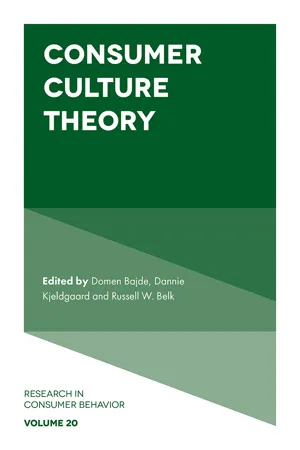
This book will allow researchers and graduate students working in the area of consumer research and marketing to explore three narrative lines that were prevalent during the conference: 'Objects and their doings', 'Glocalization', and 'Constituting Markets'. The volume concludes with an awarded paper by Brown, who takes a critical look at the quality of storytelling in the CCT tradition and helps us learn from the great storytellers of the past.
eBook - ePub
Consumer Culture Theory
- 225 pages
- English
- ePUB (mobile friendly)
- Available on iOS & Android
eBook - ePub
Consumer Culture Theory
About this book
The twentieth volume of Research in Consumer Behavior presents twelve chapters, selected from the best papers submitted at the 13th annual Consumer Culture Theory Conference held in Denmark in June 2018. Aligned with the conference's thematic emphasis on storytelling, the contributors' research stories open the eyes and minds of readers to thought-provoking ideas, theories, and contexts.
Information
PART I
OBJECTS AND THEIR DOINGS
CHAPTER 1
LOVE AND LOCKS: CONSUMERS MAKING PILGRIMAGES AND PERFORMING LOVE RITUALS
ABSTRACT
Purpose: This study contributes to understanding how consumers perform new rituals of love and gather in pilgrimage sites.
Methodology/Approach: Five years of engagement with 21 consumers involving prolonged observations and unstructured in-depth interviews provided the empirical evidence for this chapter.
Findings: Consumers’ love rituals are better explained by considering not only consumers’ actions and performances but also their physical environment. The authors found that love rituals are rites of passage following three sequences of a script. By using the religious connotation of pilgrimage, the authors highlight the importance of the location of rituals, as well as material objects. Providing contrasting perspectives, the authors also show that rituals follow substantial variations and display the instability and ambiguity of its symbolic meanings.
Originality/Value: By doing so, the authors contribute to research about rituals, singularized objects, and love relationships. More importantly, this research contributes by demonstrating the need to enrich studies of consumers rituals with historical and cultural perspectives, and transdisciplinary investigations.
Keywords: Love; ritual; pilgrimage; space; materiality; mythology
Pilgrimage belongs to the vocabulary of religious systems, doctrines, and the sacred, and ritual is an essential concept of anthropologic studies. Still, in a more secular context, consumers perform many rituals in their everyday life, and some specific, important locations for entertainment or consumption are modern-day modern pilgrimage sites. The concept of pilgrimage is rarely implemented in consumer research although “intensification” experiences occur increasingly in themed commercial environments. Recent theoretical developments on pilgrimage by Eade and Sallnow (2013) regarding its conflictual aspects are understudied yet they would highlight the complexity of a social performance from different perspectives. On the other hand, after important contributions to ritual theory with structuralist anthropology, the concept of ritual was neglected by a new generation of anthropologists due to its contradictions, limits, and the suspicion of ethnocentrism. Still, a new interest for kinship, role performances (Wulf & Gabriel, 2005) and the need to analyze contemporary rituals led to renewed interest in the concept. Rook (1985) studied the ritual dimension of consumer behavior and underscored that rituals consist of a string of events, a script. He demonstrated the central role of four tangible components (artifacts, script, performance role, and audience) and focused on individual behavior (body language and mental and physical behaviors).
In this research, we specifically seek (1) to underscore the importance of a neglected feature in ritual theory; we aim at building upon Rook (1985) by showing new interest for other components at play during rituals and investigating the role of location during ritual performances. We argue that these places are true pilgrimage sites. By doing so, (2) we demonstrate the instability and ambiguity of symbolic meanings in rituals, underscoring its dynamic and non-static dimensions and enabling changes as well as adaptation. Finally, (3) we focus on the contextual and historical background that supports the practice and investigate how consumers behave according to symbolic and mythological unconscious frameworks beyond simple observation. To position our research, we present literature that grounds our perspectives and assumptions.
CONCEPTUAL BACKGROUND
Originally, pilgrimages were intended for the worship of relics during a sacred journey (Geary, 1986). Relics demonstrate the possibilities of transfiguration of the material substance; they empowered artifacts with a sacred agency (Preziosi & Farago, 2012). The ultimate goal for a pilgrim is to accomplish several rituals such as praying, approaching the relics, making a wish, and requesting or thanking the divinity by holding an ex voto and bringing back some evidence of coming, such as “locus sanctus” souvenirs (Hahn, 1990). In consumer research, by investigating contemporary pilgrimage centers connected to religion or spirituality, scholars show how sites across the world have also become marketed (Higgins & Hamilton, 2016; Rinallo, Scott, & Maclaran, 2013). For O’Guinn and Belk (1989), the religious theme park Heritage Village is an explicit synthesis of worship and shopping. On the other hand, scholars also studied new secular pilgrimage centers that are not based on traditional religious beliefs. They found that during their journey, consumer-pilgrims are looking for the same delivery of extraordinary experiences in amusement parks (Moore, 1980), or in sacred natural places such as “magic rivers” (Arnould & Price, 1993). The theoretical framework of pilgrimage allows consumption scholars specifically to investigate the three phases of rites of passage, transformation and rediscovery of self, connection to the sacred, and the importance of the communitas in the ritual.
Ritual theory highlights the performances that unfold during pilgrimages. Rituals are normative symbolic acts performed to allow symbolic changes (Strathern, 2015). Despite some controversies (Goody, 1977), the concept presents new interest for the study of contemporary secular rituals which contain no element or reference to a transcendental power (Warburg, 2015). Rituals involve seriousness, mental investment, intense, and meaningful experience for individuals and persist across generations. Rituals are seen as action and embodied performances where institutions “enroll their objectives, values and social norms in bodies.” Scholars used the ritual dimension in consumer behavior (for a review, see Rook, 1985) as an extraordinary experience, described at the etic level as a scripted sequence of events and involving tangible components such as artifacts, script, performance roles, and audience. Analyzing the rituals specific to pilgrimages, Turner and Turner (1978) show the relevance of the concept of rite of passage (Gennep, 1909), displaying a sequencing of three essential phases. In the first pre-liminal phase of separation, pilgrims leave their daily habits; in the second transitional liminal phase, they enter the enclosure of the sacred place and suspended time during which normative social constraints are suspended (status, class, and nationality). The last liminal phase opens up pilgrims to experience direct “communitas” fellowship with others and the sacred. In contrast to Turner and Turner’s focus on social harmony during the suspended time of pilgrimage, Eade and Sallnow (2013) show the conflictual aspects of pilgrimage when people assign different meanings to the same site. As such, the pilgrimage provides a political “arena for competing discourse, religious meanings, orthodoxies” and highlights the complexity of a social performance from different perspectives.
By engaging with this theoretical framework, we aim to investigate how consumers act when they move to pilgrimage places to demonstrate love and feelings with ritual performances in such places.
CONTEXTUALIZATION
The origins of the Parisian love locks ritual come from an Italian novel by Federico Moccia, Ho voglia di te (2006) that inspired readers to attach locks to bridges in Rome to express romantic love. The ritual became famous and mimics immediately spread in other cities worldwide. The first padlocks appeared on the Pont des Arts bridge in Paris in 2008, spreading quickly thereafter. In 2014, the City Hall of Paris faced security concerns as two railings collapsed under the weight of the locks, following which they unsuccessfully attempted to promote a selfie campaign instead of locks to end the practice. However, the practice kept increasing with an estimated 1 million locks on the Pont des Arts and extends to 11 other bridges (mainly Pont de l’Archevéché) and other landmarks. Collapsing railings were replaced with wooden panels until a solution was found in 2015, with the installation of protective glass panels and removal of the locks from the Pont des Arts and the Pont de l’Archevéché. A temporary art installation was set up until final changes were made. In 2017, a successful auction sale was organized, and the removed love locks were sold by set or by complete railings. While it is no longer possible to add locks on the glass screens of the two bridges, locks are visible on lamp posts and other parts of the bridge as well as other landmarks (such as the Alma victory flame and the Eiffel Tower).
While the practice spread (2010–2015) and extended to other bridges, cities, and landmarks, various stakeholders voiced objections. From citizen associations or community organizations, the objections raised several concerns that may be conflated or not according to their political agendas. They denounced the narrowness of a conception of love where individuals are “locked,” and highlighted the inauthenticity of a “so-called Parisian tradition.” They underscored the security concerns of collapsing railings, the pollution of keys thrown into the river, and visual pollution that damages the architectural view from and onto the bridge. Finally, they asserted that such a magical practice is irrational and has no real effects. The huge quantities of padlocks that are held on the bridges and historical landmarks quickly became a difficult issue for a local institutional actor, namely the Town Hall of Paris. Because of the heavy dependence of Paris toward the tourism industry, some fear was expressed that a hasty decision would damage the image of Paris as the “city of love” and would affect tourist flows. For this reason, the Town Hall of Paris looked at the policies set up in other countries and tested several solutions before the complete withdrawal of all the padlocks (2014–2016). Indeed, the weight made several parts of the bridge collapse and endangered human lives in boats running underneath. Those parts of the bridge were replaced routinely, leading to heavy maintenance costs. A statistical review of the photos taken by informants and personal fieldnotes reveal details about consumers’ practice. In some cases (20%), we observed more than two names, suggesting the ritual extends to family or friends groups. From the quantity of foreign names (60%), we understand that the practice is accomplished mostly by tourists. A majority of the locks include drawings and various decorations (60%). If locks are dominant on the bridge, we have also noticed consumers holding ribbons and other artifacts (10%).
RESEARCH METHOD
Our investigation began in February 2012 with observations in Paris on the primary location of the Pont des arts in Paris and with a netnography of the very active Internet community of participants and protestors. We spent six half-days of participant observation in situ throughout 2012–2017, during “regular” days. We did observe behaviors on Valentine’s Day when the practice culminated in 2013 and 2015. During the observations, we took photographs that were completed with some others, made accessible by our informants. Before, during and after our immersion in observation, we kept detailed written field notes. Throughout the five years of the study, we collected data from Internet observations without participating in the online communities (Kozinets, 2015) in interest-based forums, support groups, social networks, and online exchanges in newspapers articles about love locks. We also investigated online groups of official opponents. In these various groups, consumers expressed the will to describe and share their practice or defend their opinions for or against in virulent conversation threads. In these online exchanges, we gathered 1,205 pages totaling roughly 15,000 posts. Data include text, images, and videos, as well as comments made by love locks participants or opponents who interact on these platforms. These observations, together with the relevant literature, informed our interpretations of our data.
Data collected from interviews (Table 1) consist of 21 interviews with male and female informants (five informants were interviewed three or four times each) who ranged in age from 18 to 62. All the informants were interviewed in Paris, France. Ten informants were obtained from our interpersonal networks and 15 from fortuitous encounters during observations, or subsequent snowball sampling. All our informants participated in the ritual, with locks attached in various co...
Table of contents
- Cover
- Title
- Introduction – Consumer Culture Fairy Tales
- Part I: Objects and Their Doings
- Part II: Glocalization
- Part III: Constituting Markets
- Part IV: Quoth the Raven
- Index
Trusted by 375,005 students
Access to over 1.5 million titles for a fair monthly price.
Study more efficiently using our study tools.
Frequently asked questions
Yes, you can cancel anytime from the Subscription tab in your account settings on the Perlego website. Your subscription will stay active until the end of your current billing period. Learn how to cancel your subscription
No, books cannot be downloaded as external files, such as PDFs, for use outside of Perlego. However, you can download books within the Perlego app for offline reading on mobile or tablet. Learn how to download books offline
Perlego offers two plans: Essential and Complete
- Essential is ideal for learners and professionals who enjoy exploring a wide range of subjects. Access the Essential Library with 800,000+ trusted titles and best-sellers across business, personal growth, and the humanities. Includes unlimited reading time and Standard Read Aloud voice.
- Complete: Perfect for advanced learners and researchers needing full, unrestricted access. Unlock 1.5M+ books across hundreds of subjects, including academic and specialized titles. The Complete Plan also includes advanced features like Premium Read Aloud and Research Assistant.
We are an online textbook subscription service, where you can get access to an entire online library for less than the price of a single book per month. With over 1.5 million books across 990+ topics, we’ve got you covered! Learn about our mission
Look out for the read-aloud symbol on your next book to see if you can listen to it. The read-aloud tool reads text aloud for you, highlighting the text as it is being read. You can pause it, speed it up and slow it down. Learn more about Read Aloud
Yes! You can use the Perlego app on both iOS and Android devices to read anytime, anywhere — even offline. Perfect for commutes or when you’re on the go.
Please note we cannot support devices running on iOS 13 and Android 7 or earlier. Learn more about using the app
Please note we cannot support devices running on iOS 13 and Android 7 or earlier. Learn more about using the app
Yes, you can access Consumer Culture Theory by Domen Bajde, Dannie Kjeldgaard, Russell W. Belk, Domen Bajde,Dannie Kjeldgaard,Russell W. Belk in PDF and/or ePUB format, as well as other popular books in Business & Consumer Behaviour. We have over 1.5 million books available in our catalogue for you to explore.