Winner of the 2019 Robert S. Liebert Award (established jointly by the Association for Psychoanalytic Medicine and the Columbia University Center for Psychoanalytic Training and Research)
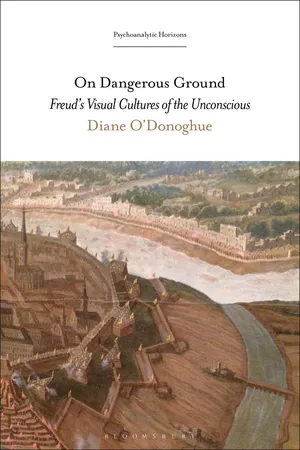
In the final years of the 19th century, Sigmund Freud began to construct evidence for the workings of an "unconscious." On Dangerous Ground offers an innovative assessment of the complex role that his encounters with visual cultures-architecture, objects from earlier cultural epochs ("antiquities"), paintings, and illustrated books-played in that process. Diane O'Donoghue introduces, often using unpublished archival sources, the ways in which material phenomena profoundly informed Freud's decisions about what would, and would not, constitute the workings of an inner life. By returning to view content that Freud treated as forgettable, as distinct from repressed, O'Donoghue shows us a realm of experiences that Freud wished to remove from psychical meaning. These erasures form an amnesic core within Freud's psychoanalytic project, an absence that includes difficult aspects of his life narrative, beginning with the dislocations of his early childhood that he declared "not worth remembering." What is made visible here is far from the inconsequential surface of experience; rather, we are shown a dangerous ground that exceeds the limits of what Freud wished to include within his early model of mind. In Freud's relation to visual cultures we find clues to what he attempted, in crafting his unconscious, to remove from sight.
- 400 pages
- English
- ePUB (mobile friendly)
- Available on iOS & Android
eBook - ePub
About this book
Information
1
The Lost Language of Stones
In the autumn of 1859, three-year-old Sigmund, then known as Sigismund, Freud arrived in Vienna, just as one of his new home’s most distinctive landmarks, the medieval wall and towers that had delimited the inner city, was in the final stage of demolition. Small portions of the Basteien—the bastions created at points along the enclosure—were in places preserved as part of the new city landscape, although little survives today. The family—Freud, his parents, and his younger sister, Anna—began their journey in the children’s birthplace in Moravia, leaving due to what Freud would later characterize as a “catastrophe” that befell “the branch of industry in which my father was concerned,” a circumstance from which the elder Freud appears never to have recovered financially.1 They arrived in Vienna in the midst of its transformation. The fragmentary bulwark in Freud’s first neighborhood stood as a mute participant in the uneasy alliance of Emperor Franz Joseph and local political elites, one that nevertheless would result in an unprecedented urbanism at the heart of Mitteleuropa. The simultaneity of Freud’s youthful arrival and the old walls’ departure was not coincidental. The Freud family had originally intended to settle in Leipzig, arriving there first, but after about two months, they were denied a residency permit and ordered to depart immediately from that city.2 Their move to Vienna placed them among the thousands of Franz Joseph’s subjects taking advantage of the Habsburg capital opening to them, with its new vision of Freiheit—a freedom that, for the new Jewish residents, marked one of the most promising results of movements for emancipatory rights that emerged from the revolutionary upheavals of 1848.3
In the year before the Freud family’s migration, a competition was announced for Vienna’s grand architectural expansion, with German-born Ludwig von Förster selected as a principal to oversee the project. His Danish son-in-law Theophil Hansen—who would go on to design four major buildings in the city, including the massive neoclassical Parliament—and an array of other major figures of the era were involved in the construction. The demise of the circular fortification brought about a new vision in stone: the Ringstrasse, an expansive boulevard built outside the enclosure marked by the old city walls, and lined with buildings, some already in place, but many others created along its route that would mark the passage of Vienna into modernity and metropolis. During the decades following the demolition of the city walls, the buildings that arose around and beyond their footprint created a visually compelling landscape claiming to serve the Habsburg citizenry and, far more for its male residents, offering the promise of unparalleled opportunity.
How might this new construction have given Freud a different understanding of how architecture could produce meaning than if he had remained in his small market-town birthplace of Freiberg (now Příbor) in the foothills of the Carpathian Mountains, or among the centuries-old Saxon buildings of medieval Leipzig? K. Michael Hays’s assertion that architecture attempts the ontological project of an “inquiry into what is, what might be, and how the latter can happen,” and thus functions as “a way of attaining the verb ‘to be’”4 would certainly have resonated with the architects and ideologues of Vienna’s striking urban display. And indeed, as I argue in this chapter, Freud, throughout his younger adulthood, appeared to embrace the elision of a built environment and the formation of a civic subjectivity, choosing to live and begin his professional life amid some of the Ringstrasse’s most notable new buildings. Such identificatory tendencies probably began in his childhood; as Ranji Devadason has argued with respect to those arriving in European cities today, “affective attachment to place” forges an “imagined identification with the political community,” providing a spatial dimension to aspirations, particularly those involving the privileges of citizenship.5 Although her analysis addresses contemporary urban environments, those who shaped mid-nineteenth-century Vienna also relied upon their buildings to convey the Habsburg version of “vernacular cosmopolitanism,” a term borrowed from Stuart Hall,6 that would create a similar, attachment-freighted reception. As a child, Freud had a connection to his surroundings that was not unmediated; he did not respond to architecture in isolation. Instead we can speculate that his response emerged from, and was an extension of, his familial—and in his case, particularly maternal—transmission of what constituted “be-ing” in Vienna. Studies such as those of Devadason and others alert us to the meaning that places may have for children who are dislocated, at an early age, from one geo-cultural environment to another, and thus offer insight into how they may experience the built environment.7
It is important to recognize that the Freud family in all likelihood chose Vienna, when forced to leave Leipzig, because it was the home city of Freud’s mother, Amalia, and where her parents still resided. Opportunities for Jews were also far more propitious there than in Saxony. Thus, Freud would have understood and experienced the city, at least in part, through his mother’s connections to it. His maternal grandparents—Sarah (Wilenz) and Jacob Nathansohn—lived in the Roberthof, a solidly middle-class apartment building that still stands along the Danube Canal in what was then the predominantly Jewish second district,8 a residence that may have had meanings of stability given the likelihood that Freud’s grandparents provided financial support for their daughter’s family. While it is not possible to ascertain all its complexities, Freud’s earliest relationship to Vienna, whose initial phases of urban transition would have coincided with his mother’s later adolescence there, was probably indebted to her and her family in significant ways.9 The early processes of meaning-making and connection are locational as well as relational: the caregiver forges affective connections to children within spaces, both domestic and public. Merleau-Ponty famously asserted that the phenomenological register of space is an embodied one: “I am not in space and time, nor do I conceive space and time; I belong to them, my body combines with them and includes them.”10 This sense of subjectivity can also extend to the physical settings in which this process takes place, constituting what the environmental geographer David Seamon characterizes as “the indivisible, normally unnoticed phenomenon of person-or-people-experiencing-place.”11
The need to make new meanings of one’s-body-in-place can be a lens for viewing the upheavals of Freud’s transition from his Moravian birthplace to his new city, which he later reworked into a narrative of internal desire that strikingly recasts his mother’s impact and changing role. This approach will be revisited in a subsequent chapter when I discuss the proof test that Freud offered for his “Oedipal” construction: his sexual awakening at the sight of his naked mother while traveling between Leipzig and Vienna. That Freud foregrounded his erotic feelings for his mother, displacing the story of his migration12 and early years in Vienna (of which he claimed nothing was worth recalling), had striking consequences for the development of his theories of childhood sexuality and fantasy. But what if that “memory,” whose veracity I will challenge, actually functioned as a screen for this story of transition and transit? Vienna will be reckoned here as a city experienced by a child who came there under duress, a place to which he attached as part of shifting familial dynamics. Like many children who undergo such a transition, Freud was a party to parental realignments after the move to Vienna, with the Nathansohns appearing now to assume a more prominent role. In Moravia, the center of the family had decisively been Freud’s father, paterfamilias to two generations of children: both young adult sons from the first of two previous marriages and the first of his children with Amalia.
If Yiddish was the mama loshen, the “mother tongue” that Freud’s mother reportedly spoke,13 then for Freud Vienna could be seen as the “mama locus.” Amalia apparently selected her birth date in the Gregorian calendar to be the same as that of the city’s most notable inhabitant, none other than Franz Joseph himself.14 The very choice of her eldest child’s given name, Sigismund, may also have been an aspirational gesture to the current regime: Freud’s father supposedly wished to honor the memory of Polish ruler Sigismund I (1467–1548), son of a Habsburg mother whose protection of the Jews Jacob Freud admired.15 However, this choice may not have been idiosyncratic, nor Jacob Freud’s alone. Sigismund was not an uncommon name for Jewish boys born in the Habsburg realm during this period. If it was associated with a tradition of imperial support for Jewish subjects, its increased popularity in Freud’s time may suggest the desire of a new generation of citizens to receive civic protection from the current royal household. Amalia (Malka) Nathansohn Freud recalled living in Vienna—she would have been thirteen at the time—through the tumult of 184816 and the assumption that she was not involved in choosing her first child’s vernacular name—his Hebrew name, Schlomo, was given in memory of Jacob Freud’s father17—speaks more to assumptions about gender than to what may have been her interest in safeguarding her child’s future. Freud would shorten the name to Sigmund during his adolescence18—several authors argue that this was a more “German-sounding” one. For despite its long association with various European imperial houses, Sigismund, by the 1860s in Vienna, was considered a “Jewish” name because so many of its Jewish citizens bore it. In reflecting the aspirations of Jews to protect their sons, the name came to figure in anti-Semitic jokes, and this has been offered as a reason why Freud chose to abandon it.19 Thus, a name initially considered apotropaic may have ended up rendering those with it vulnerable rather than protected.
Adam Phillips, in writing about Freud’s life and work until mid-life, makes an important point as he discusses his early professional years: “Describing what he would ultimately call the Unconscious was to be Freud’s way of talking about why we can never settle down, and why we can’t stop wanting to.”20 This articulation of the tension between transience and durability may also be understood as an affective index of Freud’s urban experience. Much scholarship has focused on Freud’s more visible relationship to his “surroundings,” specifically the antipathy, rather than attachment, that he frequently expressed toward Vienna, as anti-Semitism became increasingly acceptable in public discourse and political hegemonies, eroding the opportunities that had once seemed very much available to him. But the complexity of that loss, commonly reckoned in terms of his diminished access to professional advantages, can also be read as a disruption of a previous connection. This later betrayal was thus more exquisitely painful; Freud would write to Fliess in 1900 that “I hate Vienna; almost personally,”21 going on to suggest that its impact on him is registered in his own physicality, for he gains strength as soon as he is away from it. Yet there are buildings where traces of an identificatory relationship can still be found, and they gesture to dimensions of “experiencing place” that could have informed not only Freud’s understanding of architectural meaning but how certain affective residues derive from it; these experiences, notably involving protection and betrayal, may have influenced the “structuring” of Freud’s earliest psychoanalytic formulations. But Freud will not be of help in clarifying their role, for he reveals little of this loss: in one case, concerning the so-called “House of Atonement” (Sühnhaus) where he lived and practiced at the start of his professional life in Vienna, there is utter silence about the tragic suicide there of a patient, ironically—as the person jumped into the core of the building—enabled by its very distinctive architectural features. In the case of the Rathaus, or City Hall (whose architect designed the Sühnhaus and was Freud’s neighbor), another loss is veiled that when recognized strikingly recasts ...
Table of contents
- Cover
- Halftitle Page
- Title Page
- Dedication Page
- Contents
- List of Figures
- Acknowledgments
- Introduction
- 1. The Lost Language of Stones
- 2. Phantasmal Fragments
- 3. Libido Awakened: In Transit and Enframed
- 4. The Painting of Everyday Life
- 5. The Magic of the Manifest: Paper Dreams
- Conclusion: Objects’ Lessons
- Afterword
- Bibliography
- Index
- Imprint
Trusted by 375,005 students
Access to over 1.5 million titles for a fair monthly price.
Study more efficiently using our study tools.
Frequently asked questions
Yes, you can cancel anytime from the Subscription tab in your account settings on the Perlego website. Your subscription will stay active until the end of your current billing period. Learn how to cancel your subscription
No, books cannot be downloaded as external files, such as PDFs, for use outside of Perlego. However, you can download books within the Perlego app for offline reading on mobile or tablet. Learn how to download books offline
Perlego offers two plans: Essential and Complete
- Essential is ideal for learners and professionals who enjoy exploring a wide range of subjects. Access the Essential Library with 800,000+ trusted titles and best-sellers across business, personal growth, and the humanities. Includes unlimited reading time and Standard Read Aloud voice.
- Complete: Perfect for advanced learners and researchers needing full, unrestricted access. Unlock 1.5M+ books across hundreds of subjects, including academic and specialized titles. The Complete Plan also includes advanced features like Premium Read Aloud and Research Assistant.
We are an online textbook subscription service, where you can get access to an entire online library for less than the price of a single book per month. With over 1.5 million books across 990+ topics, we’ve got you covered! Learn about our mission
Look out for the read-aloud symbol on your next book to see if you can listen to it. The read-aloud tool reads text aloud for you, highlighting the text as it is being read. You can pause it, speed it up and slow it down. Learn more about Read Aloud
Yes! You can use the Perlego app on both iOS and Android devices to read anytime, anywhere — even offline. Perfect for commutes or when you’re on the go.
Please note we cannot support devices running on iOS 13 and Android 7 or earlier. Learn more about using the app
Please note we cannot support devices running on iOS 13 and Android 7 or earlier. Learn more about using the app
Yes, you can access On Dangerous Ground by Diane O'Donoghue in PDF and/or ePUB format, as well as other popular books in Art & Art Theory & Criticism. We have over 1.5 million books available in our catalogue for you to explore.