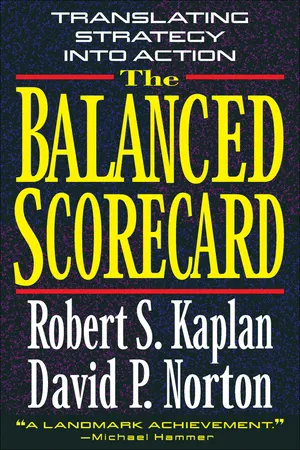
The Balanced Scorecard translates a company's vision and strategy into a coherent set of performance measures. The four perspectives of the scorecard--financial measures, customer knowledge, internal business processes, and learning and growth--offer a balance between short-term and long-term objectives, between outcomes desired and performance drivers of those outcomes, and between hard objective measures and softer, more subjective measures. In the first part, Kaplan and Norton provide the theoretical foundations for the Balanced Scorecard; in the second part, they describe the steps organizations must take to build their own Scorecards; and, finally, they discuss how the Balanced Scorecard can be used as a driver of change.
IMAGINE ENTERING THE COCKPIT of a modern jet airplane and seeing only a single instrument there. How would you feel about boarding the plane after the following conversation with the pilot?
Q:
I’m surprised to see you operating the plane with only a single instrument. What does it measure?
A:
Airspeed. I’m really working on airspeed this flight.
Q:
That’s good. Airspeed certainly seems important. But what about altitude. Wouldn’t an altimeter be helpful?
A:
I worked on altitude for the last few flights and I’ve gotten pretty good on it. Now I have to concentrate on proper air speed.
Q:
But I notice you don’t even have a fuel gauge. Wouldn’t that be useful?
A:
You’re right; fuel is significant, but I can’t concentrate on doing too many things well at the same time. So on this flight I’m focusing on air speed. Once I get to be excellent at air speed, as well as altitude, I intend to concentrate on fuel consumption on the next set of flights.
We suspect that you would not board the plane after this discussion. Even if the pilot did an exceptional job on air speed, you would be worried about colliding with tall mountains or running low on fuel. Clearly, such a conversation is a fantasy since no pilot would dream of guiding a complex vehicle like a jet airplane through crowded air spaces, with only a single instrument. Skilled pilots are able to process information from a large number of indicators to navigate their aircraft. Yet navigating today’s organizations through complex competitive environments is at least as complicated as flying a jet. Why should we believe that executives need anything less than a full battery of instrumentation for guiding their companies? Managers, like pilots, need instrumentation about many aspects of their environment and performance to monitor the journey toward excellent future outcomes.
The Balanced Scorecard (BSC) provides managers with the instrumentation they need to navigate to future competitive success. Today, organizations are competing in complex environments so that an accurate understanding of their goals and the methods for attaining those goals is vital. The Balanced Scorecard translates an organization’s mission and strategy into a comprehensive set of performance measures that provides the framework for a strategic measurement and management system. The Balanced Scorecard retains an emphasis on achieving financial objectives, but also includes the performance drivers of these financial objectives. The scorecard measures organizational performance across four balanced perspectives: financial, customers, internal business processes, and learning and growth. The BSC enables companies to track financial results while simultaneously monitoring progress in building the capabilities and acquiring the intangible assets they need for future growth.
COMPETING IN THE INFORMATION AGE
Companies are in the midst of a revolutionary transformation. Industrial age competition is shifting to information age competition. During the industrial age, from 1850 to about 1975, companies succeeded by how well they could capture the benefits from economies of scale and scope.1 Technology mattered, but, ultimately, success accrued to companies that could embed the new technology into physical assets that offered efficient, mass production of standard products.
During the industrial age, financial control systems were developed in companies, such as General Motors, DuPont, Matsushita, and General Electric, to facilitate and monitor efficient allocations of financial and physical capital.2 A summary financial measure such as return-on-capital-employed (ROCE) could both direct a company’s internal capital to its most productive use and monitor the efficiency by which operating divisions used financial and physical capital to create value for shareholders.
The emergence of the information era, however, in the last decades of the twentieth century, made obsolete many of the fundamental assumptions of industrial age competition. Nolonger could companies gain sustainable competitive advantage by merely deploying new technology into physical assets rapidly, and by excellent management of financial assets and liabilities.
The impact of the information era is even more revolutionary for service organizations than for manufacturing companies. Many service organizations, especially those in the transportation, utility, communication, financial, and health care industries, existed for decades in comfortable, noncompetitive environments. They had little freedom in entering new businesses and in pricing their output. In return, government regulators protected these companies from potentially more efficient or more innovative competitors, and set prices at a level that provided adequate returns on their investment and cost base. Clearly, the past two decades have witnessed major deregulatory and privatization initiatives for service companies throughout the world as information technology created the “seeds of destruction” of industrial-era regulated service companies.
The information age environment for both manufacturing and service organizations requires new capabilities for competitive success. The ability of a company to mobilize and exploit its tangible or invisible assets has become far more decisive than investing and managing physical, tangible assets.3 Intangible assets enable an organization to:
develop customer relationships that retain the loyalty of existing customers and enable new customer segments and market areas to be served effectively and efficiently;
introduce innovative products and services desired by targeted customer segments;
produce customized high-quality products and services at low cost and with short lead times;
mobilize employee skills and motivation for continuous improvements in process capabilities, quality, and response times; and
deploy information technology, data bases, and systems.
New Operating Environment
Information age organizations are built on a new set of operating assumptions.
CROSS-FUNCTIONS
Industrial age organizations gained competitive advantage through specialization of functional skills: in manufacturing, purchasing, distribution, marketing, and technology. This specialization yielded substantial benefits, but, over time, maximization of functional specialization led to enormous inefficiencies, hand-offs between departments, and slow response processes. The information age organization operates with integrated business processes that cut across traditional business functions.4 It combines the specialization benefits from functional expertise with the speed, efficiency, and quality of integrated business processes.
LINKS TO CUSTOMERS AND SUPPLIERS
Industrial age companies worked with customers and suppliers through arm’s-length transactions. Information technology enables today’s organizations to integrate supply, production, and delivery processes so that operations are triggered by customer orders, not by production plans that push products and services through the value chain. An integrated system, from customer orders upstream to raw material suppliers, enables all organizational units along the value chain to realize enormous improvements in cost, quality, and response times.
CUSTOMER SEGMENTATION
Industrial age companies prospered by offering low-cost but standardized products and services; recall Henry Ford’s famous dictum, “They can have whatever color they want as long as it is black.” Once consumers have satisfied their basic needs for clothing, shelter, food, and transportation, they want more individualized solutions to their wants. Information age companies must learn to offer customized products and services to its diverse customer segments, without paying the usual cost penalty for high-variety, low-volume operations.5
GLOBAL SCALE
Domestic borders are no longer a barrier to competition from more efficient and responsive foreign companies. Information age companies compete against the best companies in the world. The large investments required for new products and services may require customers worldwide to provide adequate returns. Information age companies must combine the efficiencies and competitive honing of global operations with marketing sensitivity to local customers.
INNOVATION
Product life cycles continue to shrink. Competitive advantage in one generation of a product’s life is no guarantee of product leadership in the next technological platform.6 Companies that compete in industries with rapid technological innovation must be masters at anticipating customers’ future needs, devising radical new product and service offerings, and rapidly deploying new product technologies into efficient operating and service delivery processes. Even for companies in industries with relatively long product-life cycles, continuous improvement in processes and product capabilities is critical for long-term success.
KNOWLEDGE WORKERS
Industrial age companies created sharp distinctions between two groups of employees. The intellectual elite—managers and engineers—used their analytical skills to design products and processes, select and manage customers, and supervise day-to-day operations. The second group was composed of the people who actually produced the products and delivered the services. This direct labor work force was a principal factor of production for industrial age companies, but used only their physical capabilities, not their minds. They performed tasks and processes under direct supervision of white-collar engineers and managers. At the end of the twentieth century, automation and productivity have reduced the percentage of people in the organization who perform traditional work functions, while competitive demands have increased the number of people performing analytic functions: engineering, marketing, management, and administration. Even individuals still involved in direct production and service delivery are valued for their suggestions on how to improve quality, reduce costs, and decrease cycle times. As the plant manager of a refurbished Ford engine plant declared, “The machines are designed to run automatically. The people’s job is to think, to problem solve, to ensure quality, not to watch the parts go by. Here, people are viewed as problem-solvers, not variable costs.”7
Now all employees must contribute value by what they know and by the information they can provide. Investing in, managing, and exploiting the knowledge of every employee have become critical to the success of information age companies.
As organizations attempt to transform themselves to compete successfully in the future, they are turning to a variety of improvement initiatives:
Total quality management
Just-in-time (JIT) production and distribution systems
Time-based competition
Lean production/lean enterprise
Building customer-focused organizations
Activity-based cost management
Employee empowerment
Reengineering
Each of these improvement programs has had demonstrated success stories, champions, gurus, and consultants. Each competes for the time, energy, and resources of senior executives. And each offers the promise of breakthrough performance and enhanced value creation for many, if not all, of a company’s constituencies: shareholders, customers, suppliers, and employees. The goal of these programs is not incremental improvement or survival. The goal is discontinuous performance, enabling an organization to succeed in the new information age competition.
But many of these improvement programs have yielded disappointing results. The programs are often fragmented. They may not be linked to the organization’s strategy, nor to achieving specific financial and economic outcomes. Breakthroughs in performance require major change, and that includes changes in the measurement and management systems used by an organization. Navigating to a more competitive, technological, and capability-driven future cannot be accomplished merely by monitoring and controlling financial measures of past performance.
TRADITIONAL FINANCIAL ACCOUNTING MODEL
All the new programs, initiatives, and change management processes of information age companies are being implemented in an environment governed by quarterly and annual financial reports. The financial-reporting process remains anchored to an accounting model developed centuries ago for an environment of arm’s-length transactions between independent entities. This venerable financial accounting model is still being used by information age companies as they attempt to build internal assets and capabilities, and to forge linkages and strategic alliances with external parties.8
Ideally, this financial accounting model should have been expanded to incorporate the valuation of a company’s intangible and intellectual assets, such as high-quality products and services, motivated and skilled employees, responsive and predictable internal processes, and satisfied and loyal customers. Such a valuation of intangible assets and company capabilities would be especially helpful since, for information age companies, these assets are more critical to success than traditional physical and tangible assets. If intangible assets and company capabilities could be valued within the financial accounting model, organizations that enhanced these assets and capabilities could communicate this improvement to employees, shareholders, creditors, a...
Table of contents
Cover
Copyright
Preface
Chapter One: Measurement and Management in the Information Age
Chapter Two: Why Does Business Need a Balanced Scorecard?
PART ONE: MEASURING BUSINESS STRATEGY
PART TWO: MANAGING BUSINESS STRATEGY
Appendix: Building a Balanced Scorecard
About the Authors
Trusted by 375,005 students
Access to over 1.5 million titles for a fair monthly price.
Study more efficiently using our study tools.
Frequently asked questions
Yes, you can cancel anytime from the Subscription tab in your account settings on the Perlego website. Your subscription will stay active until the end of your current billing period. Learn how to cancel your subscription
No, books cannot be downloaded as external files, such as PDFs, for use outside of Perlego. However, you can download books within the Perlego app for offline reading on mobile or tablet. Learn how to download books offline
We are an online textbook subscription service, where you can get access to an entire online library for less than the price of a single book per month. With over 1.5 million books across 990+ topics, we’ve got you covered! Learn about our mission
Look out for the read-aloud symbol on your next book to see if you can listen to it. The read-aloud tool reads text aloud for you, highlighting the text as it is being read. You can pause it, speed it up and slow it down. Learn more about Read Aloud
Yes! You can use the Perlego app on both iOS and Android devices to read anytime, anywhere — even offline. Perfect for commutes or when you’re on the go. Please note we cannot support devices running on iOS 13 and Android 7 or earlier. Learn more about using the app
Yes, you can access The Balanced Scorecard by Robert S. Kaplan, David P. Norton in PDF and/or ePUB format, as well as other popular books in Business & Business Strategy. We have over 1.5 million books available in our catalogue for you to explore.