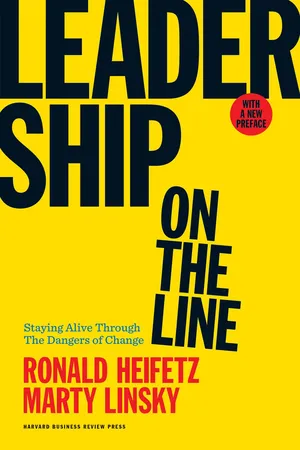
To lead is to live dangerously. It's romantic and exciting to think of leadership as all inspiration, decisive action, and rich rewards, but leading requires taking risks that can jeopardize your career and your personal life. It requires putting yourself on the line, disrupting the status quo, and surfacing hidden conflict. And when people resist and push back, there's a strong temptation to play it safe. Those who choose to lead plunge in, take the risks, and sometimes get burned. But it doesn't have to be that way say renowned leadership experts Ronald Heifetz and Marty Linsky. In Leadership on the Line, they show how it's possible to make a difference without getting "taken out" or pushed aside. They present everyday tools that give equal weight to the dangerous work of leading change and the critical importance of personal survival. Through vivid stories from all walks of life, the authors present straightforward strategies for navigating the perilous straits of leadership. Whether you're a parent or a politician, a CEO or a community activist, this practical book shows how you can exercise leadership and survive and thrive to enjoy the fruits of your labor.
eBook - ePub
Leadership on the Line, With a New Preface
Staying Alive Through the Dangers of Change
- 288 pages
- English
- ePUB (mobile friendly)
- Available on iOS & Android
eBook - ePub
Leadership on the Line, With a New Preface
Staying Alive Through the Dangers of Change
About this book
Information
Topic
Personal DevelopmentSubtopic
ManagementPART ONE
The Challenge
1
The Heart of Danger
Maggie Brooke grew up on a small Native American reservation in which nearly everyone older than twelve drank alcohol. After sobering up in her twenties, she spent more than a decade leading her people toward health. Now a grandmother in her forties and a tribal elder, Maggie counsels a steady stream of visitors in her home throughout the day. One evening, she told her visitor about Lois, the woman who first inspired her to try to do something about the alcohol dependency among her people.
“Twenty years ago I used to baby-sit for Lois, who lived in a neighboring band within our tribe. Once a week I’d go the few miles to her community and take care of Lois’s little ones. But after about two months, I started to wonder, ‘What could Lois possibly be doing every Tuesday night? There’s not much to do around here in these villages.’ So one evening after Lois left to go to the meeting lodge, I packed up the children and went over to the lodge to find out what she was doing. We looked through a window into the lodge and saw a big circle of chairs, all neatly in place, with Lois sitting in a chair all by herself. The chairs in the circle were empty.
“I was really curious, you know, so when Lois came home that evening, I asked her, ‘Lois, what are you doing every Tuesday night?’ And she said, ‘I thought I told you weeks ago, I’ve been holding AA (Alcoholics Anonymous) meetings.’ So I asked her back, ‘What do you mean you’re holding meetings? I went over there tonight with the children and looked through the window. We watched you sitting there in that circle of chairs, all alone.’
“Lois got quiet—‘I wasn’t alone,’ she said. ‘I was there with the spirits and the ancestors; and one day, our people will come.’”
Lois never gave up. “Every week Lois set up those chairs neatly in a circle, and for two hours, she just sat there,” Maggie recalled. “No one came to those meetings for a long time, and even after three years, there were only a few people in the room. But ten years later, the room was filled with people. The community began turning around. People began ridding themselves of alcohol. I felt so inspired by Lois that I couldn’t sit still watching us poison ourselves.”
Lois and then Maggie worked on becoming sober themselves, and then challenged their friends, families, and neighbors to change and renew their lives, too. Leading these communities required extraordinary self-examination, perseverance, and courage. Their native history was full of people, some of them with goodwill, who had forced tribes to give up familiar and reliable ways, and now these communities were being asked to change again, with no reason to think that things would get much better. Lois and Maggie were asking people to face the trade-offs between the numbing solace of alcohol and the hard work of renewing their daily lives. There would be no progress until they had put alcohol dependency behind them. But people found it extremely difficult to give up their way of coping, particularly for some intangible idea about the future. They had fought back before when others had made them change their ways, and they fought Lois and Maggie.
The two women were mocked and marginalized. They spent years feeling out of place in their own communities, unwelcome at parties and gatherings where alcohol flowed, so ostracized that even holidays became lonely, solitary events. Indeed, for long stretches of time they spent weekends off the reservation to find people they could talk to. They had put themselves at risk, as well as key relationships with neighbors, friends, and family. Eventually, they succeeded and survived. But for a long time, they could not know. They could have lost everything.1
Leadership Is Dangerous
In the early 1990s, Yitzhak Rabin, then prime minister of Israel, had been moving the country toward an accommodation with the Palestinians. Slowly but surely Rabin was bringing a majority of Israelis along with him. But he also had deeply disturbed the right wing in Israel, particularly the religious right, by his success in getting the community to wrestle with the difficult and painful trade-offs between long-term peace and territory. The right wing refused to face the reality that they would have to give up land they considered sacred for peace. They tried to debate the issue, but they were losing the argument. So they began to make Rabin himself the issue, rather than his policies. The result was Rabin’s assassination, a tragedy, as well as a terrible setback for his initiatives. His successor, Benyamin Netanyahu, retreated, unwilling to push the Israeli people to face the costs of peace. Indeed, the period before Rabin’s death marked a high point in the willingness of the Israeli people to decide, among deeply held values, which were most precious and which could be left behind.
Assassinations are extreme examples of what people will do to silence the voices of frustrating realities. Asking an entire community to change its ways, as Lois and Maggie succeeded in doing and Yitzhak Rabin sacrificed himself in attempting, is dangerous. If leadership were about giving people good news, the job would be easy. If Lois had been gathering people every week to distribute money or to sing their praises, the chairs would not have stayed empty for so long. If Rabin had promised peace with no loss of land, he might have survived. People do not resist change, per se. People resist loss.
You appear dangerous to people when you question their values, beliefs, or habits of a lifetime. You place yourself on the line when you tell people what they need to hear rather than what they want to hear. Although you may see with clarity and passion a promising future of progress and gain, people will see with equal passion the losses you are asking them to sustain.
Think about the times you have had something important to say and have pulled back, when you have tried and failed, or succeeded but were bruised along the way. Or when you have watched the trials and successes of other people. The hope of leadership lies in the capacity to deliver disturbing news and raise difficult questions in a way that people can absorb, prodding them to take up the message rather than ignore it or kill the messenger.
As a doctor, Ron faced this challenge every day. Every patient looks to the doctor, hoping for a painless remedy; and every day doctors have to tell people that their health depends on enduring the pains of change—in giving up their favorite foods, taking time out of each overextended day for exercise, taking medications that have side effects, or breaking an addiction to cigarettes, alcohol, or work. Ron saw a few doctors who were artists of the profession as well as technical experts. They had learned how to engage patients and their families in reshaping their values, attitudes, and long-standing habits. But this was demanding and risky. Discussions can backfire if they seem unfeeling or abrupt, and angry patients can find a variety of ways to damage a doctor’s reputation. Ron saw many more doctors give little more than lip service to this part of their job, all the while complaining about patient noncompliance—a term doctors use to describe people’s resistance to taking medicine and advice. In frustration, they would say to themselves, “Why do people avoid facing reality and resist following my instructions?” But then they would take the easy road, playing it safe by pandering to the desire for a technical fix, avoiding the difficult conversations rather than disturbing people in an attempt to change the ways they lived.
Lois, Maggie, and Rabin had to engage people in facing a hard reality. Just as patients hope to receive a doctor’s fast and painless cure, some Native Americans might place all their hopes on a new casino or look for a technical explanation for their pains (a genetic predisposition to alcoholism). And most every Israeli would prefer to have peace without giving up any of their ancient homeland. In each case—the patient, the Native American community, the Israeli people—people must face the challenge of adapting to a tough reality, and the adaptation requires giving up an important value or a current way of life. Leadership becomes dangerous, then, when it must confront people with loss. Rabin, Lois, Maggie, and the best doctors mobilize change by challenging people to answer a core but painful question: Of all that we value, what’s really most precious and what’s expendable?
The Perils of Adaptive Change
Leadership would be a safe undertaking if your organizations and communities only faced problems for which they already knew the solutions. Every day, people have problems for which they do, in fact, have the necessary know-how and procedures. We call these technical problems. But there is a whole host of problems that are not amenable to authoritative expertise or standard operating procedures. They cannot be solved by someone who provides answers from on high. We call these adaptive challenges because they require experiments, new discoveries, and adjustments from numerous places in the organization or community. Without learning new ways—changing attitudes, values, and behaviors—people cannot make the adaptive leap necessary to thrive in the new environment. The sustainability of change depends on having the people with the problem internalize the change itself.
People cannot see at the beginning of the adaptive process that the new situation will be any better than the current condition. What they do see clearly is the potential for loss. People frequently avoid painful adjustments in their lives if they can postpone them, place the burden on somebody else, or call someone to the rescue. When fears and passions run high, people can become desperate as they look to authorities for the answers. This dynamic renders adaptive contexts inherently dangerous.
When people look to authorities for easy answers to adaptive challenges, they end up with dysfunction. They expect the person in charge to know what to do, and under the weight of that responsibility, those in authority frequently end up faking it or disappointing people, or they get spit out of the system in the belief that a new “leader” will solve the problem. In fact, there’s a proportionate relationship between risk and adaptive change: The deeper the change and the greater the amount of new learning required, the more resistance there will be and, thus, the greater the danger to those who lead. For this reason, people often try to avoid the dangers, either consciously or subconsciously, by treating an adaptive challenge as if it were a technical one. This is why we see so much more routine management than leadership in our society.
The table “Distinguishing Technical from Adaptive Challenges” captures the difference between the technical work of routine management and the adaptive work of leadership.
Indeed, the single most common source of leadership failure we’ve been able to identify—in politics, community life, business, or the nonprofit sector—is that people, especially those in positions of authority, treat adaptive challenges like technical problems.
In times of distress, when everyone looks to authorities to provide direction, protection, and order, this is an easy diagnostic mistake to make. In the face of adaptive pressures, people don’t want questions; they want answers. They don’t want to be told that they will have to sustain losses; rather, they want to know how you’re going to protect them from the pains of change. And of course you want to fulfill their needs and expectations, not bear the brunt of their frustration and anger at the bad news you’re giving.
| Distinguishing Technical from Adaptive Challenges | ||
| What’s the Work? | Who Does the Work? | |
| Technical | Apply current know-how | Authorities |
| Adaptive | Learn new ways | The people with the problem |
In mobilizing adaptive work, you have to engage people in adjusting their unrealistic expectations, rather than try to satisfy them as if the situation were amenable primarily to a technical remedy. You have to counteract their exaggerated dependency and promote their resourcefulness. This takes an extraordinary level of presence, time, and artful communication, but it may also take more time and trust than you have.
This was the box Ecuador’s president Jamil Mahuad found himself in early in January 2000, when he faced the prospect of mass demonstrations, with thousands of indigenous Ecuadorians mobilizing to throw him out of office. His popularity had fallen from 70 percent approval to 15 percent in less than a year. With the country in the midst of a catastrophic and rapid economic meltdown, on the eve of the demonstrations Mahuad said he felt trapped. “I’ve lost my connection with the people.”
One year before, he had been a hero, a peacemaker. In his first months in office, he ended a war with Peru that had lasted more than two hundred years, signing a peace treaty with great excitement in the air. But his heroic accomplishments were to be washed away within less than four months by the effects of numerous natural and economic disasters: El Niño storms, which devastated 16 percent of Ecuador’s gross domestic product, the financial crisis that swept through East Asia and then Latin America, high inflation, crushing foreign debt, bankrupt banks, the lowest oil prices since Ecuador had started to export oil, and a political culture that had brought down four presidents in eight years. On January 21, 2000, a coalition of military officers and indigenous demonstrators forced Mahuad out of office, another casualty of the country’s ongoing crisis.
Mahuad described the contrast between being mayor of Quito and president of the entire country. As mayor, the people welcomed him openly as he walked daily around town. During his walks, he could often get people to cooperate to solve their own problems, or he could apply a little pressure and resources to help out. As mayor, he had the advantage that people looked for local solutions to local problems, and worked with him. He was in touch with them and they with him.
However, when he became president and had responsibility for the national economic crisis, the people wanted him to find remedies for which other regions and localities would pay the costs. The people did not want him to tell them they had to change. He made several trips abroad to plead for help from the International Monetary Fund, World Bank, and U.S. Treasury. He consulted many worthy economic experts at home, in Latin America generally, in the United States, and in Europe. He came to see that any practical solution would require each region and sector of his society to endure considerable pain, at least in the short run.
Mahuad said afterward, “I felt like a doctor in an emergency ward on a Saturday night. And the patient came in with a badly damaged and gangrenous leg. And, from my medical experience, I had to amputate the patient’s leg to save the patient’s life. The family said, ‘You don’t have to amputate.’ I insisted on amputation to save the patient’s life, but I lost the confidence of the family. The family held me responsible for the patient’s problem.”
As president, he grew increasingly distant from his various publics as he faced rising hostility and focused most of his attention on finding the right economic policy to reverse the downturn. Yet his trips to Washington yielded no assistance. Countless conversations with policy experts prompted a variety of prescriptions, but no clear way out of the quagmire. Meanwhile, poor people in the villages found the price of food rising beyond their reach. Many flocked to the cities, selling their wares on the streets. As inflation soared, the unions became furious at the lost value of paychecks. The business sector lost faith, sending their money north to the United States and hastening the insolvency of the banks.
Mahuad made bold moves in response to the crisis. Ecuador would cut government salaries, reduce conscription into the army, cancel orders for the purchase of military equipment, default on its loans, freeze bank balances to stop the run on the banks and the draining of foreign currency reserves, and finally, convert its currency to the dollar.
Yet the adaptive challenge was enormous. Even under the rosiest scenarios, there would be further job loss, more rising prices, and increased uncertainty before people would feel the benefits of an economic turnaround. The most brilliant policy solution, coupled with a rise in the price of oil, would not have stopped the ongoing disruption caused by opening the economy to a more competitive world.
Although Mahuad worked tirelessly to halt the falling economy, ironically, the public felt that he had disengaged. They were right in one sense: He had disengaged from them. To use his metaphor, he had performed the amputation because it was the best of the available options, but he did not prepare the family for what they would have to endure. Many surgeons could have done the amputation, but only Mahuad, as president, could have helped the family face their situation. Spending most of his time working through the issues and options with technical experts and trying every means available to persuade foreign creditors for assistance, Mahuad paid less attention to his political colleagues and to the people on the streets and in the villages. In retrospect, he might have let his technical experts in the ministries do all of the technical work so that he could focus heavily on the political and adaptive work. Instead, looking back at his weekly calendar, Mahuad realized he had spent more than 65 percent of his time working in a technical problem-solving mode and less than 35 percent of his time working with the politicians and public groups with direct stakes in the situation. Rather than using every day as an opportunity to be a visible champion to his people—to provide hope and to explain the process and pains of modernization in a globalizing economy—he devoted most of his time to searching for the right policy solution and then attempting to get the people to be reasonable in accepting the necessary technical fixes. Although he recognized the adaptive challenges, he hoped to find a short-term remedy that would give him time to deal with them.2
Clearly, the odds were badly stacked against him. But when you focus your energy primarily on the technical aspects of complex challenges, you do opt for short-term rewards. Sometimes by doing so you might strategically buy some time to deal with the adaptive elements. But you might use up precious time and find yourself, like Mahuad, running out of it anyway. In a far less demanding crisis, you may make people happy for a while, but over time you risk your credibility and perhaps your job. Reality may catch up with you as people discov...
Table of contents
- Cover
- Title
- Copyright
- Contents
- Preface
- Acknowledgments
- Introduction
- Part One: The Challenge
- Part Two: The Response
- Part Three: Body and Soul
- Notes
- Index
- About the Authors
Trusted by 375,005 students
Access to over 1.5 million titles for a fair monthly price.
Study more efficiently using our study tools.
Frequently asked questions
Yes, you can cancel anytime from the Subscription tab in your account settings on the Perlego website. Your subscription will stay active until the end of your current billing period. Learn how to cancel your subscription
No, books cannot be downloaded as external files, such as PDFs, for use outside of Perlego. However, you can download books within the Perlego app for offline reading on mobile or tablet. Learn how to download books offline
Perlego offers two plans: Essential and Complete
- Essential is ideal for learners and professionals who enjoy exploring a wide range of subjects. Access the Essential Library with 800,000+ trusted titles and best-sellers across business, personal growth, and the humanities. Includes unlimited reading time and Standard Read Aloud voice.
- Complete: Perfect for advanced learners and researchers needing full, unrestricted access. Unlock 1.5M+ books across hundreds of subjects, including academic and specialized titles. The Complete Plan also includes advanced features like Premium Read Aloud and Research Assistant.
We are an online textbook subscription service, where you can get access to an entire online library for less than the price of a single book per month. With over 1.5 million books across 990+ topics, we’ve got you covered! Learn about our mission
Look out for the read-aloud symbol on your next book to see if you can listen to it. The read-aloud tool reads text aloud for you, highlighting the text as it is being read. You can pause it, speed it up and slow it down. Learn more about Read Aloud
Yes! You can use the Perlego app on both iOS and Android devices to read anytime, anywhere — even offline. Perfect for commutes or when you’re on the go.
Please note we cannot support devices running on iOS 13 and Android 7 or earlier. Learn more about using the app
Please note we cannot support devices running on iOS 13 and Android 7 or earlier. Learn more about using the app
Yes, you can access Leadership on the Line, With a New Preface by Ronald Heifetz, Marty Linsky in PDF and/or ePUB format, as well as other popular books in Personal Development & Management. We have over 1.5 million books available in our catalogue for you to explore.