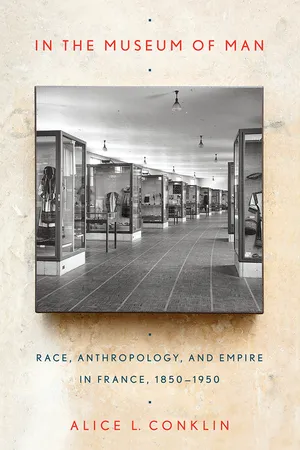
In the Museum of Man offers new insight into the thorny relationship between science, society, and empire at the high-water mark of French imperialism and European racism. Alice L. Conklin takes us into the formative years of French anthropology and social theory between 1850 and 1900; then deep into the practice of anthropology, under the name of ethnology, both in Paris and in the empire before and especially after World War I; and finally, into the fate of the discipline and its practitioners under the German Occupation and its immediate aftermath.Conklin addresses the influence exerted by academic networks, museum collections, and imperial connections in defining human diversity socioculturally rather than biologically, especially in the wake of resurgent anti-Semitism at the time of the Dreyfus Affair and in the 1930s and 1940s. Students of the progressive social scientist Marcel Mauss were exposed to the ravages of imperialism in the French colonies where they did fieldwork; as a result, they began to challenge both colonialism and the scientific racism that provided its intellectual justification. Indeed, a number of them were killed in the Resistance, fighting for the humanist values they had learned from their teachers and in the field. A riveting story of a close-knit community of scholars who came to see all societies as equally complex, In the Museum of Man serves as a reminder that if scientific expertise once authorized racism, anthropologists also learned to rethink their paradigms and mobilize against racial prejudice—a lesson well worth remembering today.
eBook - ePub
In the Museum of Man
Race, Anthropology, and Empire in France, 1850–1950
- 392 pages
- English
- ePUB (mobile friendly)
- Available on iOS & Android
eBook - ePub
About this book
Information
CHAPTER 1
RACES, BONES, AND ARTIFACTS
A General Science of Man in the Nineteenth Century
In France, anthropology took a course of development distinct from that in other countries. It was a Frenchman, Boucher de Perthes, who inaugurated the epoch-making advances of prehistory; and his continuators, from Lartet and de Mortillet to l’Abbé Breuil, have remained pre-eminent. Man as a biological organism has also stirred French enthusiasm for many decades, as the names of Broca, Topinard and Boule testify. But for some inscrutable reason the arts and manners of living peoples have attracted little interest. There were French colonies with Oceanian and Negro populations, but the accounts published of them long remained few in number and inferior in quality to the comparable reports of British and German officials. As for scholars trained to observe in the field—until lately there were none.
—ROBERT LOWIE, The History of Ethnological Theory (1937)
In the nineteenth century, physicians and naturalists began inventorying the physical and racial variability of the human species on a much greater scale than ever before. At the same time, a movement among writers, artists, and linguists to study the spirit of vanishing peoples through their customs and languages developed, originally in German-speaking lands but soon throughout Europe and the Americas. Educated French men and women and their governments participated fully in these new trends, by embarking on a long path to professionalize the science that would come to be known as anthropology—that is to say, the science of humanity in its physical and sociocultural dimensions. These aspiring scholars created institutions for collecting, defining, and dispensing their new knowledge, including learned societies, peer-reviewed journals, private schools, and museums, at home and in their new colonies. Indeed, by the 1870s, France boasted a rich proliferation of all these structures, the most ambitious of which embraced the goal of building a “general anthropology,” whose object was the human species in all its aspects: biological, linguistic, and civilizational.
Despite a number of partial successes, nineteenth-century anthropologists failed to develop this general science of their dreams, and no discipline of anthropology entered the university before the twentieth century. This was in contrast to the successful launching of Durkheimian sociology during the period of expansion of academic positions that took place between 1880 and 1910, when the early Third Republic modernized higher education.1 While empirically minded French anthropologists were pioneers in the biological study of human traits, especially racial ones that ostensibly lent themselves to precise quantification, the scientific study of languages and civilizations of “primitive” peoples—what came to be called in France “ethnography” (ethnographie)—was particularly slow to gain traction. American and British universities established general anthropology departments from the 1890s onward; in Germany physical anthropology and sociocultural anthropology were recognized as sciences by the fin de siècle.2 In contrast, only in 1925 did a combined discipline of physical and sociocultural anthropology enter the University of Paris, under the new (or rather “old”—as we shall see below) name of “ethnology” (ethnologie). The reasons for this slower French path to professionalization ranged from early divergences over how to define, much less organize, the various branches of a new science of man in the age of Darwin, a lack of forceful personalities at the right moment, and the periodic politicization of scientific agendas because of persistent ideological division. One result of France’s distinctive path to disciplinarization was that even when an interest in studying so-called primitive peoples scientifically developed, the old nineteenth-century ideal of a unified science—one that considered races, customs, and languages together—remained the unquestioned objective.
This chapter analyzes two of the most important clusters of scholars in Paris from the 1850s to the 1890s who sought to organize a general anthropology (anthropologie générale); both would leave their distinctive mark on the development of academic ethnology in the twentieth century. The first initiative was led by Paul Broca, who established an anthropological institute that became world famous in the 1860s and 1870s for the study of humanity in all its dimensions. In practice, however, the Brocan school saw anthropometry and racial science, and the pursuit of physical anthropology in general (including prehistory and paleoanthropology), as its essential vocation.3 Most of Broca’s followers never developed a serious interest in premodern societies; nor would they shed the notion that an understanding of race was fundamental to explaining human behavior. Brocan investigation of racial traits temporarily lost much of its original appeal and direction in the last two decades of the nineteenth century—especially in the wake of the Dreyfus affair—but his anthropological school would reemerge in the 1920s and 1930s as an influential center for the study of the natural history of humanity, including races.
The second cluster in general anthropology to develop in this period centered on Broca’s contemporary and friendly rival, Jean Louis Armand de Quatrefages de Bréau, holder of the first chair in anthropology, established in 1856, at one of the most venerable research institutes in the natural sciences in Paris, the Muséum National d’Histoire Naturelle. This Muséum school subscribed to the same general definition of anthropology as the Brocan circle—but unlike Broca’s acolytes, they practiced what they preached. Muséum denizens not only embraced paleoanthropology and racial science; they also studied the ethnographic (i.e., man-made) artifacts and customs of “primitive” civilizations. By the late 1870s, in a context of expanding colonization and new investments in improving a recently defeated French nation through science, the Third Republic created Paris’s first public museum dedicated only to ethnography, the Musée d’Ethnographie du Trocadéro, and chose a young anthropologist from the Muséum to head it, Ernest-Théodore Hamy. The latter wished to use this institution to develop the study of premodern cultures into a serious science—one that could finally take its place alongside physical anthropology in a genuinely general science of man. Hamy, however, found little support in France’s scientific community for his museum venture. Only with new actors, a new political context, and consolidation of empire in the early twentieth century would the conditions be right for a scientific field of ethnography to take off in France as part of a new academic discipline of ethnology—an ethnography that was a reaction against, but also heir to, the long and prestigious nineteenth-century tradition of privileging racial science over the study of languages and customs.
BROCAN ANTHROPOLOGY DEFINED: THE PRIMACY OF RACE, 1839–1879
The dubious “achievement” of one cluster of nineteenth-century anthropologists was the creation of a doctrine of race more scientific than any before it, in France and internationally. The epistemological origins of this doctrine can be traced back to the end of the eighteenth century, when certain geographers, naturalists, anatomists, phrenologists, and physiognomists first began to explore the observable differences, and particularly racial differences, among human groups and to hypothesize about racial influence on individual and group behavior and capacity.4 At the time it was widely assumed that humans sorted themselves into a natural hierarchy of distinct and stable races whose characteristics manifested themselves osteologically, particularly in the size of the skull, which could be measured; only a few voices argued for the possible equal endowment of the different races, but many were willing to believe that hereditarian inequality did not mean inability to progress, and that environmental influences rather than heredity (or some combination of the two) were responsible for the different races. Anthropometry and craniometry were invented as methods to try to demonstrate the biological reality of racial differences, although there was no scholarly agreement in this period on how to measure racial traits, much less on the proper methods to use to classify races.
The question of racial diversity, the reasons for it, and its implications for psychic capacity, were themselves part of a larger debate that riveted contemporaries, especially from the 1820s onward when Lamarckian transformism first began to win adherents: whether humanity at its origin was single (monogenesis), as stated in the Bible—with all races descending from the same first man and woman—or multiple (polygenesis)—that is to say, with each race constituting a different species from the outset.5 This question became entangled in another, more political one unleashed by Anglo-American imperialism and the early nineteenth-century practice of slavery: whether certain “primitive” races were capable of improvement. Yet, while French scholars from a variety of fields contributed to this nascent racial science, the most famous controversies of the era pitted the American, pro-slavery craniologists Samuel Morton, George Glidden, and Josiah Nott against the British scientist and defender of slaves James Pritchard. After 1850 the center of racial science moved to France, in large part because a gifted and ambitious doctor, Paul Broca, had trained in the shadow of these earlier debates and become frustrated by what he saw as a fundamental lack of scientific rigor in his elders’ approach to this “essential” aspect of human biology.
If we turn from the ideas that helped to launch the science of humanity in France as its own discipline to the key moments in its professional organization, the date 1839 stands out. In that year, a physiologist and antislavery advocate originally from Jamaica, the monogenist William Frédéric Edwards, founded the Société Ethnologique de Paris. Edwards is commonly recognized as the progenitor in France of a specifically racial science. Edwards’s major accomplishments in the short term were twofold: he managed for the first time to bring rival groups of naturalists, historians, travelers, and geographers together in a single society; and second, he brought about this reconciliation by arguing that race was permanent and determinative in human affairs, and by convincing the members of his new society that the proper object of “ethnological” studies should henceforth be the methodical study of the human races.6 According to Edwards, pure races could be discovered beneath all the mixing of populations that had taken place over the past 6,000 years, principally through an examination of facial features (as opposed to the bone structures that so captivated craniologists).7 Despite this emphasis on physical difference, Edwards’s research program involved more than racial mapping; for Edwards, who was particularly interested in Celtic dialects, the peopling of Europe, and the original racial makeup of the French nation, ethnology included the study of not only the racial but also the intellectual, moral, and linguistic characteristics, and historical traditions and migrations, of each people.8 His society immediately attracted a core of university-based academics and a large group of gentleman scholars.9 The Société Ethnologique nevertheless foundered from Edwards’s death in 1842 on, and the association disappeared for good in 1862.
By this time, however, an ambitious freethinking and polygenist professor of anatomy and surgeon at the Faculté de Médecine in Paris, Paul Broca, had already emerged with the energy and vision to take up Edwards’s research program—but also to make it broader still, as well as more scientific.10 Broca early on in his career became a convert to craniometry, and more particularly to the position staked out by the “Americans” versus James Pritchard in the debate over the fixity of racial traits: for Broca there was no fundamental unity of the species. One of Broca’s primary specialties was the physical location of cerebral functions, the traditional preoccupation of phrenologists, from whom he nevertheless kept his distance.11 Broca’s expertise in brain localization, too, would play a key role in his contribution to anthropology. In 1859, he and a small group of other dissident biologists, whose positivist inquiries into human origins and evolution were increasingly in conflict with what they perceived to be the old-fashioned teachings of the Catholic Church, helped to create a new society called the Société d’Anthropologie de Paris. The conservative government of Napoleon III, which remained suspicious of any science that smacked of materialism, reluctantly authorized its creation ...
Table of contents
- Acknowledgments
- List of Abbreviations
- Introduction
- 1. Races, Bones, and Artifacts
- 2. Toward a New Synthesis
- 3. Ethnology for the Masses
- 4. Skulls on Display
- 5. Ethnology
- 6. From the Study to the Field
- 7. Ethnologists at War
- Epilogue
- Selected Bibliography
Trusted by 375,005 students
Access to over 1.5 million titles for a fair monthly price.
Study more efficiently using our study tools.
Frequently asked questions
Yes, you can cancel anytime from the Subscription tab in your account settings on the Perlego website. Your subscription will stay active until the end of your current billing period. Learn how to cancel your subscription
No, books cannot be downloaded as external files, such as PDFs, for use outside of Perlego. However, you can download books within the Perlego app for offline reading on mobile or tablet. Learn how to download books offline
Perlego offers two plans: Essential and Complete
- Essential is ideal for learners and professionals who enjoy exploring a wide range of subjects. Access the Essential Library with 800,000+ trusted titles and best-sellers across business, personal growth, and the humanities. Includes unlimited reading time and Standard Read Aloud voice.
- Complete: Perfect for advanced learners and researchers needing full, unrestricted access. Unlock 1.5M+ books across hundreds of subjects, including academic and specialized titles. The Complete Plan also includes advanced features like Premium Read Aloud and Research Assistant.
We are an online textbook subscription service, where you can get access to an entire online library for less than the price of a single book per month. With over 1.5 million books across 990+ topics, we’ve got you covered! Learn about our mission
Look out for the read-aloud symbol on your next book to see if you can listen to it. The read-aloud tool reads text aloud for you, highlighting the text as it is being read. You can pause it, speed it up and slow it down. Learn more about Read Aloud
Yes! You can use the Perlego app on both iOS and Android devices to read anytime, anywhere — even offline. Perfect for commutes or when you’re on the go.
Please note we cannot support devices running on iOS 13 and Android 7 or earlier. Learn more about using the app
Please note we cannot support devices running on iOS 13 and Android 7 or earlier. Learn more about using the app
Yes, you can access In the Museum of Man by Alice L. Conklin in PDF and/or ePUB format, as well as other popular books in History & Museum Studies. We have over 1.5 million books available in our catalogue for you to explore.