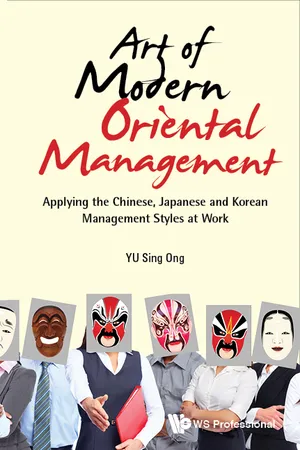
Art Of Modern Oriental Management: Applying The Chinese, Japanese And Korean Management Styles At Work
eBook - PDF

Art Of Modern Oriental Management: Applying The Chinese, Japanese And Korean Management Styles At Work

Applying the Chinese, Japanese and Korean Management Styles at Work

  1. 272 pages
  2. English
  3. PDF
  4. Available on iOS & Android
eBook - PDF

Art Of Modern Oriental Management: Applying The Chinese, Japanese And Korean Management Styles At Work

Applying the Chinese, Japanese and Korean Management Styles at Work

About this book

-->

This book aims to present an overview of Chinese, Japanese and Korean modern management styles. The cultures of China, Japan and Korea are influenced by Confucianism, Daoism and Buddhism. As such, there are some basic similarities in their management styles. As business operations become more internationalised, the management styles among Chinese, Japanese and Korean companies have blurred the lines of distinction between Western and Eastern cultures. The need for Western managers to adapt to Asian way of doing business, and likewise for Asian companies to understand Western business practices, means that managers have to bridge the gaps and adopt the best management practices containing both Western and Eastern elements.

Unlike the traditional approach of setting clear differentiation between Western and Eastern cultures, this book looks at Oriental management from a modern perspective, that is, the fusion of Western and Eastern management styles. By using a multifaceted approach to understanding modern Oriental management, the author stresses the complexities of the business environment in China, Japan and Korea. He suggests that Western theories of management are applicable to Eastern cultural context with some adaptations to the local environment. The author also offers valuable insights into the management styles of Oriental managers by providing a critical perspective of their thought processes in simple yet highly relevant illustrations of models and frameworks. This book is recommended for those who are interested in attaining a deeper knowledge of Oriental management practices.

-->

Contents:

  • Preface
  • Acknowledgements
  • About the Author
  • Influences of Philosophy and Religion:
    • Confucianism
    • Confucianism Influences on Modern Management
    • Daoism
    • Modern Daoism's Application in Business
    • Buddhism
    • Contribution of Confucianism, Daoism and Buddhism to Modern Oriental Management
  • Cultural Sensitivities:
    • Cultural Dimensions
    • Understanding Oriental Business Culture
    • Failure of Foreign Companies in China
    • Recent Corporate Events
  • Chinese Management Styles:
    • Chinese Management Practices
    • Guanxi
    • Management Paradox: Divide and Rule
  • Sun Tzu Art of Management:
    • Sun Tzu Art of Modern Management
    • Analysis and Laying Plans
    • Waging War
    • Attack by Stratagem
    • Tactical Dispositions
    • Use of Energy
    • Weakness and Strength
    • Military Combat
    • Variation of Tactics
    • Army on the March
    • Classification of Terrain
    • Nine Terrains
    • Fiery Attack
    • Employing Spies
  • Japanese Management Styles:
    • Japanese Philosophy
    • Japanese Management Practices
    • Just-In-Time Manufacturing
    • Kaizen
    • Toyota Production System
    • Theory Z
    • Keiretsu System
    • Influences of Western Management Styles
  • Korean Management Styles:
    • Korean Philosophy and Religions
    • Korean Management Practices
    • Chaebols
    • Collaboration among Rivals
    • Korean Culture
  • Comparison of Chinese, Japanese and Korean Management Styles:
    • Differences in Management Styles
    • Core Values of Cultures
  • West Learning from East:
    • What Western Managers Could Learn from Their Eastern Counterparts?
  • References
  • Index

-->
--> Readership: Readers who are interested in attaining a deeper understanding of Oriental management practices. -->

Frequently asked questions

Yes, you can cancel anytime from the Subscription tab in your account settings on the Perlego website. Your subscription will stay active until the end of your current billing period. Learn how to cancel your subscription.
No, books cannot be downloaded as external files, such as PDFs, for use outside of Perlego. However, you can download books within the Perlego app for offline reading on mobile or tablet. Learn more here.
Perlego offers two plans: Essential and Complete
  • Essential is ideal for learners and professionals who enjoy exploring a wide range of subjects. Access the Essential Library with 800,000+ trusted titles and best-sellers across business, personal growth, and the humanities. Includes unlimited reading time and Standard Read Aloud voice.
  • Complete: Perfect for advanced learners and researchers needing full, unrestricted access. Unlock 1.4M+ books across hundreds of subjects, including academic and specialized titles. The Complete Plan also includes advanced features like Premium Read Aloud and Research Assistant.
Both plans are available with monthly, semester, or annual billing cycles.
We are an online textbook subscription service, where you can get access to an entire online library for less than the price of a single book per month. With over 1 million books across 1000+ topics, we’ve got you covered! Learn more here.
Look out for the read-aloud symbol on your next book to see if you can listen to it. The read-aloud tool reads text aloud for you, highlighting the text as it is being read. You can pause it, speed it up and slow it down. Learn more here.
Yes! You can use the Perlego app on both iOS or Android devices to read anytime, anywhere — even offline. Perfect for commutes or when you’re on the go.
Please note we cannot support devices running on iOS 13 and Android 7 or earlier. Learn more about using the app.
Yes, you can access Art Of Modern Oriental Management: Applying The Chinese, Japanese And Korean Management Styles At Work by Sing Ong Yu in PDF and/or ePUB format, as well as other popular books in Business & Management. We have over one million books available in our catalogue for you to explore.

Information

Table of contents

  1. Contents
  2. Preface
  3. Acknowledgements
  4. About the Author
  5. Section 1 Influences of Philosophy and Religion
  6. Section 2 Cultural Sensitivities
  7. Section 3 Chinese Management Styles
  8. Section 4 Sun Tzu Art of Management
  9. Section 5 Japanese Management Styles
  10. Section 6 Korean Management Styles
  11. Section 7 Comparison of Chinese, Japanese and Korean Management Styles
  12. Section 8 West Learning from the East
  13. References
  14. Index