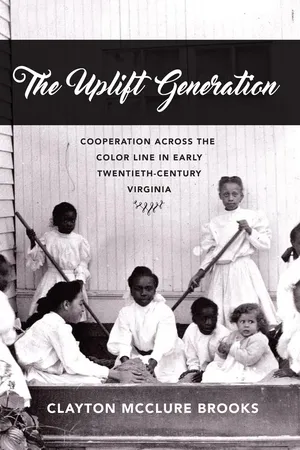
Offering a fresh look at interracial cooperation in the formative years of Jim Crow, The Uplift Generation examines how segregation was molded, not by Virginia's white political power structure alone but rather through the work of a generation of Virginian reformers across the color line who from 1900 to 1930 engaged in interracial reforms. This group of paternalists and uplift reformers believed interracial cooperation was necessary to stem violence and promote progress. Although these activists had varying motivations, they worked together because their Progressive aims meshed, finding themselves unlikely allies. Unlike later incarnations of interracialism, this early work did not challenge segregation but rather helped to build and define it, intentionally and otherwise. The initiatives—whose genesis ranged from private one-on-one communications to large-scale interracial organizations—shaped Progressivism, the emergence of a race-conscious public welfare system, and the eventual parameters of Jim Crow in Virginia. Through extensive use of personal papers, newspapers, and other archival materials, The Uplift Generation shares the stories of these fascinating—yet often forgotten—reformers and the complicated and sometimes troubling consequences of their work.
eBook - ePub
The Uplift Generation
Cooperation across the Color Line in Early Twentieth-Century Virginia
- 288 pages
- English
- ePUB (mobile friendly)
- Available on iOS & Android
eBook - ePub
The Uplift Generation
Cooperation across the Color Line in Early Twentieth-Century Virginia
About this book
Information
Subtopic
North American HistoryIndex
History1

Paternalism and Cooperation in the Old Dominion
The liberal minded white men of the Southland must be encouraged in their efforts to aid us in our march forward. The actions of the Negro hating white elements should not cause us to lose our discretion and self-control to the extent of using language and acting in a way to drive this element from us and there by causing us to lose their support. God is on our side, but these kinds of white folks can do much to better our condition before He gets to work punishing these agents of the Devil who are so active in this world of sin and sorrow.
—John Mitchell Jr., 1906
THIS STORY OF attempted cooperation and uplift in the Progressive Era is, like all of southern history, deeply rooted in place. The activism was rooted, in part, in a belief in Virginia’s superiority that resulted in an uncomfortable mixture of virulent racism and civility characterizing segregation in the Old Dominion. Although its rampant repression and inequity found parallels throughout the United States and particularly in the South, the tale of race in twentieth-century Virginia is unique. Virginians depended on and promoted interracial cooperation and communication to institute order and minimize overt racial violence. To achieve this end, Virginians, across the color line, did what came naturally by seeking answers in their own braggadocian history. White leaders revitalized the language of paternalism while African American elites appealed in hope to whites’ professed goodwill. These conversations across the color line, over time, molded the boundaries of a new segregated order.
Like their slaveholding ancestors, many white Virginians at the turn of the twentieth century obsessed over maintaining white supremacy and patrolling the boundaries of racial identity. To impose greater control on the interracial world in which they lived, they turned to segregation—a modern, Progressive reform that they hoped would solve their perceived “race problem.”1 Although opting for a repressive Jim Crow system like the rest of their southern neighbors, white Virginians cultivated a distinctive form of “polite racism” that, although as destructive and inequitable as elsewhere, was concerned with a pretense of civility and reaffirming their state’s imagined but beloved glory days. Image, these men and women believed, was everything.
Virginians loved nothing more than to sing the praises of Virginian supremacy, taking pride in their state’s self-proclaimed aristocracy and acclaim as the birthplace of seven of the first twelve United States presidents.2 Although Virginia was the largest and most influential state in the era of the New Republic, the commonwealth’s power had seeped away, and no resident of Virginia had been elected president since James Monroe won his second term in 1820.3 By the early twentieth century, the Old Dominion was no longer the dominant national power it had once been. Burdened by debt and a tarnished reputation from its Confederate secession, Virginians struggled to rebuild the image of the “mother of all states” that many felt had slipped away. Seeking to change the perception of their state as one left behind by modernity, whites promoted their state as an idyllic haven of racial harmony, where segregation brought peace and interracial goodwill and vigilante violence was viewed with distaste as unseemly. Toward this end, a number of elite white Virginians reacclaimed their faith in paternalism, arguing that benevolence was more suitable than hostility for handling their “white man’s burden.”
African American leaders, on the other hand, acutely aware of the dangers of the interracial world in which they lived, hoped to alleviate their situation and stop the gradual ebbing of their civil and political rights by encouraging whites’ paternalism. Earl Lewis in his book In Their Own Interests, a study of race in Norfolk, Virginia, in the twentieth century, argued that African Americans “never abided racism, ‘polite’ or otherwise.” While this may be true on an internal level, the black reformers in this study were not opposed to using racist paternalism to their advantage whenever possible.4 Initiated by both races, interracial cooperation functioned to extend segregation while offering black communities needed material concessions.5 These efforts served to reinforce many Virginians’ conviction of their state’s superiority. While outwardly promoting the state as a lingering sanctuary of American aristocracy, white and black leaders engaged in cooperative initiatives that, despite white claims of amity and blacks’ struggles against racial discrimination, helped to build in Virginia one of the most restrictive segregated societies in America.
Many black leaders (Maggie Lena Walker, Janie Porter Barrett, Ora B. Stokes, Giles Jackson, John Mitchell Jr., and Thomas Walker, among others) decided to work with white paternalists who asserted that it was their “moral duty” to assist in the uplift of their believed racial inferiors. Recognizing the deterioration of African American neighborhoods while often ignoring the role of segregation in creating these conditions, white paternalists inspired by the fervor of the Progressive Era (Mary Munford, Elizabeth Cocke, Jackson Davis, James Dillard, Annie Schmelz, and Joseph Mastin, among others) sought out the black middle class to “instruct” them on needed reforms.6 Black leaders encouraged these whites, hoping to gain the same material concessions and municipal services that white communities received. These individuals worked together to address a wide range of modern societal problems, including overcrowded and insufficient housing, disease epidemics, poor sanitation, and abandoned or delinquent children. They concentrated their work on solving primarily urban problems because cities, like Richmond and Norfolk, represented potentially dangerous sites of racial interaction. This “interracial cooperation” was not based on equality or equitable bargaining power but rather was a means for whites to justify their interference in a world they had worked to define as separate from their own. Black and white leaders alike spoke on the importance of “cooperating” and making friends with the opposite race.
At the turn of the twentieth century, interracial reformers in Virginia were neither silent nor secretive about their work. Instead, the whites involved proudly acclaimed what they believed to be exemplary paternalism. Perhaps the most well-known of this generation of paternalists at that time was a white woman—Mary Cooke Branch Munford. Munford accumulated an impressive résumé of work throughout her life yet was significant as well for simply what she represented— the epitome of Virginia paternalism. Although she never held political office, historians should not overlook Munford and her significant role in shaping Progressive social welfare and education in the state. Munford, like her counterparts across the color line, believed fervently in working to better the lives of all Virginians and, despite its limitations, saw interracial cooperation to be essential.
Before becoming involved in cross-racial reforms in the early 1910s, Munford was already recognized across the state as a prominent supporter of woman suffrage, increased educational opportunities for women, and various other Progressive social causes. Like many of her fellow white activists, including Lucy Randolph Mason and Elizabeth Cocke, Munford’s Virginia roots ran deep. Born in 1865 as the Civil War ended, she grew up in Richmond and not only belonged to one of the most prominent families in the state but was related to numerous other First Families of Virginia. Although Munford’s family never experienced poverty, she became interested at a young age in social welfare issues. This passion intensified after her 1893 marriage to Beverley Munford.7 Beverley was also interested in social issues and dedicated his 1909 Virginia’s Attitude toward Slavery and Secession to his wife. This book claimed, in very much the Lost Cause tradition, that the Civil War, or War of Secession (in his view), resulted from northern aggression against the South’s sovereignty; it also asserted, somewhat contradictorily, that white Virginians were largely against slavery but also that slavery was more “humane” in the state. In a featured article commemorating his life at the time of his death in 1910, the Richmond Times-Dispatch declared the work to be an “unanswerable defense of Virginia’s attitude toward an institution in connection with which she has been misrepresented.”8 Although of questionable historical accuracy, the book was well received and widely read at the time by white Virginians because it so clearly fit the prevailing view of white paternalism, a philosophy that shaped Mary Munford’s activism as well.
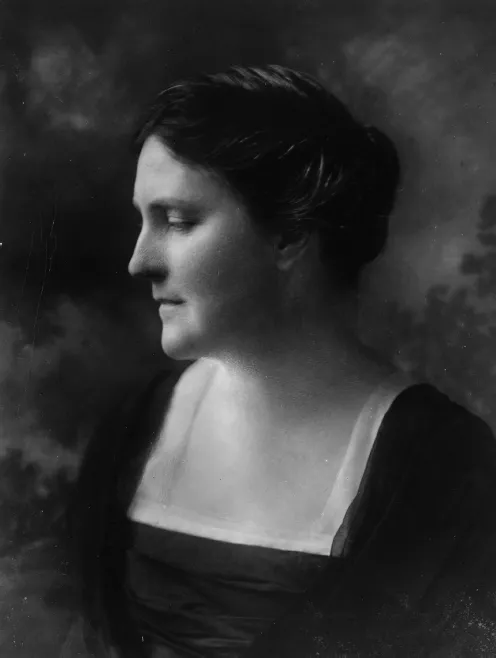
Mary Munford. (Courtesy of the Virginia Historical Society)
In the 1890s, Munford organized and headed the Saturday Afternoon Club, a weekly study and social club of elite white Richmond women. Her involvement declined over time, however, when she could not convince the group to study “unfeminine” issues such as child labor and municipal sewage systems rather than just topics like Homer and Goethe. She also became involved with the Richmond Education Association, which promoted public education (still a hotly debated issue in Virginia at the time, following its mandated implementation by Reconstruction), including a focus on African American educational opportunities. Connected with a national organization, the group held or attended national conferences every year that usually included a tour of some of the South’s African American educational institutions. Although membership in the Richmond Education Association was restricted to whites, the organization had both male and female members, and Mary Munford (as well as Lila Meade Valentine) served as president for a number of years. Munford also joined and frequently held offices in many other organizations, including the National Consumers League, the Equal Suffrage League of Virginia, the National Municipal League, and the YWCA. She led a fervent, although ultimately unsuccessful, campaign to found a coordinate college for (white) women at the University of Virginia because she felt her sex had kept her from having a true education.9 By the second decade of the twentieth century, Munford had established herself as a dedicated advocate of education, health, and labor reforms, as well as woman suffrage.
Beginning around 1910, Munford focused increasingly on the plight of African Americans out of a sense of responsibility to her family’s and state’s history. According to her biographer, Walter Russell Bowie (her nephew and a social activist himself), Mary Munford took great pride in her family’s heritage and the aristocracy it implied. She believed this status gave her the right and duty to speak on behalf of African Americans. The Richmond black newspaper, the St. Luke Herald, run by Maggie Lena Walker, praised Munford by highlighting her lineage: “She [Mary Munford] belongs to that distinctive group that the colored people in the South call ‘real’ white people or ‘bloods,’ and sometimes, the entire descriptive phrase ‘the blue bloods of Virginia.’ We say this not with a bragging boast, but by way of explanation, that there are only a precious few white people in the South who gain such an estimate from the colored people.”10 Munford became an advocate of African American concerns from an ingrained sense of noblesse oblige, believing like her slaveholding ancestors that it was her responsibility as a white aristocrat to care for the black race. Rather than rejecting white-supremacist ideologies like the Lost Cause, she drew inspiration from Confederate commemoration, often citing the love and loyalty of her family’s ex-slave servants as the reason for her activism in African American uplift causes.11
The unusual circumstances of her father’s death also shaped Munford’s commitment to racial paternalism. After the Civil War, Thomas Branch, a Confederate veteran, joined the Conservatives, a group of white politicians who hoped to regain their former power within the state and rebuild postwar Virginia by winning the votes of newly enfranchised blacks, believing naively that freedmen would turn to their former masters for guidance. As part of their campaign, on July 2, 1869, the Conservatives held a picnic designed especially to attract black voters on Vauxhall Island in the James River in support of their gubernatorial candidate, Gilbert C. Walker. Two hundred and fifty white and African American men gathered under a banner of “United we stand; divided we fall.”12 In bitter irony, the pedestrian bridge out to the island collapsed under the weight of the crowd, and several individuals died; Munford’s father was one of the victims. According to Bowie, Branch “was flung into the river, with a beam from the bridge pinning him down upon its rocks. Many men tried to save him, among them a Negro who himself was badly hurt, but they could not get him free in time.”13 Throughout her life, Munford frequently referred to this act of attempted heroism on the part of the black man as the impetus for her activism. In the words of Douglas Southall Freeman, the white editor of the Richmond News Leader and member of the Board of Charities and Corrections: “It was because of the circumstances of his [Thomas Branch’s] death that her work for justice to the Negroes had a vigor and a positive persistence that could not be balked. . . . One of her ideals . . . was to follow the same kindly road of amity and helpfulness to the Negroes.”14 The dramatic story of her father’s demise in literal “sacrifice” to the “protection” of the African American race and the unnamed black man’s effort to save her father influenced Munford to become one of Virginia’s most vocal white advocates of paternalistic interracial cooperation.
Through her work with the Richmond Education Association, Munford expressed her concern about the problems and limitations of African American educational opportunities, and in the 1910s, she broadened her approach to include a full-scale critique of the difficulties facing Virginia’s African Americans, particularly those living in urban areas such as Richmond. She never publicly spoke against segregation as the root cause, but Munford recognized the growing problems in communities like Jackson Ward, the primarily African American district in Richmond, which never received the same sanitation, modernization, and maintenance as white sections. She deplored the inadequate, overcrowded housing. In the words of her fellow reformer Elizabeth Cocke: “The most extensive of these conditions exist among the negroes. These appear to be the most squalid and least progressive, but this I believe to be largely due to the demoralizing effects of bad housing and surroundings which do not tend to any uplift.”15 Motivated by Progressive ideals of increasing government activism, Munford frequently attended city council meetings to petition for improved services for black residential and business districts.
In February 1912, Munford and Cocke encouraged the council to organize an “inspec...
Table of contents
- Cover Page
- Title Page
- Copyright
- Dedication
- Contents
- List of Illustrations
- Acknowledgments
- Introduction: The Uplift Generation
- 1. Paternalism and Cooperation in the Old Dominion
- 2. Encroaching Segregation
- 3. Public Welfare and the Segregated State
- 4. Women and Cooperation
- 5. Race and War
- 6. Contested Authority
- 7. Rethinking Alliances
- Conclusion: New Strategies in a Changed World
- Notes
- Bibliography
- Index
Trusted by 375,005 students
Access to over 1.5 million titles for a fair monthly price.
Study more efficiently using our study tools.
Frequently asked questions
Yes, you can cancel anytime from the Subscription tab in your account settings on the Perlego website. Your subscription will stay active until the end of your current billing period. Learn how to cancel your subscription
No, books cannot be downloaded as external files, such as PDFs, for use outside of Perlego. However, you can download books within the Perlego app for offline reading on mobile or tablet. Learn how to download books offline
Perlego offers two plans: Essential and Complete
- Essential is ideal for learners and professionals who enjoy exploring a wide range of subjects. Access the Essential Library with 800,000+ trusted titles and best-sellers across business, personal growth, and the humanities. Includes unlimited reading time and Standard Read Aloud voice.
- Complete: Perfect for advanced learners and researchers needing full, unrestricted access. Unlock 1.5M+ books across hundreds of subjects, including academic and specialized titles. The Complete Plan also includes advanced features like Premium Read Aloud and Research Assistant.
We are an online textbook subscription service, where you can get access to an entire online library for less than the price of a single book per month. With over 1.5 million books across 990+ topics, we’ve got you covered! Learn about our mission
Look out for the read-aloud symbol on your next book to see if you can listen to it. The read-aloud tool reads text aloud for you, highlighting the text as it is being read. You can pause it, speed it up and slow it down. Learn more about Read Aloud
Yes! You can use the Perlego app on both iOS and Android devices to read anytime, anywhere — even offline. Perfect for commutes or when you’re on the go.
Please note we cannot support devices running on iOS 13 and Android 7 or earlier. Learn more about using the app
Please note we cannot support devices running on iOS 13 and Android 7 or earlier. Learn more about using the app
Yes, you can access The Uplift Generation by Clayton McClure Brooks in PDF and/or ePUB format, as well as other popular books in History & North American History. We have over 1.5 million books available in our catalogue for you to explore.