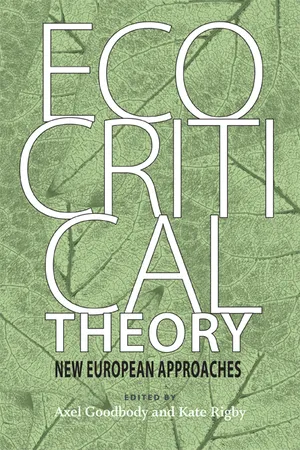
One of the more frequently lodged, serious, and justifiable complaints about ecocritical work is that it is insufficiently theorized. Ecocritical Theory puts such claims decisively to rest by offering readers a comprehensive collection of sophisticated but accessible essays that productively investigate the relationship between European theory and ecocritique. With its international roster of contributors and subjects, it also militates against the parochialism of ecocritics who work within the limited canon of the American West. Bringing together approaches and orientations based on the work of European philosophers and cultural theorists, this volume is designed to open new pathways for ecocritical theory and practice in the twenty-first century.
eBook - ePub
Ecocritical Theory
New European Approaches
- 336 pages
- English
- ePUB (mobile friendly)
- Available on iOS & Android
eBook - ePub
About this book
Information
1
MEMORY & POLITICS
KATE SOPER
Passing Glories and Romantic Retrievals: Avant-garde Nostalgia and Hedonist Renewal
This essay offers a rather more general argument than do many others in this collection. It arose out of a paper delivered to a conference entitled “Romanticism, Environment, Crisis” organized by the Centre for Romantic Studies at the University of Wales, Aberystwyth, in 2006, and its main aim is to consider the nature and extent of the relevance of Romantic thinking about nature, particularly that associated with the English Romantic poets, to our contemporary ecological “crisis.” In pursuing this theme, it takes issue with simplistic interpretations of the nature philosophy attributed to Romanticism by some environmentalists. But it also resists the suggestion that Romantic understanding has nothing to offer in our current predicament, and claims instead that there are aspects of it that could be harnessed to the development of a new politics of consumption organized around more sensually rewarding and ecologically progressive conceptions of pleasure and fulfillment.
In developing these arguments, the essay draws on the dialectical approach to the ontology and aesthetic of nature developed in the philosophy of the Frankfurt school critical theorist Theodor Adorno. In that sense, although it does not offer a full or contextualized exposition and discussion of his more environmentally relevant writings (such as is to be found in the treatments given to other theorists in this collection), it does give some sense of Adorno’s contribution to ecocriticism. It should be noted, too, that this is an essentially English- rather than American-oriented discussion, although its argument on the possible resources of Romantic forms of self-consciousness and imagination for rethinking the commitment to the “work and spend” economy and its consumerist dynamic applies to all affluent societies, and those aspiring to emulate them, in the era of globalization.
War, Poetry, and Commemoration
The bicentenary of the naval victory at Trafalgar that checked Bonaparte’s invasion of England in 1805 was the occasion of commemorations lasting over several months, beginning with Queen Elizabeth’s review of the fleet in June and mounting to their culmination with the beacon lighting on Trafalgar Day (21 October). Very feeble in contrast have been the memorials to the great flowering of Romantic poetry two hundred years ago. Preferring military to poetic glory, the nation has celebrated the immortal Nelson rather than the Immortality Ode, the feats of war rather than those of literature.
Our finest writers—and maybe particularly those of the Romantic period—are, it is true, still held in great esteem. What is more, literary and artistic work generally, some of that of the Romantics included, has been the vehicle for patriotic celebration itself or has been harnessed to that end. Romanticism has also of late become an adjunct in various ways of the British heritage industry, for example, in the millennium spectacles of the Greenwich Dome and the London Eye big wheel. As Mark Dorrian has pointed out, if Coleridge was the Romantic figure implicit in “the pleasure dome,” Wordsworth is the one explicit in the London Eye, where an engraving of his poem “Composed upon Westminster Bridge, Sept. 3, 1802” faces visitors as they queue for their “flight.”1 But such qualifications apart, I am speaking here of a rather more general cultural tilt toward finding the primary sources of national pride and rejoicing in military rather than artistic achievement.2
This constant privileging of a bellicose patriotism over other sources of national pride is, however, but one aspect of a larger set of post-Trafalgar afflictions. For we are also, of course, now living with all the consequences of two hundred years of industrial capitalism and its progressive globalization. Our economic, social, and cultural life remains shaped throughout by the uncurbed commitment to economic growth and hence to a dynamic of production and consumption, work and spend, that is exploitative of poorer regions, and has proved hugely damaging to the environment. The forms of consumption this has encouraged are both unsustainable, and in many respects dystopian, yet despite all this, mainstream politics remains committed to technical-fix responses to everything from climate change to childhood obesity. Put the package together and one might be forgiven for claiming that Romanticism—construed in the broadest sense as a countering impulse to instrumental rationality, the dominance of the cash nexus, and the constant recourse to what Raymond Williams in Towards 2000 has called “Plan X” (short-term, technological solutions to social problems)—has failed abjectly. For if Romanticism remains relevant today, it might seem as if it does so only as supplying the epithet for a naïvely idealist aspiration to what can never be; or else in the invocation of catastrophic sublimities and the aesthetic of the ruin: only in that sense of a world where, as Keats put it, “but to think is to be full of sorrow / And leaden-eyed despairs”;3 or else (to invoke the image of Shelley’s poem on Ozymandias) in the apocalyptic contemplation of the “colossal wreck, boundless and bare” that our children’s children may have to look upon and despair.4
Romanticism and Dialectics
Perhaps what seems is indeed the case, and the gloomy and elegiac cultural role is all that remains to Romanticism. I want to suggest otherwise here, and to sketch a more complex and somewhat less negative picture of its resources for us today. Thus I shall present Romantic poetry as an abidingly important dialectical asset of critical thought in our times because of the powerful expression it gives to the “otherness” and preconceptuality of “nature” even as it reminds us of the cultural mediation of all ideas about or supposed means of access to that “otherness.” I shall also argue that there are elements of Romanticism understood in a broader sense that could play a role in the revisions of thinking about pleasure and the good life that I see as crucial to the furtherance of a green political agenda.
I am not implying, however, that one can trace some continuous movement of Romanticism through to its supposed telos in a green renaissance today, but only that there is a past of Romanticism available in a present for which it may provide some resources or inspiration.5 Nor do I want to give the impression that I feel greatly optimistic that any more constructive Romantic revival will come to our aid. Nor, finally, do I want to endorse the rather simplistic “back to nature” responses within the environmental movement that have sometimes been associated with the Romantic critique. I refer here to the unqualified celebration of “nature” conceived as an independent site of truth, authenticity, and intrinsic value that should everywhere be preserved against the intrusion of the human and to whose superior wisdom we should now attend as a condition of any redemption.
For the Romantic influence on the ecological movement is by no means exhausted in this problematic mysticism or “back to nature” ethic, and there are less simplified and more authentically Romantic aspects of cognition and aesthetic response that are of greater relevance to our time. Indeed, the approach of much of the poetry of the period is altogether more complex, since even as it summons the otherness of nature and celebrates its independence, it also recalls us to the culturally mediating role of the summons, and to the extent of the dependence of the aesthetic response to nature on its human representation. It is a characteristic of much Romantic poetry, notably that of Wordsworth, in poems such as “Animal Tranquility and Decay,” “Resolution and Independence,” “Michael,” and “Old Man Travelling,” that it reflects the pull of what I have elsewhere termed the “envy of immanence.” It reflects, that is, the yearning for an immersion within the natural world, or closeness to it, that is associated either with animality or a peasant existence. Such poetry is also often written in a heightened awareness of the unreachable otherness of nature and the “betrayal” involved in giving voice to its “dumbness” and preconceptuality. Its inspiration can thus prompt a certain intellectual self-deprecation whereby the poet expresses regret for the self-distancing and alienation of expression itself. In “Animal Tranquility and Decay,” the old laborer is so unintrusive in his progress that “The little hedgerow birds, / That peck along the road, regard him not”; his peace is so perfect that “the young behold / With envy, what the Old Man hardly feels.”6 In “Resolution and Independence,” the leech gatherer is compared, on first encounter, to a huge stone “endued with sense” and to a “sea-beast” that has crawled out to sun itself. His silence or inarticulacy “was like a stream / Scarce heard: nor word from word could I divide,” and it is presented in idealized contrast to the voluble angst of the poet: “I could have laughed myself to scorn to find / In that decrepit Man so firm a mind.”7 Yet the essential point is that poetry is being written, the alienated writer “envies” immanence, but cannot give voice to the envy.8
The dialectic involved in this has received sophisticated philosophical exposition (as opposed to poetic expression) in Theodor Adorno’s work. Adorno always presents nature as compelling for us precisely as a counter to commodification and the dominance of our own constructions;9 but even as he recognizes the summons of the spontaneously given and preconceptual in nature, he also acknowledges the extent to which what is discoverable as beautiful or worthy in virtue of its naturalness owes its reception as such to culture. He is as cautious about the appeal to nature as he is about the appeal to what is cultural or historical, and he constantly uses the one to correct the confident pronouncements of the other and vice versa. Hence his resistance both to false and fetishizing forms of naturalization of history and to the “enchantment of history,” that is, to any view of history as a form of mastery of or escape from nature.10
Of particular relevance to the understanding of the nature-culture dialectic of the Romantic text are the passages in Aesthetic Theory where Adorno expands on his claim that the disinclination to talk about natural beauty “is strongest where love of it survives.” The “How beautiful!” at the sight of a landscape, he tells us, “insults its mute language and reduces its beauty.”11But landscape in reality can sense no insults, and it is, of course, we who observe and admire it and who experience any diminishment there might be of its beauty. Speech or writing mediates, either deliberately or as an effect, that which is immediate and preconceptual, and thus renders conceptual—and in the process in some sense “betrays”—that which is as it is, and is experienced as it is, only because it cannot be spoken.12 On the other hand, even as nature transcends expression, anyone capable of experiencing its beauty feels compelled, Adorno tells us, to speak as a way of signaling the momentary liberation it affords from the confines of the enclosure within the perceiving and representing self. One might note in this context the detachment or erasure of self-consciousness that critics have associated with Keats’s “negative capability” and his aspiration to an “art of sensations rather than an art of thought.”13 Comparable, too, is Wordsworth’s famous concluding sentiment in the “Intimations of Immortality”: “To me the meanest flower that blows can give / Thoughts that do often lie too deep for tears.” What nature prompts at times is a grief beyond emotion or an understanding that transcends articulation. Speech cannot fathom it, nor in the spirit of acceptance of the unfathomable associated with “negative capability,” does it even want to.14 Yet the poetic reminder of this natural power that can reside in the “meanest flower” helps to keep alive that potency by rendering us more sensible of it.
The paradox is that one talks in order to register the beyond of nature to conceptualization; one represents it in order to capture its independence of representation. Natural beauty demands to be conceptualized, but to be conceptually determined as something that is not conceptual. It also acts as a kind of reminder of, or utopian gesture toward, a world in which humanity would enjoy a harmonious and egalitarian existence. Adorno argues, for example, that aesthetic appreciation of natural beauty recollects a world without domination. But this romance, too, is paradoxical. Not only is this a world that almost certainly never existed (so that any recollection of it could only be a fantasy), there is the further consideration that it is “through this recollection that experience dissolves back into that amorphousness out of which genius arose and for the first time became conscious of the idea of freedom that could be realised in the world free of domination.”15 A similar idea is to be found in Keats’s “Ode to Autumn” in which, as Jerome McGann has put it, Keats asks us to believe in a universal “season of mists and mellow fruitfulness” because he knows that it is not true, and that so perfect an autumn is purely an “autumn of the mind.”16 According to Keats, it is only the poetic imagination that can create the image of beauty that we, who are caught up in temporality and historical contradictions, project on nature as a mirror of our desire for unity and reconciliation. Harmonious immersion in nature, Adorno suggests, is incompatible with the human consciousness that comes to an understanding of freedom and desires the release from domination. There cannot, in the end, be any “envy of immanence” because the envy itself is in contradiction to its own desire. In all this, the dialectical position on nature that is intimated by the Romantic poets and theorized by Adorno is altogether more complex and politically perceptive than that of the many nature lovers and environmentalists who have more recently emphasized the dumb-striking and ineffable qualities of natural beauty (especially wilderness) but who fail to acknowledge its dependency on subjective representation and articulation and the always aesthetically mediated quality of what we value or find beautiful in landscape.17 They thus underestimate the contribution that human beings and their ideas mak...
Table of contents
- Cover
- Half title
- Title
- Copyright
- Contents
- Acknowledgments
- Introduction
- 1 Memory and Politics
- 2 Culture, Society, and Anthropology
- 3 Phenomenology
- 4 Ethics and Otherness
- 5 Models From Physics and Biology
- Bibliography
- Notes on Contributors
- Index
Trusted by 375,005 students
Access to over 1.5 million titles for a fair monthly price.
Study more efficiently using our study tools.
Frequently asked questions
Yes, you can cancel anytime from the Subscription tab in your account settings on the Perlego website. Your subscription will stay active until the end of your current billing period. Learn how to cancel your subscription
No, books cannot be downloaded as external files, such as PDFs, for use outside of Perlego. However, you can download books within the Perlego app for offline reading on mobile or tablet. Learn how to download books offline
Perlego offers two plans: Essential and Complete
- Essential is ideal for learners and professionals who enjoy exploring a wide range of subjects. Access the Essential Library with 800,000+ trusted titles and best-sellers across business, personal growth, and the humanities. Includes unlimited reading time and Standard Read Aloud voice.
- Complete: Perfect for advanced learners and researchers needing full, unrestricted access. Unlock 1.5M+ books across hundreds of subjects, including academic and specialized titles. The Complete Plan also includes advanced features like Premium Read Aloud and Research Assistant.
We are an online textbook subscription service, where you can get access to an entire online library for less than the price of a single book per month. With over 1.5 million books across 990+ topics, we’ve got you covered! Learn about our mission
Look out for the read-aloud symbol on your next book to see if you can listen to it. The read-aloud tool reads text aloud for you, highlighting the text as it is being read. You can pause it, speed it up and slow it down. Learn more about Read Aloud
Yes! You can use the Perlego app on both iOS and Android devices to read anytime, anywhere — even offline. Perfect for commutes or when you’re on the go.
Please note we cannot support devices running on iOS 13 and Android 7 or earlier. Learn more about using the app
Please note we cannot support devices running on iOS 13 and Android 7 or earlier. Learn more about using the app
Yes, you can access Ecocritical Theory by Axel Goodbody, Kate Rigby, Axel Goodbody,Kate Rigby in PDF and/or ePUB format, as well as other popular books in Literature & Literary Criticism Theory. We have over 1.5 million books available in our catalogue for you to explore.