Sustainability is one of the great problems facing food production today. Using cross-disciplinary perspectives from international scholars working in social, cultural and biological anthropology, ecology and environmental biology, this volume brings many new perspectives to the problems we face. Its cross-disciplinary framework of chapters with local, regional and continental perspectives provides a global outlook on sustainability issues. These case studies will appeal to those working in public sector agencies, NGOs, consultancies and other bodies focused on food security, human nutrition and environmental sustainability.
eBook - ePub
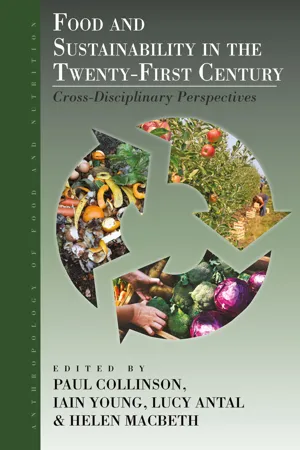
Food and Sustainability in the Twenty-First Century
Cross-Disciplinary Perspectives
- 226 pages
- English
- ePUB (mobile friendly)
- Available on iOS & Android
eBook - ePub
Food and Sustainability in the Twenty-First Century
Cross-Disciplinary Perspectives
About this book
Trusted by 375,005 students
Access to over 1.5 million titles for a fair monthly price.
Study more efficiently using our study tools.
Information
CHAPTER 1
TOWARDS A CROSS-DISCIPLINARY APPROACH TO FOOD AND SUSTAINABILITY IN THE TWENTY-FIRST CENTURY
Iain Young, Paul Collinson, Lucy Antal and Helen Macbeth
Introduction
In the previous chapter, the editors discussed the word ‘sustainability’. We highlighted the difficulty of defining the concept, the importance of clarifying precisely the variable that is to be sustained, as well as emphasising the complexity of the interactions and interrelationships between different variables. There is a voluminous literature in which the variable to be sustained is the ecosystem within which food is produced; this may relate to climate and climate change, air purity, sufficient water, water purity, productivity of the soil and appropriate recycling of waste materials. Other research focuses on biodiversity as the variable to be sustained, either in one place, in a region or globally. Then there is the sustainability of the human activities needed to produce food. In many areas of study, the focus is on the sustainability of human populations themselves, frequently discussed under the heading of food security, where food has to be secured to sustain the population. The focus here can be on any combination of the social, environmental, economic and political factors that underpin food security, as well as its effects on the nutritional health and well-being of a population, differentiated perhaps by ethnicity, status, wealth or age. A key theme in much of the literature is how food production, distribution, preparation, consumption and disposal can be sustained for future generations in the face of such challenges as population growth, climate and environmental change, conflict and deepening social and geographical inequalities. In all cases the interaction of factors adds complexity, which is why we stress not just multidisciplinary perspectives, however incomplete, but the need to communicate between disciplines through a cross-disciplinary approach.
In this chapter, we introduce some of these variables and discuss the interrelationships and interactions between them through our application of a multidisciplinary lens on human food and sustainability.
Global Perspectives
In recent decades, ‘development’ has come to be viewed as perhaps the primary variable to be sustained, judging by the widespread, almost ubiquitous use of the term ‘sustainable development’ both in academic and in political, practitioner and popular discourses. We, therefore, begin this chapter with the list of UN Sustainable Development Goals adopted at the United Nations Sustainable Development Summit in New York in 2015 (United Nations Department of Economic and Social Affairs 2015). These goals are intended as a ‘blueprint to achieve a better and more sustainable future for all’ by 2030 (United Nations 2018). Most of these goals interrelate in one way or another with the provision of food to humans – some more obviously than others.
‘This compilation provides a summary of 17 initiatives – one for each of the goals …:
• Goal 1 – End poverty in all its forms everywhere
• Goal 2 – End hunger, achieve food security and improved nutrition, and promote sustainable agriculture
• Goal 3 – Ensure healthy lives and promote well-being for all at all ages
• Goal 4 – Ensure inclusive and equitable quality of education and promote lifelong learning opportunities for all
• Goal 5 – Achieve gender equality and empower all women and girls
• Goal 6 – Ensure availability and sustainable management of water and sanitation for all
• Goal 7 – Ensure access to affordable, reliable, sustainable and modern energy for all
• Goal 8 – Promote sustained, inclusive and sustainable economic growth, full and productive employment and decent work for all
• Goal 9 – Build resilient infrastructure, promote inclusive and sustainable industrialisation and foster innovation
• Goal 10 – Reduce inequality within and among countries
• Goal 11 – Make cities and human settlements inclusive, safe, resilient and sustainable
• Goal 12 – Ensure sustainable consumption and production patterns
• Goal 13 – Take urgent action to combat climate change and its impacts
• Goal 14 – Conserve and sustainably use the oceans, seas and marine resources for sustainable development
• Goal 15 – Protect, restore and promote sustainable use of terrestrial ecosystems, sustainably manage forests, combat desertification, halt and reverse land degradation and halt biodiversity loss
• Goal 16 – Promote peaceful and inclusive societies for sustainable development, provide access to justice for all and build effective, accountable and inclusive institutions at all levels
• Goal 17 – Strengthen the means of implementation and revitalise the global partnership for sustainable development.’
(United Nations Department of Economic and Social Affairs 2015).
The dimensions envisaged by the United Nations (UN) for sustainable development are by no means the only perspectives on concepts of sustainability, but they provide many examples to consider. They also highlight the diversity of perspectives on this topic, which strongly supports the need for cross-disciplinary dialogue such as is set out in this volume.
Many would argue that the UN goals are utopian ideals and that even partially meeting these targets represents an enormous, perhaps even insurmountable, challenge for humanity. However, the achievements that have been recorded in improving food security, if not sustainability, worldwide over the past three decades are testament to the combined efforts of the international community, and they demonstrate what can be achieved through concerted multinational action. This is exemplified by the fact that the proportion of people suffering from undernourishment worldwide has declined from 18 percent in 1990 to 11 percent in 2016. The fall in the developing countries has been even more dramatic – from 23 percent to 12 percent (Food and Agriculture Organization et al. 2017: 7). This decline in the number of hungry people has occurred despite a rapidly expanding population in developing countries, which has more than doubled over the same period. However, there is no room for complacency, because undernourishment has risen since 2014, both in absolute terms (from 775 million people in 2014 to 815 million people in 2016) and as a proportion of the global population (from 10.7 percent in 2014 to 11 percent in 2016) (ibid.: 5). This last represents the first rise in the proportion of people going hungry since 2001–2 (ibid.: 5).
Although global food prices have been generally stable since the food price shocks of 2008–11, the cost of importing food is increasing, rising around 6 percent in 2017; these rises are even more marked in the least-developed countries (Food and Agriculture Organization 2017). Drought, flooding and protracted conflicts are all key factors in food insecurity. The United Nation’s Food and Agriculture Organization Global Information and Early Warning System report ‘Crop Prospects and Food Situation’ (Food and Agriculture Organization 2018a) highlights conflict as a key driver for severe food insecurity (see also Collinson, this volume). This is a particularly important factor in parts of sub-Saharan Africa, the Middle East, South East Asia and elsewhere. This report also observes that conflict is a barrier to access to food, impedes aid and increases numbers of displaced people. Recent conflicts in Afghanistan, Iraq and Syria have brought chronic hunger to 7.6, 3.2 and 6.5 million people respectively. Unfavourable rainy seasons between 2015 and 2017 have driven food insecurity in Kenya, Ethiopia and Somalia, and drought in Mongolia has halved the country’s wheat crop, whilst in the same period, Bangladesh has suffered three major episodes of flash flooding, destroying most of the country’s rice crop.
With the population of the world set to increase from 8 to 10 billion between 2018 and 2050, it has been estimated that food production will need to increase by 70 percent over the same period to feed everyone on the planet (Food and Agriculture Organization 2009: 14). This seems to be an impossible challenge, except that, at the present time, there is more than enough food to provide nutrition for all. The Food and Agriculture Organization estimates that a third of all food grown across the world is wasted. The sustainable circular food model (outlined below) shows how a shift away from the linear food production model to a circular one would use fewer resources and repurpose surplus food, in the first instance, to feed people. Given that the improvements in food security which have been recorded over recent decades have occurred in parallel with a huge rise in the global population, there are some grounds for optimism for the future.
Nevertheless, we are facing a crisis in the ways that food is produced, distributed, consumed and disposed of, which has the potential to undermine the achievements that have been made (c.f. Devereux 2007). Food prices and supply remain unstable, fluctuating wildly in times of conflict and other global events (Piesse and Thirtle 2009). These fluctuations are likely to be exacerbated by climate change (Nelson et al. 2014) and by nutrient stripping in nutrient-poor soils in developing countries the world over (Jones et al. 2013). The disconnect between heavy nutrient use by arable farming and nutrient production in the form of animal waste from agriculture and human waste from urban concentration is discussed by Young (this volume).
In an insightful commentary on anthropological approaches to food and water security, Wutich and Brewis (2014: 445) suggest five factors that cause the risk of food insecurity: ecology, population, governance, markets and entitlements. In assessing the relevance of each, they argue that in relation to the first two, whilst environmental issues and population pressures may be significant factors, each is an insufficient explanation on its own. However, they consider the other three factors to have the potential to be the primary driver of food insecurity in most circumstances. In their demonstration of the relevance of anthropology and its sub-disciplines to understanding the issues surrounding sustainability, they stress the need for a cross-disciplinary approach which focuses on availability and entitlement to food.
A fundamental problem is differential access to food, both on a global level and within regions and countries (c.f. Sen 1981). If this can be addressed – and it is a big ‘if’ – it is at least a realistic possibility that a huge increase in food production will not be required. Whilst far too many people in the developing world do not have enough food to eat, many countries in the industrialised world are facing crises over what to do about surplus food and food waste. However, solving this problem on its own would do little to resolve food crises elsewhere. Global differentials in calories produced and consumed are partly a reflection of a food production and distribution paradigm which is fundamentally skewed in favour of the industrialised world (Biel 2016). Even within the developing and least-developed countries, food insecurity does not affect people equally: an absence of democracy, tensions between different social groups, neocolonialist production systems, violent conflict and different local environments, among other factors, lead to entrenched inequalities in food access. This is a problem that is increasingly affecting the industrialised world as well; witness the recent and contemporary rise of food banks in many European countries and the United States (c.f. Caplan 2016).
The situation is further complicated when we look more closely at the nutritional value of food. In many parts of the world, a simple, mutually exclusive distinction between undernutrition for the poor and overnutrition for the better off does not apply (Tanumihardjo et al. 2007; Delisle and Batal 2016). Undernutrition and obesity can exist in parallel. Research has demonstrated that as a country’s income increases, obesity shifts from wealthier to poor groups (Bann et al. 2018), and patterns also start to emerge between obesity in adults and undernutrition in offspring. Further, undernutrition in early life predisposes the individual for obesity in adulthood.
Meanwhile, the environmental effects of current systems of food production, from the impacts on land use of the rise in cash cropping and monoculture, and the depletion of soils and soil nutrients in many areas of the world, to the pollution caused by transporting food over vast distances, are contributing to increasingly alarming changes in the global climate. These changes are likely to be difficult to halt, let alone reverse, over the coming decades – even if the political will exists to take action, which is by no means certain. The globalisation of the food supply chain has led to a situation where, increasingly, food production and redistribution are managed and ‘owned’ by a small number of shareholder-led companies, whose primary focus is profit (Taylor 2017).
It is clear, therefore, that the planet is currently facing a profound crisis not of food availability but of food sustainability. Intensive farming systems requiring high mechanisation and vast inputs of chemical nutrients, over-cultivation, soil erosion and inadequate nutrient replacement systems have led to both soil erosion and a precipitous decline in soil quality over recent decades, overwhelmingly concentrated in the developing and the least-developed parts of the world (Tan et al. 2005: 127–28). As well as contributing to food insecurity, this also leads to conflict between different communities as the amount of land for growing crops and grazing animals reduces.
A fundamental problem is the resources devoted to livestock production. Worldwide, land given over to animal grazing and the production of feed occupies over 80 percent of the world’s agricultural land (Food and Agriculture Organization 2018b) but only contributes 18 percent of the total calories consumed (Poore and Nemecek 2018). Despite the efforts of the UN to reduce the amount of meat consumed (Henchion et al. 2017), global meat consumption is expected to increase by 76 percent by 2050 (WRAP 2018). The demand for grain and protein concentrates is closely related to meat production, with beef cattle consuming around 6 kg of plant protein for every kilogram of weight gained (Pimentel and Pimentel 2003). Thus, an increasing demand for meat accelerates the demand for agricult...
Table of contents
- Cover
- Title Page
- Copyright Page
- Contents
- List of Illustrations
- Preface
- Introduction. Food and Sustainability in the Twenty-First Century
- 1. Towards a Cross-Disciplinary Approach to Food and Sustainability in the Twenty-First Century
- 2. Food Insecurity and Sustainability in Sub-Saharan Africa
- 3. From Healthy to Sustainable: Transforming the Concept of the Mediterranean Diet from Health to Sustainability through Culture
- 4. Cultures of Sustainability in the Anthropocene: Understanding Organic Food in Palermo
- 5. Wild Phytogenetic Resources for Food in the Barranca del Río Santiago, Mexico: A First Approach to Sustainability
- 6. Farm Urban and Urban Aquaponics: Changing Perceptions in Classrooms and Communities
- 7. ‘Dig for Sustainability’ in the Twenty-First Century: Allotments, Gardens and Television
- 8. Food and Sustainability in the Twenty-First Century: How Places in the UK Are Working to Meet this Challenge
- 9. Food and the Problem of Uncertainty – Refugees and the Sense of Sustainability: The Case of Karen Farmers Returning to Their Villages from Refugee Camps along the Thai–Burmese Border
- 10. In Praise of a Fermented Bread: An Ethiopian Recipe for Frugal Sustainability
- 11. The Indian ‘Meat Dilemma’: Malnutrition, Social Hierarchy and Ecological Sustainability
- 12. Eating Outside the Home: Food Practices as a Consequence of Economic Crisis in Spain
- 13. First Steps in Developing a Food Waste Management Strategy in a UK Higher Education Institution: The University of Liverpool Case Study
- 14. The Demand for Sustainable Ways of Dealing with Waste from Agriculture and Aquaculture
- Index
Frequently asked questions
Yes, you can cancel anytime from the Subscription tab in your account settings on the Perlego website. Your subscription will stay active until the end of your current billing period. Learn how to cancel your subscription
No, books cannot be downloaded as external files, such as PDFs, for use outside of Perlego. However, you can download books within the Perlego app for offline reading on mobile or tablet. Learn how to download books offline
Perlego offers two plans: Essential and Complete
- Essential is ideal for learners and professionals who enjoy exploring a wide range of subjects. Access the Essential Library with 800,000+ trusted titles and best-sellers across business, personal growth, and the humanities. Includes unlimited reading time and Standard Read Aloud voice.
- Complete: Perfect for advanced learners and researchers needing full, unrestricted access. Unlock 1.5M+ books across hundreds of subjects, including academic and specialized titles. The Complete Plan also includes advanced features like Premium Read Aloud and Research Assistant.
We are an online textbook subscription service, where you can get access to an entire online library for less than the price of a single book per month. With over 1.5 million books across 990+ topics, we’ve got you covered! Learn about our mission
Look out for the read-aloud symbol on your next book to see if you can listen to it. The read-aloud tool reads text aloud for you, highlighting the text as it is being read. You can pause it, speed it up and slow it down. Learn more about Read Aloud
Yes! You can use the Perlego app on both iOS and Android devices to read anytime, anywhere — even offline. Perfect for commutes or when you’re on the go.
Please note we cannot support devices running on iOS 13 and Android 7 or earlier. Learn more about using the app
Please note we cannot support devices running on iOS 13 and Android 7 or earlier. Learn more about using the app
Yes, you can access Food and Sustainability in the Twenty-First Century by Paul Collinson,Iain Young,Lucy Antal,Helen Macbeth in PDF and/or ePUB format, as well as other popular books in Politik & Internationale Beziehungen & Öffentliche Landwirtschaftspolitik. We have over 1.5 million books available in our catalogue for you to explore.