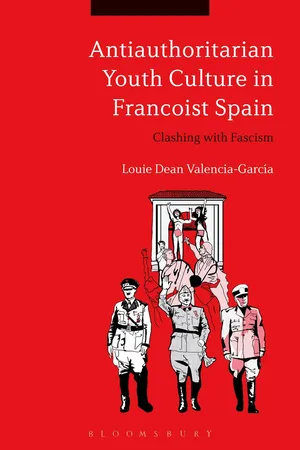
How did kids, hippies and punks challenge a fascist dictatorship and imagine an impossible dream of an inclusive future? This book explores the role of youth in shaping a democratic Spain, focusing on their urban performances of dissent, their consumption of censored literature, political-literary magazines and comic books and their involvement in a newly developed underground scene.
After forty years of dictatorship, Madrid became the centre of both a young democracy and a vibrant artistic scene by the early 1980s. Louie Dean Valencia-García skillfully examines how young Spaniards occupied public plazas, subverted Spanish cultural norms and undermined the authoritarian state by participating in a postmodern punk subculture that eventually grew into the 'Movida Madrileña'. In doing so, he exposes how this antiauthoritarian youth culture reflected a mixture of sexual liberation, a rejection of the ideological indoctrination of the dictatorship, a reinvention of native Iberian pluralistic traditions and a burgeoning global youth culture that connected the USA, Britain, France and Spain.
By analyzing young people's everyday acts of resistance, Antiauthoritarian Youth Culture in Francoist Spain offers a fascinating account of Madrid's youth and their role in the transition to the modern Spanish democracy.
Not even a decade after the ratification of the Spanish Constitution of 1978, radio disk jockey and music critic Jesús Ordovás (1947–) was already writing with a sense of nostalgic melancholia about the changes that had occurred to the Madrid Scene since its rise. In 1987, he wrote:
It all began when Madrid assumed its role as a grand modern city, without complexes … The news of punk and its echoes were received in Madrid almost instantaneously, thanks to the radio and music magazines. Madrid now connects to London, New York and Paris, and knows it belongs to the modern world. Punk is the revulsion that opens new doors to dozens of groups and characters who have things to say.1
By the late 1980s, Madrid had indeed sloughed off much of the shell of Francoism. As Ordovás indicates, the city had rejected many of its own complexes – especially its so-called backwardness. Madrid had embraced a new image for itself as part of a network of cities located in the ‘modern world’. For Ordovás, these metropolitan centres were connected by a common, vulgar, aesthetic language – punk. In that same paragraph, Ordovás also writes about the young people who produced music because it was ‘pure and simple fun’.2 While there is certainly an argument to be made that punk culture was based on a devil-may-care attitude and a sort of nihilistic diversion, it can also be said that punk participants directly combatted authority and societal norms – self-consciously or not – even claiming the explicitly antiauthoritarian anarchist ‘
’ as one of its symbols. If it was just pure and simple fun, it certainly made transgression broadly appealing. Ordovás tells of participants of the Movida, before it was called that, making homemade demos and recordings, while noting a shift away from the Do-It-Yourself (DIY) aspect of the Madrid Scene with the arrival of ‘contracts, managers and promotion companies, tours and success’. By 1987, the scene had changed; it had become commercialized and professionalized – mainstream. Ordovás had seen his underground scene become incorporated into the new Spanish state; moreover, he had professionally benefitted from that integration. Had Madrid’s antiauthoritarian ideals died – was punk dead? For many who experienced the Madrid Scene, especially amongst the participants who financially and culturally profited most from it, this disillusionment is a pervasive sentiment in many of their reflections. One might argue, although the aesthetic of punk might have transformed, the elusive culture of antiauthoritarianism might have evolved and moved elsewhere once it created a space for those once marginalized participants to access power. Perhaps this ephemerality is part of what makes antiauthoritarianism so prevailing. It does not linger too long once its job is done. It finds a new audience that is still marginalized. However, one hopes, once the formerly marginalized are pulled to the centre, they use their newly acquired privilege not to chastise newcomers, becoming authoritarian gatekeepers themselves, but instead act to integrate new voices.
What Ordovás might not have seen in his contemporary moment was that the creation of the Madrid Scene reached further back than he might have imagined, or experienced himself, starting with young people who rejected Falangist norms by adopting antiauthoritarian values that pre-dated punk’s arrival to Spain. The streams and tributaries of liberation are hardly stagnant and have the tendency to find undiscovered crevices to permeate. In fact, one might say that Francoism did not necessarily wholly crush Spanish liberalism – although, for many liberals and leftists who fought against fascism in the civil war, liberalism and pluralism had both seemingly received an impossible setback. Instead, liberalism (in the broadest sense of the word) hid in unseen corners, melded with global antiauthoritarian youth movements, and re-emerged as part of a postmodern youth movement that incorporated elements of liberalism past into Madrid’s own variation of antiauthoritarian global youth culture. This is the nature of antiauthoritarianism – it knows how to hide amongst the gears of the all-encompassing systems of power, seeking allies and learning new tactics. Antiauthoritarianism adapts and learns from the past – fighting stubbornly not for a utopian future, but an alternative to the present.
Contrary to popular political narratives that posit Spanish democracy emerged from the decisions made by a few powerful men following Franco’s death, I argue that starting as early as the mid-1950s, young Spaniards were already transforming into what journalist John Hooper later called the ‘new Spaniards’ of the post-Franco era.3,4 As in most cases of successful democratic transition, democracy and pluralism were not imposed from above; rather, those tendencies were cultivated – existing in tension with radical political and social changes that had already been emerging under the dictatorship. Young people of the 1950s and 1960s began to imagine what a ‘modern’ Spain could be through the practice of everyday dissent.
This chapter will set up a theoretical framework for the book and locate this study historiographically. As a parallel purpose, this book also sets forward to describe insidious everyday fascist tendencies that are authoritarian, nationalist, racist, classist, sexist, queerphobic, ethnocentric and ableist. To understand these fascist tendencies, I suggest that scholars must think of ‘intersectionality’ not as a goal, but instead, it should be an approach we must use because fascism acts intersectionally itself – combining and using multiple levers in its strategies of oppression.5 Intersectional analysis gives us the ability to name categories that otherwise are collapsed into an umbrella category of the ‘Other’ by fascistic thinking (in the broadest sense). Moreover, intersectional analysis describes the symptoms of fascism and how those oppressions interconnect. If fascism in its variant strains has acted as an antithesis to Enlightenment-era liberal, pluralistic and democratic ideas, intersectional analysis is literally a categorical response that attempts to reassert rationality into discourse to counter to the fascist tendency to homogenize identities through alterophobia. By naming the elements of fascism – the symptoms – we can treat the disease. However, intersectional approaches still require us to think hard about the categories we do create, and recognize the limits and problematics of any sort of categorization (to push against binaries, as it were). To this end, I believe the cure to fascism is found in representation and pluralism, acknowledging infinite subjectivities, which can ultimately function as a panacea to everyday fascism – or what Hannah Arendt might call the ‘banality of evil’. Only once pluralism is expected, promoted and respected in the public sphere can democracy take root.
Many scholars of modern Spain have drawn a hard line between a ‘Franco era’ and a ‘post-Franco era’. Initially, this division gave invaluable insight to understanding the political changes of the time; however, such a strict periodization can lead scholars to overlook what cultural changes overlapped the eras. I ask: what prepared young Spaniards for what would become known as the ‘transition to democracy’? Because of this predilection towards using a predeterminist political narrative to describe the transition to democracy, scholars have largely ignored the ways in which young Spaniards rejected Francoism through an adoption of transgressive ideals, seen in acts of everyday dissent under the régime. Can a democracy be imposed from above by the appointed would-be successor of a dictatorship? Were the grounds for democracy already being fertilized long before Franco’s death?
The Spanish transition to democracy depended upon not only important political shifts, but also cultural shifts that started well before Franco’s death. If we are to understand the drastic cultural change of the 1980s, we must re-evaluate and expand the temporal scope of the period of the transition to democracy, and move away from a narrative that assumes the Spanish democracy was solely the product of political change at the top, while still acknowledging that that political change certainly exacerbated revolution. While it is understandable that in the wake of the dictatorship historians focused on (re)constructing the political history of the administration and the state, which had largely been obfuscated by the régime’s own narrative constructions, such a history does not entirely consider the importance of the cultural shift in the mentalitié of young Spaniards that had occurred prior to the promulgation of the Spanish Constitution of 1978.6
The Franco régime promoted an exceptionalist image of Spain as ‘different’ from other European countries, seen in an extended Francoist campaign that attempted to create an image of an ‘exotic’ Spain to attract foreign tourists.7 The inscription of this ‘exotic’ Spain onto the Spanish mentalitié also attempted to legitimate Francoism through an explanation that posited a particular Spanish need for an authoritarian régime because of its ‘difference’ to other European countries. Nevertheless, ideologies from other parts of Western Europe and the United States seeped into Spain through the tourism industry despite state censorship and oppression.8 As Richard Kagan has argued, historians must consider Spanish history in relation to Europe and the United States – not as exceptional.9
In fact, already in the 1950s and 1960s many young Spaniards, who had grown up after the Spanish Civil War, not only rejected the régime’s attempt at homogeneity, but also did so through a (re)appropriation and creation of language, art, technology, media, politics and sociality that rejected this ‘Otherness’ of Spain. While there might have been a ‘peaceful’ European invasion of Spain, Spaniards were far from passive in that process. Moreover, any cultural change that was happening in Spain should be considered in parallel to, and oftentimes in conjunction with, other contemporary youth movements, rather than solely in contrast or as an echo.
The transformation of Madrid from a drab city closely associated with the stifling Francoist régime into a colourful, spectacular city was a product of regionalism and symbolic of a (re)construction of local identity – a trend also seen in contemporary Basque and Catalan regionalist projects that attempted to shed the husk of Francoism.10 The demise of Franco presented new opportunities for young people to further subvert cultural normativity amongst political turmoil. This Madrid culture, which I describe as ‘carnivalesque’, was utilized by the local government to gain popular legitimacy as being ‘modern’ (and consequently anti-Francoist).11 This culture was also subsumed into the emerging capitalist system of democratic Spain – both transgressing and reinforcing capitalist and consumerist tendencies simultaneously. It would only be later political figures, such as Madrid’s socialist mayor Enrique Tierno Galván, who would latch onto the transgressive culture of the Movida to promote it as part of a new and ‘modern’ Spain.12
The Movida, sometimes called Nueva ola madrileña, or el Rrollo in its early phases, served as a model on which to reimagine Madrid without Franco through a process that valued lo cheli, or culture and language typically associated with working class and marginal cultures of Madrid. Important work has been done on the remaking of a local Madrid identity, but little attention has been given by historians to the early emergence of the Nueva ola madrileña or cheli culture, both necessary for understanding the reconstruction of local regional identity. It is this local Madrid identity, mixed with a myriad of global and Iberian influences, which contributed to the culture of the new, young, post-Franco Spain.13 Thus we must not only look at the construction of this ‘new’ Madrid through the lens of Spanish youth culture, but also must consider how this seemingly regional project of reconstructing local identity also can be compared to the (re)construction of other Spanish identities such as Catalan and Basque, and even global punk cultures.14
Spaniards transitioned from dictatorship to democracy through political and social change at multiple levels of society (i.e. the actions of politicians and more formalized community organizations). Young people contributed to this project by opening informal pluralistic spaces under the dictatorship – first clandestinely, and then in the public sphere. This youth culture not only began the process of (re)appropriating public space at the end of an oppressive dictatorship through the creation of a carnivalesque habitus, but they also proposed new norms that contributed to a discourse of inclusion and plurality, essential for democracy to take hold.15 By the time Franco died, Spanish culture had already been changing; democratic spaces had begun to open despite the régime.
What would become known as the Movida did not start with Franco’s death, but rather began with the emergence of a generation that had no memory of the Spanish Civil War.16 For these young people the norms of the dictatorship did not make sense, and so they had to find public spaces where they could propose and act out alternative models of Spanishness – seen in the production of comic books, magazines, music and poetry, which later appeared in the streets, cafés and bars. While those who had lived through the civil war suffered what historian Paloma Aguilar has termed ‘cultural amnesia’, young Spaniards who did not experience that trauma did not suffer from the same sort amnesia as their parents – although they certainly were affected. The memory of the Spanish Civil War played an important role after the death of Franco in the creation of the Spanish Democracy; the ‘forgotten memory’ of the war affected the political decisions made during the democratic transition. This mass ‘amnesia’ was the result of an acceptance of the Francoist government as legitimate – the product of a country petrified of another war.17 Despite historical revisionism, and the ways in which the Spanish people allowed for the régime’s official history to be promulgated into memory, there was still an underlying historical memory of the war that the régime was not able to eliminate.18 As the legacy of Francoism waned, so did that cultural amnesia, culminating with the passing of the Historical Memory Law in 2007 which attempted to literally bring the skeletons out of the closet in some cases by identifying and exhuming victims of the dictatorship buried in mass graves, and removed Francoist symbols from public spaces, amongst other provisions.19
Not having directly experienced the civil war, the postwar children not only rejected Franco’s image of Spain, but radically transgressed Francoist constructions of gender, sexuality, national identity and class in what can be described as a combination of antiauthoritarianism and decadent consumption that played in tandem with the history of Americanization, globalization and the emergence of new technological capabilities. For the young, ‘amnesia’ was a product of a disjuncture in experiences that occurred between the generations that lived through the civil war and those who grew up afterwards – not self-imposed. This cultural amnesia functioned to give young Spaniards a reason to look away from a ‘backwards’, forgotten past, and towards a future that was lived in the moment – exemplified in the youthful, Dionysian culture of the Movida Madrileña. If fascism looks to an imagined past to reconstruct an idealized future, antiauthoritarian youth culture embraces its present as future – forcing the here and now to conform to a new idealized future by creating (or embracing) a radical disjuncture.
While historians such as Antonio Cazorla Sánchez, Nigel Townson and Javier Muñoz Soro have tackled questions of everyday life in the second half of the dictatorship, and others such as Pamela Radcliff, Sasha Pack and Hamilton Stapell have aptly elaborated upon the drastic socio-political changes that occurred in Spain after Franco, sparse scholar...
Table of contents
Cover
Halftitle Page
Title Page
Dedication Page
Contents
List of Figures
Preface: Indignant Youth
Acknowledgements
An Introduction
1. Making a Scene
2. To Study is to Serve Spain
3. The Revolt of the Youth
4. Truth, Justice and the American Way in Spain
5. The Penetration of Franco’s Spain
6. Clashing with Fascism
7. Madrid Kills Me
Epilogue: Uncertain Times
Notes
Bibliography
Index
Imprint
Trusted by 375,005 students
Access to over 1.5 million titles for a fair monthly price.
Study more efficiently using our study tools.
Frequently asked questions
Yes, you can cancel anytime from the Subscription tab in your account settings on the Perlego website. Your subscription will stay active until the end of your current billing period. Learn how to cancel your subscription
No, books cannot be downloaded as external files, such as PDFs, for use outside of Perlego. However, you can download books within the Perlego app for offline reading on mobile or tablet. Learn how to download books offline
Perlego offers two plans: Essential and Complete
Essential is ideal for learners and professionals who enjoy exploring a wide range of subjects. Access the Essential Library with 800,000+ trusted titles and best-sellers across business, personal growth, and the humanities. Includes unlimited reading time and Standard Read Aloud voice.
Complete: Perfect for advanced learners and researchers needing full, unrestricted access. Unlock 1.5M+ books across hundreds of subjects, including academic and specialized titles. The Complete Plan also includes advanced features like Premium Read Aloud and Research Assistant.
Both plans are available with monthly, semester, or annual billing cycles.
We are an online textbook subscription service, where you can get access to an entire online library for less than the price of a single book per month. With over 1.5 million books across 990+ topics, we’ve got you covered! Learn about our mission
Look out for the read-aloud symbol on your next book to see if you can listen to it. The read-aloud tool reads text aloud for you, highlighting the text as it is being read. You can pause it, speed it up and slow it down. Learn more about Read Aloud
Yes! You can use the Perlego app on both iOS and Android devices to read anytime, anywhere — even offline. Perfect for commutes or when you’re on the go. Please note we cannot support devices running on iOS 13 and Android 7 or earlier. Learn more about using the app
Yes, you can access Antiauthoritarian Youth Culture in Francoist Spain by Louie Dean Valencia-García in PDF and/or ePUB format, as well as other popular books in History & European History. We have over 1.5 million books available in our catalogue for you to explore.