eBook - ePub
Available until 5 Apr |Learn more
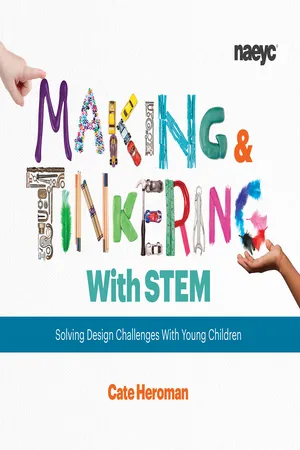
Making and Tinkering With STEM
Solving Design Challenges With Young Children
This book is available to read until 5th April, 2026
- English
- ePUB (mobile friendly)
- Available on iOS & Android
eBook - ePub
Available until 5 Apr |Learn more
About this book
Tinker, make, engineer—solving problems from picture books!
Can you build a sturdy house that is safe from the big, bad wolf?
Imagine your dream car. What special features does it have? What can you use to create it?
Teaching and learning STEM subjects (science, technology, engineering, and mathematics) is more accessible than ever before! Children will be inspired, delighted, and challenged as they use everyday materials and STEM concepts to design and build solutions to problems faced by characters in their favorite books. This practical, hands-on resource includes:
- 25 engineering design challenges appropriate for children ages 3–8
- Suggestions for creating a makerspace environment where children can tinker with materials, use tools to make creations, and improve on their ideas
- A list of 100 picture books that encourage STEM-rich exploration and learning
- Questions and ideas for expanding children’s understanding of STEM concepts
- A planning template so you can create your own design challenges
Tools to learn more effectively

Saving Books

Keyword Search

Annotating Text

Listen to it instead
Information
Year
2019Print ISBN
9781938113284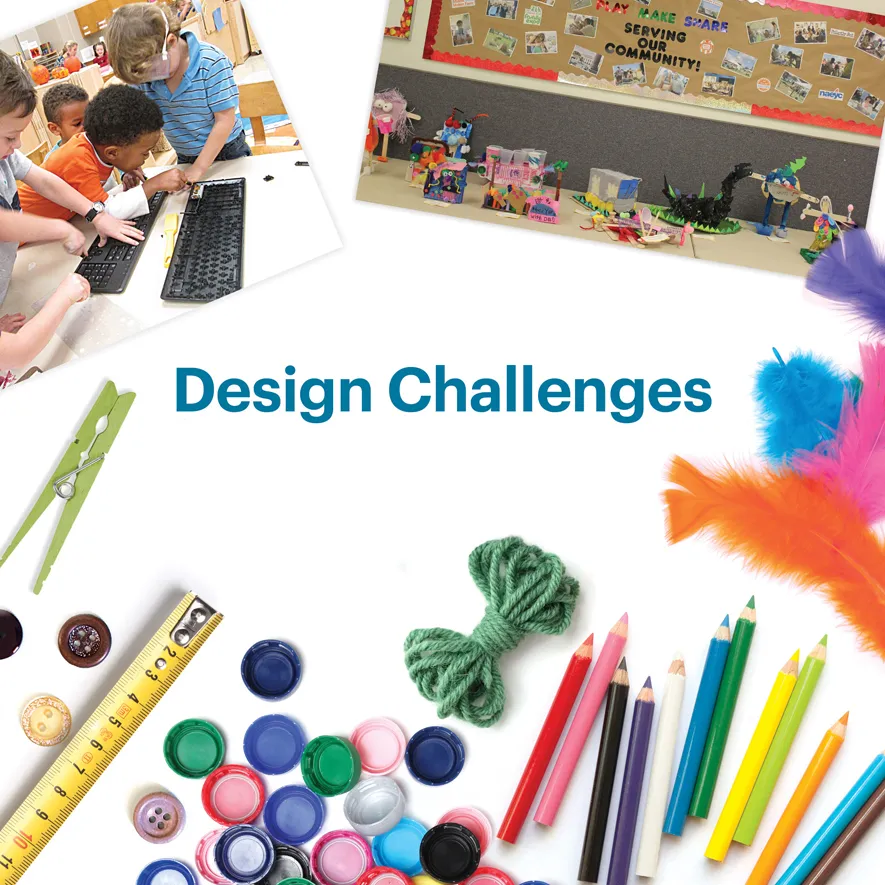
Baby Bear’s Chair

LET’S LOOK AT THE PROBLEM
After a walk in the woods, the three bears return to their house to find Little Wee Bear’s chair broken, his porridge gone, and someone sleeping in his bed.
What do the three bears do about the broken chair? How do you think they could have fixed it? Have you ever fixed something that broke at home or at school? How did you do it?
MATERIALS
□ Reusable resources such as boxes, cardboard sheets and tubes, wood scraps, and craft sticks
□ Connectors such as tape, glue, a low-temperature glue gun, cardboard connectors, and brads
□ Tools such as scissors, child-safe cardboard cutters, and measuring tapes
□ Broken or nonworking items such as toys or small appliances
□ A balance scale and a 5 lb. weight
□ Paper and markers, crayons, or pencils
Safety note: Adult assistance needed in cutting cardboard
TINKER WITH THE MATERIALS
Pretend you work at a fix-it shop near the woods where Goldilocks might take Little Wee Bear’s chair to be repaired. Look at the broken things (toys and small appliances) and at the tools and materials you might use to fix them. What can you fix? Try some different connectors to hold things together. Which one seems to work best with the object you chose to fix?
STEM CONCEPTS
balance / design engineering / force / gravity / measurement / number concepts / patterning / scientific inquiry / stability
THE DESIGN CHALLENGE
Making Build a chair that stands on its own.
Engineering Build a stable chair that doesn’t wobble and can hold an object that weighs at least five pounds.
WORKING ON THE DESIGN CHALLENGE
• Think about it. How will you build the chair? What does your chair need to include? What will you do to make it stable? Draw or sketch your ideas.
Engineering. What part of Little Wee Bear’s chair do you think broke and why? What part of the chair does he sit on? What part keeps him off the floor? How can you use this information to design your chair? How will you make the chair strong so Goldilocks can’t break it?
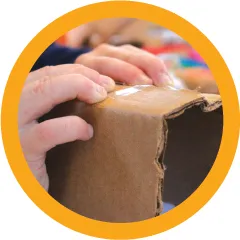
• Build or create it. Gather your materials to build the chair. Make sure that it is strong and sturdy.
• Try it. Try to make the chair stand up on its own.
Engineering. What will you use for a five-pound weight? What is the most weight the chair will hold?
• Revise or make it better. Does it work? If it doesn’t, what can you change to make the chair better, stronger, or more stable?
Engineering. Is your chair stable (no wobbling)? Does it hold at least five pounds?
• Share. Tell someone about your chair and how you made it. Ask them if they have ideas about how to make it better.
Engineering. Test several chairs. Which one holds the most weight? Look closely at that chair and discuss with someone which features you think make it strong.
QUESTIONS AND COMMENTS
What do you think will happen if __________?
Tell me about your chair.
How much weight do you think your chair will hold?
What part do you think is the weakest? How could you strengthen that part?
BACK TO THE PROBLEM IN THE BOOK
Why do you think Little Wee Bear’s chair breaks but the other chairs do not?
How do you think your chair compares with Little Wee Bear’s chair?
GOING DEEPER
• Design a chair that reclines. What other tools and materials would you need? How would you make it?
• Use tools to take apart and/or fix a broken chair donated by a family, friend, school, or community member. What can you do to make it usable and look new again?
• What if animals could sit in chairs? How would you design and make a chair for a snake? a giraffe? a porcupine? an octopus? an ant?
• Examine different types of wheelchairs. How do they work? Interview someone who uses a wheelchair. What are their ideas for making it better? Design and make a prototype (model) of a wheelchair that helps a person do a special task or an activity.
OTHER BOOKS TO USE
A Chair for Baby Bear / Kaye Umansky, illustrated by Chris Fisher
A Chair for My Mother / Vera B. Williams
Peter’s Chair / Ezra Jack Keats
A Chair for My Mother / Vera B. Williams
Peter’s Chair / Ezra Jack Keats
Beautiful Buildings

LET’S LOOK AT THE PROBLEM
Iggy Peck began building at the early age of 2, when he built a tower from dirty diapers! As he grows, he continues to build things like a cathedral out of apples and a castle out of chalk. When he gets to second grade, his teacher forbids him to build anything more. But when the class goes on a field trip, it’s up to Iggy to rescue them all from trouble.
Why does Iggy’s teacher forbid him to build anything in class? What problem arises on the field trip? How does Iggy use his building skills to solve the problem?
MATERIALS
□ Reusable resources such as boxes, cartons, cardboard tubes, craft sticks, toothpicks, paper plates, plastic cups, pipe cleaners, wooden skewers, and drinking straws
□ Connectors such as tape, glue, brads, binder clips, rubber bands, playdough, clay, wire, and cardboard connectors
□ Tools such as scissors, measuring tapes, rolling pins, and pliers
□ Photos or magazine pictures of tall buildings in your community and other locations
□ 100 pennies
□ Paper and markers, crayo...
Table of contents
- Cover
- Title Page
- Copyright
- Table of Contents
- What You Need to Know About Tinkering, Making, and Engineering
- Design Challenges
- Appendix
- Book List
- About the Author
- Acknowledgments
Frequently asked questions
Yes, you can cancel anytime from the Subscription tab in your account settings on the Perlego website. Your subscription will stay active until the end of your current billing period. Learn how to cancel your subscription
No, books cannot be downloaded as external files, such as PDFs, for use outside of Perlego. However, you can download books within the Perlego app for offline reading on mobile or tablet. Learn how to download books offline
Perlego offers two plans: Essential and Complete
- Essential is ideal for learners and professionals who enjoy exploring a wide range of subjects. Access the Essential Library with 800,000+ trusted titles and best-sellers across business, personal growth, and the humanities. Includes unlimited reading time and Standard Read Aloud voice.
- Complete: Perfect for advanced learners and researchers needing full, unrestricted access. Unlock 1.4M+ books across hundreds of subjects, including academic and specialized titles. The Complete Plan also includes advanced features like Premium Read Aloud and Research Assistant.
We are an online textbook subscription service, where you can get access to an entire online library for less than the price of a single book per month. With over 1 million books across 990+ topics, we’ve got you covered! Learn about our mission
Look out for the read-aloud symbol on your next book to see if you can listen to it. The read-aloud tool reads text aloud for you, highlighting the text as it is being read. You can pause it, speed it up and slow it down. Learn more about Read Aloud
Yes! You can use the Perlego app on both iOS and Android devices to read anytime, anywhere — even offline. Perfect for commutes or when you’re on the go.
Please note we cannot support devices running on iOS 13 and Android 7 or earlier. Learn more about using the app
Please note we cannot support devices running on iOS 13 and Android 7 or earlier. Learn more about using the app
Yes, you can access Making and Tinkering With STEM by Cate Heroman in PDF and/or ePUB format, as well as other popular books in Education & Early Childhood Education. We have over one million books available in our catalogue for you to explore.