He outlines the main theories of planning, from the traditional view of urban planning as an exercise in physical design, to the systems and rational process views of planning of the 1960s; from Marxist accounts of the role of planning in capitalist society in the 1970s, to theories about planning implementation, and more recent views of planning as a form of `communicative action?.
- 192 pages
- English
- ePUB (mobile friendly)
- Available on iOS & Android
eBook - ePub
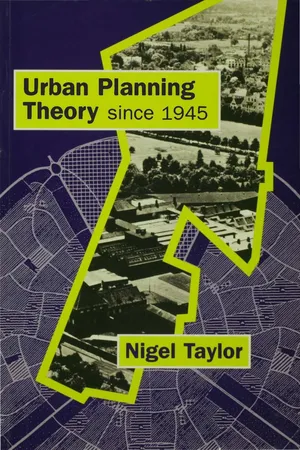
Urban Planning Theory since 1945
About this book
Following the Second World War, modern systems of urban and regional planning were established in Britain and most other developed countries. In this book, Nigel Taylor describes the changes in planning thought which have taken place since then.
Information
Publisher
SAGE Publications LtdYear
1998Print ISBN
9780761960935
9780761960942
Edition
1eBook ISBN
9781446237458
EARLY POST-WAR PLANNING THEORY
1

Town planning as physical planning and design

INTRODUCTION
In this and the following chapter we shall be examining the view, or theory, of town and country planning which prevailed in Britain for about twenty years following the Second World War. There are two aspects of post-war planning theory which I shall distinguish and examine separately in this and the next chapter.
First, in this chapter, I examine the prevailing conception of the nature of town (and country) planning as a discipline; that is, the view which most town planners held in the post-war years about the kind of activity they were engaged in – how planning theorists at this time would have defined town planning. A useful way of approaching this is to imagine a leading town planner of the post-war years being asked by an intelligent layperson: ‘what is town and country planning?’ Although as we shall see, the concept or definition of town planning which prevailed at this time could be summarised in one or two sentences, we get a richer picture if we fill out this definition somewhat, and that, too, I shall do in this chapter.
Second, in the next chapter, I examine the main views held during the post-war period of what the purposes or aims of town planning should be. This necessarily involves an inquiry into the values which underpinned town planning at this time, and so in describing this second aspect of post-war planning theory we examine the normative theory of planning which predominated in those years.
First, the prevailing view held in the post-war years of the nature of town planning. The concept of town planning which predominated was similar to that which was held during the war and pre-war years and, indeed, long before that. During and after the Second World War there was in Britain (as in other western democracies) an added political ingredient to town planning because of the widespread discussion about establishing a new system of planning for the country as a whole. This was connected with a view that emerged following the war and the interwar economic depression that the state should play a much more active, interventionist role in society. The post-war Labour Government represented this emergent position of ‘social democracy’ (as it came to be called), and between 1945 and 1951 this government established a new political agenda based on an expansion of the state’s responsibilities: a ‘welfare’ state providing universal education, health care and social security, etc., and in the state’s more active role in managing the economy (including, in some cases, the nationalisation of major industries and services). The expansion of the state’s role in town planning, as represented by various pieces of planning legislation (of which the centrepiece was the Town and Country Planning Act 1947), was thus part and parcel of this new post-war politics.
But if people had been asked at this time what sort of an activity town and country planning was, then, I suggest, their answers would have reflected a concept of town planning that had not changed significantly for some hundreds of years, since at least the time of the Renaissance and subsequent European Enlightenment. It was generally assumed that town planning was essentially an exercise in the physical planning and design of human settlements. As such, it was seen as a natural extension of architecture and (to a lesser extent) civil engineering, and hence as an activity most appropriately carried out by architects (and civil engineers). It is therefore this ‘physicalist’, design-based view of town and country planning which I describe in this chapter.
Before doing so, there are two preliminary points to note here which anticipate material presented later in the book. First, whilst conceptions about the nature of planning during the post-war years exhibited continuity with earlier periods of history, views about the purposes or aims planning should pursue were more particular to that time and had their roots in more recent history (see Chapter 2).
Secondly, though the view about the nature of town and country planning stretched back into history, it was a view that came to be questioned and to some extent abandoned during the 1960s because many of the outcomes (or apparent outcomes) of post-war planning practice were criticised in the late 1950s and 1960s. The conception of town planning described here is one which persisted for about twenty years following the Second World War. After that, new ideas and perspectives emerged, and it is the task of the rest of this book to describe these.
My account of the ‘physicalist’ conception of planning is drawn chiefly from books and other written sources published in and around the period of the Second World War, and especially from ‘textbooks’ which sought to explain, in a general sense, what town and country planning was about. After all, our understanding of the view of planning that was taken during this or any other period must rest to a large extent on what relevant people said about it, and this translates, for the most part, into what people wrote about planning. Examples of such texts include Patrick Abercrombie’s Town and Country Planning (first published in 1933), Thomas Sharp’s Town Planning (1940), Lewis Keeble’s Principles and Practice of Town and Country Planning (1952), and Frederick Gibberd’s Town Design (1953). Keeble’s was a standard and highly recommended textbook for students and practitioners of planning from the time of its publication through to the mid-1960s, and thus it expresses in a particularly vivid way the view of town and country planning which prevailed during this period. As was written on the sleeve of the fourth edition of Keeble’s book published in 1969:
‘Principles and practice’ has always been much more than a student’s textbook. In this edition it emerges fully as probably the clearest and most explicit, certainly the fullest and most comprehensive, work yet published upon the vital subject of physical planning . . . Today there are few planning offices and almost certainly no schools of planning in the English speaking world where it is not in use.
The blurbs on book jackets, of course, always makes grand claims like this. Nevertheless, I do not think this particular claim is either untrue or unreasonably immodest. Throughout the 1950s and into the mid-1960s, Keeble’s book was recommended to all students of planning (and often as the main course text). It was also used as a standard work of reference, even as a planning ‘manual’, in many planning offices, so that amongst planners themselves it was probably the best known and most widely used book on town planning.
THE COMPONENTS OF THE POST-WAR CONCEPTION OF PLANNING
The description of town and country planning in the post-war period (and long before that was conceived) as essentially an exercise in physical planning and design, but this abbreviation needs to be more fully explained. We can distinguish three related components to this:
1)Town planning as physical planning.
2)Design as central to town planning.
3)The assumption that town planning necessarily involved the production of ‘master’ plans or ‘blueprint’ plans showing the same degree of precision in the spatial configuration of land uses and urban form as the ‘end-state’ blueprint plans produced by architects or engineers when designing buildings and other human-made structures.
Town planning as physical planning
After the Second World War, there was much talk of ‘planning’ in a general sense – that is, state intervention in, and playing a more active role in, the managing and planning of social and economic affairs generally as part of the changed political climate. As town and country planning was only one form of planning activity, the question naturally arises as to what made town and country planning different from other forms of planning. The prevailing view was that, with the possible exception of regional planning controls over industry,1 town and country planning was concerned with the ‘physical’ environment and was thus most appropriately described as physical planning, as opposed to ‘social’ and ‘economic’ planning. As Keeble (1952, p. 1, emphasis added) put it on the first page of his book:
Town and Country Planning might be described as the art and science of ordering the use of land and the character and siting of buildings and communicative routes . . . Planning, in the sense with which we are concerned with it, deals primarily with land, and is not economic, social or political planning, though it may greatly assist in the realisation of the aims of these other kinds of planning.
There are three points about this statement worthy of comment. The first concerns the conceptual problem of distinguishing between ‘physical’ and ‘social’ (as well as ‘economic’) planning. The second concerns the alleged relation between physical and other forms of planning. And the third concerns the suggestion that town and country planning is not ‘political’.
The conceptual problem arises because it is difficult to make much sense of the idea that town and country planning is not concerned with ‘social’ and ‘economic’ matters. One could suggest that town and country planning is concerned with the ‘physical environment’ – and so with buildings, roads, land, etc. (i.e. with physical objects), and that this is distinct from planning (for example) health care or education. The former could be described as ‘physical’ and the latter as ‘social’ planning. This is, however, a rather contrived distinction. If one were to ask what physical planning is for, or why one might wish to plan a part of the physical environment, then it is difficult to think of a reason for this planning which is not ‘social’: for people generally wish to control the form of their environment to maintain or enhance their well-being or welfare. The nineteenth-century town planning movement in Britain was very much concerned with the physical planning of cities for reasons of public health, and policy for health is generally regarded as ‘social’. Furthermore, town and country planning is a form of social action just as much as planning the provision of health care or education. So there is some incoherence in this distinction between planning which is said to be only, or even primarily, ‘physical’, and planning which is, by contrast, ‘social’.2 However, as is evident from Keeble’s way of defining planning, town and country planning was typically thought of at this time as being about the physical environment, and hence as only physical planning.3
This is not merely a pedantic point. For if we allow that there is some distinction between ‘physical’ and ‘social’ planning, the question of whether town planning should be defined as ‘physical’ (and not ‘social’), or alternatively as ‘physical and social’, is a question of what the proper scope, and hence the purposes, of town planning should be; it is a question of whether town planning should be conceived as an activity which is ‘only about’ the physical environment and physical development or as a wider activity encompassing ‘social’ and ‘economic’ matters as well. Donald Foley drew attention to these alternative conceptions of town planning in a well-known paper about the ideology of British post-war planning (Foley, 1960). Here he made clear that there is considerable tension, and ideological debate between, a ‘physicalist’ view and a wider ‘social’ concept of town planning.
Secondly, Keeble suggests that town planning, though it is not social and economic (or even political) planning, ‘may greatly assist in the realisation of the aims of these other kinds of planning’. If we allow that there is some distinction between physical, social and economic ends, then implicit in this statement is an assumption that social and economic ends could be advanced by physical means – that is, by the location, siting, disposition and physical layout of buildings and roads, etc. At one level there is nothing exceptional about this, for clearly the physical form and layout of a town can affect social and economic life (e.g. new roads can attract commercial development to an area; and a toddlers’ play area can attract young children and so bring children in a neighbourhood into contact with each other). Keeble’s statement, however, is worth attending to because the idea that the physical form of the environment could affect social and economic life was quite central to planning thought at the time. This sometimes took the stronger thesis that the physical form and layout of buildings and spaces could determine the quality of social or economic life, and this thesis was appropriately termed physical, architectural or environmental determinism (see Broady, 1968, Chap. 1). The post-war ‘Mark 1’ new towns, for example, were designed from a common assumption that, by laying out residential areas in physically distinct neighbourhoods, with ‘their own’ local shops, recreational open spaces, primary schools, etc., there was a greater likelihood that a ‘social’ neighbourhood (i.e a ‘community’) would develop. As it turned out, this was sociologically naive (as we shall see in Chapter 3). Nevertheless, this assumption was built into early post-war planning thought, and Keeble’s statement hints at this.
The third point concerns Keeble’s assertion that town and country planning is not ‘political’ planning. Again, much hangs on how we interpret this. If he meant that town and country planning is not concerned with planning the political system, then we could concur with this. But if he meant that planning does not involve or assume a commitment to a political position, then this is questionable. The very introduction of land-use planning entails an acceptance of some form of state intervention in the property market, which in turn entails a particular political ideology (such as social democracy). Indeed, the introduction of p...
Table of contents
- Cover Page
- Title
- Dedication
- Copyright
- Contents
- Acknowledgements
- Introduction
- Part I Early post-war planning theory
- Part II Planning theory in the 1960s
- Part III Planning theory from the 1970s to the 1990s
- Part IV Conclusion
- Bibliography and references
- Index
Trusted by 375,005 students
Access to over 1.5 million titles for a fair monthly price.
Study more efficiently using our study tools.
Frequently asked questions
Yes, you can cancel anytime from the Subscription tab in your account settings on the Perlego website. Your subscription will stay active until the end of your current billing period. Learn how to cancel your subscription
No, books cannot be downloaded as external files, such as PDFs, for use outside of Perlego. However, you can download books within the Perlego app for offline reading on mobile or tablet. Learn how to download books offline
We are an online textbook subscription service, where you can get access to an entire online library for less than the price of a single book per month. With over 1.5 million books across 990+ topics, we’ve got you covered! Learn about our mission
Look out for the read-aloud symbol on your next book to see if you can listen to it. The read-aloud tool reads text aloud for you, highlighting the text as it is being read. You can pause it, speed it up and slow it down. Learn more about Read Aloud
Yes! You can use the Perlego app on both iOS and Android devices to read anytime, anywhere — even offline. Perfect for commutes or when you’re on the go.
Please note we cannot support devices running on iOS 13 and Android 7 or earlier. Learn more about using the app
Please note we cannot support devices running on iOS 13 and Android 7 or earlier. Learn more about using the app
Yes, you can access Urban Planning Theory since 1945 by Nigel Taylor in PDF and/or ePUB format, as well as other popular books in Physical Sciences & Geography. We have over 1.5 million books available in our catalogue for you to explore.