![]()
1
Introduction
DO SCHOOLTEACHERS NEED TO LEARN MANAGEMENT?
Are good managers born, not trained? Does management come naturally to us? Before answering these questions, you may find it useful to complete the following brief questionnaire. Answer each question in turn, without hesitating too long, and without reading ahead.
Management principles questionnaire
Award a grade of 0 (totally disagree) to 4 (totally agree) to indicate to what extent you agree or disagree with each of the statements that follow. Please do not look at Questions 6–10 until you have answered Questions 1–5.
(1) | One should ignore certain faults in the work of subordinates in order not to discourage them. |
| | 0 1 2 3 4 |
(2) | I spend too much time sorting out problems that my subordinates ought to be able to deal with. |
| | 0 1 2 3 4 |
(3) | I try to tell my subordinates exactly what they have to do and how I want it done. |
| | 0 1 2 3 4 |
(4) | I know enough about my area of responsibility to be able to take most decisions quickly and without having to seek the views of my subordinates. |
| | 0 1 2 3 4 |
(5) | I always tell my staff why we are making changes. |
| | 0 1 2 3 4 |
(6) | If anyone finds any fault at all with my work I would rather he or she told me to my face. |
| | 0 1 2 3 4 |
(7) | If I have a problem I like my boss to take over and sort it out. |
| | 0 1 2 3 4 |
(8) | I like to be told exactly how I am to do my job. |
| | 0 1 2 3 4 |
(9) | If my boss is going to take a decision affecting me or my department I like him or her to consult me first. |
| | 0 1 2 3 4 |
(10) | It is difficult to appreciate the logic behind many education office decisions. |
| | 0 1 2 3 4 |
Interpreting the questionnaire
As you neared the end of the questionnaire you probably realized that there was a relationship between Questions 1 and 6, 2 and 7, etc. In fact, the first five questions all relate to the way in which we manage others or believe that we ought to manage others. Questions 6–10, on the other hand, are concerned with the way in which we believe we are or ought to be managed.
It seems logical that we should manage others in the way that we like to be managed. However, you will be among the vast majority of those who have answered this questionnaire if you have, by a ‘4’ grading, firmly asserted that ‘if anyone finds any fault at all with my work I would rather he or she told me to my face’ (Question 6), yet have at the same time suggested by a ‘3’ or a ‘4’ that ‘One should ignore certain faults in the work of subordinates in order not to discourage them’ (Question 1).
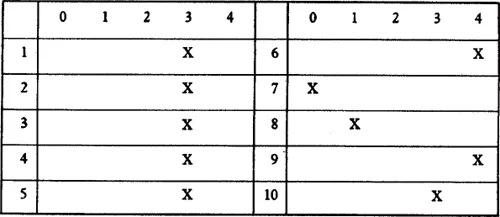
Answers by a typical group of fifty headteachers of all types to the questionnaire gave the average results shown in Figure 1.1.
Figure 1.1 Scoring sheet for management principles questionnaire
In looking at your own scores or at the above scores, two objections may emerge:
(1) | ‘The questions are not exact matches.’ This is true – but necessary in the interests of not making the correspondence too obvious during the answering of the questionnaire. The match is close enough to make the point. |
(2) | ‘The way in which you manage or wish to be managed differs from level to level. Headteachers do wish to be told of their faults (and can safely be told of their faults as they will be too mature to be discouraged!), but this is not the case with less senior staff.’ However, this questionnaire has been given to groups of school staff at all levels and the mean response has been almost identical. |
| In the case of Question 10, the wording was changed to ‘Many of my headteacher’s decisions …’ The responses still clearly made the point that at any level we believe that we are keeping others informed of the reasons for change. However, in the vast majority of cases we are living in a fool’s paradise. |
INSTINCT, COMMON SENSE, SKILLS AND TECHNIQUES
From what we have seen above, it would appear that our ‘instinct’ for managing others may be less reliable than we think. We may, in fact, be rationalizing ourselves out of facing up to issues with our colleagues or subordinates when, in fact, this sort of evasiveness of real issues is frustrating, destructive and time-wasting for all concerned.
Most of what we shall say in this book may well appear to be common sense, as it indeed is once the issues have been thought through. Unfortunately, as we often see in others, people sometimes do not behave in accordance with principles which should be obvious to them. The remedy is to be clearly aware of
(1) | the pitfalls; |
(2) | the guiding principles which will help us to avoid the pits – or to get out of those we do happen to fall into; and |
(3) | the early warning signs of trouble. |
Practice at reacting in the light of these principles will develop our management ‘skills’.
Finally, the book will suggest certain techniques and ‘tools’ that we can use to improve the effectiveness of the ‘team’ for which we are responsible or of which we are members.
WHAT IS MANAGEMENT? WHO IS A MANAGER?
As all teachers will know from their university days, a great deal of ink can be expended in defining one’s terms. Definitions of management are so many and varied that we could spend the next twenty pages on this subject alone. Our aim, however, is not philosophy but practical guidance. Let us therefore be brief.
What management is not is carrying out a prescribed task in a prescribed way. As we discussed in the Preface, management in its broadest sense is about
(1) | setting direction, aims and objectives; |
(2) | planning how progress will be made or a goal achieved; |
(3) | organizing available resources (people, time, materials) so that the goal can be economically achieved in the planned way; |
(4) | controlling the process (i.e. measuring achievement against plan and taking corrective action where appropriate); and |
(5) | setting and improving organizational standards. |
As all teaching jobs contain at least some element of ‘management’ in this sense, one can argue that every teacher is a manager.
More restrictive definitions of management argue that a manager must additionally ‘direct’ the work of others. Again, in their classroom role, this definition could apply to all teachers and, indeed, almost all principles of management do have very direct application to ‘managing’ the classroom.
However, our prime concern will be with school ‘managers’ in the more conventional sense, i.e. those teachers who have some responsibility for planning, organizing, directing and controlling the work of other teachers.
THE MANAGER AND THE ORGANIZATION
The ‘organization’ – be it department, school, college, university, education authority or, indeed, the educational system in toto – expects of its ‘managers’ three things. These are that they will
(1) | integrate its resources in the effective pursuit of its goals; |
(2) | be the agents of effective change; and |
(3) | maintain and develop its resources. |
Integration of resources
The managerial role – as opposed to the teaching role – is to be the ‘glue’ in the organization, not, it is hoped, in the sense of ‘gumming up’ the works – though those whom you manage will inevitably see it that way at times – but in the sense of holding the organization together.
The first post in which a teacher has to plan, organize, direct and control the work of other teachers involves a fundamental change in the criteria for job success. Many learn the lessons the hard way.
Throughout the educational process, success as a student tends to depend on demonstrating and exploiting one’s own ideas and talents. This may also be the focus in one’s first teaching appointment. As a manager, on the other hand, success depends on using the ideas and talents of a team, on arriving at decisions and actions to which the team members feel committed and on ensuring that they are put into effect. Though you do not feel that someone else’s idea is quite as good as your own, ...