"The first edition of this book brought difficult questions about selfhood together with equally awkward issues of power and the ?social?. Not since Mead or Goffman, perhaps, had this been attempted in such a useful way, and in such an assured and accessible text... This completely reworked second edition retains all of these virtues, and takes the original analysis into new territory, not least with new chapters on gender and class... If you?re interested in identity - particularly how identity ?works? - this book is essential reading".
- Richard Jenkins, Professor of Sociology, Sheffield University
"A foundational book, beautifully framed for this new century. The old theories of self and identity must be revisited in these times of global and cultural transformation. What kinds of selves are now available to us? Which theories best help us make sense out of who we are today. Burkitt brilliantly charts a path through this complex set of issues, and we owe him a huge debt for doing so".
- Norman K. Denzin, Distinguished Research Professor, University of Illinois at Urbana-Champaign
This new, completely revised version builds on the popular success of the first edition. It seeks to answer the basic social question of ?who am I?? by developing an understanding of self-identity as formed in social relations and social activity. Comprehensive, jargon-free and authoritative, it will be required reading on courses in self and society, identity and personality formation.
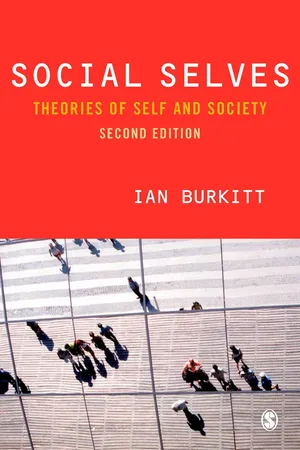
- 216 pages
- English
- ePUB (mobile friendly)
- Available on iOS & Android
eBook - ePub
About this book
Information
Publisher
SAGE Publications LtdYear
2008Print ISBN
9781412912723
9781412912716
Edition
2eBook ISBN
9781473902664
CHAPTER 1
SOCIETY AND THE SELF
Who am I? This must be one of the most frequently asked questions in the modern Western world. It seems that at key points in our lives we all address this question in one way or another. On the surface this is a deceptively easy question, because if there is one thing we ought to know it is our own self: who we are. Yet anyone who has tried to answer this question will know how difficult it is. In the modern world we are engaged in so many activities that take place in a variety of contexts with a mixture of people, we become many different things to different people. We can also be many different things to ourselves. There might not be a single answer to the question of who we are. Furthermore, if none of the varied roles we play seem to fit us, we get more confused and the question becomes more insistent: who am I? We then find ourselves in a search for self. But where do we look for it? ‘I’m trying to find myself’ is a phrase often heard from the people we encounter, and maybe many of us have said it or thought it ourselves. For those who live in Western societies, with a history of individualism, the temptation is to look inside ourselves, to examine our thoughts and feelings, as if our self-identity is a treasure locked inside, like a pearl in its shell.
Paradoxically, this search for self is rarely a lonely task. In trying to find out who we are, even if we believe the riddle is locked inside, we invariably engage others in the search for the key to ourselves; whether they are friends and family, or counsellors and therapists, we look to other people to see the image of ourselves reflected back in their words, attitudes, expressions or actions. Yet strangely we often fail to notice this, that the search for our own individual self is a social activity. In Western societies that put a high value on the individual – its freedom, autonomy, creativity, and the expression of its own individuality – we can easily overlook the role that others play in giving us the pieces with which to put together an image of our self. This is what I mean here by the notion of social selves, which provides the title of this book and is the conundrum I will investigate in these pages, that to become an individual self with its own unique identity, we must first participate in a world of others that is formed by history and culture. What I want to investigate is the idea of social individuality. This does not mean that each one of us is not an individual self, we clearly are: rather, I want to ask questions about how this self is formed in social relations with others and how it is through them, and through the relation to our own selves, that we answer the question ‘who am I?’
I therefore do not intend this book to be used as a ‘self help’ book, in the manner of those that fill the shelves of bookstores under the heading ‘popular psychology’ or ‘self development’. You will not find here techniques for self-analysis or exercises for addressing personal problems. Most of the book is devoted to the debates about the self that have dominated the social and human sciences; the various ways in which sociologists, philosophers and social psychologists have addressed the question of the self in the contemporary Western world. Yet each of the thinkers I discuss, along with the position I will develop here, have addressed and informed the question ‘who am I?’ or, more generally, ‘who are we?’ as human beings. Many of their ideas have permeated everyday understandings about the self, so it is impossible to think about who you are independent of the answers that these thinkers have given to the question ‘who am I?’. This is also because their answers were formed in the general historical and cultural epoch that still influences our lives and selves today. However, there is no such thing as a complete answer to any question, and each thinker has left us with a series of problems still to be addressed. If it is true to say we are never quite sure of who we are as individuals, it is also true to say that collectively we are still not sure of who we are as humans.
What, then, will you learn from this book? Not exactly an answer to the question ‘who am I?’ but an understanding of why we even bother to ask this question, why it is so important to us, and knowledge of some of the ideas that currently shape any possible answer you could be given to this question. Before we embark on the journey through some answers to the question, first I want to make clear my own view of the issues and why I am so insistent on suggesting that we are social selves.
Social selves: a challenge to individualism
I have already begun to address the question of why I have called this book Social Selves, because seeing ourselves as isolated cuts off the primary connection we have to other people in the creation of self. It is not that I want to deny the fact that each one of us is a unique individual, or that individualism can be a positive value. The ideals of freedom, liberty and individual autonomy are values that can prevent us from submitting to authorities that crave too much power, seeking to subjugate free people. But like all good ideas and ideals, individualism can also have its dangers. The political thinker C. B. Macpherson characterized the type of individualism that arises in Western capitalist societies as ‘possessive individualism’, which means each individual is thought to be the possessor of their own skills and capacities, owing nothing to society for the development of these.1 A free society is then seen as a market society, one in which individuals can sell their capacities on the labour market for a wage, with which they buy the goods they need to consume in order to live. But Macpherson believed that this type of individualism could be corrosive of human society, because each person is understood as bound to others only through the competitive market and nothing more. It is also a political theory that distorts human nature, because each one of us develops our capacities in society.
For the social and human sciences, the problem of possessive individualism is the creation of a division between the individual and society. An example of this is the approach to social study known as ‘methodological individualism’, typified by thinkers like F. A. Hayek, Karl Popper and J. W. N. Watkins, for whom all explanations of society must be based on statements about the dispositions and actions of individuals. That is because society is not a supra-individual entity, but composed of the individuals who make it what it is. Ironically, these thinkers actually agreed with many sociologists, whom they took as the target of their critiques, believing that society was nothing more than the relations between individuals. The real source of disagreement between these two camps is the status given to social relations – whether they are seen as primary in people’s lives or merely contingent upon already existing individuals. The latter position was the one adopted by methodological individualists, while sociologists and social psychologists tend to believe that social relations are primary in our experience. In the approach I develop here, I am against the methodological individualist position of seeing the individual as a primary fact, one that possesses given capacities or a determinate essence. That is because we are all born into social relations that we didn’t make, and much of who and what we are is formed in that context. But I do not want to reduce individuals to the mere products of their society, for the methodological individualists are right to say that there is no society without individuals and the relations between them. I prefer Norbert Elias’s solution to this problem by thinking in terms of a society of individuals.2
Hence, my attempt to understand humans as social selves is a way of trying to overcome this dichotomy. I want to suggest that when we ask the questions ‘who am I?’ or ‘who are we?’ we try to understand ourselves as social individuals rather than self-contained atoms. I also draw attention to the fact that I speak of social selves, in the plural rather than the singular, for we are all individual selves who necessarily relate to each other: there are many different selves in a society of individuals. But also, as individuals, we are multiple: I am not exactly the same person in all the different situations I act in, nor am I exactly the same person today as I was 20 years ago. This much may be uncontroversial, but why do I insist on the necessity of the concept of social selves? I do so for three basic reasons.
Firstly, we are born into a place and time that is not of our own making, and into a network of social relations we haven’t chosen. Each one of us is born into a society composed of social relations that bear the imprint of a power structure, including a hierarchy of social classes or other groupings according to rank and status, along with a culture with its beliefs and values, such as religion, or other bodies of knowledge, like science. The position into which we are born as an individual – our family, neighbourhood, social contacts, social class, gender, ethnicity, and the beliefs and values in which we are educated – will put a sizable imprint on the self we become. Those who surround us will judge, influence and mirror an image of our self back to us in many different ways. Even those who have sought solitude in order to find themselves, wandering into the wilderness, have nevertheless come from a tradition, religious or mystical, that will guide their meditation. All cultural traditions have theories about what it is to be a person, created in a network of everyday experiences and professional or theological debates. They have their own social history and will vary between cultures, yet all will provide the basis on which the selves who populate that culture emerge, forming their self-identities by moulding them with their own particularities.
Secondly, when we try to find who we are, we often turn to some social activity to reveal that ‘hidden’ self. We try out different roles, jobs, education, hobbies, arts, or sporting activities, hoping to find ourselves in them. The search for self therefore involves what we do, the activity informing who we are through the talents and capacities it may develop. However, this raises another issue, in that the self may not be pre-given: it is not something hidden that we have to find, but something that has to be made. Self, then, is something to be created with other people in joint activities and through shared ideas, which provide the techniques of self-formation. ‘Who am I?’ is perhaps a mistaken question: it should be, ‘who do I want to be?’ or ‘what shall I become?’ It is not being but becoming that is the question. Note also that in both ways of making ourselves, in relations with others and in activities undertaken with others, we are not actually looking ‘inward’ to find ourselves, but ‘outward’ towards other people and joint activities. Primarily, the place where we look for ourselves is in the world we share with others, not the world we have for ourselves through reflection on thoughts and feelings.
Thirdly, the above point is underscored in the fact that who we are, or can become, is often a political issue involving rights and duties fought over within society. Becoming who we want to be, if that is possible, often involves a political struggle. This has been witnessed in recent years with the women’s movement, the black power movement, and the gay, lesbian and transgender movement. The right to become a certain type of person, or to live freely as a particular person with a full complement of rights without persecution – as Asian, black, female, or gay – for many is something that has to be won, rather than something that is given. And the identities forged in such struggle are not formed prior to it, but in it. It is a very different thing today to live openly as a ‘gay’ man, than it was 70 years ago to live secretly as a ‘homosexual’. Even when we do not think that being ourselves involves politics, this is often a misguided assumption. Those who assume that their self-identity is a given right or a natural fact – say, a straight white man in Britain – are those in a privileged position whose identities have automatic ‘right of way’ in most social contexts. Such people assume their privileged position, not realizing that other identities might be silenced in their presence.
These are the three main reasons why I will explore the notion of social selves and social individuality in this book, trying to understand how it is that we can only attain the state of individual self-identity in relations and activities with others. What initially looks like a contradiction in terms – social individuality – will hopefully by the end of the book look like the only sensible way to proceed in confronting the dualisms and dichotomies that theories and methodologies of individualism have left us with. However, what I will do in the rest of this chapter is say a little more about the social and philosophical heritage that has created the problem of individualism, and of the relation between society and self, along with some of the solutions it has proposed to its own problem. How has this heritage created the question ‘who am I?’ and what are the various answers it has devised, leaving us with a conflicting and contradictory understanding of what it is to be human?
Some Western conceptions of the individual self
Originally, there were two main sources of the self in Western culture: the concept of the person as it emerged in ancient Greco-Roman society, and Christian ideas of the soul. As the anthropologist Marcel Mauss noted in his seminal essay ‘A category of the human mind: the notion of person: the notion of self’ (1938),3 the notion of ‘persona’ was first used in Roman culture to refer to the masks that people adopted in public ceremony. The use of masks was not restricted to ancient Rome, being common to a whole range of tribal societies as a way of marking out different roles or statuses within ritual ceremonies. What was unique to ancient Rome in its use of the term ‘persona’, according to Mauss, was that the notion acquired a legal status with certain rights and duties attached. The freeborn of Roman society (obviously this does not apply to slaves) became citizens of the state who had rights and responsibilities conferred upon them as persons.
In Hellenist and Roman culture the Stoic philosophers also contributed to the idea of the person as a free individual. They introduced the notion of an ethic of the self on a personal level, in which individuals made choices about who they wanted to be through their relationship with a philosophical teacher, and also by using new techniques of paying attention to, and taking care of, the self. One of these new techniques was the writing of letters to friends and teachers that recorded the details of a person’s everyday life, such as their health and diet, and their general regimen for living.4 This began a tradition of forming a ‘narrative of self’ that is still familiar today whenever we catch up with friends and tell them stories about what we have been doing, either in face-to-face conversation, letters, or emails. What the letters of such Stoic philosophers as Seneca, Epictetus, and Aurelius demonstrate is the beginning of narrative correspondence between people that dwells on the private world more than on the public world.5 All these trends are evidenced in the development of biography, which starts out as a public rhetorical act – in particular, the ‘encomium’ or memorial speech at civic funerals – and eventually arrives at one of the first known written autobiographies, Marcus Aurelius’s To Myself. Such a text, together with the letters of the Stoics, reveal notions of biography and narrative similar to today in that they record the events of a life (usually in chronology) as evidence of a person’s character. While the events recorded are increasingly to do with the private rather than the public life of a person, what they lack is the tendency for self-analysis and revealing the ‘inner’ life of thoughts and feelings that we would expect today.6 What is emerging is a private world of self-attention and care of self, but this is still based around a notion of self-mastery rather than self-analysis.7 Self-mastery is about watching one’s habits and routines for signs of immoderation – because the right of being a free citizen goes hand-in-hand with showing you can govern yourself – rather than asking the question ‘who am I?’
This question looms more in Christian autobiographies, such as St Augustine’s The Confessions (397). In this book, St Augustine recognized the struggle between good and evil in the hearts of all humans, including his own, charting his path to God through this ‘inner’ turmoil. While the question ‘who am I?’ is not explicitly asked, Mauss understands Christian records of the struggle in a soul as another step towards modern notions of the self, because with the idea that each one of us has our own soul, even if it is ridden with conflict, we come closer to a metaphysical foundation for the self. This is because the soul is conceived as something inward and indivisible, almost like a substance in itself that characterizes our own individuality, which can be divided from the body – our physical and earthly mark of difference. It could be said that Augustinian Christian ideas and practices are an important development in the turn ‘inwards’ in the search for self.8
However, it must be emphasized that when St Augustine searched to the depths of his soul, what he found there was God – the ‘changeless light’ of spiritual being – and not a self. The Western notion of self begins to appear in more recog...
Table of contents
- Cover Page
- Title
- Copyright
- Dedication
- Contents
- Preface to the Second Edition and Acknowledgements
- 1 Society and the Self
- 2 Dialogue and the Social Self
- 3 Ethics, Self and Performativity
- 4 Power, Knowledge and the Self
- 5 Gender, Sexuality and Identity
- 6 Social Relations, Social Class and the Self
- 7 Self in Contemporary Society
- 8 Conclusion
- Index
Trusted by 375,005 students
Access to over 1.5 million titles for a fair monthly price.
Study more efficiently using our study tools.
Frequently asked questions
Yes, you can cancel anytime from the Subscription tab in your account settings on the Perlego website. Your subscription will stay active until the end of your current billing period. Learn how to cancel your subscription
No, books cannot be downloaded as external files, such as PDFs, for use outside of Perlego. However, you can download books within the Perlego app for offline reading on mobile or tablet. Learn how to download books offline
Perlego offers two plans: Essential and Complete
- Essential is ideal for learners and professionals who enjoy exploring a wide range of subjects. Access the Essential Library with 800,000+ trusted titles and best-sellers across business, personal growth, and the humanities. Includes unlimited reading time and Standard Read Aloud voice.
- Complete: Perfect for advanced learners and researchers needing full, unrestricted access. Unlock 1.5M+ books across hundreds of subjects, including academic and specialized titles. The Complete Plan also includes advanced features like Premium Read Aloud and Research Assistant.
We are an online textbook subscription service, where you can get access to an entire online library for less than the price of a single book per month. With over 1.5 million books across 990+ topics, we’ve got you covered! Learn about our mission
Look out for the read-aloud symbol on your next book to see if you can listen to it. The read-aloud tool reads text aloud for you, highlighting the text as it is being read. You can pause it, speed it up and slow it down. Learn more about Read Aloud
Yes! You can use the Perlego app on both iOS and Android devices to read anytime, anywhere — even offline. Perfect for commutes or when you’re on the go.
Please note we cannot support devices running on iOS 13 and Android 7 or earlier. Learn more about using the app
Please note we cannot support devices running on iOS 13 and Android 7 or earlier. Learn more about using the app
Yes, you can access Social Selves by Ian Burkitt,Author in PDF and/or ePUB format, as well as other popular books in Social Sciences & Cultural & Social Anthropology. We have over 1.5 million books available in our catalogue for you to explore.