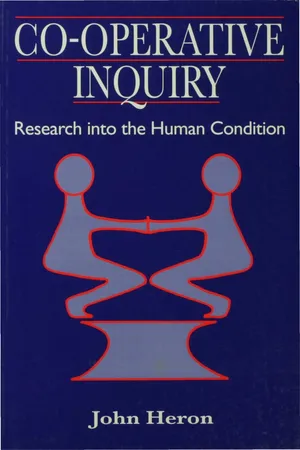
Co-operative inquiry is a distinctive and wide-ranging form of participative research in which people use the full range of their sensibilities to inquire together into any aspect of the human condition. This book offers both an extensive exploration of its theoretical background and a detailed practical guide to the methods involved. Topics covered include: a critique of established research techniques; the underlying participative paradigm of co-operative inquiry; the epistemological and political aspects of participation; different types of co-operative inquiry and the range of inquiry topics; ways of setting up inquiry groups and enabling their development; four kinds of inquiry outcome and the primacy of the practical; the main stages of the inquiry cycle, highlighting key issues for practice at each stage; and special skills and procedures used for enhancing validity.
- 240 pages
- English
- ePUB (mobile friendly)
- Available on iOS & Android
eBook - ePub
About this book
This is the first book to provide a comprehensive account of co-operative inquiry: a way of doing research with people where the roles of researcher and subject are integrated.
Information
1
Introduction
A brief history of co-operative inquiry
Co-operative inquiry involves two or more people researching a topic through their own experience of it, using a series of cycles in which they move between this experience and reflecting together on it. Each person is co-subject in the experience phases and co-researcher in the reflection phases. While this model has affinities with the account of action research and experiential learning arising from the work of Kurt Lewin (1952), its source, range of application and epistemology – as I have conceived these – are quite distinct, and take it on to a different plane. It is a vision of persons in reciprocal relation using the full range of their sensibilities to inquire together into any aspect of the human condition with which the transparent body-mind can engage.
The co-operative inquiry model was born, in my world, in 1968–69 when I started to reflect on the experience of mutual gazing in interpersonal encounters. Out of this experience I wrote a paper called ‘The phenomenology of social encounter: the gaze’ which was published in Philosophy and Phenomenological Research (Heron, 1970). To cut a long paper short, I made several points about the gaze:
- It is a distinct phenomenal category which cannot be reduced to any set of statements about the eyes as physical objects.
- Its combination of both spatial and mental properties involves a non-Cartesian account of mind.
- It provides participative noninferential but partial knowledge of the state of mind of the other.
- Its inherent mutuality of meaning is presupposed by, and the ground of, the use of speech.
I also made the point that the conventional social scientist cannot properly inquire into the nature of the gaze by doing experiments on and gathering data from other people. The status and significance of the gaze can only be explored fully from within, by full engagement with the human condition. This means the researcher is also the socially sensitive subject involved in mutual gazing with another. There was the unstated implication that any such research, in which experimenter and subject are one and the same person, would also be co-operative, involving a reciprocal relation with another person with the same double role.
From March 1970 there was an influx of experiential groups of many kinds in London. Various verbal and nonverbal one-to-one exercises, followed by shared feedback, were in vogue. Exploring these convinced me that only shared experience and shared reflection on it could yield a social science that did justice to the human condition. I thought that the researcher who wants to do research on or about other people’s experience of the human condition is not only likely to misrepresent it, but is open to the charge of being in flight from a full openness to his or her own experience. Moreover, the misrepresentation and the flight are likely to reinforce each other.
Also in 1970 I felt that the human condition within myself, in relating with others, and on the wider canvas, was about increasing self-direction in living, in co-operation with other persons similarly engaged. And that this quest for personal and social transformation, for the interacting values of autonomy and co-operation, was at the heart of any truly human social science.
Many cultural strands of the postwar decades fed into this view: the focus on freedom, and on the person as self-creating, in European personalism and existentialism; Macmurray’s account (1957) of the self as agent in reciprocal relation with other agents; the reaffirmation among many English-speaking academic philosophers of Kantian views of human freedom, autonomy and rational agency as transcending ‘determination by alien causes’ (peters, 1958; Kenny, 1963; Taylor, 1966); the affirmation of self-directed and whole person learning by Rogers (1969), and of self-esteem and self-actualization by both Rogers (1961) and Maslow (1962); the humanistic, participative, democratic values and technologies of experiential learning and action research emerging from T-groups and laboratory method and the work of Kurt Lewin (Bradford et al., 1964); the Leicester–Tavistock conferences on group dynamics; a paper by Sid Jourard (1961) on experimenter–subject dialogue; the values of the civil rights and anti-war student struggles of the sixties in the USA and of the students’ mentor Marcuse (1964); the women’s liberation movement of the sixties and the feminist texts of Friedan (1963), Millett (1977) and Greer (1970); the emergence of radical action and body-oriented therapies from the pioneer work of Moreno and Reich; the appearance of peer self-help groups of diverse kinds as a major social phenomenon; the occurrence of holistic and systemic models of explanation for organic and psychosocial life, as in Koestler (1964), von Bertalanffy (1968); and so on.
In November 1970 I founded the Human Potential Research Project at the University of Surrey to explore what a person-centred science might be like, and presented a paper about it at the annual conference of the British Psychological Society in 1971. About seventy psychologists attended the session and seemed to find it an entertaining distraction from the mainline offerings of the day. This paper, ‘Experience and method’, was published in 1971 as a monograph by the University of Surrey, and was my first formal account of co-operative inquiry. In those days I called it experiential research.
In my paper I argued that the basic explanatory model for creative, original research behaviour is that of intelligent self-direction. Original researchers in any field, because they generate new ideas that are in principle unpredictable, are the free, autonomous cause of their own behaviour, which thus transcends any sufficient explanation in terms of causal laws of physical or psychic determinism. Such researchers in psychology cannot with any consistency exhibit this autonomous explanatory model in their own behaviour and at the same time deny its relevance to the behaviour of their subjects, for example by explaining their subjects’ behaviour in terms of strict causal determinism.
I then suggested that the central research question for psychology is ‘How can self-directing capacity be developed?’, and that this question can only properly be answered, logically and morally, from the standpoint of the agent, that is, of the person who is developing their self-directing capacity. Thus the researcher is necessarily also the inquiring agent, who is both experimenter and subject combined.
I took it as a fundamental assumption of the method that self-directing persons develop most fully through fully reciprocal relations with other self-directing persons. Autonomy and co-operation are necessary and mutually enhancing values of human life. Hence experiential research involved a coequal relation between two people, reversing the roles of facilitator and agent, or combining them at the same time. They would support each other in applying to themselves, on a peer basis, some theory of personal development, where any such theory would involve relations between the potential self, the socially conditioned self, the directing self and the transformed self. The examples I suggested were co-counselling (Jackins, 1965; Schef, 1971), transactional analysis (Berne, 1961), bio-energetic analysis (Lowen, 1970). They would also give each other feedback, and together evaluate the theory in the light of their experience of it.
As well as, or instead of, this personal development approach, they could explore the ongoing dyadic relation itself and its potential. And both approaches could be developed by a larger number of people using group interaction methods. The paper also looked at issues of validity, compared and contrasted the experiential method with the traditional experimental method in psychology, and considered their relative advantages and disadvantages, especially the problem of consensus collusion in experiential research.
In October 1971 I applied the method, through the Human Potential Research Project at the University of Surrey, in an adult education 20-week training course in co-counselling. The training was at the same time an experiential peer inquiry, including myself, into the theory and practice of co-counselling. An account of this rudimentary endeavour was published in the British Journal of Guidance and Counselling (Heron, 1972).
Looking back now on the original paper and this early application of it, some obvious limitations stand out. While the paper was clear about the danger of consensus collusion, it had no suggestions about how to counter this; nor did it consider any other validity procedures, as they were called later. It said nothing about research cycling, moving to and fro between experience and reflection. It considered as topics for inquiry only personal and interpersonal growth through mutual aid; it did not address social and political issues such as disempowerment and oppression; nor did it consider the wider reaches of research that embrace any aspect of the human condition.
During the seventies I continued to apply the method in rudimentary form in workshops on a wide range of topics, and as facilitator I was also the initiating researcher inviting participants to be co-inquirers. These workshops were run informally in the spirit of co-operative inquiry, certainly not with any rigour: the participative method was improvisatory, not highly formalized. As well as personal growth through mutual aid, the topics included: the elements of human communication and encounter; intrapsychic states and processes; interpersonal and professional skills; group dynamic phenomena; altered states of consciousness; peer self-help networks; peer learning communities; peer review audits of professional practice (Heron, 1973a, 1973b, 1 974a, 1 974b, 1974c, 1 974d, 1974e, 1975a, 1975b, 1975c, 1977a, 1977b, 1977c, 1977d, 1978a, 1978b, 1978c, 1979).
During this period three developments occurred. The first was an interim account of experiential research method (Heron, 1977a), which affirmed the interdependence between phenomenological mapping and intentional action: between noticing phenomena and trying out new behaviours. The second was the importance of applying peer experiential research in the burgeoning field of transpersonal psychology (Heron, 1975b) as a counter to the dogmatic intuitionism and traditional authoritarianism to which spiritual experience so readily falls prey. The third was to extend co-operative inquiry, as a project for the future, to include all aspects of social life in what I call a self-generating culture (Heron, 1978c), as a counter to prevailing forms of social oppression and disempowerment.
A self-generating culture, I should explain in passing, is a society whose members are in a continuous process of co-operative learning and development, and whose forms are consciously adopted, periodically reviewed and altered in the light of experience, reflection and deeper vision. Its participants continually recreate it through cycles of collaborative inquiry in living. It includes several strands: forms of decision-making and political participation; forms of association; forms of habitation; revisioning a wide range of social roles; forms of economic organization; forms of ecological management; forms of education for all ages; forms of intimacy and parenting; forms of conflict resolution; forms of aesthetic expression and celebration; forms of transpersonal association and ritual (Heron, 1993a).
In 1978 Peter Reason, John Rowan and I set up the New Paradigm Research Group in London. Peter had realized in his postgraduate work that it is impossible to conduct intimate inquiry into human relationships as an outsider (Reason, 1976). John had distributed in 1976 his seminal paper ‘A dialectical paradigm for research’ (Rowan, 1981). The New Paradigm Research Group met every three weeks or so for three years and provided a major forum for the development of creative thinking and of practical projects in the field, including my own. It also set the scene for Peter and John editing their breakthrough work Human Inquiry: A Sourcebook of New Paradigm Research (Reason and Rowan, 1981a).
I contributed two chapters to this (Heron, 1981a, 1981b). The philosophical one expanded the case for co-operative inquiry in several directions beyond the 1971 paper, including a new argument from an extended epistemology, about the interdependence of propositional, practical and experiential knowledge. The methodological chapter introduced the snowperson diagram (see Figure 3.1, Chapter 3) and gave a more coherent account of the stages of the co-operative inquiry cycle, in terms of this extended epistemology.
Peter and John wrote an important chapter (Reason and Rowan, 1981c) on issues of validity in new paradigm research, which was influential in my own thinking. Peter and I then began an active phase of collaboration in developing together the methodology of co-operative inquiry. We initiated two inquiries with co-counselling colleagues (Heron and Reason, 1981, 1982). These together with an inquiry I launched in 1981 on altered states of consciousness (Heron, 1988c), led to a paper of mine on validity in co-operative inquiry which set out a whole range of validity procedures and associated skills (Heron, 1982b; revised and restated in Heron, 1988b). After over a decade of preliminaries, and with the strong creative input of Peter Reason, co-operative inquiry had acquired an innovative, rigorous and coherent form.
The next step was to apply the method in a more substantial setting. This proved to be at the British Postgraduate Medical Federation, University of London, where I was then Assistant Director. I invited Peter Reason to join me in initiating with a group of general practitioners a co-operative inquiry into whole person medicine, which ran from the summer of 1982 to the summer of 1983 (Heron and Reason, 1985; Reason, 1988c). Peter and I then started to share the fruits of four years of collaborative thinking and action, authoring a series of papers presenting co-operative inquiry to a wider audience (Heron and Reason, 1984, 1986a, 1986b; Heron, 1985; Reason, 1986, 1988d; Reason and Heron, 1995).
Since the mid-eighties, the academic centre for co-operative inquiry and related forms of participative research in the UK has been sustained by Peter Reason and colleagues, and their Postgraduate Research Group, in the School of Management at the University of Bath. This centre hosts the newsletter Collaborative Inquiry, edited by Peter Reason, and annual conferences on participative approaches to inquiry. It has generated a diversity of research projects, many in the field of professional practice, and two important books edited by Peter Reason (l988a, 1994a).
The first of these, Human Inquiry in Action, in its introduction and first two chapters, gives a well-grounded, accessible account of co-operative inquiry in its developed form. The second, Participation in Human Inquiry, includes Peter’s important perspective on participative knowing. Both include a wide range of research reports by a number of different inquiry groups. This work, including other approaches to participative inquiry, became formally constituted in 1994 as the Centre for Action Research in Professional Practice, directed by Peter Reason. CARPP hosted an international conference on Quality in Human Inquiry in March 1995.
I left the British Postgraduate Medical Federation at the end of 1985 to pursue an independent career as consultant, educator, researcher and writer. In 1989–90 I established a centre in Tuscany, Italy, where I have initiated three co-operative inquiries in the transpersonal field, and explored twice in micro-format the shared experience of a self-generating culture. I have also initiated three transpersonal co-operative inquiries in New Zealand, where I have been commuting for several months each year. This work (Heron, 1993b, 1995) will be the subject of a separate volume.
Writing this book gives me an opportunity to bring my version of the theory and practice of co-operative inquiry into much sharper focus than hitherto. In doing so, I am conscious at the outset of four main issues, which I address in the remainder of this chapter:
- The problem of a new orthodoxy.
- The overlap with other forms of participative research.
- The relation between co-operative inquiry and the very broad field of qualitative research in the social sciences.
- The nature of the inquiry paradigm underlying the method and its relation with other paradigms.
The problem of a new orthodoxy
It follows from the model of reality as subjective–objective, which I elaborate in this book, that there is no such thing as the account of co-operative inquiry, only an account, including varying degrees of intersubjective agreement and disagreement with others who use the method. However, the more I elaborate and articulate an account, the greater the danger that it will be construed by the beginner in the field as the account, which prescribes how to do a co-operative inquiry properly and correctly.
So I here and...
Table of contents
- Cover Page
- Title Page
- Copyright Page
- Contents
- Preface
- 1. Introduction
- 2. Research Method and Participation
- 3. Overview of Co-operative Inquiry
- 4. Initiating an Inquiry Group
- 5. Stages of the Inquiry Cycle
- 6. Inquiry Outcomes
- 7. Radical Memory and Inquiry Skills
- 8. Validity Procedures
- 9. Validity and Beyond
- 10. A Postconceptual Worldview
- 11. Arguments for Co-operative Inquiry
- References
- Index
Trusted by 375,005 students
Access to over 1.5 million titles for a fair monthly price.
Study more efficiently using our study tools.
Frequently asked questions
Yes, you can cancel anytime from the Subscription tab in your account settings on the Perlego website. Your subscription will stay active until the end of your current billing period. Learn how to cancel your subscription
No, books cannot be downloaded as external files, such as PDFs, for use outside of Perlego. However, you can download books within the Perlego app for offline reading on mobile or tablet. Learn how to download books offline
Perlego offers two plans: Essential and Complete
- Essential is ideal for learners and professionals who enjoy exploring a wide range of subjects. Access the Essential Library with 800,000+ trusted titles and best-sellers across business, personal growth, and the humanities. Includes unlimited reading time and Standard Read Aloud voice.
- Complete: Perfect for advanced learners and researchers needing full, unrestricted access. Unlock 1.5M+ books across hundreds of subjects, including academic and specialized titles. The Complete Plan also includes advanced features like Premium Read Aloud and Research Assistant.
We are an online textbook subscription service, where you can get access to an entire online library for less than the price of a single book per month. With over 1.5 million books across 990+ topics, we’ve got you covered! Learn about our mission
Look out for the read-aloud symbol on your next book to see if you can listen to it. The read-aloud tool reads text aloud for you, highlighting the text as it is being read. You can pause it, speed it up and slow it down. Learn more about Read Aloud
Yes! You can use the Perlego app on both iOS and Android devices to read anytime, anywhere — even offline. Perfect for commutes or when you’re on the go.
Please note we cannot support devices running on iOS 13 and Android 7 or earlier. Learn more about using the app
Please note we cannot support devices running on iOS 13 and Android 7 or earlier. Learn more about using the app
Yes, you can access Co-Operative Inquiry by John Heron in PDF and/or ePUB format, as well as other popular books in Social Sciences & Social Science Research & Methodology. We have over 1.5 million books available in our catalogue for you to explore.