![]()
1 | Being and Becoming a Highly Effective Team Leader |
Only those who have fully found themselves in this world can realise their natures. Only those who realise their natures can lead other natures to self-realization. Only those who lead other natures to self-realisation can realize the nature of things.
(Tzu-Ssu, a grandson of Confucius)
INTRODUCTION
Tzu-Ssu’s wise words about self-knowledge and self-realization may seem a little divorced from the reality of school life when you are trying to deal with next year’s timetable; deficit budgets; yet more changes to the syllabus; boys’ underperformance; and the underperformance of a colleague. Yet, at the heart of this chapter, and indeed the book, is the need for each of us as team leaders to understand the intimate relationship between knowing, understanding and developing ourselves and knowing, understanding and developing our team members. This chapter provides guidance to aspiring and existing team leaders by responding to the following questions:
- What is the key to effective team leadership?
- How do I become a highly effective team leader?
- What about the constraints, demands and choices associated with my team leadership role?
- What are the characteristics of highly effective leaders?
- How can I gauge my personal effectiveness as a team leader?
- How can I gauge my competence as a team leader?
- What is meant by leadership style? How important is this in leading a team?
- How can I help to improve the quality of what we do and achieve as a team?
WHAT IS THE KEY TO EFFECTIVE TEAM LEADERSHIP?
Effective team leadership relies upon mastering a wide assortment of skills; skills ranging from implementing policies and organizing procedures to motivating staff to achieve high standards. The aim of team leadership is to assist members of the team to achieve their personal best. To achieve this, team leaders have to:
- set high, but realistic, performance objectives, not only for themselves, but also for team colleagues;
- find ways to improve existing practices and policies; and
- meet and, better still, exceed current standards of learning, teaching, and pupil achievement.
It is this latter point that provides the focus and rationale for the team leader’s role. However, before team leaders and their teams can achieve their goals, it is important that they are clear about expectations relating to how things might be done and the standards of performance that need to be reached, for example, through the school’s improvement plan. Communicating these expectations to others is an important next step. In this way, team leaders can also demonstrate their commitment to the key task of improving quality. Maintaining and improving existing standards is, of course, an ongoing process that requires team leaders to impress upon their team the importance of analysing the problem areas they encounter and of working together to find solutions. Involving staff in this way helps not only to generate fresh ideas but also to create a climate of participation and increased motivation.
Point for reflection
How do you currently involve your team in looking for ways to improve standards, practices, processes and performance? Which methods have you found to be most successful?
HOW DO I BECOME A HIGHLY EFFECTIVE TEAM LEADER?
Highly effective leadership, particularly in the role of team leader, is of crucial importance to the success of any school. How you perform now, and how you might perform in the future, often depends on career experiences and on opportunities for reflecting on these experiences. How you are perceived as a team leader will affect the attitude and performance of those both ‘above’ and ‘below’ you. Because team leaders do not work in isolation, they have to display a complex mix of different styles, qualities and attitudes to be effective. These important skills and qualities are likely to derive from your perceptions of the effectiveness of team leaders that you have worked with and the values that underpin your approach.
Point for reflection
Think of a team leader you know who, in your view, is ineffective in the role. Suggest reasons why she or he fails to provide adequate leadership. Now, think of a team leader who you consider is effective. Why do you consider him or her to be successful?
To be highly effective as team leaders we need to know something about ourselves. In doing so, we expand the range of behaviours upon which we can draw in different situations. Several models exist that help us to understand our own development. For example, Boydell (1985) proposes a model of management competence that has three levels (Table 1.1).
Table 1.1 A model of management competence (based on Boydell, 1985)
| Level | Characteristics |
| Level one - Manager as technician | - focuses on performing standard routines and procedures
- places great store on responding to things correctly
|
| Level two - Manager as professional | - develops a personal style of doing things
- accumulates personal knowledge
- builds systems of knowledge rather than collections of unrelated facts
- synthesizes ideas
- chooses effectively from alternative courses of action
- does not rely on standard, correct, pre-determined solutions
- monitors own decisions
- develops increasing levels of self-awareness
- learns consciously from experience
- makes personal sense out of what is happening
- generates creative ideas
- looks at old problems in a new way
|
| Level three - Manager as artist | - fully understands what it means to be a manager/leader
- understands and displays personal standards and values
- fully understands how the work fits with all other aspects of personal and professional life
|
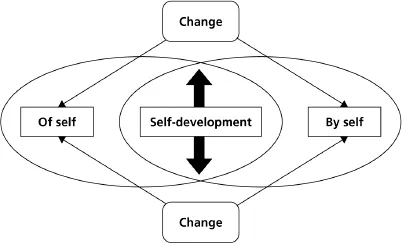
The usefulness of Boydell’s model in helping you analyse the development you are now undertaking as a leader, is that it provides a perception of where you might be heading so that ultimately you have a fuller insight of what it means to you personally to be a highly effective team leader. This self-development is the product of making sense of your own experiences and dealing with challenges as they impinge upon your professional and personal life. In effect, self-development is about change of self, by self (Figure 1.1) – itself a form of learning. Pedler, Burgoyne and Boydell (1986) refer to this as ‘managing ME’:
Managing ME is the first step for the self-developer – unless I take charge of myself, how can I take charge of situations; unless I create order in myself how can I contribute to creating order with others? Managing ME first is the key of self-empowerment and the empowerment of others.
Leaders and managers who are comfortable operating at a technician level, focusing on routine administrative tasks, often lack the confidence to deal with outcomes that are unpredictable or vague. A major dimension of effective leadership is having enough confidence in yourself and in your ability to respond appropriately in given circumstances. Ultimately, of course, this entails knowing yourself, your strengths and weaknesses and learning from the everyday experiences presented to you in the role. For Boydell (1985), self-development involves personal change:
Figure 1.1 Self-development is about change of self by self
it is not just about improving, refining and adding to what you have already, but about moving out of comfort zones, expanding your personal limits and aiming for peak performance. It involves changes in thinking, feeling and willing …
Point for reflection
Having considered Boydell’s three-level model of competence, where would you locate your existing competence level as a leader and manager? Which areas lend themselves to further improvement? What development opportunities might be most helpful for you to seek to bring about these improvements?
WHAT ABOUT THE CONSTRAINTS, DEMANDS AND CHOICES ASSOCIATED WITH MY TEAM LEADERSHIP ROLE?
Anyone with leadership and management responsibilities in schools is faced with choices, demands and constraints in relation to their role. Performing a role as important as team leader is dependent on a set of separate, but interacting, influences:
- personal characteristics, e.g. personality, skills, motivation;
- self-presentation, e.g. visibility, profile, role modelling;
- self-organization, e.g. time management, stress management, selecting priorities;
- self-development, e.g. reflection, career aspirations, development opportunities; and
- situational characteristics, e.g. school context, team maturity, length of experience.
Point for reflection
This is an opportunity for you to analyse your own performance as a team leader in the light of the constraints, demands and choices associated with your leadership role.
- Identify constraints on you in your team leadership role (they may derive from resource considerations; national, local or school policy; people’s attitudes; time; etc.).
- Identify demands on you as a team leader (they may derive from national, local or school policies; the extent and nature of your responsibilities; the types of relationship you have with colleagues; etc.).
- Now list some choices you make in:
- how you do your work
- what work you do
- how you work with others
It will come as no surprise to anyone that managing a diversity of roles brings significant pressures and challenges. In performing their roles, team leaders may experience some or all of the role strains examined in Table 1.2.
Point for reflection
Taking into account the nature and extent of your role, identify examples of the different kinds of ‘...