Unique in its conceptual coherence and the level of practical detail, this book provides a comprehensive resource for those concerned with the practice of semi-structured interviewing, the most commonly used interview approach in social research, and in particular for in-depth, biographic narrative interviewing. It covers the full range of practices from the identification of topics through to strategies for writing up research findings in diverse ways.
eBook - ePub
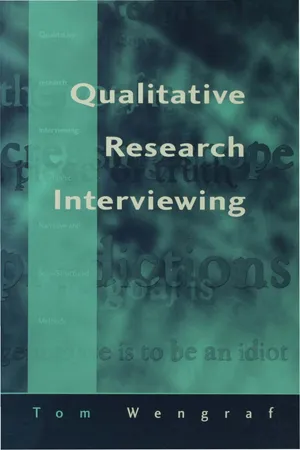
Qualitative Research Interviewing
Biographic Narrative and Semi-Structured Methods
- 424 pages
- English
- ePUB (mobile friendly)
- Available on iOS & Android
eBook - ePub
About this book
`Wengraf provides a comprehensive theoretical and practical guide to the planning, conduct, and interpretative analysis of data by semi-structured interviewing methods. Forthright and frank in his comments about the limitations and practical implications of varying choices which investigators have to make in designing their research projects. Reading this text is like having a tough but expert and caring mentor who wants you to do the best research possible, but will not hesitate to tell you when your ideology and assumptions skew that possibility? - Vincent W Hevern, Le Moyne College, USA
Information
Publisher
SAGE Publications LtdYear
2001Print ISBN
9780803975019
9780803975002
Edition
1eBook ISBN
9781446240205
I
CONCEPTS AND APPROACHES TO DEPTH INTERVIEWING
OVERVIEW
‘Qualitative’ research interviewing tends to under-theorize its data (see, e.g., Frisch, 1 998). It assumes too easily that an interview is an unproblematic window on psychological or social realities, and that the ‘information’ that the interviewee gives about themself and their world can be simply extracted and quoted, as the word of an ominiscient and disinterested witness might be accepted at face-value in a law-court.
I start from a particular position about interview data – namely that, in themselves, they are data only about a particular research conversation that occurred at a particular time and place. If we wish to use such data as evidence to support assertions about extra-interview realities (as we nearly always do), then this requires assumptions and contextual knowledge and argument.
Starting from this deliberately narrow position, I then go on to show the problematic nature of interviews and suggest some models put forward for interpreting the facts of interview interaction. I compare interactional models with anthropological ones, to show that both narrow and broad concerns need to be addressed.
Finally, I look at models of research design in general and interview research in particular to suggest the issues that must be borne in mind.
In this context, I then put forward a case for an approach to semi-structured depth interviewing in which the purposes and theory of the interviewer are always strategically crucial but in which that theory requires the interviewer to combine – but not necessarily in the same session – sometimes fairly-fully or heavily structured and sometimes very lightly structured sessions and questions.
Unlike many who argue for ‘qualitative interviewing’, I believe that great attention must be paid by the researcher to his or her own conceptual frameworks and to clarifying the research questions. In addition, proper design and analysis calls for a full acceptance of a distinction usually summed up as ‘operationalization’, a term normalized in quantitative social research but usually ignored or underplayed by so-called qualitative researchers. Making inferences from interview data is no less problematical than making inferences from quantitative data, as we shall see. However, I personally find it more fun.
1
Interview ‘Facts’ as Evidence to Support Inferences to Eventual Theorization/Representation Models
DATA-COLLECTION (UP TO AND INCLUDING THE INTERVIEW) AND DATA-INTERPRETATION (FROM INTERVIEW TO RESEARCHER PRODUCT)
In social research methodology we typically distinguish the collection of data from the interpretation of data. How these are to be related can then be seen in two different ways: by a common-sense hypothetico-inductivist model and by a hypothetico-deductivist model.
Common-sense Hypothetico-inductivist Model
In a fairly common-sensical model, the researcher collects ‘all the relevant facts’ and then examines them to see what theory is suggested by this set of ‘all the relevant facts’. The theory thus ‘emerges’ from the data. This is the original ‘grounded theory’ tradition (Glaser and Strauss, 1968) in which theory emerges by a process of ‘induction’. The facts are believed to suggest – or even ‘require’ or ‘dictate’ – the theorization.
Anti-common-sense Hypothetico-deductivist Model
The counter-model is anti-inductivist. It declares that there is no thing as ‘all the relevant facts’, there are only ‘hypothesis-relevant facts’, and that research must always start with a body of prior theory, if only to decide which set of ‘collectable facts’ should be collected or generated. It is this prior body of theory from which the researcher generates a particular hypothesis whose truth or falsity could be ‘tested’ by a particular selection of ‘hypothesis-relevant facts’. The hypothesis-relevant facts are then collected, and the hypothesis is either supported by the evidence of those facts or it is refuted by them.
Inductivist and Deductivist ‘Moments’ in Doing Research
Both the ‘inductivist’ and the ‘deductivist’ models correspond to styles of doing research; both have philosophical flaws which enable them to be criticized for ever. In order to have survived their innumerable critics for so long (see, for example, Layder, 1998) each model must correspond to some real experience of researchers.
I would argue that both are appropriate as descriptions of what researchers experience as happening at different moments of the research cycle and that another relationship between the inductivist and deductivist models may be that of level.
I would regard myself as strategically being largely a ‘deductivist’ or a theoreticist while fully appreciating the need for particular moments of inductive working. For many of the purposes for which I do research, my general ‘deductivist’ strategic theory dictates ‘giving up control’ at a tactical level to the person being interviewed. For other purposes, my same theoretical model – which will be elaborated later – dictates ‘control being taken back’ by the interviewer. However, other researchers may be strategically inductivist while at certain moments using deductivist tactics. To understand why one can feel both an inductivist and a deductivist at different times or even in the same moment of research, I find the concepts of different levels, or of the difference between strategy and tactics, to be helpful. Gregory Bateson’s argument for a combination of ‘loose’ and ‘tight’ thinking is similar.
SOME FEATURES OF DEPTH INTERVIEWING AS DESIGNED PRACTICE
If these are features of the approach being taken, what are the main points that I wish to stress about the style of interview that I am talking about?
- The interview is a research interview, designed for the purpose of improving knowledge.
- It is a special type of conversational interaction: in some ways it is like other conversations, but it has special features which need to be understood.
- It has to be planned and prepared for like other forms of research activity but what is planned is a deliberate half-scripted or quarter-scripted interview: its questions are only partially prepared in advance (semi-structured) and will therefore be largely improvised by you as interviewer. But only largely: the interview as a whole is a joint production, a co-production, by you and your interviewee.
- It is to go into matters ‘in depth’.
I shall deal with these briefly in turn.
The Interview is a Research Interview
The ‘form’ of an interview – questioning by one person, answering by another – can be used for a variety of purposes (Dillon, 1990: 2, and below, p. 154). Teachers use questions in order to help students learn; psychotherapists use questions to heal; secret police use brainwashing questioning to break down the interviewee’s grip on reality.
In future, when I refer to ‘interviewing’ in this book – unless it is clear from context that I am using it differently – 1 shall mean ‘research interviewing’. To me – and in this book – scientific research has to do with ‘getting a better understanding of reality’.1 The ethics of the research interview are that, at minimum, the informant should not be changed for the worse: against certain objections, I maintain that the research interview is not designed to ‘help’ or ‘empower’, or ‘change’ the informant at all. In my interviews, I collect information with the purpose of
- developing/constructing a ‘model’ of some aspect of reality that I hope will be found to be in accordance with ‘the facts’ about that reality,
or - testing a constructed model to see whether it is confirmed or falsified by ‘the facts’,
and, more usually, - doing both the above.
I shall argue in Part II that the ‘semi-structured depth interview’ normally involves the interviewer in a process of both model-building and model-testing, both theory-construction and theory-verification, within the same session or series of sessions.2 I shall explore further the considerable difficulties that arise with the concept of ‘the facts’, the concept of ‘being in accordance with the interview facts’ so easily (but only provisionally) assumed in statements 1 and 2 in the list above.
The Interview is a Type of Conversational Face-to-face Interaction
Psychologists, social psychologists, sociologists, anthropologists all study human interaction in general and face-to-face interaction in particular. People work together, live together, make love together: there are co-operative aspects to (interview) interactions, and conflictual ones. Interactions can be between people of similar statuses or those of different statuses. They can be ritualized, heavily formatted by custom, or they can be more exploratory, uncertain and potentially innovative. They can leave people feeling positive, negative, or nothing. They can involve expensive material resources, or none at all. They can be remembered, they can be forgotten. They can be ‘typical of the time and place and of their type’, they can be ‘different’.
When you come to study and plan interviewing, bear fully in mind all the knowledge derived from your discipline (sociology, psychology, cultural studies, history, etc.) about face-to-face interaction and about the specificity of the society and the setting and the types of people involved, especially yourself. Don’t put on a set of blinkers marked ‘research methodology’ to exclude other considerations!
The interviews that you do or that you study are not asocial, ahistorical, events. You do not leave behind your anxieties, your hopes, your blindspots, your prejudices, your class, race or gender, your location in global social structure, your age and historical positions, your emotions, your past and your sense of possible futures when you set up an interview, and nor does your interviewee when he or she agrees to an interview and you both come nervously into the same room. Nor do you do so when you sit down to analyse the material you have produced.
It has to be Particularly Well-prepared (Designed) to Allow it to be Semi-Structured
Semi-structured interviews are designed to have a number of interviewer questions prepared in advance but such prepared questions are designed to be sufficiently open that the subsequent questions of the interviewer cannot be planned in advance but must be improvised in a careful and theorized way. As regards such semi-structured interviews, they are ones where research and planning produce a session in which most of the informant’s responses can’t be predicted in advance and where you as interviewer therefore have to improvise probably half – and maybe 80% or more – of your responses to what they say in response to your initial prepared question or questions.
In particular, I am concerned with semi-structured interviews where the interviewee is asked to tell a story, produce a narrative of some sort regarding all or part of their own life-experience. These biographic-narrative interviews are of considerable interest in their own right, and they also illustrate rather well more general principles of semi-structured interviewing.
Very often, semi-structured interviewing is seen as ‘easier’ in some not very clear way. Novice researchers often feel that, with interviews that are only semi-structured, they do not have to do as much preparation, they do not have to work each question out in advance. This is a terrible mistake. Semi-structured interviews are not ‘easier’ to prepare and implement than fully structured interviews; they might be seen as more difficult. They are semi-structured, but they must be fully planned and prepared. Improvisation requires more training and more mental preparation before each interview than simply delivering lines prepared and rote-learned in advance. Compared with fully structured interviews, semi-structured interviews to be successful require
- as much preparation before the session, probably, and certainly
- more discipline and more creativity in the session, and certainly
- more time for analysis and interpretation after the session.
Given an equivalent amount of time and money, you can ‘do’ (prepare, do and analyse) far fewer semi-structured interviews than you can do fully structured ones. They may yield much more than fully structured ones can, under the right condi...
Table of contents
- Cover Page
- Title Page
- Copyright Page
- Summary of Contents
- Contents
- List of Figures
- List of Exercises
- Abbreviations
- Preface
- Introduction
- PART I: CONCEPTS AND APPROACHES TO DEPTH INTERVIEWING
- PART II: UP TO THE INTERVIEW: STRATEGIES FOR GETTING THE RIGHT MATERIALS
- PART III: AROUND THE INTERVIEW: CONTACT MANAGEMENT – THEORY AND PRACTICE
- PART IV: AFTER THE INTERVIEW: STRATEGIES FOR WORKING THE MATERIALS
- PART V: COMPARISON OF CASES: FROM CONTINGENCIES OF CASES TO TYPES OF TYPOLOGIES
- PART VI: WRITING UP: STRATEGIES OF RE/PRESENTATION
- APPENDICES
- Bibliography
- Index
Trusted by 375,005 students
Access to over 1.5 million titles for a fair monthly price.
Study more efficiently using our study tools.
Frequently asked questions
Yes, you can cancel anytime from the Subscription tab in your account settings on the Perlego website. Your subscription will stay active until the end of your current billing period. Learn how to cancel your subscription
No, books cannot be downloaded as external files, such as PDFs, for use outside of Perlego. However, you can download books within the Perlego app for offline reading on mobile or tablet. Learn how to download books offline
Perlego offers two plans: Essential and Complete
- Essential is ideal for learners and professionals who enjoy exploring a wide range of subjects. Access the Essential Library with 800,000+ trusted titles and best-sellers across business, personal growth, and the humanities. Includes unlimited reading time and Standard Read Aloud voice.
- Complete: Perfect for advanced learners and researchers needing full, unrestricted access. Unlock 1.5M+ books across hundreds of subjects, including academic and specialized titles. The Complete Plan also includes advanced features like Premium Read Aloud and Research Assistant.
We are an online textbook subscription service, where you can get access to an entire online library for less than the price of a single book per month. With over 1.5 million books across 990+ topics, we’ve got you covered! Learn about our mission
Look out for the read-aloud symbol on your next book to see if you can listen to it. The read-aloud tool reads text aloud for you, highlighting the text as it is being read. You can pause it, speed it up and slow it down. Learn more about Read Aloud
Yes! You can use the Perlego app on both iOS and Android devices to read anytime, anywhere — even offline. Perfect for commutes or when you’re on the go.
Please note we cannot support devices running on iOS 13 and Android 7 or earlier. Learn more about using the app
Please note we cannot support devices running on iOS 13 and Android 7 or earlier. Learn more about using the app
Yes, you can access Qualitative Research Interviewing by Tom Wengraf in PDF and/or ePUB format, as well as other popular books in Social Sciences & Social Science Research & Methodology. We have over 1.5 million books available in our catalogue for you to explore.