The book will appeal to students and newly qualified practitioners in teaching, health and social work and their managers.
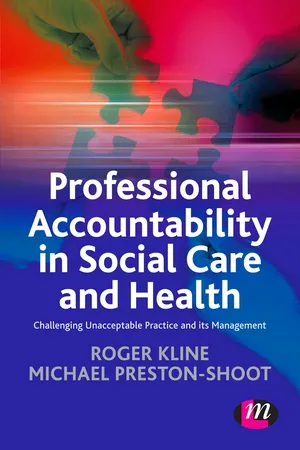
eBook - ePub
Professional Accountability in Social Care and Health
Challenging unacceptable practice and its management
- 224 pages
- English
- ePUB (mobile friendly)
- Available on iOS & Android
eBook - ePub
Professional Accountability in Social Care and Health
Challenging unacceptable practice and its management
About this book
Many social workers, health care staff and teachers maintain high standards of professionalism, often in stressful and challenging circumstances. However, research also reveals instances where individual practitioners and managers, or whole organisations, fail to act lawfully, ethically and/or carefully. This book addresses just those instances by providing guidance on how to maintain accountable professionalism in tricky "what if?" situations. Dilemmas are explored using case studies and the mosaic of legal rules and regulatory body requirements for accountable professionalism are also laid out.
Information
Chapter 1
Cause for concern?
OBJECTIVES
By the end of this chapter, you should have an understanding of:
- Findings from various types of inquiry into unethical and/or unlawful practice in health and social care organisations, and into the management and regulation of that practice.
- Ways in which practitioners, managers and their organisations have failed to uphold their duty of care towards service users.
- Ways in which practice has departed significantly from standards on how values, knowledge and skills should contribute to decision making and intervention.
- Obstacles which might have prevented the learning from such incidents becoming embedded in practice.
Introduction
Why should we be concerned with questions of professional accountability? Can we not rely on social and healthcare practitioners and managers, and the organisations that employ them, to uphold professional values and standards, and to provide services with care and skill, founded upon up-to-date knowledge? Not always, apparently.
People appear concerned about the quality and safety of local health services (NHS Future Forum, 2011). Phair and Heath (2010) remark that 10 per cent of referrals to the Nursing and Midwifery Council (NMC) professional conduct committee in 2007–08 were for neglect of basic care of older people, including failures in respect of medication management, appropriate discharge procedures, assistance after falls and meeting core needs.
Sercombe (2010) indicates the type of problems which may occur in youth work, including sexual exploitation of young people, misuse of agency resources, and buying or selling of drugs. He also cautions that the organisational and political environment may be unsym-pathetic towards youth work practice, managers may prefer conformity to advocacy from youth workers, and agencies can become susceptible to corruption, rationalisation and self-deception. Preston-Shoot (2000) gives examples from social workers where organisations have acted unlawfully and/or unethically.
Preston-Shoot and Kline (2009) highlight the pressure on managers and how provision is adjusted to inadequate funding, often at the expense of considering legal rules and accountability. Across the social and healthcare professions, greater importance may have been attached to meeting financial and other targets, and adhering to agency procedures and customs, than to legal and moral duties (Braye et al., 2007; Healthcare Commission, 2007a; Preston-Shoot, 2010a).
ACTIVITY 1.1
Access the Commission for Local Administration (Local Government Ombudsman; LGO) web pages (www.lgo.org.uk) and read the latest social services summaries. Alternatively or additionally, access the Health Service Ombudsman website (www.ombudsman.org.uk) and explore the latest investigations into complaints about NHS provision. List what you consider to be the key findings and themes, and consider their implications for professional practice.
ACTIVITY 1.2
Take an organisation with which you are familiar. Ask yourself:
- What might it be like to be a service user or patient there?
- How effective might be the systems for ensuring that patients or service users receive quality care and are appropriately safeguarded?
- What are the strengths and weaknesses of the organisation?
Investigations into standards in healthcare settings
The Patients Association (2011) has reported examples of exemplary care given with genuine compassion. However, it has also detailed distressing accounts of poor nursing and medical care, which were not isolated incidents but indicators of a systemic problem in the NHS.
The government (Department of Health (DH), 2011a) has recognised that people using NHS provision have had variable experiences. Inquiries into serious breakdowns in patient care consistently report a range of organisational, cultural and systemic factors, which together impact on the ability of services to ensure that provision is safe and patients are protected from harm (Care Quality Commission (CQC), 2009a; Cantrill et al., 2010).
A review of standards of midwifery practice (Healthcare Commission, 2008) uncovered concerns about inadequate staffing levels, poor team work, and poor communication by staff with women. It pointed to wide variations between trusts concerning women’s reported levels of satisfaction with the care they received. One-fifth of trusts were not performing well, with criticism of doctors and midwives for not engaging in continuing professional development, for inadequate continuity of care, not adhering to recommendations regarding antenatal care practice, and poor communication and support post delivery.
Equally, referrals about individual practitioners’ fitness for practice have risen. The NMC (2011a) has reported double the number of cases considered by its investigating committee in 2011 compared with 2010, and almost an equivalent rise in cases referred to a conduct and competence committee for hearing.
Standards of patient care
Inquiries have found examples of poor patient care. Patients’ requests for help have been ignored or responses delayed, communication with patients and their relatives has been poor, doctors have not questioned the treatments being given, and the skills, for instance assessment skills, to inform clinical interventions have been lacking. Attitudes have been experienced as uncaring, basic care has been neglected and discharges have been inappropriate. Patients have been left in soiled sheets, medication has not been given on time, medical reviews of patients have been insufficiently frequent, and infection-control practices have been insufficiently promoted and monitored (Kennedy, 2001; Healthcare Commission, 2007a; Cantrill et al., 2010; Francis, 2010).
One inquiry – that by Francis (2010) – is not unusual in the list of areas where practice standards had become unacceptably low. The Francis report details failings in respect of continence care, falls, hygiene, nutrition and hydration, pressure area care, cleanliness and infection control, patient privacy and dignity, delayed and inaccurate diagnosis, patient involvement in decision making and information sharing, and discharge management. Assessment and communication practices were inconsistent and poor. People were left in pain and distress.
Lack of management oversight and action
Systems to monitor the supply and administration of drugs, the management of pain, the adequacy of ward areas, and staffing in terms of available skill mix and numbers of doctors and nurses on duty have been insufficiently robust to prevent malpractice or risks to patients. Changes in key personnel have also meant that action plans to secure improvements have drifted (Kennedy, 2001; Healthcare Commission, 2007a; CQC, 2009a; Cantrill et al., 2010; Francis, 2010).
Organisational culture
Inquiries often criticise organisations for being isolated, reactive, closed, and unwilling to acknowledge that there might have been errors (Kennedy, 2001; Healthcare Commission, 2007a; Francis, 2010). One review, for example, by Marsden and Mechen (2008), found no evidence that doctors and nurses were sufficiently concerned to escalate issues within the hospital, including to the board, and that the trust was not predisposed to seek help with its problems. Another inquiry (Francis, 2010) found evidence of denial rather than self-criticism, and an organisation that had accepted poor standards of conduct and been unwilling to use governance and disciplinary procedures to tackle poor performance. The pressure to meet externally imposed performance targets, including for financial savings, is seen to have diverted attention from clinical issues and delayed recognition of breakdowns in patient care (Healthcare Commission, 2007a; Marsden and Mechen, 2008; Francis, 2010).
Research has demonstrated the significant improvements to patient health outcomes, service quality and satisfaction, and to staff health and well-being, from a supportive collegial working environment (Borrill et al., 2001). However, too many organisations persist with hierarchical and authoritarian leadership. Here staff may believe that employers do not value their health and well-being. High levels of bullying and harassment prevent the questioning of practices and challenging of decisions, and impact negatively on stress and mental health (Boorman, 2009; Santry, 2009; Peters et al., 2011; Bowen v Hywel Dda NHS Trust, 2010).
Training and support
Low attendance at mandatory training, and the scarcity of advice, for instance from pharmacists, have been noted (Healthcare Commission, 2007a; CQC, 2009a). Staff may also not have been trained to keep records appropriately or been given sufficient time for continuing professional development, clinical supervision and appraisal (Kennedy, 2001; Cantrill et al., 2010).
Clinical governance and audit
Inquiries have found that clinical governance has been insufficiently embedded, and that monitoring and audit systems have failed to identify problems and risks or to follow through with constructing, implementing and then reviewing the outcomes of risk management and action plans (Healthcare Commission, 2007a; Cantrill et al., 2010). Action plans may have been developed without the involvement of key staff, and systems for disseminating lessons to be learned may be obscure (CQC, 2009a; Cantrill et al., 2010). Clinical supervision and staff induction and appraisal systems may also have been insufficiently embedded (CQC, 2009a; Cantrill et al., 2010). There may not have been any agreed standards for, and means of, assessing the quality of patient care (Kennedy, 2001).
Legal literacy
There have been examples where the implementation of legal requirements to safeguard adults (DH, 2000a) has been delayed (Cantrill et al., 2010). Record keeping has also not conformed to legal requirements or best practice (Cantrill et al., 2010). Junior doctors have reported feeling inadequately prepared for some tasks such as certifying deaths (Cantrill et al., 2010), echoing research that has criticised medical education for giving insufficient prominence to law, and that has found medical students to be insufficiently confident in their knowledge of, and skills for implementing, legal rules (Preston-Shoot and McKimm, 2011).
Lines of accountability
Inquiries have reported ambiguity concerning who might be responsible for patient safety, the delivery of quality service standards, and the implementation of action plans. Doctors and nurses have been unclear about the arrangements and allocation of responsibility for reporting incidents (Kennedy, 2001; Healthcare Commission, 2007a; CQC, 2009a; Cantrill et al., 2010).
Settings
Buildings have been old and unfit, not conducive to high quality care (Kennedy, 2001; Healthcare Commission, 2007a; CQC, 2009a). Risks derived from having insufficient beds have not been addressed (Healthcare Commission, 2007a; CQC, 2009a).
Record keeping
The absence of signatures, legible notes, care plans and detail such as the timings of medication reviews, coupled with inattention to the patient’s history, has made it difficult to track the care given to patients, as has the practice of doctors and nurses maintaining separate records (Cantrill et al., 2010; Francis, 2010). Equally, the recording of adverse incidents has sometimes been insufficient to inform organisational learning about patient safety and the performance of systems and procedures, or available data has not been analysed (Marsden and Mechen, 2008; Cantrill et al., 2010).
Handling complaints
Concerns and complaints expressed by patients and their relatives have not been adequately recorded or responded to, conveying the impression that people’s experiences have not been taken seriously (Marsden and Mechen, 2008; Cantrill et al., 2010). Communication with and support for patients and relatives in such situations has been poor, characterised by delays in providing information, conveying the outcomes of investigations, and apologising.
Handling staff concerns
Inquiries note the presence of an informal culture where issues of concern, if discussed at all, are not documented and not addressed via organisational management structures (Kennedy, 2001; Cantrill et al., 2010). Staff frequently comment about being unclear with whom and how to raise concerns of patient care, and have also referred to organisational and management cultures involving bullying and harassment (CQC, 2009a; Francis, 2010), conveying the perception that critical comments are not welcome and will be ignored. Consequently, staff have been reluctant to raise issues of concern.
There is a perception, supported by evidence (Kennedy, 2001; House of Commons Health Committee, 2009a), that raising concerns may have adverse consequences for staff members’ careers and health. One study (Peters et al., 2011), for example, has reported the long-term serious impact on nurses’ emotional well-being of whistle blowing, including intense and long-lasting distress, aggravated by bullying, ostracism and a hostile working environment. This has led the Health Committee to call for better protection for whistle blowers and for NHS employers to banish a blame culture and give patient safety the highest priority. Greater protection for whistle blowers may follow by strengthening the right and duty in the NHS Constitution to raise concerns in response to neglect of patients’ needs (Santry, 2011).
Serious incident management
Not all unexplained deaths or other types of serious incident have been reviewed effectively, and some evidence about patient outcomes has either not been analysed sufficiently to identify concerns and/or has not been reported to regulatory authorities and hospital governing bodies. Practitioners and managers have been confused about what procedures to follow for different types of serious incident reporting and follow-up action, sometimes resulting in significant delays in reporting and investigation (Kennedy, 2001; CQC, 2009a; Cantrill et al., 2010; Francis, 2010).
Concerns have been expressed about the priority given by managers and boards to safeguarding and patient safety (Healthcare Commission, 2007c; CQC, 2009b; House of Commons Health Committee, 2009a), with serious case reviews having shown some failures to take responsibility for raising safeguarding concerns regarding children, and to act decisively. The CQC (2009b) has criticised primary care trusts for giving insufficient oversight to safeguarding when commissioning services, and for failing to ensure that doctors engage with training on child protection and are clear about their roles and the leadership expected of them.
Organisational change
Inquiries frequently highlight reorganisation within NHS trusts and within the architecture surrounding them (strategic health authorities, primary care trusts and regulatory authorities) as contributing to the failure to recognise and/or respond effectively to breakdowns in patient care. Organisational reconfigurations may contribute to a lack of clarity about roles and responsibilities, and may have resulted in commissioners of services exercising inadequate reviews of performance (CQC, 2009a; ...
Table of contents
- Cover Page
- Title
- Copyright
- Contents
- About the authors
- Acknowledgements
- Introduction
- Table of cases
- 1 Cause for concern?
- 2 Accountable professionalism
- 3 Law for professional practice
- 4 Practising accountable professionalism
- 5 Workloads and skill mix
- 6 Advocacy
- 7 Equality, human rights and the duty of care
- 8 Confidentiality and record keeping
- 9 Health and safety duties of health and social care employers
- 10 What to do if …
- Bibliography
- Index
Trusted by 375,005 students
Access to over 1.5 million titles for a fair monthly price.
Study more efficiently using our study tools.
Frequently asked questions
Yes, you can cancel anytime from the Subscription tab in your account settings on the Perlego website. Your subscription will stay active until the end of your current billing period. Learn how to cancel your subscription
No, books cannot be downloaded as external files, such as PDFs, for use outside of Perlego. However, you can download books within the Perlego app for offline reading on mobile or tablet. Learn how to download books offline
Perlego offers two plans: Essential and Complete
- Essential is ideal for learners and professionals who enjoy exploring a wide range of subjects. Access the Essential Library with 800,000+ trusted titles and best-sellers across business, personal growth, and the humanities. Includes unlimited reading time and Standard Read Aloud voice.
- Complete: Perfect for advanced learners and researchers needing full, unrestricted access. Unlock 1.5M+ books across hundreds of subjects, including academic and specialized titles. The Complete Plan also includes advanced features like Premium Read Aloud and Research Assistant.
We are an online textbook subscription service, where you can get access to an entire online library for less than the price of a single book per month. With over 1.5 million books across 990+ topics, we’ve got you covered! Learn about our mission
Look out for the read-aloud symbol on your next book to see if you can listen to it. The read-aloud tool reads text aloud for you, highlighting the text as it is being read. You can pause it, speed it up and slow it down. Learn more about Read Aloud
Yes! You can use the Perlego app on both iOS and Android devices to read anytime, anywhere — even offline. Perfect for commutes or when you’re on the go.
Please note we cannot support devices running on iOS 13 and Android 7 or earlier. Learn more about using the app
Please note we cannot support devices running on iOS 13 and Android 7 or earlier. Learn more about using the app
Yes, you can access Professional Accountability in Social Care and Health by Roger Kline,Michael Preston-Shoot in PDF and/or ePUB format, as well as other popular books in Sozialwissenschaften & Sozialarbeit. We have over 1.5 million books available in our catalogue for you to explore.