- 208 pages
- English
- ePUB (mobile friendly)
- Available on iOS & Android
eBook - ePub
What is Counselling and Psychotherapy?
About this book
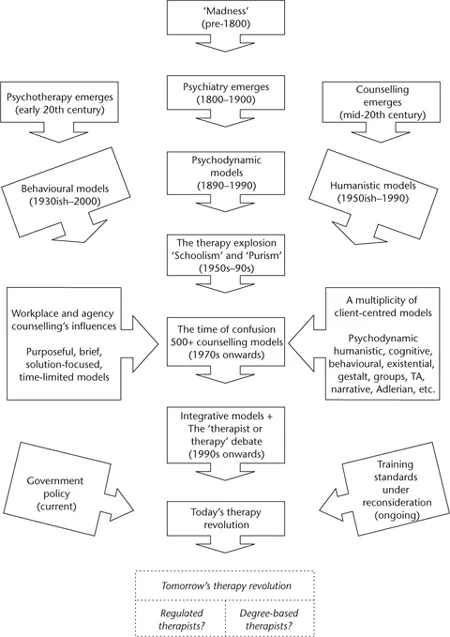
Written specifically for students on counselling and psychotherapy courses, this book gives an overview of the profession from its early beginnings in psychotherapy and psychoanalysis through the development of the different schools and approaches of talking therapies including psychodynamic, cognitive behavioural and person-centred approaches. Working within various sectors, such as the commercial, educational and public, is also considered and discussed. The author concludes the book by looking at where counselling and psychotherapy is heading in the future.
Information
PART 1
WHERE HAS COUNSELLING
& PSYCHOTHERAPY
COME FROM?
The story of the talking therapies – how they evolved
CHAPTER 1
Counselling & psychotherapy –
the opening story
CORE KNOWLEDGE
- The explosion in the demand for personal therapy after the Second World War led to the emergence of many hundreds of therapy types.
- Historically, the development of counselling and psychotherapy has depended on three main theoretical ‘schools’:
– psychodynamic
– behavioural
– humanistic.
- Modern counselling theories have evolved to include:
– cognitive-behavioural ideas
– integrative methods.
- Counselling and psychotherapy are based on extensive research-based evidence. The talking therapies are now established professional disciplines.
- Counselling and psychotherapy are likely to become statutorily regulated professions.
TO BEGIN AT THE BEGINNING
The tale of personal or psychological therapy, which is also the tale of psychotherapy and the tale of counselling, is as old as the story of the human race (Cushman, 1990; Hollanders, 2000a). Humans have long tried to make sense of themselves and their worlds (Bettleheim, 1983). That is why people have always used therapists, be they priests, gurus, wise ones, philosophers, doctors, good friends, or in fact just about anybody prepared to listen, as sounding boards and as guides to help to try to bring some order into their inner and outer worlds. In other words, the role of the talking therapist goes back to the dawn of humanity (Ehrenwald, 1976). However, in terms of what we today would recognise as the discrete discipline (or disciplines) of counselling and psychotherapy, it is probably the profession’s developmental history over the last 100 years or so that interests us most (Freedheim, 1992). Of course, personal therapy has come a long way since its early days.
However, before we get too far into exploring therapy’s story, let us clear up one important source of confusion. There are many terms used to describe professionals who get involved with helping people who have emotional, psychological or mental health problems. Titles such as counsellor, psychotherapist, psychological therapist, psychoanalyst, psychologist and so on are all used, sometimes apparently at random. Naturally, people are often puzzled about how to understand the differences between all these professionals. The practical reality is that, historically, these different titles have probably owed more to the inbuilt prejudices learned during early therapeutic training than they do to actual differences in professional practice. After all, many authors (Duncan et al., 1992; Fiedler, 1950; Wosket, 1999, etc.) give us reason to suppose that experienced therapists are far less worried about therapeutic style-boundaries than are the less experienced practitioners. Therefore, the answer to the ‘what’s in a name’ puzzle (as far as this book is concerned anyway) is simple: there are NO differences. If you are a professional – and that includes all the personal therapists – who is trying to help somebody with emotional, personal or mental health problems, then you are a psychological therapist and practising what today are often called the talking therapies. Of course, in these more enlightened times these therapies increasingly include a lot more treatment methods than just ‘talking the talk’. Today’s psychological therapists work with action therapies, treatment plans, practical activities, psycho-education and many other interventions; they ‘walk the walk’ as well. In other words, today at least, the choice of which professional therapist title to use to describe your practice is yours to make. However, it is very important to note that the current (July 2009) proposals to officially regulate counsellors and psychotherapists may result in these two callings becoming separately registered. This might happen perhaps from about 2014–15 onwards and may possibly even involve different levels of training. Nevertheless, in this book, all the talking therapy titles will still be used interchangeably.
There is one important exemption to the blanket definition of psychological therapist (or any other title that you prefer) that was given above. It is an iron-clad rule that all psychiatrists must be qualified medical practitioners. Psychiatrists are doctors who sometimes prescribe medical treatment for those suffering from mental distress. Therefore, their professional title is legally protected. It is theirs alone. However, having said that, wise counsellors and psychotherapists will not allow the high-level professional status enjoyed by psychiatrists to lead them into automatically awarding superior professional status to the medically qualified. Psychiatrists are our respected colleagues and valued co-workers at the psychological coalface; they are not the mine owners.
Whatever we call them (counsellors, psychotherapists or any name you like), what we really need to know is: What is it that they actually do? Well, that is a tale that is long in the telling. This book will give you one take on the therapy story. Perhaps by the end of this book you might have some stories of your own to tell about the psychological therapies.
So, let us think again about the core question that this book will be exploring. What indeed are counsellors and psychotherapists for? What do they do? Do they really sort out people’s minds? Surely treating the mad is a job for doctors? Well, historically that might have often been true (except, of course, when the priests claimed their share of the action!). However, we will begin our exploration of counselling’s story by considering how madness has been viewed throughout history.
HISTORICAL EXPLANATIONS OF MADNESS
From the earliest of times, humans have struggled to understand mental distress. A brief history of some of these earlier explanations is shown in Table 1.1.
When/who | Cause | Treatment |
Prehistoric | Evil spirits/ pressures in the brain | Trepanning |
Early Egypt | Loss of status or money | Talking it out; religion or suicide |
Old Testament | Despair/incorrect thinking | Faith |
Aeschylus | Demons | Exorcism |
Socrates | Heaven sent | None – it’s a blessing! |
Aristotle | Melancholia | Music |
Hippocrates | Natural medical causes | Abstain from excesses; diet and exercise |
Celsus | Madness is madness | Entertaining stories, diversions, persuasion |
Galen | Functions of the brain | Confrontation, humour, exercise |
Table 1.1: Historical explanations of madness.
As time progressed, however, the idea that the mind was the source of madness began to predominate and with it the conviction that the sufferer was to blame. Possession by evil spirits, moral weakness and similar ‘blame the patient’ explanations placed the responsibility for both the disease and its cure on the resulting outcast victims themselves. They were locked away and shut off from society so that ‘decent’ people could forget all about them. That way the mad were not a problem as they no longer existed.
In these institutions, the mad were cruelly treated. They were whipped, beaten, starved and treated like animals. No differentiation was made between the mentally ill, the criminally insane or the socially disruptive. For example, women were committed for wanting to leave their husbands; men were committed for sedition; and children were committed for being deformed. The mentally ill were accused of having abandoned themselves to the devil and to evil sorcerers and they were considered to be wilfully sinful. They were persecuted without mercy.
REFLECTION POINT
Have our views about either the cause of mental dysfunction or the treatment of the mentally disturbed really altered so much since those early days?
During the eighteenth century, conditions for the insane started to improve, and hospitals and asylums began to care properly for the mentally ill. In 1752, the Quakers opened the first ever hospital that tried to treat the insane kindly, even constructively. By the mid-1800s many institutions were genuinely trying to ‘cure’ the mentally afflicted. It is important to note that, by the end of the nineteenth century, the medical profession had attained a monopoly in the treatment of the mad. This meant that all psychological disturbances were believed to have medical or biological explanations and so discovering a sufficiency of correct biological cures was the ultimate goal of the doctor-therapists.
PSYCHOTHERAPY IN THE NINETEENTH CENTURY
Medicine’s monopoly quickly led to the emergence of specialist doctors (eventually known as psychiatrists) to treat these new illnesses. In the late nineteenth century, the term ‘psychotherapy’ began to be used to describe a new psychiatric subdivision – one that was based on attempts to ‘cure the body by the mind, aided by the impulse of one mind to another’ (Van Eeden, 1887, cited in Ellenburger, 1970, p765).
Of course, it is acknowledged today that the great psychotherapist of that period was Sigmund Freud. This ‘greatness’ is certainly true in terms of his overwhelming and long-lasting influence on the psychotherapy profession. Whether it is true in terms of scientific rigour and honesty, or practitioner integrity, is quite another matter and we will look further into these issues in Chapter 3. However, Freud’s ideas were not his alone. Like all trendsetters, his work was very dependent on a number of widely held, pre-existing theoretical concepts and attitudinal beliefs. For example, as McLeod (2003) tells us:
- Early nineteenth-century biological theories already included the concept of a unitary life-force or libido.
- Many nineteenth-century theorists were already debating the possibility that emotions and psychological disturbances had (at least in part) sexual origins.
- By the early eighteenth century, the possibility that humans had both conscious and unconscious minds had already begun to be investigated. During the nineteenth century, psychiatrists such as Charcot or Janet began exploring how to tap into the assumed curative powers of the unconscious. Interestingly, even at this very early stage in its development, psychotherapists were aware of the importance of establishing a good rapport between doctors and their patients. In other words, good working alliances were essential.
Then along came Freud. Although he did not invent psychological therapy, what he did do, and did very well, was to bring all the already existing ideas together and take them forward into an innovative, even pioneering, and certainly extremely well-organised theoretical model of human personality development. The heuristic value of Freud’s model has so far stood the test of time. However, its true curative powers remain a matter of intense debate. Freud’s model underpins what is generally known in today’s psychotherapeutic world as the psychodynamic tradition and, even today, psychodynamic modelling provides useful metaphors to help us understand what makes someone tick. It offers us a comprehensive theory of human development. This is because the Freudians claim that all of us – the mad, the bad, the sad and the glad – are the products of our inner psychological conflicts and our instinctual drives.
PSYCHOTHERAPY IN THE TWENTIETH CENTURY
Real changes in how we viewed the ‘mad’, and started to wonder more about the ‘sad’, began to occur as the twentieth century dawned and progressed. Looking back, we can now see the importance of Freud’s theories to the evolution of the counselling and psychotherapy trade. However, it took time for his ideas to permeate society to the point where today they are prevalent, even inherent, in everyday language and activities, even when people are unaware that they are being ‘Freudian’. It took much of the first third or so of the twentieth century for Freud’s ideas about the origins of psychological disturbance to permeate the Eurocentric world. Two big developments in particular influenced people’s thinking:
- During the First World War it was noticed that large numbers of soldiers were incapacitated by emotional problems and it was plain to see that not just the few, but the many, developed apparently ‘abnormal’ thinking and behaviour. I...
Table of contents
- Cover
- Title
- Copyright
- Contents
- Preface
- Part 1 Where has counselling & psychotherapy come from?
- Part 2 What do therapists do?
- Part 3 Where do therapists work?
- Part 4 Where is counselling & psychotherapy going?
- References
- Index
Trusted by 375,005 students
Access to over 1.5 million titles for a fair monthly price.
Study more efficiently using our study tools.
Frequently asked questions
Yes, you can cancel anytime from the Subscription tab in your account settings on the Perlego website. Your subscription will stay active until the end of your current billing period. Learn how to cancel your subscription
No, books cannot be downloaded as external files, such as PDFs, for use outside of Perlego. However, you can download books within the Perlego app for offline reading on mobile or tablet. Learn how to download books offline
Perlego offers two plans: Essential and Complete
- Essential is ideal for learners and professionals who enjoy exploring a wide range of subjects. Access the Essential Library with 800,000+ trusted titles and best-sellers across business, personal growth, and the humanities. Includes unlimited reading time and Standard Read Aloud voice.
- Complete: Perfect for advanced learners and researchers needing full, unrestricted access. Unlock 1.5M+ books across hundreds of subjects, including academic and specialized titles. The Complete Plan also includes advanced features like Premium Read Aloud and Research Assistant.
We are an online textbook subscription service, where you can get access to an entire online library for less than the price of a single book per month. With over 1.5 million books across 990+ topics, we’ve got you covered! Learn about our mission
Look out for the read-aloud symbol on your next book to see if you can listen to it. The read-aloud tool reads text aloud for you, highlighting the text as it is being read. You can pause it, speed it up and slow it down. Learn more about Read Aloud
Yes! You can use the Perlego app on both iOS and Android devices to read anytime, anywhere — even offline. Perfect for commutes or when you’re on the go.
Please note we cannot support devices running on iOS 13 and Android 7 or earlier. Learn more about using the app
Please note we cannot support devices running on iOS 13 and Android 7 or earlier. Learn more about using the app
Yes, you can access What is Counselling and Psychotherapy? by Norman Claringbull in PDF and/or ePUB format, as well as other popular books in Psychologie & Conseil en psychothérapie. We have over 1.5 million books available in our catalogue for you to explore.