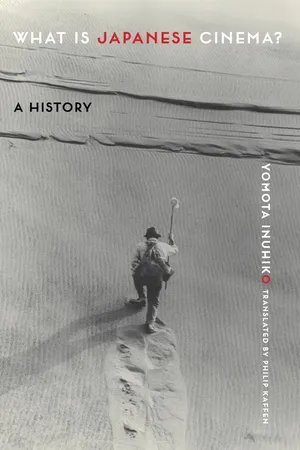
What might Godzilla and Kurosawa have in common? What, if anything, links Ozu's sparse portraits of domestic life and the colorful worlds of anime? In What Is Japanese Cinema? Yomota Inuhiko provides a concise and lively history of Japanese film that shows how cinema tells the story of Japan's modern age.
Discussing popular works alongside auteurist masterpieces, Yomota considers films in light of both Japanese cultural particularities and cinema as a worldwide art form. He covers the history of Japanese film from the silent era to the rise of J-Horror in its historical, technological, and global contexts. Yomota shows how Japanese film has been shaped by traditonal art forms such as kabuki theater as well as foreign influences spanning Hollywood and Italian neorealism. Along the way, he considers the first golden age of Japanese film; colonial filmmaking in Korea, Manchuria, and Taiwan; the impact of World War II and the U.S. occupation; the Japanese film industry's rise to international prominence during the 1950s and 1960s; and the challenges and technological shifts of recent decades. Alongside a larger thematic discussion of what defines and characterizes Japanese film, Yomota provides insightful readings of canonical directors including Kurosawa, Ozu, Suzuki, and Miyazaki as well as genre movies, documentaries, indie film, and pornography. An incisive and opinionated history, What Is Japanese Cinema? is essential reading for admirers and students of Japan's contributions to the world of film.
- English
- ePUB (mobile friendly)
- Available on iOS & Android
eBook - ePub
About this book
Information
Subtopic
Asian ArtTable of contents
- Cover
- Title Page
- Copyright
- Dedication
- Contents
- Note on Names and Film Titles
- Preface to the English Translation
- Introduction
- 1. Motion Pictures: 1896–1918
- 2. The Rise of Silent Film: 1917–1930
- 3. The First Golden Age: 1927–1940
- 4. Japanese Cinema During Wartime
- 5. Film Production in the Colonies and Occupied Lands
- 6. Japanese Cinema Under American Occupation: 1945–1952
- 7. Toward a Second Golden Age: 1952–1960
- 8. Upheaval Amid Steady Decline: 1961–1970
- 9. Decline and Torpor: 1971–1980
- 10. The Collapse of the Studio System: 1981–1990
- 11. The Indies Start to Flourish: 1991–2000
- 12. Within a Production Bubble: 2001–2011
- Notes
- Index
Trusted by 375,005 students
Access to over 1.5 million titles for a fair monthly price.
Study more efficiently using our study tools.
Frequently asked questions
Yes, you can cancel anytime from the Subscription tab in your account settings on the Perlego website. Your subscription will stay active until the end of your current billing period. Learn how to cancel your subscription
No, books cannot be downloaded as external files, such as PDFs, for use outside of Perlego. However, you can download books within the Perlego app for offline reading on mobile or tablet. Learn how to download books offline
Perlego offers two plans: Essential and Complete
- Essential is ideal for learners and professionals who enjoy exploring a wide range of subjects. Access the Essential Library with 800,000+ trusted titles and best-sellers across business, personal growth, and the humanities. Includes unlimited reading time and Standard Read Aloud voice.
- Complete: Perfect for advanced learners and researchers needing full, unrestricted access. Unlock 1.5M+ books across hundreds of subjects, including academic and specialized titles. The Complete Plan also includes advanced features like Premium Read Aloud and Research Assistant.
We are an online textbook subscription service, where you can get access to an entire online library for less than the price of a single book per month. With over 1.5 million books across 990+ topics, we’ve got you covered! Learn about our mission
Look out for the read-aloud symbol on your next book to see if you can listen to it. The read-aloud tool reads text aloud for you, highlighting the text as it is being read. You can pause it, speed it up and slow it down. Learn more about Read Aloud
Yes! You can use the Perlego app on both iOS and Android devices to read anytime, anywhere — even offline. Perfect for commutes or when you’re on the go.
Please note we cannot support devices running on iOS 13 and Android 7 or earlier. Learn more about using the app
Please note we cannot support devices running on iOS 13 and Android 7 or earlier. Learn more about using the app
Yes, you can access What Is Japanese Cinema? by Yomota Inuhiko, Philip Kaffen in PDF and/or ePUB format, as well as other popular books in Media & Performing Arts & Asian Art. We have over 1.5 million books available in our catalogue for you to explore.