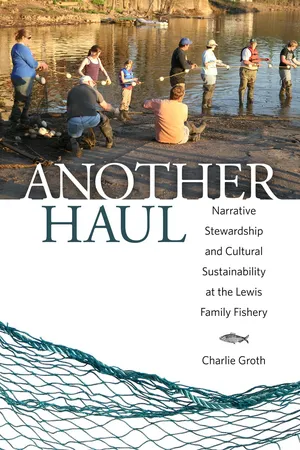
Lewis Island in Lambertville, New Jersey, is the site of the Lewis Fishery, the last haul seine American shad fishery on the nontidal Delaware River. The Lewis family has fished in the same spot since 1888 and operated the fishery through five generations. The extended Lewis family, its fishery's crew, and the Lambertville community connect with people throughout the region, including environmentalists concerned about the river. It was a Lewis who raised the alarm and helped resurrect a polluted river and its biosphere. While this once exclusively masculine activity is central to the tiny island, today men, women, and children fish, living out a sense of place, belonging, and sustainability.
In Another Haul: Narrative Stewardship and Cultural Sustainability at the Lewis Family Fishery, author Charlie Groth highlights the traditional, vernacular, and everyday cultural expressions of the family and crew to understand how community, culture, and the environment intersect. Groth argues there is a system of narrative here that combines verbal activities and everyday activities.
On the basis of over two decades of participation and observation, interviews, surveys, and a wide variety of published sources, Groth identifies a phenomenon she calls "narrative stewardship." This narrative system, emphasizing place, community, and commitment, in turn, encourages environmental and cultural stewardship, tradition, and community. Intricate and embedded, the system appears invisible, but careful study unpacks and untangles how people, often unconsciously, foster sustainability. Though an ethnography of an occupation, the volume encourages readers to consider what arises as special about all cultures and what needs to be seen and preserved.
eBook - ePub
Another Haul
Narrative Stewardship and Cultural Sustainability at the Lewis Family Fishery
- 272 pages
- English
- ePUB (mobile friendly)
- Available on iOS & Android
eBook - ePub
Another Haul
Narrative Stewardship and Cultural Sustainability at the Lewis Family Fishery
About this book
Information
Publisher
University Press of MississippiYear
2019Print ISBN
9781496820853
9781496820365
eBook ISBN
9781496820372
FOUR

“Were You There When … ?”: Microlegends
We knew that something big was coming in the net, but when the net started to fold in half such that the lead line and cork line met like a cinched bag, the ferocious splashing was not that of a nice load of shad or even spikey, rancorous catfish. No slime and scales flying, just churning water … and claws … and teeth. We had caught a beaver, the one who had been felling saplings along the island’s outside path. For weeks, we had shivered at seeing its path of destruction as we pulled the boat upriver at the start of each haul, kind of like the feel of the Jersey Devil stories we’d heard growing up. Now we encountered its huge size. All of us terrified, crew member Tim Genthner leapt into action first—thus earning the moniker “Beaver Boy.” He stepped on the top of the cork line to enable the beaver to hop over the net, like misguided rowers sometimes do. However, up and over is not in a beaver’s nature. The thrashing beast kept trying to dive through a foot of water into cement and cobblestone, until Tim finally went against a shad crew’s instinct and sacrificed the haul, pulling up the lead line just moments after the nightly “keep the lead line down” chorus. The animal swam away, and “The Night We Caught a Beaver” became a microlegend by sundown.
What and When: Definitions and Storytelling Settings
One of the particular narrative types found on Lewis Island, “microlegend,” is akin to legend in that it is told as true about real-life figures, but the scope and context are local, emerging from happenings at the fishery or close by, most often within living memory. The microlegend type may overlap with character anecdotes about captains, and both may support the themes of the Big Stories. In contrast, “everyday storying” (to be covered in chapter 5), emphasizes the most ordinary and quotidian aspects of telling personal experience narratives. While everyday storying focuses more on the mundane, microlegends lift experiences out of the mundane for special attention.
Citing Elliott Oring’s work with narrative, Ray Cashman (2008, 109–10) draws our attention to the fact that legends are not formally much different from the surrounding conversation, because content is more important than artistry. Frequently the microlegends are “micro” in form, with artistry second to content, values, and truthfulness. In his classic article “The La Have Island General Store: Sociability and Verbal Art in a Nova Scotia Community,” Richard Bauman argues that “although telling yarns [exaggerated wholly or partly fictional stories] was an important component of the process of establishing a social identity, being a good storyteller was not itself a significant identity feature” (1972, 337). Similarly, on Lewis Island, people connect themselves to the island, haul seine shad fishing, and Lambertville through storytelling as a way of establishing their own identities, but being an artful storyteller is not as important as having knowledge and experience of the community, or as important as enacting Lewis Island values. Indeed, a particularly artful storyteller can lose status if the storytelling appears to be too professional or practiced, dividing teller, topic, and listeners from each other.
Several scholars of culture have studied value systems that require connection between authenticity and tradition or the past (Bendix 1997; Cashman 2008; Hobsbawm and Ranger 1983). In such systems, the professional and competitive storytelling events that emerged with other folk revival activity in the late twentieth century may be considered a “new” thing, and therefore less authentic than an aesthetic that embeds storytelling in everyday conversation, keeping teller and listener within reach of each other as well as linking the past, the place, and the people. By telling a particular microlegend, one asserts status through connection with the past. That status can be greater or lesser depending on whether the teller witnessed the event, how long the teller has known of the story, who originally told the teller the microlegend, and what the first and subsequent tellers’ relationship to the story was. The relative position between teller, time, and place (Lewis Island) can also enable the teller to share status with an audience member who hears the story for the first time. Narrative stewardship occurs primarily through sharing of stories that empower both tellers and audiences to conserve community resources.
Talking of flood stories emerging in Indiana, Barbara Johnstone labels the barest outline of plot a “narrative core,” which is then “fleshed out” with characters, settings, “and elements that underline the story’s relevance and point” (1990, 23). Their repeatability and important content are what make them legendary. Part of the “micro” quality of the fishery’s microlegends is the fact that these discrete stories at the fishery, like the stories Johnstone presents and discusses, center on the concerns of a small community. In my interviews, informants assuming my group membership condensed the narrative core into phrases that approximate titles, such as “The Night We Caught the Beaver,” “The Night the Brail Broke,” and “The Longest Night of Fishing.” These stories can be merely referred to when former crew members return to the island for a visit and wish to reconnect with crew members from their era. “Old crew” can also share these stories with new crew members, friends, and customers. Crew member Keziah describes a process in which adults in the crew and family collaborate in telling stories to children. For example, she says of captain Steve Meserve,
He’ll tell stories … to us, but usually he’ll say something that would trigger a story that either you or Sue [Meserve] will tell me and Adelaide [Keziah’s younger sister]. Like he usually isn’t the one that actually tells the story, but he’ll trigger something about it. He’ll say something vaguely, and then we won’t get it, so then you guys will tell the story to explain it. (October 3, 2009)
The stories Keziah refers to here might be parts of fishery history but may also be discrete microlegends. Both island children and visitors of all ages are targeted for telling microlegends, using the excitement and novelty of the story to get people interested in passing oral history and preserving community.
Wonder Stories
There are two basic types of microlegend cycles: surveillance stories (to be described in the next section) and wonder stories, which are narratives about unusual happenings. The story of “The Night We Caught the Beaver” exemplifies the wonder stories that catch the crew’s attention, and although beaver have been caught since, the story of the first time this crew caught a beaver remains the beaver story. Although fishermen are known for exaggerating stories (particularly regarding the proverbial fish that got away), narrators at the Lewis Fishery strive to remain truthful in keeping with the values of civility and the integrity that is central to the captains’ character anecdotes. Indeed, the fishery family’s Christian faith in the Ten Commandments, including “Thou shalt not lie,” allows for joking and “tricking” but does not extend to making the crew or captain look important by exaggerating the size of a catch. That same faith is anchored in the idea of the natural world reflecting a divine creation; it is the truth of the haul, not the extent of imagination, that inspires awe. Rejecting the fisherman’s yarn-telling tradition also has practical implications for the crew members’ stewardship role. That is, they could not effectively report environmental problems to government agencies and enlist their help in protecting the river and shad if their honesty were doubted. The fishery’s alliance with the press in getting out the Big Story of the environment also requires strict adherence to the truth. As reporter Renée Kiriluk-Hill says, “The knowledge is a big part of [the captain’s role], because otherwise it just comes across as fish stories” (June 3, 2011). Clearly, “fish stories” are not valued by the paper, and exaggerated wonder stories could compromise the ability of the press and the fishery to raise public awareness about environmental issues.
The quintessential wonder story is perhaps “The Longest Day Fishing,” an event that happened before any of the current crew was born. Fred told it this way on March 1, 1996: “The longest day I ever put in was from midnight Sunday night until four o’clock Wednesday morning. We fished a haul every hour.” Fred Lewis enjoyed framing the “longest day” as lasting multiple days, as was characteristic of his sense of humor and skillful turn of phrase, and this story appears in Bruce Stutz’s Natural Lives, Modern Times: People and Places of the Delaware River (1992, 228–29) and John McPhee’s The Founding Fish (2002, 256). When asked to recall fishery stories that stand out to her, Keziah replies, “Well, there’s the one that people mention a lot when they, I can’t remember it exactly, but they were fishing for a couple of days straight, or something, ’cause the shad were so good. And so, they would sleep, and they’d take shifts and just keep going” (October 3, 2009). Condensing the story in telling it to someone she expects will know the story, she picks out the important parts: that the fish were plentiful, the fishing kept going from one day to another, and the crew cooperated to perform this feat of endurance. The triumph here is a combination of good fortune, strong backs, and good teamwork under conditions when a sleep-deprived crew could become testy.
Other wonder stories emphasize just the fortune—good, bad, or just strange fortune—of what appears in the net, such as in “The Night We Caught the Beaver.” In his recollection of key microlegends, crew member Dan Tuft recalls the same stories that other crew members of his era do: “The night they caught the beaver, and I wasn’t there…. Whenever there’s sturgeon …, which I think has been maybe … twice … since I’ve been there? Maybe just once? … The time that we caught that huge grass carp that looked like a monster” (October 3, 2009). Different narrators hearken back to strange hauls they witnessed themselves, and for Muriel Meserve, that recalls the night the crew caught a muskie:
Just because it’s so big and so, so ugly and so rare. And everybody was there with their cameras taking pictures of this, you know. And they wanted to get it back in the water, because you can’t keep them, but also wanted to make sure that everybody got their pictures, so you were kind of torn between the two. So let’s get the pictures, but don’t let the fish die here either, you know? [laughs] (October 5, 2009)
Here, Muriel catches the practical tension in the stewardship role. First, the crew cannot control which fish appear in the net; they can just make sure they safely release those they cannot or will not keep. They need photos to help tell the story, attest to its truth, record the local happening for local history, and report the details to authorities who monitor the environment, but they also need to save that specific fish and get it quickly back into the water. In recent years images have proliferated on the internet, and on one occasion this tension was heightened when a vocal critic erroneously assumed that the time it took to snap a photo of a fish endangered the fish. Thus, not only must the crew actually protect the fish, but they also need to carefully manage the impression of protecting the fish. This brought amusing results the night the crew caught an almost four-foot-long grass carp in 2007, the event Dan mentioned in his interview. Pam Meserve Baker identifies the grass carp story as one of the children’s favorites (October 4, 2009), which perhaps is so because it was a child who resolved the tension between protecting the fish and recording the natural oddity. While rushing to take photos before the fish was taxed, the crew reached for the best readable measuring device close at hand: Adelaide, a six-year-old who happened to be the same length as the grass carp. So important in crew memory is Adelaide’s role as yardstick that the story is often called “The Night We Caught a Fish as Big as Adelaide.”
The occasional sightings of sturgeon show the tension sometimes inherent in the complex relationship between narrative and stewardship. On January 31, 2012, the National Marine Fisheries Service listed the Atlantic sturgeon as an endangered species under the federal Endangered Species Act (Today’s Sunbeam 2012), but before their numbers dropped to dangerous lows, sturgeon were included in the list of food fish the fishery is allowed to catch, keep, and sell. In fact, they were a particularly plentiful population at one time. However, when sturgeon numbers dropped, the Lewis Fishery refused to keep them even though it was legal to catch them, and if one ever appeared in the net, freeing it was the highest priority, done with great speed and little-to-no human contact. A portion of the catch was released if doing so would give the sturgeon a less stressful release back into the river. If someone needed to help the sturgeon into the river, the captain would be the only one to touch it, handling the fish as gently as he would a newborn kitten. The sturgeon inspire awe because of their unusual, ancient appearance, low numbers, and sometimes huge size—they can grow up to fourteen feet and eight hundred pounds (Today’s Sunbeam 2012). They also inspire joy, because their presence shows that the river is very clean as a result of environmental activities owing in part to Bill Lewis Sr.’s great efforts to catch the authorities’ attention. Thus, their presence in the river is a confirmation of the Big Story of environmental stewardship.
In 2013, three smallish sturgeon appeared in the net at once, instantly becoming a wonder story among the crew. On earlier occasions, sturgeon might be spotted, but it wasn’t until multiple sturgeon appeared together that it was clear that they existed in at least small numbers on that stretch of the river. Nevertheless, this microlegend is rarely discussed outside the crew, and when the occurrence is referred to in a semipublic setting, the narration will include a recounting of how quickly and gently the sturgeon were released, include the preferred wording that sturgeon were “spotted,” and/or will include a caution about not letting the story get out widely. There is essentially no physical risk to sturgeon caught in the net, and their special treatment—both physically and narratively—seems to have almost ritual import, beyond what is practically needed. At the same time, the stories are limited to protect the fish from thrill seekers who might hear the stories and seek out the rare sturgeon, posing a real threat.
While effort is taken not to widely retell wonder stories about sturgeon in the net, there are a couple of very tellable stories about extremely large sturgeon that have been observed outside the net. In an interview, Diane and Ted Kroemmelbein share two stories of oversize sturgeon from two generations of shad crew. When asked for repeated crew stories, Diane thought of one her father, Johnny Isler, repeated to the family and other crew members:
I don’t remember when it was…. But they used to talk about this one time they were just, you know, they were hauling the net or whatever, and they saw these two things coming up the river, and they looked like torpedoes, and they were humongous sturgeon. They said they must have been six feet long, and … it just caught all their attention. [To her husband, Ted] Do you remember my dad [Ted: yeah, yeah] talking about that? I wasn’t there, but … I don’t know if that’s something Steve would remember or not. (June 15, 2013)
Subsequently, using references to her daughter Kelly’s youth and Steve’s memory, Diane places the story possibly as late as the 1980s, a time of relatively good fishing, but when Steve was the young guy on the old crew. Ted brings the conversation c...
Table of contents
- Cover
- Title Page
- Copyright
- Dedication
- Contents
- Acknowledgments
- Preface: Through the Gate: Research Methodology and Reflexivity
- One: Welcome to the Island: The Lewis Fishery in Context
- Two: Fishing with Purpose: The Big Stories
- Three: The Captains: Between Myth and Legend, Article and Anecdote
- Four: “Were You There When … ?”: Microlegends
- Five: “It’s Like I Said to So-and-So”: Everyday Storying
- Six: Talking the Walk: Processional Storytelling
- Seven: Who-All’s Coming Down to the Island: Belonging at the Lewis Fishery
- Eight: “A Whole ‘Nother Place”: Narrative Stewardship and Sense of Place
- Nine: Fishing in the Mainstream: Anomie, Sustainability, and Narrative Stewardship
- Appendix A: Map of Lewis Island
- Appendix B: Lewis Family Tree
- Appendix C: Lewis Fishery Catch Statistics
- Notes
- References
- Index
Trusted by 375,005 students
Access to over 1.5 million titles for a fair monthly price.
Study more efficiently using our study tools.
Frequently asked questions
Yes, you can cancel anytime from the Subscription tab in your account settings on the Perlego website. Your subscription will stay active until the end of your current billing period. Learn how to cancel your subscription
No, books cannot be downloaded as external files, such as PDFs, for use outside of Perlego. However, you can download books within the Perlego app for offline reading on mobile or tablet. Learn how to download books offline
We are an online textbook subscription service, where you can get access to an entire online library for less than the price of a single book per month. With over 1.5 million books across 990+ topics, we’ve got you covered! Learn about our mission
Look out for the read-aloud symbol on your next book to see if you can listen to it. The read-aloud tool reads text aloud for you, highlighting the text as it is being read. You can pause it, speed it up and slow it down. Learn more about Read Aloud
Yes! You can use the Perlego app on both iOS and Android devices to read anytime, anywhere — even offline. Perfect for commutes or when you’re on the go.
Please note we cannot support devices running on iOS 13 and Android 7 or earlier. Learn more about using the app
Please note we cannot support devices running on iOS 13 and Android 7 or earlier. Learn more about using the app
Yes, you can access Another Haul by Charlie Groth in PDF and/or ePUB format, as well as other popular books in Social Sciences & Workplace Culture. We have over 1.5 million books available in our catalogue for you to explore.