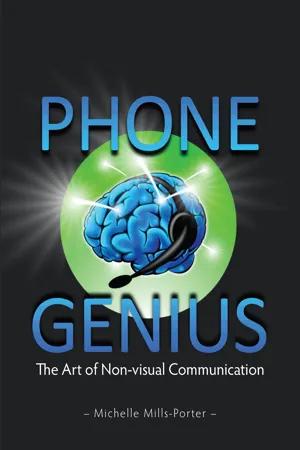
Take your communication to a whole new level. Become a Phone Genius! You probably already have a technical manual that tells you how to use your telephone efficiently. Yet there has never been a manual that tells you how to actually communicate effectively using this highly important piece of business equipment. Until now. In Phone Genius you will discover: Why talking to someone you can't see is so much harder than in person. What technology does to your voice and how you can change that. How to recognise behaviour and language patterns so as to pre-empt the needs and wants of others. How to increase your effectiveness over the phone and gain better results. Michelle Mills-Porter passes on her skills in using the telephone as her main tool of communication. Using stories and lessons gleaned from her 25 years of making calls, building business relationships and securing high level appointments, Michelle will show you how you too can become a Phone Genius.
- English
- ePUB (mobile friendly)
- Available on iOS & Android
eBook - ePub
About this book
Chapter 1 – Phone Genius – what is it?
Between the covers of this book lies the concentrated understanding of 25 years’ experience of using the phone as a communication tool. It is the amalgamation of everything I have learned, developed and distilled. It contains the essence of all that I teach in my intense training courses, workshops and seminars.
Let’s be clear: this is not a book on telesales techniques or sales strategies. Phone Genius is all about communication – communication at an evolved state, a higher level of consciousness, if you like. It explores how people who are great on the phone listen in a completely different way from those who aren’t so good, and how they use their voices more effectively. It is called Phone Genius simply because I learned what I am going to share with you by using the phone as my main form of communication, but the contents are relevant wherever one person is trying to understand, and be understood by, another.
Yes, the contents of this book will enable you to be more effective in your communication over the phone, but the science spreads beyond that, and will enhance your communication skills in all situations.
I use the phone on a daily basis in my work winning new business for my clients, arranging meetings at director level, negotiating, selling, building rapport, networking and match-making. These skills, however, also spill over into all aspects of my life, as I was recently reminded when using them to get my Dad an appointment with a neurologist, and then into hospital when the time element was crucial. That sounds like a simple process, but in fact it took many difficult phone calls, and a need, on occasions, to impart a sense of urgency. Lots of negotiation and tenacity was required. Sometimes it was appropriate to be patient and calm, and at other times simply to express my exasperation. These elements, deployed in the right way at the right time, get you results.
Although the subject of communication undoubtedly starts with basic animal behaviour, and this is something we touch on, this book also explores the power of our intentions and how they can affect the results we achieve. It is, therefore, all about human communication at an advanced level.
I will use the word ‘sales’ in this book. This doesn’t mean you have to be a sales person to take from this book, since we all have to sell ourselves, or our services, throughout the working day. Apply the contents to your situation, whatever it is, and use them in the way that is right for you. I use examples of reaching people in the corporate world because that’s the clearest way to show the strategies I am sharing, but in actual fact these practices can be used in virtually any scenario.
The toolbox I have created in Phone Genius not only helps you achieve great communication on the phone; the tools you will learn to apply here can be used in all communication situations. They will take your skills to an advanced level, and will help you to communicate effectively whether or not you use the phone for the major part of your day.
These tools are also designed to be an asset to senior executives, such as key account managers, directors and business owners. Their time is valuable, and they need to be able to engage effectively on the phone at a senior level.
Communicating effectively sight unseen
There are two key elements that must be applied to everything I teach. They are: authenticity and personality.
If you can communicate authenticity and personality effectively over the phone, then you are more than halfway there. There are many lessons in this book that will help you to achieve this.
A long time ago, I found that using the phone to communicate meant to all intents and purposes stripping myself of the predominant sense that human beings use in communication – visual communication.
Working on the phone, I found that without sight, my other senses were enhanced and I could ‘pick up’ on things that others couldn’t. I found that made me a better communicator in general, not only when I was using the phone. It wasn’t long before I noticed that a lot of people who predominantly used the phone during their working day were far better communicators in general.
On the other hand, those who considered themselves to be great in face-to-face situations would squirm at the thought of using the phone instead. That is when I realised people need a very different skill-set in order to communicate effectively on the phone.
I’ve seen this in a whole range of situations. Take, for instance, sales reps who are forced to work in the office for a while and how reluctant they are to pick up the phone to reach their clients, or, Heaven forbid, to make their own sales appointments. Despite their stated objections that it is beneath them, or that they don’t like talking on the phone, what it nearly always boils down to is a fear of failure. They lack the skills that those who communicate well on the phone have learned to develop.
I have never understood why sales people who work on the phone are less highly regarded than those who work ‘on the road’, despite the fact that they reach many more people in a fraction of the time. Salesmen are not selling while they are driving – just look at the expenses!
To communicate well on the phone requires an advanced skill-set that should be recognised.
What I have realised is that only without visual communication can we really bring our other senses to the enhanced level I am talking about.
Daniel Kish is the President of World Access for the Blind. He’s blind and an astonishing human being who I will talk about further later. Daniel wrote this passage specifically for Phone Genius to corroborate the point that I am making:
‘When I’m on stage, I read and respond to my audience by listening to every nuance that is happening – every movement, every fidget, every shuffle of every type of shoe, every yawn and turn of the head, every whisper, every stroke of pen to paper, no matter how many people or how large the auditorium – sometimes, even a smile causes the air to stir.
Yes, sometimes I miss things, but so do the eyes. The eyes see only what they are looking at. The ears can hear everything all around us, all at once. We just have to listen.’
That’s quite beautiful and profound, is it not?
Ask yourself this question: Do you totally free yourself of the ability to see when you are on the phone, or do you try to visualise the person you are talking to? Do you try to picture the office, and the building? The reception desk?
Now, have you ever visited somebody with whom you have built a rapport on the phone only to be surprised or confused when you meet them? It’s not surprising, is it?
The fact is, though, that many people who are great communicators over the phone never try to visualise the other person, so there is no break in rapport when they meet face to face.
How I became a ‘phone genius’
I would like to start by telling you how I learned the elements of the subject.
I joined the Royal Air Force at the age of 17, and, when I left a few years later, I found myself with no trade, and no specific skill that was relevant in ‘Civvy Street’. But, as I flicked through the ‘Situations Vacant’ pages of the papers, one thing became very clear. There were sales jobs everywhere!
It seemed to me that, if you could make it in sales, you would never be short of employment. They were well paid positions too, so I put in for quite a few of the jobs being advertised. I found myself being offered a number of possible options.
I chose a modest telesales position in a local magazine which sold advertising space, and quickly established that I was rather good at it. In fact, my first realisation of that was during the World Cup in 1990, when David Platt was the man of the moment. He had scored an amazing goal against Belgium, but the team had been knocked out, so they were coming home.
Our sales team was running a feature in which local businesses placed adverts in the paper to welcome the England Team home, and to say how proud of them we were.
Our promise was that we would get their messages to the team. I decided to see if I could actually get an interview with one of the squad in order to prove that our advertisers’ good wishes had reached the players.
I was only 21, and John was a much older colleague. He had heard me trying to reach the secretary of England’s manager, Bobby Robson to arrange an interview, and he thought it was ridiculous. Perhaps he was disappointed and bitter about his career; after all, he must have been in his forties, and he was still selling space for a very small magazine on a very low salary. Apparently the thought of our tiny little ads mag running an interview of any description was laughable, and he had decided to ‘take me down a peg or two’. So I got a call back from Bobby Robson’s office, and the man I spoke to was really enthusiastic.
‘Michelle,’ he said, ‘We really love the sentiment of what you are doing and we don’t just have to do the written interview, we can get some TV cameras down to your offices and interview you on local TV too!’
I finished the conversation and put the phone down to squeals of excitement from the girls in the office. We were all thrilled! That was until John entered the office, doubled over in fits of laughter. It had been him on the phone, and he couldn’t believe that I had fallen for it. I was crushed. What a horrible trick to play! I don’t think anyone was very amused.
It was then that my physical education teacher’s wise words came back to me. It was when I was playing hockey at school, and Miss Prest had said to me, ‘Michelle, the best way to get revenge is to shut up, and stick one in the back of the net!’
So the incident with John gave me some serious motivation, and I was adamant that I was going to get the interview. And I did! A few phone calls later, and I had secured an exclusive interview with none other than my hero, David Platt!
There are several revelations here that are important to the whole concept of Phone Genius. The most powerful of all was the motivation. I had to get the result I wanted, and it wasn’t down to sales skills, experience or practise. It was mindset!
Over the years, the importance of mindset and the power of intention has proved beyond a shadow of doubt that it has a bigger part to play in the results of your success than any other single factor.
Why should anyone still use the phone?
So, how much do we still use the phone for communication? Well, I think it is sad that we rely so heavily on e-mails and written social media. The massive pitfalls lying in wait for the unwary are already well documented, but, on a much less dramatic, day-to-day level, I see relationships damaged by misinterpreted e-mails all the time. I have been as guilty as the next person – I once lost a large commission cheque because of a misplaced exclamation mark! Smiley faces can be used, but they do not give much of an opportunity for expressing yourself – and there are quite a few people who find them inappropriate and irritating in business correspondence.
I recently read a heated discussion on LinkedIn in which somebody replied to a post which was written in capitals with the question, ‘Why are you shouting at me?’ Although it might have been intentional, it is more likely that the capitals had been left locked on by mistake, and the wrong impression had been given as a result.
Clearly, the issue is that the intended tone may be lost as soon as you press ‘send’, and you then have to rely upon the other party putting the correct interpretation on what you wrote. It’s rarely accurate.
Using the phone is still a much more personal form of communication. In business, it is arguably the quickest and most effective route to reaching a potential client, and we can certainly control the intended tone much more accurately. It’s true that we are using video and Skype so much more now, but...
Table of contents
- Title page
- Copyright information
- – Dedication –
- – Contents –
- – Foreword –
- – What people are saying –
- Chapter 1 – Phone Genius – what is it?
- Chapter 2 – What we all know about communication – and how we forget it!
- Chapter 3 – Why do we sound different over the phone?
- Chapter 4 – The toolbox
- Chapter 5 – The foundations
- Chapter 6 – How to build rapport
- Chapter 7 – How to reduce the fear of rejection
- Chapter 8 – How to make a cold call sound like a warm call
- Chapter 9 – How to engage with the contact
- Chapter 10 – The three stages of listening
- Chapter 11 – Behaviour profiling over the phone
- Chapter 12 – How to introduce yourself and how to present yourself
- Chapter 13 – Closing
- Chapter 14 – How to get a VIP to call you back and more voicemail message tips
- Chapter 15 – My hot tips
- – Afterword –
- – Acknowledgements –
- – About the author –
Trusted by 375,005 students
Access to over 1.5 million titles for a fair monthly price.
Study more efficiently using our study tools.
Frequently asked questions
Yes, you can cancel anytime from the Subscription tab in your account settings on the Perlego website. Your subscription will stay active until the end of your current billing period. Learn how to cancel your subscription
No, books cannot be downloaded as external files, such as PDFs, for use outside of Perlego. However, you can download books within the Perlego app for offline reading on mobile or tablet. Learn how to download books offline
Perlego offers two plans: Essential and Complete
- Essential is ideal for learners and professionals who enjoy exploring a wide range of subjects. Access the Essential Library with 800,000+ trusted titles and best-sellers across business, personal growth, and the humanities. Includes unlimited reading time and Standard Read Aloud voice.
- Complete: Perfect for advanced learners and researchers needing full, unrestricted access. Unlock 1.5M+ books across hundreds of subjects, including academic and specialized titles. The Complete Plan also includes advanced features like Premium Read Aloud and Research Assistant.
We are an online textbook subscription service, where you can get access to an entire online library for less than the price of a single book per month. With over 1.5 million books across 990+ topics, we’ve got you covered! Learn about our mission
Look out for the read-aloud symbol on your next book to see if you can listen to it. The read-aloud tool reads text aloud for you, highlighting the text as it is being read. You can pause it, speed it up and slow it down. Learn more about Read Aloud
Yes! You can use the Perlego app on both iOS and Android devices to read anytime, anywhere — even offline. Perfect for commutes or when you’re on the go.
Please note we cannot support devices running on iOS 13 and Android 7 or earlier. Learn more about using the app
Please note we cannot support devices running on iOS 13 and Android 7 or earlier. Learn more about using the app
Yes, you can access Phone Genius by Michelle Mills-Porter in PDF and/or ePUB format, as well as other popular books in Business & Sales. We have over 1.5 million books available in our catalogue for you to explore.