In 2016, a small protest encampment at the Standing Rock reservation in North Dakota, initially established to block construction of the Dakota Access oil pipeline, grew to be the largest Indigenous protest movement in the twenty-first century, attracting tens of thousands of Indigenous and non-Native allies from around the world. Its slogan "Mni Wiconi"-Water is Life-was about more than just a pipeline. Water Protectors knew this battle for Native sovereignty had already been fought many times before, and that, even after the encampment was gone, their anti-colonial struggle would continue.
In Our History is the Future, Nick Estes traces traditions of Indigenous resistance leading to the #NoDAPL movement from the days of the Missouri River trading forts through the Indian Wars, the Pick-Sloan dams, the American Indian Movement, and the campaign for Indigenous rights at the United Nations. While a historian by trade, Estes also draws on observations from the encampments and from growing up as a citizen of the Oceti Sakowin (the Nation of the Seven Council Fires), making Our History is the Future at once a work of history, a personal story, and a manifesto.
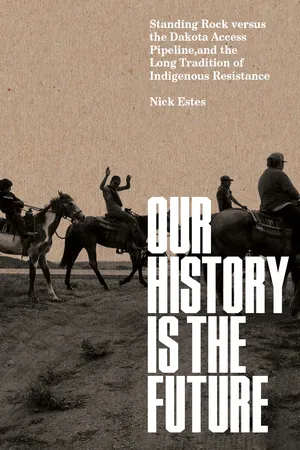
eBook - ePub
Our History Is the Future
Standing Rock Versus the Dakota Access Pipeline, and the Long Tradition of Indigenous Resistance
- 320 pages
- English
- ePUB (mobile friendly)
- Available on iOS & Android
eBook - ePub
Our History Is the Future
Standing Rock Versus the Dakota Access Pipeline, and the Long Tradition of Indigenous Resistance
About this book
Information
1
Siege
To us, as caretakers of the heart of Mother Earth, falls the special responsibility of turning back the powers of destruction … Did you think the Creator would create unnecessary people in a time of such terrible danger?
—Chief Arvol Looking Horse,
Keeper of the Sacred Buffalo Calf Pipe1
Keeper of the Sacred Buffalo Calf Pipe1
“We’re going to declare war on the Keystone XL Pipeline,” announced Oglala Sioux Tribal President Bryan Brewer, before a throng of cameras and microphones.2 It was late March 2014, at an opening ceremony for a spirit camp on the Rosebud Indian Reservation in South Dakota. A crowd erupted into bursts of akisas and lililis—Lakota war cries and the high-pitched tremolos of assent. Keystone XL (KXL), or any oil pipeline, would not pass through Oceti Sakowin territory without a fight. This is a war story. But it is not always with weapons that warriors wage their struggle.
A dozen tribal national flags fluttered behind Brewer in the prairie wind, a sign of growing unity among Indigenous nations. His speech marked the beginning of a historic resistance that was to coalesce against the Dakota Access Pipeline at Standing Rock in 2016. It was not orchestrated behind closed doors by wealthy think tanks or big environmental NGOs. Rather, like its people, it grew from the earth and this humble landscape, often viewed as flyover country. It also grew from a deep history of struggles over land and water, and a fight for a livable future on a planet so thoroughly devastated by climate change.
Earlier in March, the Rosebud Sioux Tribe, under the direction of its president, Cyril “Whitey” Scott, abruptly ended a lease with a white farmer renting reservation land adjacent to the KXL pipeline’s path. The pipeline snaked carefully through a complex checkerboard of private and tribal land ownership, a legacy of the 1887 Dawes General Allotment Act that broke up large chunks of reservation land by selling it off to white settlers. With yellow cornstalks still jutting through the snow from last year’s harvest, workers from the Wica Agli men’s health initiative, citizens of Rosebud, and supporting Native people erected tipis on reclaimed earth—directly in the path of the pipeline. They called the camp Oyate Wahacanka Woecun, meaning “shield the people.” Large, round hay bales were taken from another plot leased by a white rancher and stacked to surround the camp, forming a barrier against harsh winds. The thick straw walls, it was said, may have also stopped bullets fired in the cover of darkness by vengeful white farmers.
It didn’t matter if this was private property. It was still treaty territory, territory that generations of Lakotas and Dakotas had died defending and lived to care for. If not stopped, 800,000 barrels of tar sands oil would be transported each day across 1,200 miles of land—from Hardisty, Alberta, to Steele City, Nebraska—traversing 357 streams and rivers (all tributaries of the Missouri River), and crossing the Ogallala Aquifer, North America’s largest aquifer. Because everyone depended on the water, whether for drinking or agriculture, Mni Wiconi (Water is life) trumped the sacredness of private property. “It’s not an Indian thing, it’s not a white thing,” Rosebud Sioux Council Representative Wayne Frederick explained. “It’s everybody’s issue.”3
White landowners from Nebraska were also at the camp’s opening, standing at the edge of the crowd holding signs that read “PIPELINE FIGHTER.” They had joined the Cowboy-Indian Alliance, a campaign led by a progressive group of white farmers and ranchers from Bold Nebraska and Dakota Rural Action. Some of the landowners, however, were libertarians who were more concerned with the sanctity of private property and the evils of “big government” than with Indian treaties and climate change. And while they captured much of the media attention around KXL resistance, they represented a minority of the affected white landowners from Montana, South Dakota, and Nebraska.4 On the plains, solidarity with Indigenous nations is a hard sell that often comes down to land and money. By this time, TransCanada, the company building the KXL, reported at least 92 percent of the 302 South Dakotan landowners in the pipeline’s path had agreed to sell their lands voluntarily.5 The situation was similar in Nebraska and Montana. The holdouts had filed lawsuits to stop eminent domain proceedings, the seizure of private land for “public use,” the definition of which includes privately owned oil pipelines. But these were a mere handful of individuals, as compared to the many Indigenous nations who, for the most part, wholly opposed KXL.
This leg of KXL crossed through the permanent reservation boundaries of the Great Sioux Nation and unceded lands of the 1868 Fort Laramie Treaty, which forbids white settlement without Indigenous consent. The irony, Lakota historian Edward Valandra observed, was that any condemned private land would be “twice stolen”—land white squatters first stole from Natives would then be taken by a Canadian oil company.6 Settlers and private property have always been the vanguards of invasion, and the sanctity of private property never applied to Indigenous peoples. But instead of turning their backs, like the first settlers did to them, Native nations—such as Rosebud, Pine Ridge, Yankton, Cheyenne River, and Standing Rock—welcomed the potential allies. After all, “Lakota” (or “Nakota” or “Dakota”) translates to “ally.” To turn away, on account of differences, those with shared enemies or mutual interests goes against the very being of Lakota culture.
Much as it has been for centuries, this conflict was about the land: who stole it, who owned it, and who claimed it. On the High Plains, land is a matter of race, class, and colonialism. KXL was possible only because Indigenous genocide and removal had cleared the way for private ownership of land. Federal laws such as the Dawes Act and the 1862 Homestead Act, which opened up 270 million acres of Native land, subsidized white settlement to supplant entire Native nations, and eventually concentrated it in the hands of a few. According to a 2002 report by the United States Department of Agriculture (USDA), white settlers own 96 percent of all private agricultural lands in the United States, and 98 percent of private lands overall.7 According to a 2012 USDA report, in Lakota and Dakota reservations, non-Natives collect 84.5 percent of all agricultural income, controlling nearly 60 percent of the agricultural lands and 65 percent of all reservation-based farms.8 This includes the white billionaire and media tycoon Ted Turner, who owns more than 2 million acres of ranchland across the globe and more than 200,000 acres of Oceti Sakowin treaty land in western South Dakota.9 The radical scholar Cedric Robinson identified this system, in which a single white man owns more wealth and land than entire Indigenous nations, as racial capitalism.10 Capitalism arose under a racist European feudal system. It used “race” as a form of rule—to subordinate, to kill, and to enslave others—and used that difference for profit-making. Racial capitalism was exported globally as imperialism, including to North America in the form of settler colonialism. As a result, the colonized and racialized poor are still burdened with the most harmful effects of capitalism and climate change, and this is why they are at the forefront of resistance. The legacy of racial capitalism and ongoing settler colonialism were why the Oceti Sakowin had gathered to oppose KXL in 2014, and why they would gather again to oppose DAPL.
KXL resistance emerged six years after the US housing market collapsed and the nation’s first Black president, Barack Obama, inherited the mantle of a white supremacist empire. As global temperatures continued rising, Obama committed to curbing carbon emissions, but as part of his “all-of-the-above energy strategy,” he also embraced the oil industry as it opened new markets and lands to exploit. US domestic crude oil production skyrocketed from 2008 to 2016—an 88 percent increase, thanks to the shale oil boom in the United States and the tar sands boom in Canada. With this acceleration came new oil pipelines and new sites of extraction. As 9.3 million US families—many of them poor, Black, and Latinx—faced home foreclosures, Indigenous lives, lands, waters, and air were once again sacrificed to help pull settler economies out of the gutter.
In response to the economic crisis, revolutionary flowers had blossomed in public squares around the world, offering for a brief moment a vision for a different world. In 2010, young people of the Arab Spring toppled dictators, and tragedy and betrayal soon followed. In 2011, disenchanted millennials of the Occupy Wall Street movement put anti-capitalism back on the agenda to challenge the rule of the 1 percent, the wealthy elite. In response, police bludgeoned, tear gassed, and jailed the 99 percent. Out of this chaos, a mass Indigenous movement reawakened, the seeds of which were planted generations before. While the movements of public squares arose in the cities, the Indigenous uprising mobilized city and country alike, everywhere Indigenous peoples and their allies were found.
During the winter of 2012 to 2013, Indigenous rebellion was afoot on Turtle Island. Its heartbeat was a drum, its voice a song. In what is currently Canada, Indigenous women of Idle No More led a mass movement of round dances (traditional healing and celebratory dancing and singing) in shopping malls and blockades of rail lines transporting oil. They protested Stephen Harper’s Conservative government’s abuse of Indigenous rights, privatization of Indigenous lands, and rollback of environmental protections to intensify fossil fuel extraction. As Cree Idle No More cofounder Sylvia McAdam noted, it was out of necessity that the movement linked Indigenous and environmental struggles to protest a system that, if not stopped, will continue to “devastate the very things needed to sustain humanity—our lands and waters—for the generations to come.”11 It was more than a battle for the present; it was a battle for the future. The growing alliances resonated across the Medicine Line, the US–Canada divide. In February 2013, one of the largest actions in the history of the US climate movement descended on Washington, DC. More than 40,000 people gathered outside the White House to protest the Keystone XL Pipeline, bringing together Indigenous and non-Indigenous movements committed to halting the extraction and transportation of highly toxic and volatile tar sands.
That summer, Métis and Cree women and elders led hundreds in a two-day journey through the Alberta tar sands during an annual Healing Walk. Jesse Cardinal, a Métis cofounder of the walk, described how “participants [saw] tailings ponds and desert-like areas of ‘reclaimed land’ that was once the boreal forest and now grows almost nothing.”12 It’s a stark and immense landscape, encompassing an area larger than the state of Florida. In Treaty 6 and Treaty 8 territories, tar sands extraction—by companies such as Suncor Energy, ConocoPhillips, ExxonMobil, and Shell Canada—has poisoned water, land, air, plants, animals, and people. Duck and moose—staple foods of many Indigenous communities—have become contaminated with toxins, and harvests of wild berries and plants have been decimated. According to Cardinal, in this modern-day gold rush, “many ‘outsiders’ are driven here by their own economic desperation.”13
Like the land itself, the bodies of Indigenous women, girls, trans, and Two-Spirit people are also seen as open for violence and violation. Resource extraction intensifies a murderous heteropatriarchy, meaning that grounding resistance in Indigenous feminist interventions has become all the more urgent. An influx of men has also flooded the region’s “man camps,” which house migrant oil laborers.14 Men outnumber women two to one in the tar sands boomtown of Fort McMurray, Alberta. While a movement has existed since the 1970s to honor the lives of the thousands of missing and murdered Indigenous women across Canada, the Two-Spirit Métis activist Sâkihitowin Awâsis has noted the “links between presence of the tar sands industry and heightened rates of missing and murdered Indigenous Two-Spirits, women, and girls.”15 It’s no coincidence that Indigenous women led the movement against the tar sands.
Put another way, settler states like Canada and the United States continue to settle the land, raping and killing Native women and Two-Spirit people in order to do so. From the 1970s onward, communities and activists have documented thousands of cases where Indigenous women, girls, trans, and Two-Spirited people who have been murdered, disappeared, and targeted by all forms of violence in Canada. The movement, operating under the hashtag #MMIWG (Missing and Murdered Indigenous Women and Girls), holds rallies around Canada every February 14, honoring the lives of the disappeared and demanding answers—a call that has been partially answered by the creation of the National Inquiry into Murdered and Missing Indigenous Women. Canada’s death culture, however, is little different than its southern neighbor. In the United States, May 5 has been declared the National Day of Awareness for Missing and Murdered Native Women and Girls. In a 2016 report, there were 5,712 cases of missing Indigenous women nationwide; experts and activists, however, believe the number to be considerably higher.16
And Canadian prosperity is gained not just at the expense of First Nations. More than half the world’s mining companies are headquartered in Canada, with properties in more than one hundred countries. Canadian extractive industries target Indigenous and colonized people throughout the world, and some have been linked to egregious human rights abuses, especially against Indigenous peoples. For example, beginning in 2007, Hudbay Minerals, a Canadian company with investments in the Fenix nickel mine, was linked to assassinations, beatings, gang rapes of women and girls, and arsons in Mayan communities in Guatemala.17
The links between the extractive industry and violence against Indigenous peoples also turn up in the United States. The Bakken shale oil boom that began in 2007, and would eventually prompt the construction of the Dakota Access pipeline, made North Dakota the second-largest oil producing state, after Texas. Much of this occurred on the Fort Berthold Reservation, the Mandan, Hidatsa, and Arikara (MHA) Nation, which sits atop some of the region’s deepest oil reserves. In 2011, Tex Hall, the tribal chairman, adopted the mantra “sovereignty by the barrel,” expressing a belief that oil wealth can strengthen economic self-determination and autonomy. Oil revenues, Hall hoped, would bring his nation out of crushing poverty and relieve the enduring devastation caused by the federal government’s construction of the Garrison Dam in the heart of the reservation in the 1950s, which forced the reservation’s residents from the fertile Missouri River valley onto the open, less productive plains. In short order, the MHA Nation became one of the wealthiest in Indian Country, and with this ascent came political corruption and high rates of violence, especially against women and girls.18
“We found a crying, naked, four-year-old girl running down one of the roads right outside of the Man Camp. She had been sexually assaulted,” Grace Her Many Horses recalled. It was just one of many horrific incidents of rape, abuse, and sex trafficking during Her Many Horses’ time at Fort Berthold in 2013 as a tribal cop. Most of her calls were related to man camps or the oil and gas industry they served.19 Towns of thousands literally sprang up overnight, made up of mobile homes and FEMA trailers, as hotels overflowed. Existing towns doubled and quadrupled in population, taxing already overstretched or nonexistent social infrastructure, including reservation emergency services. Nearly all the new arrivals were men, leading to some of the highest concentrations of men, outside of prisons, in North America. While emergency calls and violent assaults were frequent, prosecutions were not. Non-Native oil workers exploited a complex patchwork of federal, state, and tribal jurisdictions in which tribal law enforcement has little or no jurisdiction over non-Natives, allowing perpetrators to escape tribal justice.20
Since the Bakken boom, the rolling prairies and lush river valleys that had survived Army Corps flooding in 1953 have been replaced by miles of metal fracking rigs and heavy construction equipment. Clustered constellations of oil flares burning off methane are visible from space at night. “What we’re dealing with is a death by a thousand cuts,” said Kandi Mossett, an organizer with the Indigenous Environmental Network and citizen of the MHA Nation.21 She explained that cancer, asthma, and respiratory diseases have increased among the children and elders because of the toxic environment. Mossett herself is a cancer survivor. But this toxic landscape is connected to another. “You would never see this in Houston’s most affluent neighborhoods,” said Yudith Neito, a resident of Houston’s mostly Latinx community Manchester, where the air smells of burnt plastic and diesel from the oil refineries along the Houston Ship Channel next door.22 These are the refineries that process oil from the Canadian tar sands and the Bakken shale.
Nevertheless, in 2012, despite massive opposition, Obama fast-tracked the construction of KXL’s southern leg from Cushing, Oklahoma, to the Gulf Coast. “As long as I’m president,” he boasted in 2012, “we’re going to keep on encouraging oil development and infrastructure, and we’re going to do it in a way that protects the health and safety ...
Table of contents
- Cover Page
- Title Page
- Copyright Page
- Contents
- Maps
- Prologue: Prophets
- 1. Siege
- 2. Origins
- 3. War
- 4. Flood
- 5. Red Power
- 6. Internationalism
- 7. Liberation
- Acknowledgments
- Notes
- Index
Trusted by 375,005 students
Access to over 1.5 million titles for a fair monthly price.
Study more efficiently using our study tools.
Frequently asked questions
Yes, you can cancel anytime from the Subscription tab in your account settings on the Perlego website. Your subscription will stay active until the end of your current billing period. Learn how to cancel your subscription
No, books cannot be downloaded as external files, such as PDFs, for use outside of Perlego. However, you can download books within the Perlego app for offline reading on mobile or tablet. Learn how to download books offline
Perlego offers two plans: Essential and Complete
- Essential is ideal for learners and professionals who enjoy exploring a wide range of subjects. Access the Essential Library with 800,000+ trusted titles and best-sellers across business, personal growth, and the humanities. Includes unlimited reading time and Standard Read Aloud voice.
- Complete: Perfect for advanced learners and researchers needing full, unrestricted access. Unlock 1.5M+ books across hundreds of subjects, including academic and specialized titles. The Complete Plan also includes advanced features like Premium Read Aloud and Research Assistant.
We are an online textbook subscription service, where you can get access to an entire online library for less than the price of a single book per month. With over 1.5 million books across 990+ topics, we’ve got you covered! Learn about our mission
Look out for the read-aloud symbol on your next book to see if you can listen to it. The read-aloud tool reads text aloud for you, highlighting the text as it is being read. You can pause it, speed it up and slow it down. Learn more about Read Aloud
Yes! You can use the Perlego app on both iOS and Android devices to read anytime, anywhere — even offline. Perfect for commutes or when you’re on the go.
Please note we cannot support devices running on iOS 13 and Android 7 or earlier. Learn more about using the app
Please note we cannot support devices running on iOS 13 and Android 7 or earlier. Learn more about using the app
Yes, you can access Our History Is the Future by Nick Estes in PDF and/or ePUB format, as well as other popular books in Social Sciences & Human Rights. We have over 1.5 million books available in our catalogue for you to explore.