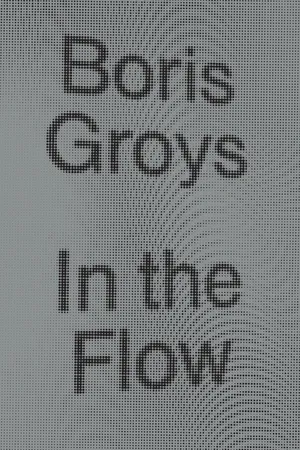
In the early 20th century, art and its institutions came under critique from a new democratic and egalitarian spirit. In an age of secularism and materialism, artworks would be understood as merely things among other things. This meant an attack on the techniques of realism, and the traditional mission of the museum, both designed shield a small class of objects from the entropic fate awaiting everything else-and the development of an approach that Boris Groys calls "direct realism": an art that would not produce objects, but practices that could enter the flow of time to live and die like the rest of us. But for more than a century now, every advance in this direction has been quickly followed by new means of preserving art's distinction.
In this major new work, Groys, one of the world's leading art theorists, charts the paradoxes produced by this tension, which continues to structure the production and reception of new art.
The internet, the latest medium through which artists have attempted to disavow this special status, inverts the most notorious consequence of early modernist developments. If the techniques of mechanical reproduction gave us objects without aura, digital production generates aura without objects, transforming all its materials into vanishing markers of the transitory present.
eBook - ePub
In the Flow
About this book
Information
Topic
ArtSubtopic
Art Theory & CriticismCHAPTER 1
Entering the Flow
Traditionally, the main occupation of human culture was the search for totality. This search was dictated by the desire of human subjects to overcome their own particularity, to get rid of the specific ‘points of view’ that were defined by their ‘life forms’ and to gain access to a general, universal worldview that would be valid everywhere and at every time. This desire to transcend one’s own particularity does not necessarily have its origin in the ontological constitution of the subject itself. We know that the particular is always subsumed, subjected to the whole. So the desire for totality is simply the desire for freedom. And this desire, again, does not need to be interpreted as being somehow inherent in human nature. We know the historical examples of self-liberation in the name of totality, and we are able to imitate these examples – as we may imitate any other form of life.
Thus, we hear and read the myths that describe the emergence of the world, its functioning and its unavoidable end. In these myths we meet gods and demigods, prophets and heroes. But we also read the philosophical and scientific treatises that describe the world according to the principles of reason. In these texts we meet the transcendental subject, the unconscious, the absolute spirit and many other similar things. Now, all these narratives and discourses presuppose an ability in the human mind to arise above the level of its material existence and find access to God or universal reason – to overcome its own finiteness, its mortality. Access to totality is the same as access to immortality.
However, during the period of modernity we got accustomed to the view that human beings are incurably mortal, finite, and therefore irreparably determined by the specific material conditions of their existence. Humans cannot escape these conditions even in a flight of imagination, because every such flight always takes the reality of their existence as a starting point. In other words, the materialist understanding of the world seems to deny human beings access to the totality of the world that was secured to them by religious and philosophical tradition. According to this view, we are merely able to improve the material conditions of our existence – but we cannot overcome them. We can find a better position inside the whole of the world – but not the central position that would allow us to view/overlook the totality of the world. This understanding of materialism has certain cultural, economic and political implications that I do not want to go into at the moment. Rather, I would like to ask the following question: Is this understanding correct, truly materialist?
Now I would suggest that it is not. The materialist discourse, as initially developed by Marx and Nietzsche, describes the world in permanent movement, in the flow – be it the dynamics of productive forces or the Dionysian impulse. According to this materialist tradition, all things are finite – but all of them are involved in the infinite material flow. So there is the materialist totality – the totality of the flow. Then the question becomes, Is it possible for a human being to enter the flow in order to get access to its totality? On a certain very banal level, the answer is, of course, yes. Human beings are things among other things in the world, and thus they are subjected to the same universal flow. They become ill, they grow old, and they die. Human bodies are always in the flow. The old-fashioned, metaphysical universality could be achieved only through very special and complicated efforts. Materialist universality seems to be always already there – achievable without any effort and without any price. Indeed, we need not make any effort to be born or to die, or, generally, to go with the flow. Materialist totality, the totality of the flow, can be thus understood as a purely negative totality: Reaching this totality simply means rejecting all attempts to escape into the fictive, metaphysical, spiritual space beyond the material world, abandoning all dreams of immortality, eternal truth, moral perfection, ideal beauty, etc.
However, even if human bodies are subject to aging, death, and dissolution in the flow of material processes, it does not mean that human beings are also in flux. One can be born, live, and die under the same name, having the same citizenship, the same CV and the same Web site, remaining the same person. Our bodies are not the only material supports of our being persons. From the moment of our birth we are inscribed into certain social orders – without our consent or even knowledge of that fact. The material supports of our persons are state archives, medical records, passwords to certain Internet sites, and other documentation. Of course, these archives will be also destroyed by the material flow at some point in time. But this destruction takes time that is not commensurable with our lifetime. Our personality survives our body – preventing our immediate access to the totality of the flow. To destroy, or at least transform, the archives that materially support our persons during our lifetime, we need to initiate a revolution. The revolution is an artificial acceleration of the world flow. It is an effect of impatience or unwillingness to wait until the existing order collapses by itself and liberates a human being from his or her personality. That is why revolutionary practice is the only way by which post-metaphysical, materialist man can find an access to the totality of the flow. However, such a revolutionary practice presupposes serious efforts on the part of the practitioner, and requires intelligence and discipline comparable to what was needed to achieve spiritual totality.
These revolutionary efforts at self-fluidization, understood as the dissolution of one’s own person, of one’s own public image, are documented by modern and contemporary art, just as efforts at self-eternalization were documented by traditional art. The artworks, considered as specific material objects – as art bodies, so to speak – are perishable. But when considered as publicly accessible, visible forms, they are not. As an artwork’s existing material support decays and dissolves, the work can be copied and placed on a different material support – for example, as a digitalized image accessible on the Internet. The history of art demonstrates this replacing of old supports by new ones – for example, in our efforts at restoration and reconstruction. Thus, the individual form of an artwork as far as it is inscribed in the archives of art history remains intact – unaffected or only marginally affected by material flux. To get access to the flow, the form must be made fluid – it cannot become fluid by itself. And that is the reason for modern artistic revolutions. The fluidization of the artistic form is the means by which modern and contemporary art tries to gain access to the totality of the world. However, such fluidization does not come by itself – again, it requires an additional effort. Now, I would like to discuss some examples of the artistic practices of fluidization and self-fluidization – and to indicate some conditions and limitations of these practices.
Let us begin by short consideration of Wagner’s notion of the Gesamtkunstwerk. Wagner introduced this notion in his programmatic treatise ‘The Artwork of the Future’ (1849–1950), which he wrote while living in exile in Zurich, after the end of the revolutionary uprisings in Germany in 1848. In it, Wagner develops the project of an artwork (of the future) that is heavily influenced by the materialist philosophy of Ludwig Feuerbach. Right at the beginning of his treatise, Wagner states that the typical artist of his time is an egoist who is completely isolated from the life of the people and practices his art for the luxury of the rich; in so doing, he exclusively follows the dictates of fashion. The artist of the future must become radically different:
He now can only will the universal, true, and unconditional; he yields himself not to a love for this or that particular object, but to wide Love itself. Thus does the egoist become a communist, the unit all, the man God, the art-variety Art.1
Thus, becoming a communist is possible only through self-renunciation, self-dissolution in the collective. Wagner writes:
The last, completest renunciation (Entäusserung) of his personal egoism, the demonstration of his full ascent into universalism, a man can only show us by his Death; and that not by his accidental, but by his necessary death, the logical sequel to his actions, the last fulfilment of his being. The celebration of such a death is the noblest thing that men can enter on.2
The individual must die in order to establish the communist society. Admittedly, there remains a difference between the hero who sacrifices himself in life and the performer who makes this sacrifice onstage – the Gesamtkunstwerk being understood by Wagner as a music drama. Nonetheless, Wagner insists that this difference is suspended, for the performer
does not merely represent in the artwork the action of the fêted hero, but also repeats its moral lesson; insomuch as he proves by this surrender of his personality that he also, in his artistic action, is obeying a dictate of Necessity which consumes the whole individuality of his being.3
The performer dissolves his or her artistic individuality in the whole of the Gesamtkunstwerk as the hero sacrifices his life for the Communist future. Wagner called the Gesamtkunstwerk the ‘Great United Art-work, which must gather up each branch of art, both to use as a means and, in some sense, to undo it for the common aim of all’. Here not only does the individual dissolve him- or herself in the social whole, but also the individual artistic contributions and particular artistic mediums lose their identities and dissolve themselves in the materiality of the whole.
Nevertheless, according to Wagner, the performer of the role of the main hero controls the whole staging of his self-demise, his descent into the material world – a descent that is represented by the symbolic death of the hero on the stage. All other performers and coworkers achieve their own artistic significance solely through participation in this ritual of self-sacrifice performed by the hero. Wagner speaks of the hero-performer as a dictator who mobilizes the collective of collaborators exclusively with the goal to stage his own sacrifice in the name of this collective. After the end of the sacrificial scene, the hero-performer is replaced by the next dictator. In other words, the hero (and, accordingly, his performer) controls his self-sacrifice from beginning to end. Wagner’s Gesamtkunstwerk shows us the descent of the hero into the material flow – but not the flow itself. Communism remains a remote ideal. Here, the event of descent into the formless materiality of the world becomes a form in itself – a form that can be repeated, restaged, re-enacted.
In Wagner’s Gesamtkunstwerk the individual voice of a singer remains identifiable – even if it is integrated into the whole of a music drama. Later, Hugo Ball dissolved the individual voice into the sound flow. Ball conceived the Cabaret Voltaire in Zurich (where Wagner wrote the ‘Artwork of the Future’) as a kind of Gesamtkunstwerk, being inspired by Wassily Kandinsky and his ‘abstract’ drama Der gelbe Klang (‘The Yellow Sound’). Ball wrote about Kandinsky: ‘He was concerned with the regeneration of society through the union of all artistic mediums and forces … It was inevitable that we should meet each other …’4 In his diary, Flight out of Time, Ball writes, in the spring of 1916:
The human organ represents the soul, the individuality in its wanderings with its demonic companions. The noises represent the background – the inarticulate, the disastrous, the decisive … In a typically compressed way, the poem shows the conflict of the vox humana with a world that threatens, ensnares, and destroys it, a world whose rhythm and noise are ineluctable.
About three months later, on 23 June 1916, Ball writes that he has invented ‘a new genre of poems – namely, Lautgedichte [‘sound poetry’]’. Sound poetry, as described by Ball, can be interpreted as the self-destruction of the traditional poem; as the exposure of the downfall and disappearance of the individual voice; as the descent of the human form into the totality of the material flow. Ball recalled of the public reading of his first sound poem at the Cabaret Voltaire: ‘Then the lights went out, as I had ordered, and bathed in sweat, I was carried off the stage like a magical bishop’. He experienced and described the reading of his work as an exhausting exposure of the human voice to the demonic forces of noise. Ball won this battle (becoming the magical bishop), but only by radically exposing himself to these demonic forces, allowing them to reduce his voice to pure noise, to senseless, purely material process.
The descent into material chaos is not presented here as a preliminary stage that announces an impending return to order, analogous to the periods of revolutionary chaos, social tumult, or carnival as they were described, for example, by Roger Caillois or Mikhail Bakhtin. In the terminology from Walter Benjamin’s ‘Essay on Violence,’ the violence of the material flow is divine and not mythical violence, insofar as the destruction of the old order does not lead to the emergence of a new order. But this divine violence is practised by an artist, not by God. There remains, therefore, merely a poem – having beginning and end, capable of being copied and repeated. We have a documentation of a descent into the flow – but not access to the flow itself. The same can be said about the later attempts of radical descent into material chaos – of fluidization of the artistic form and corresponding self-fluidization. I mean here Guy Debord’s dérive, the artistic practice of fluxus, or texts and films – for example, films by Christoph Schlingensief – in which the personality of the hero or heroine becomes decentred, deconstructed, fluidized. All these texts and images show the limit that the artist necessarily reaches as he stages the descent of an artistic form into the flow. In the end, only the documentation of the descent into chaos and flow is produced – but the image of flow itself remains elusive.
Thus, it becomes clear that the descent of a subject into the material flow shares the fate of a subject’s ascent to the contemplation of God or eternal ideas. The religious and philosophical tradition demonstrates repeated attempts to reach this contemplation, but it never presents their results in a convincing form. All religious illuminations and scientific proofs can be interpreted as products of our own imagination, which is determined by the material conditions of our existence. To the same degree and for the same reason, we cannot claim to have any evidence that we have ever entered the material flow. In this sense, that flow is as unreachable as eternal ideas. But at the same time, we have a collection of our attempts to enter the flow. The documentations of these attempts are added to the archive – the archive of self-fluidizations.
However, our art museums are no longer places of permanent collections and archives that would be able to stabilize at least these documentations of the flow. Instead, they have become places of temporary curatorial projects. Not accidentally, Harald Szeemann, who initiated the curatorial turn contemporary art has taken, was fascinated by the idea of the Gesamtkunstwerk and in 1984 based an exhibition on it, ‘Hang zum Gesamtkunstwerk’ (‘The Tendency to Gesamtkunstwerk’).5 But what is the main difference between a curatorial project and a traditional exhibition? The traditional exhibition treats its space as anonymous and neutral. Only the exhibited artworks are important. Thus, artworks are perceived and treated as potentially immortal, even eternal, and the space they inhabit as contingent, accidental – merely a station where the immortal, self-identical artworks take a temporary rest from their wanderings through the material world. On the contrary, the installation – be it an artistic or curatorial installation – inscribes the exhibited artworks in this contingent material space. The curatorial project is a Gesamtkunstwerk because it instrumentalizes all the exhibited artworks, making them serve a common purpose that is formulated by the curator. At the same time, a curatorial or artistic installation is able to include all kinds of objects – some of them time-based artworks, or processes, some of them everyday objects, documentations, texts, and so forth. All of these elements, as well as the architecture of the space, its sound and light, lose their respective autonomy and begin to serve the creation of the whole, in which visitors and spectators are also included. Thus, ultimately, every curatorial project demonstrates its accidental, contingent, eventful, finite character – its own precariousness.
In fact, every curatorial project has the goal of contradicting the previous, traditional art-historical narratives. If such a contradiction does not take place, the curatorial project loses its legitimacy. An individually curated exhibition that merely reproduces and illustrates the already known narratives simply does not make any sense. For the same reason, each curatorial project should contradict the previous one. A new curator is a new dictator who erases the traces of the previous dictatorship. Thus, more and more contemporary museums are being transformed from spaces for permanent collections into stages for temporary curatorial projects – temporary Gesamtkunstwerken. And the main goal of these temporary curatorial dictatorships is to bring the art museum into the flow – to make art fluid, to synchronize it with the flow of time. Today, the museum ceases to be a space of contemplation but rather becomes a place where things happen. The contemporary museum stages not only curatorial projects but also lectures, conferences, readings, screenings, concerts, guided tours. The flow of events inside the museum is today often faster than the flow outside its walls. Meanwhile, we have got used to asking ourselves what is going on in this or that museum. And to find the relevant information, we search not only the Web site of the museum but also blogs, social media pages, Twitter, etc. We follow a museum’s activities on the Internet more often than we visit the museum. On the Internet, the museum functions as a blog. Thus, today, the museum presents not a universal history of art but, rather, its own history, in the chain of events staged by the museum itself.
Nowadays one speak...
Table of contents
- Cover Page
- Halftitle Page
- Title Page
- Copyright Page
- Contents
- Introduction: The Rheology of Art
- Chapter 1: Entering the Flow
- Chapter 2: Under the Gaze of Theory
- Chapter 3: On Art Activism
- Chapter 4: Becoming Revolutionary: On Kazimir Malevich
- Chapter 5: Installing Communism
- Chapter 6: Clement Greenberg: An Engineer of Art
- Chapter 7: On Realism
- Chapter 8: Global Conceptualism Revisited
- Chapter 9: Modernity and Contemporaneity: Mechanical vs. Digital Reproduction
- Chapter 10: Google: Words beyond Grammar
- Chapter 11: WikiLeaks: The Revolt of the Clerks, or Universality as Conspiracy
- Chapter 12: Art on the Internet
- Index
Trusted by 375,005 students
Access to over 1.5 million titles for a fair monthly price.
Study more efficiently using our study tools.
Frequently asked questions
Yes, you can cancel anytime from the Subscription tab in your account settings on the Perlego website. Your subscription will stay active until the end of your current billing period. Learn how to cancel your subscription
No, books cannot be downloaded as external files, such as PDFs, for use outside of Perlego. However, you can download books within the Perlego app for offline reading on mobile or tablet. Learn how to download books offline
Perlego offers two plans: Essential and Complete
- Essential is ideal for learners and professionals who enjoy exploring a wide range of subjects. Access the Essential Library with 800,000+ trusted titles and best-sellers across business, personal growth, and the humanities. Includes unlimited reading time and Standard Read Aloud voice.
- Complete: Perfect for advanced learners and researchers needing full, unrestricted access. Unlock 1.5M+ books across hundreds of subjects, including academic and specialized titles. The Complete Plan also includes advanced features like Premium Read Aloud and Research Assistant.
We are an online textbook subscription service, where you can get access to an entire online library for less than the price of a single book per month. With over 1.5 million books across 990+ topics, we’ve got you covered! Learn about our mission
Look out for the read-aloud symbol on your next book to see if you can listen to it. The read-aloud tool reads text aloud for you, highlighting the text as it is being read. You can pause it, speed it up and slow it down. Learn more about Read Aloud
Yes! You can use the Perlego app on both iOS and Android devices to read anytime, anywhere — even offline. Perfect for commutes or when you’re on the go.
Please note we cannot support devices running on iOS 13 and Android 7 or earlier. Learn more about using the app
Please note we cannot support devices running on iOS 13 and Android 7 or earlier. Learn more about using the app
Yes, you can access In the Flow by Boris Groys in PDF and/or ePUB format, as well as other popular books in Art & Art Theory & Criticism. We have over 1.5 million books available in our catalogue for you to explore.