eBook - ePub
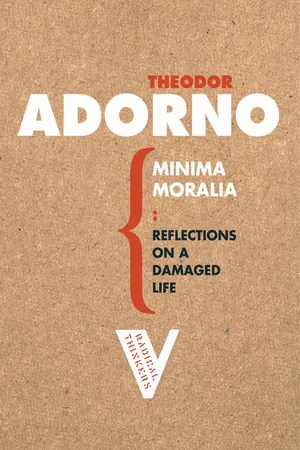
Minima Moralia
Reflections from Damaged Life
- 256 pages
- English
- ePUB (mobile friendly)
- Available on iOS & Android
eBook - ePub
About this book
Written between 1944 and 1947, Minima Moralia is a collection of rich, lucid aphorisms and essays about life in modern capitalist society. Adorno casts his penetrating eye across society in mid-century America and finds a life deformed by capitalism. This is Adorno's theoretical and literary masterpiece and a classic of twentieth-century thought.
Information
Topic
PhilosophySubtopic
Critical TheoryMinima Moralia
PART ONE
1944
Life does not live
Ferdinand Kürnberger
1
For Marcel Proust. – The son of well-to-do parents who, whether from talent or weakness, engages in a so-called intellectual profession, as an artist or a scholar, will have a particularly difficult time with those bearing the distasteful title of colleagues. It is not merely that his independence is envied, the seriousness of his intentions mistrusted, and that he is suspected of being a secret envoy of the established powers. Such suspicions, though betraying a deep-seated resentment, would usually prove well-founded. But the real resistances lie elsewhere. The occupation with things of the mind has by now itself become ‘practical’, a business with strict division of labour, departments and restricted entry. The man of independent means who chooses it out of repugnance for the ignominy of earning money will not be disposed to acknowledge the fact. For this he is punished. He is not a ‘professional’, is ranked in the competitive hierarchy as a dilettante no matter how well he knows his subject, and must, if he wants to make a career, show himself even more resolutely blinkered than the most inveterate specialist. The urge to suspend the division of labour which, within certain limits, his economic situation enables him to satisfy, is thought particularly disreputable: it betrays a disinclination to sanction the operations imposed by society, and domineering competence permits no such idiosyncrasies. The departmentalization of mind is a means of abolishing mind where it is not exercised ex officio, under contract. It performs this task all the more reliably since anyone who repudiates the division of labour – if only by taking pleasure in his work – makes himself vulnerable by its standards in ways inseparable from elements of his superiority. Thus is order ensured: some have to play the game because they cannot otherwise live, and those who could live otherwise are kept out because they do not want to play the game. It is as if the class from which independent intellectuals have defected takes its revenge, by pressing its demands home in the very domain where the deserter seeks refuge.
2
Grassy seat.1 – Our relationship to parents is beginning to undergo a sad, shadowy transformation. Through their economic impotence they have lost their awesomeness. Once we rebelled against their insistence on the reality principle, the sobriety forever prone to become wrath against those less ready to renounce. But today we are faced with a generation purporting to be young yet in all its reactions insufferably more grown-up than its parents ever were; which, having renounced before any conflict, draws from this its grimly authoritarian, unshakeable power. Perhaps people have at all times felt the parental generation to become harmless, powerless, with the waning of its physical strength, while their own generation already seemed threatened by the young: in an antagonistic society the relation between generations too is one of competition, behind which stands naked power. But today it is beginning to regress to a state versed, not in the Oedipus complex, but in parricide. One of the Nazis’ symbolic outrages is the killing of the very old. Such a climate fosters a late, lucid understanding with our parents, as between the condemned, marred only by the fear that we, powerless ourselves, might now be unable to care for them as well as they cared for us when they possessed something. The violence done to them makes us forget the violence they did. Even their rationalizations, the once-hated lies with which they sought to justify their particular interest as a general one, reveal in them an inkling of the truth, an urge to resolve a conflict whose existence their children, proof against all uncertainty, cheerfully deny. Even the outdated, inconsistent, self-doubting ideas of the older generation are more open to dialogue than the slick stupidity of Junior. Even the neurotic oddities and deformities of our elders stand for character, for something humanly achieved, in comparison to pathic health, infantilism raised to the norm. One realizes with horror that earlier, opposing one’s parents because they represented the world, one was often secretly the mouthpiece, against a bad world, of one even worse. Unpolitical attempts to break out of the bourgeois family usually lead only to deeper entanglement in it, and it sometimes seems as if the fatal germ-cell of society, the family, were at the same time the nurturing germ-cell of uncompromising pursuit of another. With the family there passes away, while the system lasts, not only the most effective agency of the bourgeoisie, but also the resistance which, though repressing the individual, also strengthened, perhaps even produced him. The end of the family paralyses the forces of opposition. The rising collectivist order is a mockery of a classless one: together with the bourgeois it liquidates the Utopia that once drew sustenance from motherly love.
3
Fish in water. – Since the all-embracing distributive machinery of highly-concentrated industry has superseded the sphere of circulation, the latter has begun a strange post-existence. As the professions of the middle-man lose their economic basis, the private lives of countless people are becoming those of agents and go-betweens; indeed the entire private domain is being engulfed by a mysterious activity that bears all the features of commercial life without there being actually any business to transact. All these nervous people, from the unemployed to the public figure liable at any moment to incur the wrath of those whose investment he represents, believe that only by empathy, assiduity, serviceability, arts and dodges, by tradesmen’s qualities, can they ingratiate themselves with the executive they imagine omnipresent, and soon there is no relationship that is not seen as a ‘connection’, no impulse not first censored as to whether it deviates from the acceptable. The concept of connections, a category of mediation and circulation, never flourished best in the sphere of circulation proper, the market, but in closed and monopolistic hierarchies. Now that the whole of society is becoming hierarchical, these murky connections are proliferating wherever there used still to be an appearance of freedom. The irrationality of the system is expressed scarcely less clearly in the parasitic psychology of the individual than in his economic fate. Earlier, when something like the maligned bourgeois division between professional and private life still existed – a division whose passing one almost now regrets – anyone who pursued practical aims in the private sphere was eyed mistrustfully as an uncouth interloper. Today it is seen as arrogant, alien and improper to engage in private activity without any evident ulterior motive. Not to be ‘after’ something is almost suspect: no help to others in the rat-race is acknowledged unless legitimized by counterclaims. Countless people are making, from the aftermath of the liquidation of professions, their profession. They are the nice folk, the good mixers liked by all, the just, humanely excusing all meanness and scrupulously proscribing any non-standardized impulses as sentimental. Indispensable for their knowledge of all the channels and plug-holes of power, they divine its most secret judgements and live by adroitly propagating them. They are found in all political camps, even where the rejection of the system is taken for granted, and has thereby produced a slack and subtle conformism of its own. Often they win sympathy by a certain good-naturedness, a kindly involvement in other people’s lives: selflessness as speculation. They are clever, witty, full of sensitive reactions: they have refurbished the old tradesman’s mentality with the day before yesterday’s psychological discoveries. They are capable of everything, even love, yet always faithlessly. They deceive, not by instinct, but on principle, valuing even themselves as a profit begrudged to anyone else. To intellect they are bound both by affinity and hatred: they are a temptation for the thoughtful, but also their worst enemies. For it is they who insidiously attack and despoil the last retreats of resistance, the hours still exempt from the demands of machinery. Their belated individualism poisons what little is left of the individual.
4
Final serenity. – A newspaper obituary for a businessman once contained the words: ‘The breadth of his conscience vied with the kindness of his heart.’ The blunder committed by the bereaved in the elevated language reserved for such purposes, the inadvertent admission that the kind-hearted deceased had lacked a conscience, expedites the funeral procession by the shortest route to the land of truth. If a man of advanced years is praised for his exceptional serenity, his life can be assumed to comprise a succession of infamies. He has rid himself of the habit of getting excited. Breadth of conscience is passed off as magnanimity, all-forgiving because all-too-understanding. The quid pro quo between one’s own guilt and that of others, is resolved in favour of whoever has come off best. After so long a life one quite loses the capacity to distinguish who has done what harm to whom. In the abstract conception of universal wrong, all concrete responsibility vanishes. The blackguard presents himself as victim of injustice: if only you knew, young man, what life is like. But those conspicuous midway through life by an exceptional kindness are usually drawing advances on such serenity. He who is not malign does not live serenely but with a peculiarly chaste hardness and intolerance. Lacking appropriate objects, his love can scarcely express itself except by hatred for the inappropriate, in which admittedly he comes to resemble what he hates. The bourgeois, however, is tolerant. His love of people as they are stems from his hatred of what they might be.
5
How nice of you, Doctor.1 – There is nothing innocuous left. The little pleasures, expressions of life that seemed exempt from the responsibility of thought, not only have an element of defiant silliness, of callous refusal to see, but directly serve their diametrical opposite. Even the blossoming tree lies the moment its bloom is seen without the shadow of terror; even the innocent ‘How lovely!’ becomes an excuse for an existence outrageously unlovely, and there is no longer beauty or consolation except in the gaze falling on horror, withstanding it, and in unalleviated consciousness of negativity holding fast to the possibility of what is better. Mistrust is called for in face of all spontaneity, impetuosity, all letting oneself go, for it implies pliancy towards the superior might of the existent. The malignant deeper meaning of ease, once confined to the toasts of conviviality, has long since spread to more appealing impulses. The chance conversation in the train, when, to avoid dispute, one consents to a few statements that one knows ultimately to implicate murder, is already a betrayal; no thought is immune against communication, and to utter it in the wrong place and in wrong agreement is enough to undermine its truth. Every visit to the cinema leaves me, against all my vigilance, stupider and worse. Sociability itself connives at injustice by pretending that in this chill world we can still talk to each other, and the casual, amiable remark contributes to perpetuating silence, in that the concessions made to the interlocutor debase him once more in the person of speaker. The evil principle that was always latent in affability unfurls its full bestiality in the egalitarian spirit. Condescension, and thinking oneself no better, are the same. To adapt to the weakness of the oppressed is to affirm in it the pre-condition of power, and to develop in oneself the coarseness, insensibility and violence needed to exert domination. If, in the latest phase, the condescending gesture has been dropped and only the adaptation remains visible, this perfect screening of power only allows the class-relationship it denies to triumph more implacably. For the intellectual, inviolable isolation is now the only way of showing some measure of solidarity. All collaboration, all the human worth of social mixing and participation, merely masks a tacit acceptance of inhumanity. It is the sufferings of men that should be shared: the smallest step towards their pleasures is one towards the hardening of their pains.
6
Antithesis. – He who stands aloof runs the risk of believing himself better than others and misusing his critique of society as an ideology for his private interest. While he gropingly forms his own life in the frail image of a true existence, he should never forget its frailty, nor how little the image is a substitute for true life. Against such awareness, however, pulls the momentum of the bourgeois within him. The detached observer is as much entangled as the active participant; the only advantage of the former is insight into his entanglement, and the infinitesimal freedom that lies in knowledge as such. His own distance from business at large is a luxury which only that business confers. This is why the very movement of withdrawal bears features of what it negates. It is forced to develop a coldness indistinguishable from that of the bourgeois. Even where it protests, the monadological principle conceals the dominant universal. Proust’s observation that in photographs, the grandfather of a duke or of a middle-class Jew are so alike that we forget their difference of social rank, has a much wider application: the unity of an epoch objectively abolishes all the distinctions that constitute the happiness, even the moral substance, of individual existence. We record the decline of education, and yet our prose, measured against that of Jacob Grimm or Bachofen,1 has in common with the culture industry cadences unsuspected by us. Nor do we any longer have the same command of Latin and Greek as Wolf or Kirchhoff.2 We point at the decline of civilization into illiteracy, and ourselves forget the art of letter-writing, or of reading a text from Jean Paul as it must have been read in his time. We shudder at the brutalization of life, but lacking any objectively binding morality we are forced at every step into actions and words, into calculations that are by humane standards barbaric, and even by the dubious values of good society, tactless. With the dissolution of liberalism, the truly bourgeois principle, that of competition, far from being overcome, has passed from the objectivity of the social process into the composition of its colliding and jostling atoms, and therewith as if into anthropology. The subjugation of life to the process of production imposes as a humiliation on everyone something of the isolation and solitude that we are tempted to regard as resulting from our own superior choice. It is as old a component of bourgeois ideology that each individual, in his particular interest, considers himself better than all others, as that he values the others, as the community of all customers, more highly than himself. Since the demise of the old bourgeois class, both ideas have led an after-life in the minds of intellectuals, who are at once the last enemies of the bourgeois and the last bourgeois. In still permitting themselves to think at all in face of the naked reproduction of existence, they act as a privileged group; in letting matters rest there, they declare the nullity of their privilege. Private existence, in striving to resemble one worthy of man, betrays the latter, since any resemblance is withdrawn from general realization, which yet more than ever before has need of independent thought. There is no way out of entanglement. The only responsible course is to deny oneself the ideological misuse of one’s own existence, and for the rest to conduct oneself in private as modestly, unobtrusively and unpretentiously as is required, no longer by good upbringing, but by the shame of still having air to breathe, in hell.
7
They, the people. – The circumstance that intellectuals mostly have to do with intellectuals, should not deceive them into believing their own kind still more base than the rest of mankind. For they get to know each other in the most shameful and degrading of all situations, that of competing supplicants, and are thus virtually compelled to show each other their most repulsive sides. Other people, particularly the simple folk whose qualities the intellectual is so fond of stressing, generally encounter him in the role of those with something to sell, yet who have no fear of the customer ever poaching on their preserves. The car mechanic, the barmaid, have little difficulty in abstaining from effrontery: courtesy is in any case imposed on them from above. If, conversely, illiterates come to intellectuals wanting letters written for them, they too may receive a tolerably good impression. But the moment simple folk are forced to brawl among themselves for their portion of the social product, their envy and spite surpass anything seen among literati or musical directors. In the end, glorification of splendid underdogs is nothing other than glorification of the splendid system that makes them so. The justified guilt-feelings of those exempt from physical work ought not become an excuse for the ‘idiocy of rural life’. Intellectuals, who alone write about intellectuals and give them their bad name in that of honesty, reinforce the lie. A great part of the prevalent anti-intellectualism and irrationalism, right up to Huxley, is set in motion when writers complain about the mechanisms of competition without understanding them, and so fall victim to them. In the activity most their own they have shut out the consciousness of tat twam asi.1 Which is why they then scuttle into Indian temples.
8
If knaves should tempt you. – There is an amor intellectualis for kitchen personnel, a temptation for those engaged in theoretical or artistic work to relax their spiritual demands on themselves, to drop their standards, to indulge, in their subject-matter and its expression, all kinds of habits that lucid appraisal has rejected. Since there are no longer, for the intellectual, any given categories, even cultural, and bustle endangers concentration with a thousand claims, the effort of producing something in some measure worthwhile is now so great as to be beyond almost everybody. The pressure of conformity weighing on all producers further diminishes their demands on themselves. The centre of intellectual self-discipline as such is in the process of decomposition. The taboos that constitute a man’s intellectual stature, often sedimented experiences and unarticulated insights, always operate against inner impulses that he has learned to condemn, but which are so strong that only an unquestioning and unquestioned authority can hold them in check. What is true of the instinctual life is no less of the intellectual: the painter or composer forbidding himself as trite this or that combination of colours or chords, the writer wincing at banal or pedantic verbal configurations, reacts so violently because layers of himself are drawn to them. Repudiation of the present cultural morass presupposes sufficient involvement in it to feel it itching in one’s finger-tips, so to speak, but at the same...
Table of contents
- Cover Page
- Halftitle Page
- Title Page
- Copyright Page
- Dedication
- Contents
- Publisher’s Note
- Dedication
- Part One: 1944
- Part Two: 1945
- Part Three: 1946–1947
- Notes
- Index
Trusted by 375,005 students
Access to over 1.5 million titles for a fair monthly price.
Study more efficiently using our study tools.
Frequently asked questions
Yes, you can cancel anytime from the Subscription tab in your account settings on the Perlego website. Your subscription will stay active until the end of your current billing period. Learn how to cancel your subscription
No, books cannot be downloaded as external files, such as PDFs, for use outside of Perlego. However, you can download books within the Perlego app for offline reading on mobile or tablet. Learn how to download books offline
Perlego offers two plans: Essential and Complete
- Essential is ideal for learners and professionals who enjoy exploring a wide range of subjects. Access the Essential Library with 800,000+ trusted titles and best-sellers across business, personal growth, and the humanities. Includes unlimited reading time and Standard Read Aloud voice.
- Complete: Perfect for advanced learners and researchers needing full, unrestricted access. Unlock 1.5M+ books across hundreds of subjects, including academic and specialized titles. The Complete Plan also includes advanced features like Premium Read Aloud and Research Assistant.
We are an online textbook subscription service, where you can get access to an entire online library for less than the price of a single book per month. With over 1.5 million books across 990+ topics, we’ve got you covered! Learn about our mission
Look out for the read-aloud symbol on your next book to see if you can listen to it. The read-aloud tool reads text aloud for you, highlighting the text as it is being read. You can pause it, speed it up and slow it down. Learn more about Read Aloud
Yes! You can use the Perlego app on both iOS and Android devices to read anytime, anywhere — even offline. Perfect for commutes or when you’re on the go.
Please note we cannot support devices running on iOS 13 and Android 7 or earlier. Learn more about using the app
Please note we cannot support devices running on iOS 13 and Android 7 or earlier. Learn more about using the app
Yes, you can access Minima Moralia by Theodor Adorno, Edmund FN Jephcott, Edmund F.N. Jephcott in PDF and/or ePUB format, as well as other popular books in Philosophy & Critical Theory. We have over 1.5 million books available in our catalogue for you to explore.