Nominated for the 2019 Gradiva® Award for Best Book by the National Association for the Advancement of Psychoanalysis (NAAP)
For Want of Ambiguity investigates how the dialogue between psychoanalysis and neuroscience can shed light on the transformational capacity of contemporary art.
Through neuroscienfitic and psychoanalytic exploration of the work of Diamante Faraldo, Ai Weiwei, Ida Barbarigo, Xavier Le Roy, Bill T. Jones, Cindy Sherman, Francis Bacon, Agnes Martin, and others, For Want of Ambiguity offers a new perspective on how insight is achieved and on how art opens us up to new ways of being.
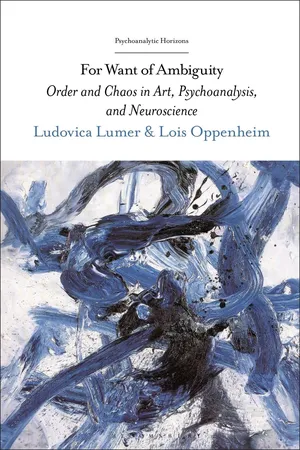
eBook - ePub
For Want of Ambiguity
Order and Chaos in Art, Psychoanalysis, and Neuroscience
- 200 pages
- English
- ePUB (mobile friendly)
- Available on iOS & Android
eBook - ePub
For Want of Ambiguity
Order and Chaos in Art, Psychoanalysis, and Neuroscience
About this book
Information
1
Shaping private demons
When I went to the old Trocadero, it was disgusting. The Flea Market. The smell. I was all alone. I wanted to get away. But I didn’t leave. I stayed. I stayed. I understood that it was very important: something was happening to me, right? The masks weren’t just like any other pieces of sculpture. Not at all. They were magic things.… Those were primitives, not magic things.… They were against everything—against unknown, threatening spirits. I always looked at fetishes. I understood; I too am against everything. I too believe that everything is unknown, that everything is an enemy! Everything! Not the details—women, children, babies, tobacco, playing—but the whole of it.… But all the fetishes were used for the same thing. They were weapons. To help people avoid coming under the influence of spirits again, to help them become independent. They are tools. If we give spirits a form, we become independent. Spirits, the unconscious (people still weren’t talking about that very much), emotion—they are all the same thing.
I understood why I was a painter. All alone in that awful Museum, with masks, dolls made by redskins, dusty manikins. Les Demoiselles d’Avignon must have come to me that very day, but not at all because of the forms; because it was my first exorcism-painting—yes absolutely!1
Being is chaotic. What we do in every area of life, as well as in so many professional arenas—from physics to painting, from chemistry to sculpture, from neurobiology to psychoanalysis—is seek meaning to make sense of that chaos and find symbols and metaphors to aid in our articulation of it. From thermodynamics to neuroscience, metaphors, symbols, and formulae serve as powerful tools for understanding, for meaning is ontologically stabilizing and homeostasis constitutes our ultimate biological objective. It is to that end, in fact, that we as a species conceptualize and narrate the chaos of being, the experience of being me. In seeking certainty, in struggling against its antithesis, we represent and thereby order what might otherwise have nefarious repercussions, such as anxiety and dread. In the artist’s studio, as in the analyst’s consulting room and the scientist’s laboratory, we give form and cohesion to me/not me experiential boundaries. But where art, and psychoanalysis as well, differs from other forms of creative thinking (and science is nothing if not creative) is in allowing ambiguity to surface and finding the value therein. For art, like psychoanalysis, enables us to look at the world more freely, which is to say without fear of uncertainty, and interact with it in new ways.
Indeed, as Picasso makes eminently clear in the statement above, artistic process is remarkable for its capacity to eternalize the tension between order and chaos. Creating art already engages the individual in a stunning struggle: finding the right medium, materials, shapes, and colors is its own complex series of acts. And artists not only give form to their “spirits”—their threatening demons—through the manipulation of the medium, there is also the sharing of that form which in itself erects new tensions: tensions between the intentionality of artist and viewer, which is to say between the world as one individual “knows” it and its re-constitution by another in accordance with what is perceived as residing in the artwork. However commonplace the idea that the viewer participates in the creative process and makes meaning by resonating with the expression of the artist, consider for the moment neither the need to share nor the needs of those who bear witness, but the invitation of the artist, Picasso or any other, to himself: the invitation to discover new possibilities, to give shape to his private meanings, demonic or not. The point, as Joel Whitebook has recently written underscoring the thought of Hans Loewald, is “not to idealize unconscious-instinctual life—to celebrate the ‘demonic’ and ignore its dark side.” Rather, it is to acknowledge, to work with, to play with material that “must be symbolized, sublimated, and integrated into ‘new synthetic organizations’ of the psyche,” organizations “in which the ‘vital links’ between ‘the lowest’ and the ‘highest in human in nature’ are preserved.” As Loewald suggests and Whitebook reminds us, it is not a question of dominating the demons, but of “‘coming to terms’ with the material unconscious-instinctual life by representing and articulating it.”2
This is precisely what we see in the developing child who, to master emotions, learns names to describe them. So, too, adults need words and symbols to process experience; we need metaphors to make sense of internal feelings. If art were to disappear from the world, objects would lose their potential of being something other than what they actually are. For it is due to the relations generated by art (relations between the artist, the artwork, and the viewer, and between intrapsychic and cultural space) that possibilities emerge for everything to become something different; it is through a creative and transformative gesture that an object acquires the power to arouse a multiplicity of emotional reactions and possible interpretations. And it is through such a gesture that we are freed from the persistent “strain of relating inner reality and outer reality,”3 as D.W. Winnicott described the tension we aim to put in high relief in this book: the tension that defines our social norms, our gender identities, our sensations of pleasure and, to cite Freud’s term, unpleasure.
Art, like dreams and fantasy, and like the analytic session as well, opens the possibility of removing oneself from the suffocating contingency of reality and the ineluctability of human destiny. So, too, perversions represent a temptation of the mind to surpass the tension of boundaries, in this case those of what is considered “normal” sexual behavior. As Janine Chasseguet-Smirgel has noted, “Man has always endeavoured to go beyond the narrow limits of his condition. I consider that perversion is one of the essential ways and means he applies in order to push forward the frontiers of what is possible and to unsettle reality.”4 As aesthetic pleasure relies on ambiguity, so “the pleasure connected with transgression is sustained by the fantasy that—in breaking down the barriers which separate man from woman, child from adult, mother from son, daughter from father, brother from sister, the erotogenic zones from each other, and, in the case of murder, the molecules of the body from each other—it has destroyed reality, thereby creating a new one, that of the anal universe where all differences are abolished.”5 Giving shape to our demons or “spirits” becomes a tool for reaching independence and freedom, the freedom to create different viewpoints and to shift from one perspective to another.
Jenny Saville, a British artist born in Cambridge in 1970, paints huge canvases representing flesh and bodies in layers, as if representing different realities. “I deliberately worked on these paintings at different times,” Saville revealed in an interview, “leaving them and coming back to them. Looking at photographs of earlier paintings taken as I was doing them, I realized I’d missed possibilities because I was so focused on working to an end.… With these paintings I wanted to keep all the possibilities alive. I like it like that. It’s much easier to finish something than to leave it incomplete.”6
Keeping possibilities alive is the matter of each analytic session. It is, actually, the aim of psychoanalysis. We adopt patterns in order to survive, we relate to people according to established behaviors that even become patterns, and we adopt defensive mechanisms that we tend to repeat over and over through the course of our lives. Psychoanalysis helps us overcome these constancies; it gives us the freedom to choose among different possibilities of being, relating, perceiving, and interacting. The brain is wired to recognize patterning in order to optimize how we decipher the environment. When we look at ambiguous figures, such as the Necker Cube, what we see are images representing stable stimuli that can be elaborated by the brain in different ways that determine our perception of them. In a world that drifts continuously through change, metaphors and symbols become something to hold on to, a saving bannister. Every individual, every family, every country even has different ways to use symbols and metaphors.
“I live in a country where everything changes continuously, our values change, our heroes, even our language and our alphabet,” Yerbossyn Meldibekov has written of Kazakhstan.7 At the Fifty-First Venice Biennale in 2005, Meldibekov’s work became the symbol of the Central Asia Pavilion, the desecrating icon of the dialogue-dispute between the new national realities that had recently appeared on the world stage. Exploring the difficulties of creating a national identity in post-communist Central Asia, Meldibekov makes use of the remains of the old communist ideology. Raw materials (such as wood, stone, sand) and animals belonging to the Steppe (horses, camels, sheep), fundamental to the nomadic life inherited from Gengis Khan and Tamerlane, are the natural elements of Meldibekov’s creative language.
Discussion with Slavic specialists Nina Colantoni and Damiano Rebecchini resulted in the idea the photo series “Giacometti,” produced by Meldibekov in collaboration with Nurbossin Oris represents a reinterpretation of classical European culture as seen through the eyes of Gengis Khan. Meldibekov desecrates the refined beauty of Giacometti’s art to offer us a new idea of beauty and the naked body. To strip, undress, did not mean to Gengis Khan to uncover or unclothe; rather, it was associated with the act of cutting, tearing apart, and lacerating. Leaving behind the Western dualistic way of thinking about body and soul, content and form, the contemporary nomadic man has a more direct and intuitive conception of the environment and a profoundly different relationship with his own body. The body is almost absent in nomadic culture, as are cities, architecture, and sculpture, as are the borders of land traversed. Meldibekov put it thus: “In the nomadic tradition boundaries do not exist. The body is absent. The individual body does not exist, only the collective body exists, as the combination of all of the servants submitted to Gengis Khan. And the constraint of the city, the town, the village does not exist, architecture doesn’t exist, as doesn’t sculpture, or a landmark or frontiers.”8 The new Central Asia, Gengis Khan’s land, is a land looking for its own national identity, its alphabet, its unique way of living Islamic tradition, its singular artistic language. It is a land shaken by conflict and well represented in all its nudity by the artwork of Meldibekov and Oris.
Meldibekov and Oris’s work represents an expressive language foreign to Western culture. From their migratory soul emerges a new concept of beauty and a new way of representing the body and of inhabiting cities. The borders of both land and human flesh vacillate and disappear. And it is from this dissolution that Meldibekov and Oris’s work takes shape to assume, as a consequence, the tones of a universal language. The two artists observe masterpieces of Western art from an Asiatic perspective and reinterpret Western traditions with a language in a sense barbaric. The work of Alberto Giacometti, Donatello, Gunther Uecker, and others is recreated with materials from the Kazakh land: organic matter, dead bodies, dead flesh (see Figure 1.1). It is as though the refined surface covering the precious European art were destroyed and the internal substance extracted in all its crudity, like flesh issuing from an open wound. Meldibekov and Oris make use of the antique nomadic act: they flay, strip, eliminate, cut, raze, and burn, and through these acts they give new voice to a culture vastly unknown to the Western world. And they depict the struggle of Central Asia to understand what it is becoming.

FIGURE 1.1 Yerbossyn Meldibekov and Nurbossin Oris, Cardinale 1, from the series Giacometti, 50 × 92 cm, photo on aluminium, 2008. Courtesy of the artists.
In what may be called a more metaphoric fashion, the ninety-six-year-old Venetian painter Ida Barbarigo reveals her art as an act of exorcism that enables her to confront the most intimate images from her present and past, her feelings and her memories. From this confrontation are shaped deformed bodies, those of such divinities as Satu...
Table of contents
- Cover
- Half-Title Page
- Dedication
- Series Page
- Title Page
- Epigraph
- Contents
- Figures
- Foreword by Semir Zeki
- Acknowledgments
- Introduction: (Re)making meaning
- 1 Shaping private demons
- 2 A play of selves: Art as play
- 3 Narrating the self
- 4 Mapping: The need for borders
- 5 The fluidity of time and space in art, psychoanalysis, and neuroscience
- 6 Resisting representation
- Conclusion: Order and chaos or framing ambiguity
- Notes
- Bibliography
- About the authors
- Index
- Copyright
Trusted by 375,005 students
Access to over 1.5 million titles for a fair monthly price.
Study more efficiently using our study tools.
Frequently asked questions
Yes, you can cancel anytime from the Subscription tab in your account settings on the Perlego website. Your subscription will stay active until the end of your current billing period. Learn how to cancel your subscription
No, books cannot be downloaded as external files, such as PDFs, for use outside of Perlego. However, you can download books within the Perlego app for offline reading on mobile or tablet. Learn how to download books offline
Perlego offers two plans: Essential and Complete
- Essential is ideal for learners and professionals who enjoy exploring a wide range of subjects. Access the Essential Library with 800,000+ trusted titles and best-sellers across business, personal growth, and the humanities. Includes unlimited reading time and Standard Read Aloud voice.
- Complete: Perfect for advanced learners and researchers needing full, unrestricted access. Unlock 1.5M+ books across hundreds of subjects, including academic and specialized titles. The Complete Plan also includes advanced features like Premium Read Aloud and Research Assistant.
We are an online textbook subscription service, where you can get access to an entire online library for less than the price of a single book per month. With over 1.5 million books across 990+ topics, we’ve got you covered! Learn about our mission
Look out for the read-aloud symbol on your next book to see if you can listen to it. The read-aloud tool reads text aloud for you, highlighting the text as it is being read. You can pause it, speed it up and slow it down. Learn more about Read Aloud
Yes! You can use the Perlego app on both iOS and Android devices to read anytime, anywhere — even offline. Perfect for commutes or when you’re on the go.
Please note we cannot support devices running on iOS 13 and Android 7 or earlier. Learn more about using the app
Please note we cannot support devices running on iOS 13 and Android 7 or earlier. Learn more about using the app
Yes, you can access For Want of Ambiguity by Ludovica Lumer,Lois Oppenheim in PDF and/or ePUB format, as well as other popular books in Art & Théorie et critique de l'art. We have over 1.5 million books available in our catalogue for you to explore.